
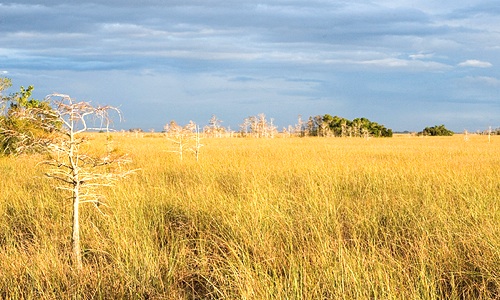
Is it appropriate for the National Park Service to allow power transmission lines to cross through portions of Shark River Slough in Everglades National Park? NPS photo of the Shark River Slough.
What would you think of utility company proposals to construct new electric transmission lines through Everglades National Park on land that's valuable for restoring the "River of Grass"? What if that project set a precedent that could jeopardize other National Park System lands across the nation? Those are key questions as the National Park Service evaluates a land exchange that's part of Florida Power and Light Co. plans to build power lines through part of Everglades National Park.
Whoa—what's afoot here?
The answer is...a very complex issue that involves several national hot-button issues for national parks and the country as a whole.
The nation is grappling with developing a sound energy policy that relies on sources that are both domestic and "greener," but do the benefits of obtaining energy from such sources justify building power transmission lines across national park property? A proposed project in Florida would string about seven miles of high voltage lines from 100-foot tall concrete transmission towers through part of Everglades National Park.
Not only would this project set back efforts to restore natural groundwater flows through the River of Grass, but the electricity would come from an expanded nuclear generating station, which raises yet other questions: Where would the utility obtain up to 80 million gallons of cooling water a day—and what impact might that have on the nearby Biscayne National Park and Biscayne Bay?
A key element in this debate is the broader question of how the NPS responds when owners of inholdings (private property within the boundaries of a national park) propose to develop the property in ways that threaten basic park values. The best solution is for the NPS to simply buy the land, but that requires a willing seller and timely funding. Another option—condemnation—can involve expensive and lengthy litigation, and the political clout and resolve to see the process through.
A third option is one now being considered in the Everglades: a land exchange.
According to Sara Fain, the Everglades Restoration program manager in the National Parks Conservation Association's Sun Coast office in Florida, utility giant Florida Power and Light (FPL) has been considering nine different alternatives for new transmission corridors to carry electricity from an expanded nuclear power plant. Only one, she says, goes through Everglades, but it involves a controversial land exchange.
The exchange is questionable because it would swap park-owned land for an inholding currently owned by FPL. If the land swap goes through, it would move the proposed transmission corridor to the edge of the park. Is this a good idea, or merely the lesser of two evils?
"It can set a very dangerous precedent," Ms. Fain says. "People will look at this and wonder what else can happen to our national parks? Once we lose land from our national parks, we never get it back."
And if this project is given the go-ahead, what does that mean for other national parks that fall in the path of proposed power transmission lines elsewhere in the nation? All of those factors are in play at Everglades National Park. Here's some background on a subject that will be the focus of lively debate in coming months:
The Everglades National Park Protection and Expansion Act of 1989 expanded the boundaries of Everglades National Park by about 109,600 acres. That act (and additional legislation) authorized the NPS and Army Corps of Engineers to acquire privately owned lands located within the expanded boundary. Among the parcels authorized for acquisition is a strip that's 330 to 370 feet wide and about 7.4 miles long. This 320-acre tract runs north-south within the "East Everglades Addition" and is owned by Florida Power and Light.
Ah, the plot thickens.
An important backdrop to this power corridor issue is the ongoing effort by state and federal agencies to restore the natural water flow into and through Everglades National Park. That water is a critical part of this complex coastal ecosystem, but the flow has been altered by development outside the park, including man-made canals and drainage ditches and roads that act as dams.
According to one analysis,
The purposes of the [1989] expansion of Everglades National Park include the preservation of the outstanding natural features of the park, enhancement and restoration of the ecological values, natural hydrologic conditions, and public enjoyment of such area by adding the area commonly known as the Northeast Shark River Slough and the East Everglades, [and] assurance that the park can maintain the natural abundance, diversity, and ecological integrity of the ecosystem.
One of the keys to achieving that restoration, according to Everglades officials, is the currently undeveloped Florida Power property, which they say is "needed for the restoration and enhancement of the ecosystem (through improvement of natural hydrologic conditions), as well as to ensure that the park’s fundamental resources and values are maintained."
If the power lines were to be built on this tract, the tall concrete towers wouldn't be the only impact. Some reports indicate considerable fill would be required to provide stable footings for each tower, and a road would likely be needed along the right-of-way to provide access for construction and ongoing maintenance. All that work would have major impacts on the environment and further complicate the water-flow issues.
What does Florida Power think? The utility company says this property is a vital route for transmission lines to carry high voltage electrical power from a planned expansion of FPL's Turkey Creek nuclear power facility.
Simply stated, FPL isn't interested in selling the property to the NPS...but they're willing to trade it for another piece of park land so they can move ahead with the power line construction.
A spokesman said the utility is under orders from the state Public Service Commission (PSC) to diversify from natural gas and to find a cleaner fuel than coal to meet greenhouse-gas reductions pushed by Florida Gov. Charlie Crist. Furthermore, the utility says expanding its nuclear power capacity is the only viable way to meet those requirements—and expanding the Turkey Creek plant requires new lines to deliver the electricity to consumers.
One big challenge: Where to put those new power lines. Routes that don't involve national parks aren't very popular either. Proposals for new 100-foot-high concrete towers for transmission lines along 18 miles of U. S. Highway 1 have stirred opposition from local residents and government officials. It's a classic NIMBY ("Not in my backyard") issue, and one that could increase pressure to use "undeveloped" areas such as park property for such utility lines.
Florida's two U. S. senators feel they have a solution for the dilemma involving the Everglades property, and they included it in the Omnibus Public Lands Act of 2009. As summarized in a park document, that Act:
identified NPS property at the eastern edge of the East Everglades Addition as potential lands to be exchanged for the FPL property. The act authorized the Secretary of the Interior to exchange NPS lands for the FPL property and to convey a perpetual easement on lands contiguous to the NPS exchange lands for the purpose of vegetation management. The potential land exchange would be subject to such terms and conditions as the secretary may require.
In short, this approach would move the location of the proposed transmission corridor to the eastern edge of the park. Park property at that site would be swapped for the existing Florida Power tract. Perhaps the easiest way to visualize the areas involved and all of the proposed power line routes is to download the map available on this FPL website. You'll find more detail on part of the route through the park on this map.
Is a land swap an appropriate solution to the issue?
One opponent of the project offered this analysis:
Three separate lines would cross approximately seven miles of what is currently national park property on more than 300 towers. Two of the three lines would carry 500,000 volts along towers 150 feet tall, while the third would carry 230,000 volts along 90-foot towers.
Consequences for the park would be enormous. First of all, the towers would dominate the eastern horizon of the entire East Everglades Expansion Area—the heart of the Shark River Slough and the main source of water for Everglades National Park. They would be visible as far away as the popular Shark Valley Visitor Center and tram/bicycle path.
"What the park has done for the last 20 years is buy these (privately owned) parcels," Ms. Fain said, referring to the directive the 1989 expansion legislation handed the Park Service. "Now they're looking at doing something completely different, which would be a land swap. They would give land currently in Everglades National Park to Florida Power and Light in exchange for land further west inside the park. The end result is that Everglades National Park's boundaries would be over 200 acres less than what it is today. This sets a really dangerous precedent for how our federal government is going to manage our national parks when there are private interests involved. It might be 200 acres today, but what is it tomorrow?"
The land exchange is authorized—but not required—by the Omnibus Public Lands Act of 2009, and among the key factors will be those "terms and conditions" included as part of any deal. If the park had to accept one of the two locations, a superficial analysis suggests the location on the edge of the park would be preferable to the route closer to the center of the park, but this decision is too important for a hasty answer. According to Ms. Fain, both tracts of land fall within the Shark Slough drainage. The parcel owned outright by the Park Service and which is being proposed for the swap contains "very high quality wetlands, which have a high ecological function," she said.
"The lands that they're proposing to give to Florida Power and Light is also land that is within the restoration plan for restoration and protection," continued Ms. Fain. "If we did this land swap, not only would we not be able to protect this land and restore it, but we would destroy it because they would need to fill the wetlands in order to build the transmission corridor."
So, what's next? Everglades officials currently are working on an environmental assessment to "determine the possible impacts, if any, on the environment from the potential land exchange and other reasonable alternatives. The environmental assessment will also serve to develop the appropriate terms and conditions for the potential exchange."
Under the current time-line, work on the draft EA is scheduled to be completed in October, and the document would be distributed for a 30-day public comment period in November. The comments received would then be analyzed; the goal for release of the final EA is December 2009.
Even while work on the EA is under way, Florida Power has taken an interesting position on the project. Information on their website states:
Although FPL currently owns sufficient right-of-way in fee or by easement for this Project through the Everglades National Park (ENP) and the Water Conservation Area 3B (WCA-3B), FPL has been working cooperatively with multiple federal and state agencies to relocate this portion of the right-of-way to outside the ENP.
To that end, these agencies have entered into agreements with FPL to implement the relocation. This land exchange has been authorized by the federal Omnibus Public Land Management Act of 2009.
FPL is agreeable to the proposed right-of-way exchange in this area if this can be accomplished in a timely manner and is therefore proposing the relocated right-of-way as its West Preferred Corridor.
Finally, there are other park-related issues in Florida Power's proposed expansion of the Turkey Creek nuclear plant. Among the unanswered questions about the project's effects on Biscayne Bay and Biscayne National Park: where will the plant get up to 80 million gallons of cooling water a day in an area that has already faced water rationing in recent years?
That brings us to a pair of meetings this week. The South Florida Regional Planning Council and Miami-Dade County Planning and Zoning Department will "co-host two, informational, public meetings" about Florida Power's plans "to expand nuclear energy production at its Turkey Point facility in Miami-Dade County. The proposed project consists of the construction of two new nuclear units ... and supporting facilities, as well as the placement of new transmission lines."
The meetings will be held Monday, August 31, in Homestead, Florida and Wednesday, September 2, in Coral Gables, Florida. You'll find details, including times and locations, on this site.
These meetings won't determine the final outcome, but they should be instructive—and could be important. According to the sponsors of the events: According to the sponsors of the events:
Attendees will be given an overview of the project and the review process. The public will also have an opportunity to ask questions and provide comment. Information received may be used to formulate an affected agency’s recommendation, regarding the application.
Given the political, economic, and environmental stakes—and the clout of some of the players—this is an issue with no easy answers. Will the eventual outcome lay the groundwork for similar questions across the country?
Stay tuned. I also hope you'll stay involved in the process.
Story Categories:
A copy of National Parks Traveler's financial statements may be obtained by sending a stamped, self-addressed envelope to: National Parks Traveler, P.O. Box 980452, Park City, Utah 84098. National Parks Traveler was formed in the state of Utah for the purpose of informing and educating about national parks and protected areas.
Residents of the following states may obtain a copy of our financial and additional information as stated below:
- Florida: A COPY OF THE OFFICIAL REGISTRATION AND FINANCIAL INFORMATION FOR NATIONAL PARKS TRAVELER, (REGISTRATION NO. CH 51659), MAY BE OBTAINED FROM THE DIVISION OF CONSUMER SERVICES BY CALLING 800-435-7352 OR VISITING THEIR WEBSITE. REGISTRATION DOES NOT IMPLY ENDORSEMENT, APPROVAL, OR RECOMMENDATION BY THE STATE.
- Georgia: A full and fair description of the programs and financial statement summary of National Parks Traveler is available upon request at the office and phone number indicated above.
- Maryland: Documents and information submitted under the Maryland Solicitations Act are also available, for the cost of postage and copies, from the Secretary of State, State House, Annapolis, MD 21401 (410-974-5534).
- North Carolina: Financial information about this organization and a copy of its license are available from the State Solicitation Licensing Branch at 888-830-4989 or 919-807-2214. The license is not an endorsement by the State.
- Pennsylvania: The official registration and financial information of National Parks Traveler may be obtained from the Pennsylvania Department of State by calling 800-732-0999. Registration does not imply endorsement.
- Virginia: Financial statements are available from the Virginia Department of Agriculture and Consumer Services, 102 Governor Street, Richmond, Virginia 23219.
- Washington: National Parks Traveler is registered with Washington State’s Charities Program as required by law and additional information is available by calling 800-332-4483 or visiting www.sos.wa.gov/charities, or on file at Charities Division, Office of the Secretary of State, State of Washington, Olympia, WA 98504.


Comments
While my first reaction is "no way, not on national parkland," I suppressed that. As you said, this is a complex issue.
FPL's rights to the land predate the 1989 park expansion. Would it be fair to seize those rights through condemnation should FPL refuse to sell the existing right of way, as they have indicated? As you said, this would "involve expensive and lengthy litigation, and the political clout and resolve to see the process through."
No, despite my initial instincts, it appears to me that the land swap is a quite fair and sensible solution, since environmental impact will be minimized by running the lines along the eastern edge of the park. An examination of those maps that you linked to is quite useful in realizing this.
Edit: This works in this case. Normally, however, running power lines or allowing development of any land designated as part of a National Park should not be allowed. This means it is irresponsible to expand such parkland without some provision for "immediately" (as possible) and "fairly" (to the environment and the general public, but with more than a nod to private ownership rights) settling the issues of "inholdings." If that meant condemnation of new Everglades parkland back in 1989, it would be resolved by now (hopefully). I'm no expert in any facet of this, but how is it possible to designate private property as national parkland and still have private property rights survive?
Edit 2: I'm showing my naiveté, I guess. Perhaps the intitial preservation of such rights was necessary for the legislation that authorized expansion of the park. Still, it seems like a contradiction to me and a postponement of controversy for a future generation to handle.
Edit 3: Sorry for the multiple edits, but the thoughts keep popping up. It's a bit unclear whether both proposed Everglades rights of way are included, but you say there are a total of nine possible routes? That means 7 or 8 alternatives, including up Route 1, that are all eliminated by NIMBYism? Sounds like Florida could use a bit of alternative YIMBYism. Not in anybody's literal backyard, of course, but why not along Route 1? No where else possible? Yeah, yeah, I'm naive. ;-)
But if I were presented with a choice of destroying part of a local, national treasure like the Everglades and running transmission towers down Route 347 in Port Jefferson Station NY, the main drag a mile or two from my house, I would vote in favor of preserving my park.
Having lived in Port Jefferson Station in the 1980s, I agree with Bruce: I, too, would run the transmission line there rather than the Everglades.
But seriously, I also spent 8 years in Miami doing research in the Greater Everglades (EPN plus Big Cypress plus the SFWMD water management areas (WMAs) to the north and Loxahatchee NWR, and poor Biscayne NP is always an afterthought). If you look at the FPL "Overall_website.pdf" map (Jim's first map link), the major issue is the tan "west southview" part. [North of Tamiami Trail the dark green corridor follows the canal and thus wouldn't affect flow (the small triangle between the dark green line, Krome, and Tamiami is the Miccosukee casino, which isn't going anywhere, and is visible for miles).]
Krome Ave (aka SW 177th Ave) has a ton of (rather deadly) traffic and an existing high voltage transmission line from ~ S 42nd St (1 mile S. of Tamiami Trail) pretty much all the way south, and I believe that there has to be some separation of the transmission lines. [There's also a major line up the turnpike corridor if I recall correctly.] So from a view standpoint, putting another 150' high line half a mile west along the levee won't change much: where you'll see the new line you already see the existing line.
Immediately south of Tamiami Trail, the dark green corridor still follows the canal: between the canal and Krome are a couple of big aggregate quarries and the Krome detention center: again, no impact on hydrology, and given the draglines in the pits, not a pristine skyline, either. [Google maps shows the development, and even the shadows of the transmission towers, and pretty clearly shows the FPL right of way through the 8 mile area).
However, the tan area where the green preferred corridor leaves the canal (L-31N) and heads due west is the problematic/infamous 8 mile area, which is crucial to Everglades restoration. It is the only residential area west of the canal: roughly from the ENP boundary to the north and west to L-31N to the east and the diagonal L-31N to the southeast; again, google maps shows what's there.
For the past decades, SFWMD has shifted water flow well to the west of the pre-engineering flow via a series of canals in WMA3 (north of Tamiami Trail (L-29) and west of Krome Ave.), combined with the major canal (L-29) & levee along Tamiami Tr. on the north edge of ENP. This puts water into ENP at only a handful of canals under Tamiami Trail, too much water (deeper and longer than natural) in areas to the west, and much too little water to the eastern Everglades, including Shark River slough (SRS, about the western edge of the FPL map). A first major project of Everglades restoration (technically, the project predates Comprehensive Everglades Restoration Plan or CERP) is restoring sheet flow of water past Tamiami Trail and into the park, which would also restore more flows to the east.
One major holdup to restoring natural flow to the eastern Everglades is the 8 mile area. It's west of the big L31-N canal & levee, but very low elevation and on very porous limestone. Therefore, even though it has a moderate levee around it, re-wetting SRS and the eastern Everglades around it (both ENP) will necessarily flood the 8 mile area: if the water levels are natural outside the levee, they will be higher than the ground elevation inside the levee, and thus water will percolate up and flood the 8 mile area faster than it can be pumped. CERP needs to buy out those landowners in order to restore the eastern Everglades, but that's a politically difficult task. [In theory the money is there in the $8B Everglades restoration.]
My concern about the proposed transmission route is whether the line would make it more difficult to buy out and re-wet the 8 mile area. Perhaps the towers could be built with the current dry access, but with fill so that they would be structurally sound isolated footprints if and when the area is re-wetted, with access via airboat. But if that's not possible, or is possible but not done, then the transmission line would become one more impediment to restoring the hydrology of the Everglades.
Finally, the FPL right of way through ENP to the north of the 8 mile area (dashed black & bright green) is in areas that should be re-wetted. Levees for access roads that far west would be a major problem for Everglades restoration. So, while I don't like the principle of NPS land swaps, in this case I'm in favor of swapping the right of way inside the park for area along the boundary that is now and will remain disturbed. I'd like to tweak the corridor to follow L-31N canal & levee from where it first intersects it, keeping the corridor outside the 8 mile area.
Well, howdy (ex-)neighbor! You would not believe Route 347 these days if you have not seen it since the 1980's. New high-voltage transmission lines along there might go virtually unnoticed these days.
I hope the right people are reading these forums and your analysis in particular. Some day there may be one less car on Route 347 and one more on SW 177th Ave on my way to the Everglades, so I hope they listen to you.
My first reaction is also " none of the above". If there are 9 potential routes, is it only the land swap that made the one involving ENP the preferred one? What is the scientific basis for this preference? Is there any? Or is the preference based on political considerations, such as that the creatures in the park don't vote, don't make political contributions, and, most of all, don't give interviews? Not a good basis for such decisions, but it is the usual one. In an ecosystem as damaged by human impact as that of South Florida, there are precious few pristine areas left. Maybe none at all! However, if worse comes to worse, the land swap is preferable to having the towers in the middle of the park.
A larger issue is the definition of nuclear power as "clean energy". It isn't, any more than "clean coal" is. They are both oxymorons, although for different reasons. Our attitude toward nuclear power seems similar to that of the Sorcer'e Apprentice. We can turn them on, but we aren't so good at controlling them or turning them off! 80 million gallons of water a day may seem like a small amount compared to the size of Biscayne Bay, but it's not. We are talking EVERY DAY use here! We are also talking about the return of the heated water to the bay. In cooler climates, this may provide additional habitat for fish, but in an already warm climate, which is getting warmer, there are bound to be prfound ecological impacts. As stated above, this is a very complex issue, with many unanswered and perhaps unanserablee questions. How much will it cost in the future to mitigate these actions which are being contemplated now? Do we really want to experiement with the Everglades again?
Helen--
Without defending nuclear power (I'm at most ambivalent about the expansion of Turkey Point), I noticed that the actual proposal for the expansion of Turkey Point is to use Miami's processed wastewater for cooling, not intake from Biscayne Bay, and using evaporation towers as part of the cooling process. [Evaporation is feasible by using reclaimed wastewater instead of saltwater from Biscayne Bay.] In theory, one could even use some of the waste heat as part of the wastewater treatment process; I don't know if that's part of what's proposed, and haven't looked into it (I'm happily living in Colorado now, and unlikely to go back even to visit!). I don't know what the treatment plant will do with the "biosolids", nor whether the freshwater would otherwise be discharged into Biscayne Bay (potentially making up for part of the interrupted/diverted pre-settlement flow).
There's a cartoon diagram but no obvious link to details at:
http://www.fpl.com/environment/nuclear/technology.shtml
If this is like other power line routing issues I'm more familiar with, the 9 alternatives count variations on only 2 or 3 major corridors. For example, the current FPL right of way 2 miles inside ENP only differs for a couple of miles from the landswap alternative along the canal/levee at the boundary of ENP, but they count as 2 alternatives. The housing sprawl extends most of the way down US1 and to the bay, and east to Krome at SW 88th and Florida City. Basically, the Everglades and the L-31N canal & levee are about the only thing stopping the sprawl (and there is developer pressure to allow development beyond the urban growth boundaries and levees, especially to the north of Tamiami Trail). Removing houses within the developed areas to create safe rights of way would be cost-prohibitive. I don't know if any alternatives are additional lines along the turnpike (a corridor through the urban area); I don't know if that is feasible.
Bruce--
I can assure you that there are plenty of folks in Universities and agencies down there with intimate knowledge of implications for the 8 mile area and everything else, far surpassing my current knowledge. And Rock Salt, the new federal almost-czar for Everglades restoration deeply cares about the Everglades, and knows enough and is smart enough to play the game 5 moves ahead.
almost apt captcha: "Phillip potshots"
Aren't the Everglades supposed to be underwater by 2100?
Richard--
The lower end of Shark River Slough will be saltwater Florida Bay well before then. [As sea level rises / land subsides, the mangroves aren't killed, but new seedlings can't establish. Then, when a storm rips through the mangroves, the "coastline" moves inland (uphill) kilometers to tens of kilometers at a time. We don't know how far inland/north the mangroves can migrate, as their northern extent is limited by occasional freezes.]
However, the area in question is the northwest corner of ENP and is a bit higher (1.24-1.69 meters above sea level!, see http://sofia.usgs.gov/eden/models/groundelevmod.php ). The old estimate of sea level rise by 2100 for south Florida was on the order of 60cm (dark blue/purple to red in that map), and thus the southern and western half to 2/3 of ENP that is now mangroves & marsh will be below sea level.
[My house was up on the ridge in South Miami, almost 5 meters asl, and thus only likely to become the equivalent of Key largo by 2100.]