

BRADENTON, Fla. — De Soto National Memorial on Florida’s West Coast is a quiet haven tucked between a county park, Tampa Bay, and a neighborhood of stately waterfront homes.
Mangrove swamp crisscrossed by a mile-long network of walking trails covers much of its 30 acres. Fiddler crabs dart across the park’s shoreline, a feast for herons, egrets and other wading birds.
On a sunny weekday afternoon in late December, families picnicked at a handful of tables scattered throughout the site. A boater netted bait fish just offshore, while a lone fisherman waded into the clear waist-deep water. Several visitors walked or ran on the trails, while others sat on nearby benches.
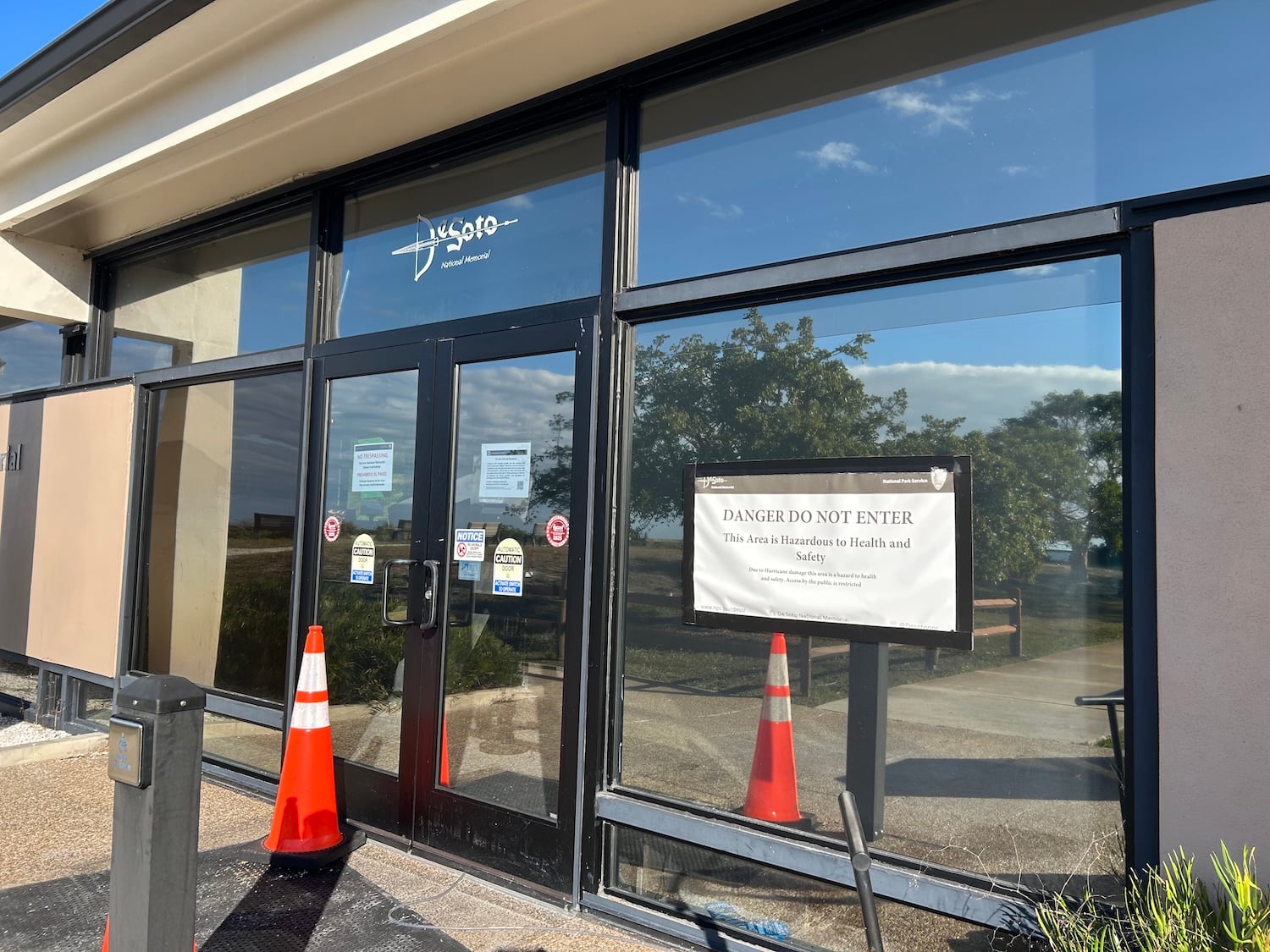
One small group of people peered into the locked doors of the memorial’s visitor center, closed since it was flooded by Hurricane Helene in September 2024. The park sustained further damage from Hurricane Milton a couple of weeks later.
Daniel Stephens, lead ranger and public information officer for De Soto, said recently that progress is slowly being made toward repairing the visitor center.
“We know that it’s going to take several years but we don’t have a firm date of when everything is going to be completed,” Stephens said.
Something that could add to the uncertainty: De Soto National Memorial is the kind of place Interior Secretary Douglas Burgum has implied could be targeted in future cuts that would prioritize the 63 National Park System sites designated specifically as “national parks” over smaller locations he calls “cost centers" that take more money to operate than they bring in.
De Soto is not alone in that pool of parks that aren't moneymakers. But Congress saw value in establishing them, and the National Park Service has worked to support and maintain them as best it can with the staff and funding it has.
A Complicated Story
Stephens said the De Soto visitor center was built as part of the National Park Service’s ambitious Mission 66, a billion-dollar plan launched in the mid-1950s that saw construction and improvements at dozens of parks across the country. The post-war projects, which included major landmarks like Great Smoky Mountains' Clingmans Dome, Canyon Village at Yellowstone National Park, and the Flamingo Visitor Center at Everglades National Park, were more modern in design than previous rustic park structures.
The center’s connection to Mission 66 means it can’t be torn down, Stephens said. The park is also listed in the National Register of Historic Places.
The story the center and the park tell, on the other hand, is much more complicated.
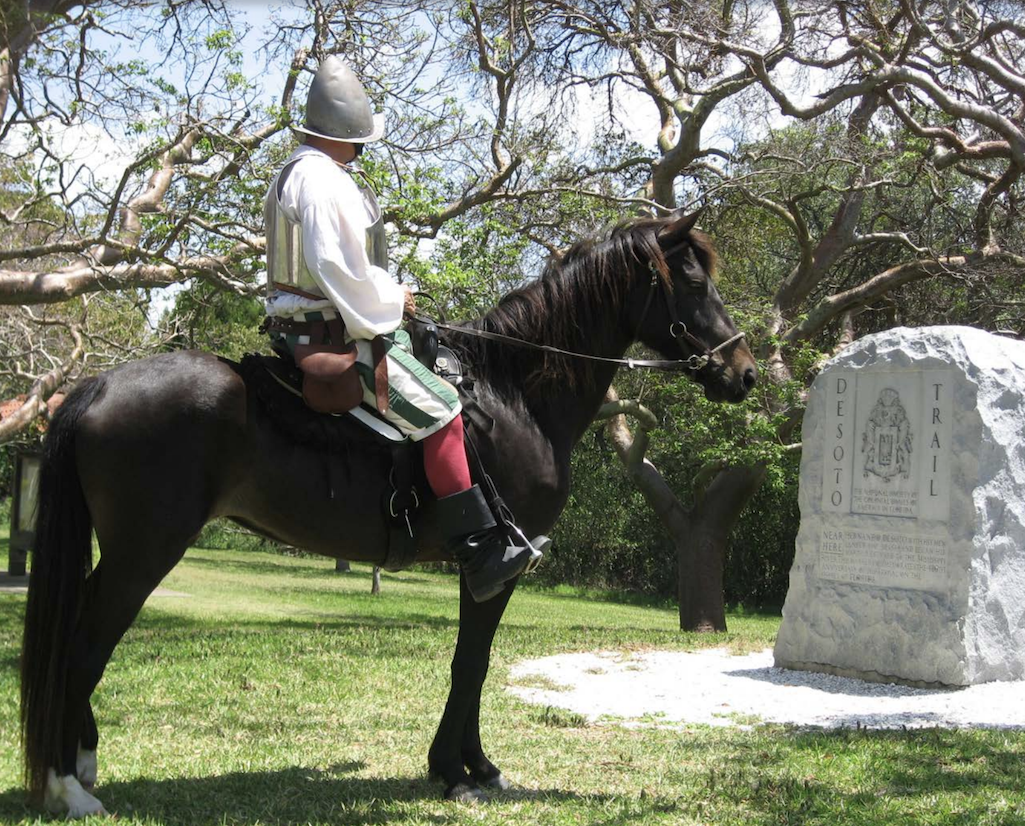
The site is said to be where, or at least near where, infamous Spanish explorer Hernando De Soto first landed in North America in 1539. Over the next four years, his expedition traveled 4,000 miles across what is now the Southeast United States in search of gold and other riches. But the mission is more well-known for its brutal violence against Indigenous people. Historians David and Anne Whisnant, a husband and wife team who compiled a modern history of the site for the National Park Service, summed it up in a previous piece for the Traveler.
“The arrogant conquistador expected submission and service from those from whom he hoped to steal gold, and when he didn’t get it, he captured leaders, unleashed fearsome weapons and vicious war dogs, and for good measure chopped off noses,” they wrote. “More harmful in the long term was the scourge of disease, which killed countless thousands of native people.”
For decades in the 1900s, De Soto was celebrated as a hero. Local officials, on the cusp of a tourism boom, jumped on an opportunity when a federal commission in 1939 identified a spot on the south side of Tampa Bay called Shaw’s Point as De Soto’s most likely landing spot.

The Colonial Dames of America quickly erected a marker there and, around the same time, the city of Bradenton staged what is today an annual (and also sometimes controversial) commemoration of De Soto’s landing.
The 30-acre site around Shaw’s Point was donated to the Interior Department and established as De Soto National Memorial in 1948. At the time, it was expected that a proposed on-site museum would generate enough money for the park to be self-supporting, according to park documents.
But, like the majority of national park sites, admission to the memorial is free. Today the park highlights stories of De Soto’s expedition, archaeological finds related to the Indigenous people who once populated this part of Florida, and the remains of a home built in 1843 by William Shaw, one of the area’s first settlers.
Park events also put a big focus on nature, with ranger-led kayak tours and environmental camps for kids.
De Soto Faces Several Threats
The park has logged an average of about 195,000 annual visitors in recent years, according to Park Service statistics. Its 2023 budget was $857,000. In 2024, the park’s budget showed $377,000 in deferred maintenance projects and $69,000 in recurring maintenance.
The dollar amounts are relatively small compared to many other parks, according to John Garder, senior director of budget and appropriations at the National Parks Conservation Association.
“It's helpful and notable that, for the most part, these smaller parks, provide more in economic benefits [to surrounding communities] than their cost to the federal government,” Garder said.
Parks like De Soto have budgets so small that NPCA said it would take closing as many as 350 of them to meet the Trump administration’s original goal of slashing $1 billion from the NPS budget. Lawmakers blocked Trump’s cuts in the most recent budget bill, but that doesn’t mean they won’t be back on the table in the future.
And while no specific plan for closing parks was ever laid out, that doesn’t mean it’s out of the picture, either.
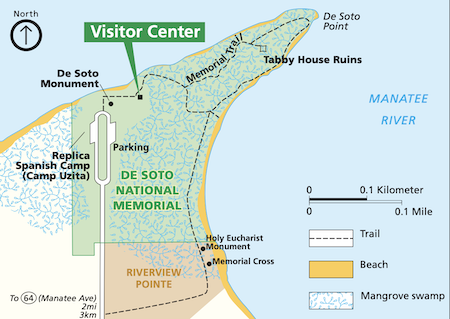
But that isn’t the only danger facing De Soto. A U.S. Geological Survey fact sheet published in 2024 lays out the threat from climate change. The report, which used a baseline from 1992, estimates that sea levels at the park could be more than 78 inches higher by the year 2100 under the worst scenario. Most of the park would also be inundated by high tide flood events.
Already, scientists say climate change is making storms like Helene worse and driving more frequent flooding in coastal areas.
Encroaching development could also cause environmental harm or, theoretically, make closing the site more attractive to the Trump administration.
A private company wants to build a cruise ship port adjacent to nearby Rattlesnake Key, less than 3 miles from De Soto as the crow flies. The proposed port, still in very early discussions, would accommodate ships too tall to fit under Tampa Bay's Sunshine Skyway Bridge, which is clearly visible from the memorial’s shoreline.
And just down the road and across a 4.5-mile causeway lies Anna Maria Island, one of Florida’s priciest and most popular vacation destinations. The sugar sand beaches have helped fuel a development boom in Bradenton and Manatee County, where U.S. Census Bureau data shows a population increase of more than 70 percent since 2000.
Holding Out Hope
For now, portable toilets greet parkgoers at the memorial’s entrance, and a tent shelters a table that holds educational materials and National Park Passport stamps.
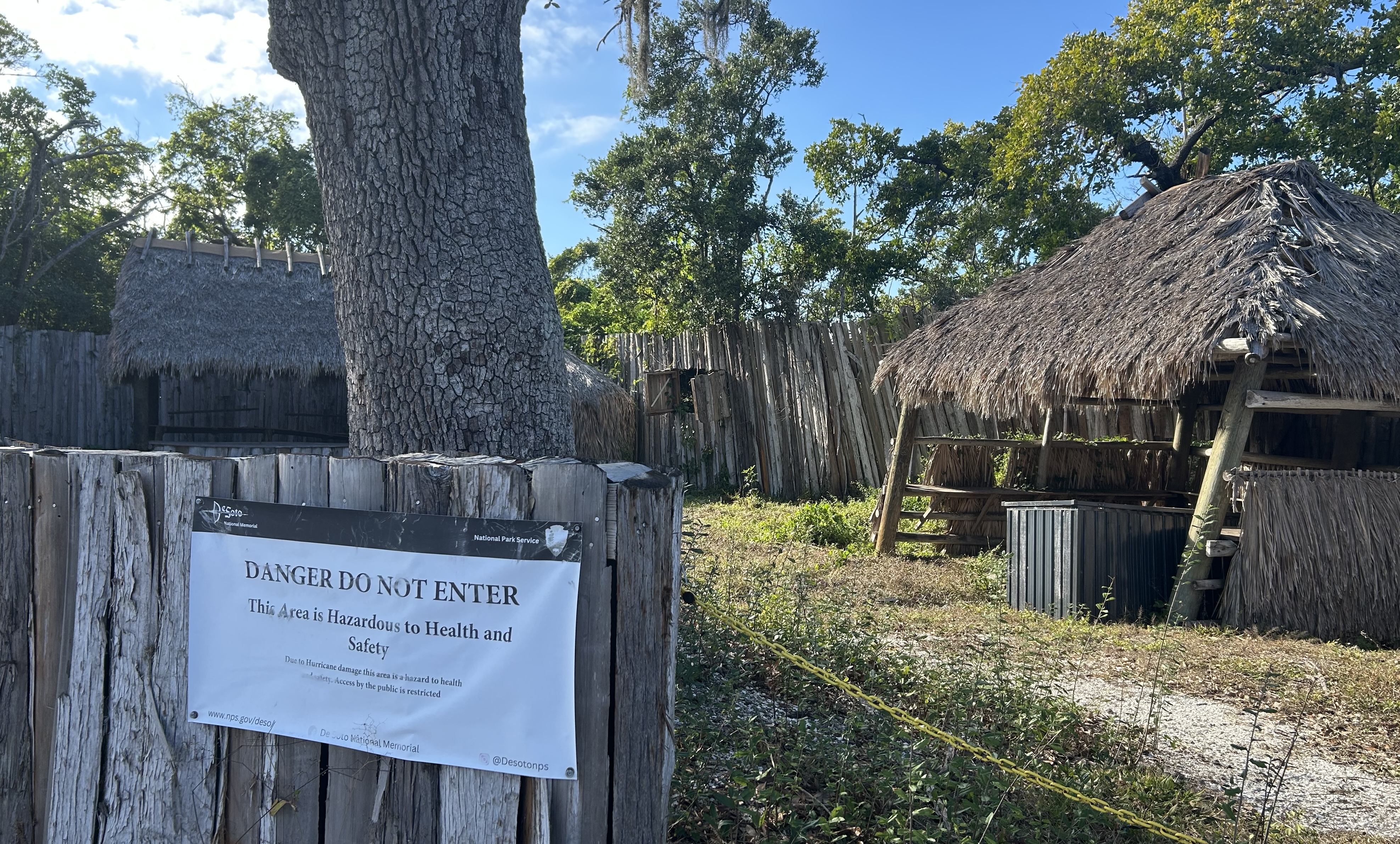
The park’s Camp Uzita interpretive area (photo below), a recreation of an Indigenous encampment seized by the De Soto expedition, remained off limits on our recent visit. But Stephens said crews were coming in to fix it soon, and a contract to start work on the inside of the visitor center was out for bid.
“So, we’re hopeful that in the next month or two the contract will be awarded and contractors will be onsite,” he said.
The visitor center repair work will include elevating the air-conditioning units to protect them from flooding, and using more storm-resistant building materials. In all, it could take several years to complete.
Stephens previously told the Traveler the staff was cut in half last year when Trump took office, and there are worries that another hurricane could setback rebuilding efforts.
But he and his co-workers remain optimistic. Thirty-seven new interpretive signs were recently installed along the park’s trails, living history programs are ramping up again and a new monthly food truck event is kicking off.
“As long as you get it back together and out in the public, which we are, we’re happy and we will continue to offer the great programs we can with the staff we have,” Stephens said.
“We’re very, very positive right now. We know that the ball is rolling, and we know that everything looks great and as far as moving forward with these projects.”
Stories about:
Story Categories:
A copy of National Parks Traveler's financial statements may be obtained by sending a stamped, self-addressed envelope to: National Parks Traveler, P.O. Box 980452, Park City, Utah 84098. National Parks Traveler was formed in the state of Utah for the purpose of informing and educating about national parks and protected areas.
Residents of the following states may obtain a copy of our financial and additional information as stated below:
- Florida: A COPY OF THE OFFICIAL REGISTRATION AND FINANCIAL INFORMATION FOR NATIONAL PARKS TRAVELER, (REGISTRATION NO. CH 51659), MAY BE OBTAINED FROM THE DIVISION OF CONSUMER SERVICES BY CALLING 800-435-7352 OR VISITING THEIR WEBSITE. REGISTRATION DOES NOT IMPLY ENDORSEMENT, APPROVAL, OR RECOMMENDATION BY THE STATE.
- Georgia: A full and fair description of the programs and financial statement summary of National Parks Traveler is available upon request at the office and phone number indicated above.
- Maryland: Documents and information submitted under the Maryland Solicitations Act are also available, for the cost of postage and copies, from the Secretary of State, State House, Annapolis, MD 21401 (410-974-5534).
- North Carolina: Financial information about this organization and a copy of its license are available from the State Solicitation Licensing Branch at 888-830-4989 or 919-807-2214. The license is not an endorsement by the State.
- Pennsylvania: The official registration and financial information of National Parks Traveler may be obtained from the Pennsylvania Department of State by calling 800-732-0999. Registration does not imply endorsement.
- Virginia: Financial statements are available from the Virginia Department of Agriculture and Consumer Services, 102 Governor Street, Richmond, Virginia 23219.
- Washington: National Parks Traveler is registered with Washington State’s Charities Program as required by law and additional information is available by calling 800-332-4483 or visiting www.sos.wa.gov/charities, or on file at Charities Division, Office of the Secretary of State, State of Washington, Olympia, WA 98504.
