
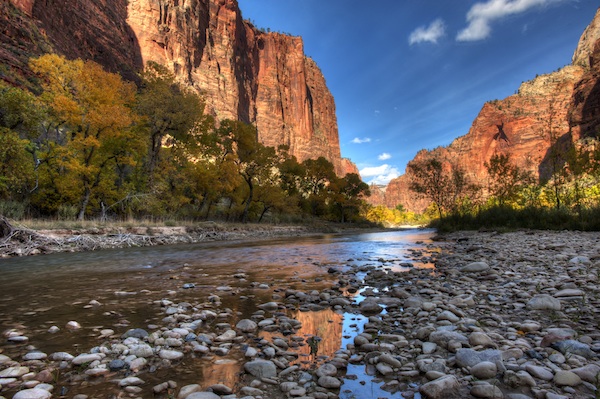
National parks generated $26.5 billion in economic activity last year. Zion National Park contributed $185.5 million/Deby Dixon photo of Zion Canyon
"This property is of no value to the Government."
"...if it cannot be occupied and cultivated, why should we make a public park of it? If it cannot be occupied by man, why protect it from occupation? I see no reason in that."
How times have changed.
Those two statements, the first from U.S. Sen. John Conness in 1864 as he urged the chamber to protect the Yosemite Valley, and the second from Sen. Cornelius Cole in 1872 in opposing legislation to create Yellowstone National Park, painted two of the more glorious units of today's National Park System as worthless tracts of land. Today they are viewed as part of a $26.5 billion economic engine that supports 240,000 jobs and countless businesses, large and small.
While Sen. Conness had to persuade his colleagues that Yosemite was worthless, and Sen. Cole believed Yellowstone to be worthless, today the National Park Service points to the economic worth of the parks.
'National parks are often the primary economic engines of many park gateway communities,' Park Service Director Jon Jarvis said last week in announcing the fiscal impacts of the park system. 'While park rangers provide interpretation of the iconic natural, cultural and historic landscapes, nearby communities provide our visitors with services that support hundreds of thousands of mostly local jobs.
"... The big picture of national parks and their importance to the economy is clear,' the director added. 'Every tax dollar invested in the National Park Service returns $10 to the U.S. economy because of visitor spending in gateway communities near the 401 parks of the National Park System.'
Lodging is the biggest business in the park system, generating $4.4 billion in economic activity last year, notes the report, 2013 National Park Visitor Spending Effects, Economic Contributions to Local Communities, States, and the Nation. Next in line, not too surprisingly, is dining and drinking (yes, bar drinking), which contributed $2.9 billion.
In 2013, NPS visitors spent a total of $14.6 billion in local gateway communities while visiting NPS lands. These expenditures directly supported over 143 thousand jobs, $4.2 billion in labor income, $6.9 billion in value added, and $11.2 billion in output in the national economy. The secondary effects of visitor spending supported an additional 94 thousand jobs, $5.0 billion in labor income, $8.8 billion in value added, and $15.3 billion in output in the national economy. Combined, NPS visitor spending supported a total of 238 thousand jobs, $9.2 billion in labor income, $15.6 billion in value added, and $26.5 billion in output in the national economy.
Which park system unit contributed the most to that total? The Blue Ridge Parkway, which generated nearly $1 billion ($999.3 million) in business last year, according to the report, followed closely by Great Smoky Mountains National Park with $943.2 million.
The report also noted that overall visitation to the parks was down in 2013, in large part due to the partial government shutdown in October, and due to ongoing impacts from Hurricane Sandy, which swept up the Eastern Seaboard in October 2012.
What was not part of the report, but which would be equally important in assessing the overall value of the National Park System, would be an analysis of the ecological worth of the parks. What value are the forests that act as air and water filters? How important to the nation are the flora and fauna protected by the parks? Let's measure the ecological, and economic, value of coastal wetlands and barrier islands at places such as Everglades National Park, Gulf Islands National Seashore, and Assateague Island National Seashore, that not only provide critical habitat for shorebirds, waterfowl, and fish, but also serve as storm buffers.
If the Park Service feels it must tout the dollar-impact of the parks to generate Congressional and public support, it could similarly bolster that argument by defining the "natural capital" that resides in the park system.
"Nature has provided ecosystems and their benefits to us for free. However, perhaps because this capital has been provided freely to us, we humans have tended to view it as limitless, abundant, and always available for our use, exploitation, and conversion. The concept of an ecosystem as natural capital can help us analyze the economic behavior that has led to the overuse of so much ecological wealth. If we can understand this behavior better, then perhaps we can find ways to manage and enhance what is left of our natural endowment. -- Edward B. Barbier, Capitalizing on Nature, Ecosystems as Natural Assets.
Story Categories:
A copy of National Parks Traveler's financial statements may be obtained by sending a stamped, self-addressed envelope to: National Parks Traveler, P.O. Box 980452, Park City, Utah 84098. National Parks Traveler was formed in the state of Utah for the purpose of informing and educating about national parks and protected areas.
Residents of the following states may obtain a copy of our financial and additional information as stated below:
- Florida: A COPY OF THE OFFICIAL REGISTRATION AND FINANCIAL INFORMATION FOR NATIONAL PARKS TRAVELER, (REGISTRATION NO. CH 51659), MAY BE OBTAINED FROM THE DIVISION OF CONSUMER SERVICES BY CALLING 800-435-7352 OR VISITING THEIR WEBSITE. REGISTRATION DOES NOT IMPLY ENDORSEMENT, APPROVAL, OR RECOMMENDATION BY THE STATE.
- Georgia: A full and fair description of the programs and financial statement summary of National Parks Traveler is available upon request at the office and phone number indicated above.
- Maryland: Documents and information submitted under the Maryland Solicitations Act are also available, for the cost of postage and copies, from the Secretary of State, State House, Annapolis, MD 21401 (410-974-5534).
- North Carolina: Financial information about this organization and a copy of its license are available from the State Solicitation Licensing Branch at 888-830-4989 or 919-807-2214. The license is not an endorsement by the State.
- Pennsylvania: The official registration and financial information of National Parks Traveler may be obtained from the Pennsylvania Department of State by calling 800-732-0999. Registration does not imply endorsement.
- Virginia: Financial statements are available from the Virginia Department of Agriculture and Consumer Services, 102 Governor Street, Richmond, Virginia 23219.
- Washington: National Parks Traveler is registered with Washington State’s Charities Program as required by law and additional information is available by calling 800-332-4483 or visiting www.sos.wa.gov/charities, or on file at Charities Division, Office of the Secretary of State, State of Washington, Olympia, WA 98504.

Comments
I'd be the first to agree that NPS numbers are soft...incredibly so.
But to attribute a 35 percent decline in business to the beach regs seems high. It'd be interesting to see just how many days Highway 12 was closed, either due to hurricanes, or problems with the Bonner Bridge, each year since 2002.
Gary, nearly a 800,000 drop in visitation is considered barely? Must be that new progressive math... Also, the beach closures include no-walking, not just ORV access. You can't even walk to the most popular beach for the past 5 months.
Kurt, I too don't believe all of that number is related to beach regs, just most of it, the dismal Obama economy had some impact as well.
All of these are ancient arguments from a century ago, originally advanced by the railroads and preservationists seeking an ecomomic rationale to save the parks. Remember Hetch Hetchy? Below are three of my favorite quotes, leading Chapter 5 of National Parks: The American Experience. I still like McFarland's best, and Kurt is the closest in sentiment to it now. Who cares what the parks "make?" Hell, if all of us were dead we couldn't spend a dime on anything. The quotes, then, and forgive me for what my publisher calls "shameless promotion."
See Europe if You Will, but See America First.
Soo Railroad Brochure, ca. 1910
War with Switzerland!
Mark Daniels, 1915
The influence of [the national parks] is far beyond what is usually esteemed or usually considered. It has a relation to efficiency— the working efficiency of the people, to their health, and particularly to their patriotism—which would make the parks worth while, if there were not a cent of revenue in it, and if every visitor to the parks meant that the Government would have to pay a tax of $1 simply to get him there.
J. Horace McFarland, 1916
I'm finding your stats a bit of a stretch over a 10 year cycle. Seems that it's held mostly steady and only fluctuated by 100,000 or so every year since 2004. And seriously, when all else fails, blame it on Obama. Classic. Since 2004, visitation has barely fluctuated beyond 5% at CHNS, with 2012 being the best year in that decade (oooh during Obama's tenure....oooh ohhhh). So, there was a 35% drop in business?
Cape Hatteras Visitation by Year
Gary, these new beach closures started happening in 2003. Beach closures resulted in lower visitation which resulted in lower tourism business. These business's are located inside the park, not adjacent. Pretending these new NPS policies didn't have an impact is lunacy. So your math is different than mine because 2.6m is greater than 2.3m using my math, oh by the way 300,000 is less than 100,000.
How is the Obama economy helping any park? I'd love to hear this...
Beach, at most there has been a 10% decline in vistation since it's peak in 2002. You might attribute that to beach closures, but that's taking into a big consideration that all those 2 million people cared about the closures, or were bringing ORVs to the park, which is highly doubtful.
Gary, these closures are not just preventing ORV access but also to a lesser degree preventing pedestrians access. I believe that most of that loss of visitation is directly related to loosing beach access. Can you tell me what changed at CHNSRA during the past decade that would result in lower visitation?
Just came home from an incredibly crowded Zion and an equally incredibly crowded Springdale. You could hear Springdale's cash registers ringing from miles away.
Came home and found an incredibly crowded pile of postings here as a whole lot of effort is wasted -- again -- on trying valiantly to respond to some shoutings from under a bridge. Might the discussions here be of greater value if we could simply ignore the tantalizing tidbits floated out into the stream to entice us to respond?
Over at Great Basin, in the tiny town of Baker, three new businesses have opened just this year. Would they have done so if the park were not there? South of Cedar City there is a large billboard alongside I-15 inviting everyone to attend the Astronomy Festival at Great Basin on September 12 and 13 (I think it was).
Economic engines? Remember what happened when the Clowns of Congress closed the parks?
Nearly 1M national park visitors deliver $67M to Oregon (Photos)
http://www.bizjournals.com/portland/blog/2014/07/nearly-1m-national-park...
Yes, peope went elsewhere to recreate.
Count me as another anecdotal example of someone who would mostly just stay home if the parks were closed. I'd probably visit some nearby state parks and forests a little more instead, but they cost almost nothing to visit.
I wouldn't spend the considerable time and money to visit Utah, for example, for any other reason than to visit the amazing national parks and monuments there.
I also have this goal of eventually restoring a Jeep Wagoneer, buying an Airstream trailer, and spending weeks on a road trip to Mount Rushmore, Bandlands, Yellowstone, etc. a la the classic 1960s Americana vacation.
If those parks weren't there, that all goes away. It's not like I'm going to put tens of thousands of dollars into restoring a classic vehicle, buying a recreational trailer, gas, food, supplies,etc. to go visit...I dunno...the *cough* allure of Cheyenne Wyoming instead?
Are national parks economic engines for industrial tourism? Of course they are! Ask anyone who lives in Pigeon Forge, TN, Gatlinburg, TN, Cherokee, NC, West Yellowstone, WY, Jackson, WY, or Mariposa, CA.
On the other hand, experience traffic and crowded conditions in a park and potential repeat park visitors might instead choose to vacation elsewhere the next time around. But, propose a plan to enhance visitor experience and protect park resources that involves restrictions on vehicle use in the parks, such as removing private car access to Cades Cove or Yosemite Valley, and hearing protection will be needed to survive the shrill cries of opposition from those economically dependent on the steady flow of tourism.
Insensitivity to the economic importance of park visitation can be hazardous to one's NPS career. Some decades ago, a newly appointed superintendent to Yosemite National Park happened to oppose contruction of a Wells Fargo Bank in Yosemite Valley. That superintendent's tenure in Yosemite lasted six months, the shortest residency of any park superintendent in Yosemite's history.
Exactly, Owen. It's impossible to even guess accurately how much of the mess faced by many of our parks are the direct result of some kind of political pressure applied by people with large financial interests and their Congresspersons.
Zion last week was incredible. All parking inside the park full by 10 a.m.. Roadside parking in Springdale was solid for perhaps a quarter mile on both sides of the street. Can you imagine Zion if the shuttle system was not in use? The park's automobile entry fee is $25. The shuttle system is free.
Without the shuttle, I'm sure many people would make one trip and one trip only.
I spoke with a man who had just had his family at Yosemite. He said they stayed two days and left because of the congestion even though they had been planning to spend five days there. He sounded as if it will be his family's first and only visit to Yosemite.
While there may be deafeningly shrill cries from vested interests who fear any change, I'd be willing to bet that if reasonable limits were set up -- not only in YOSE, but other parks as well -- there might actually be an increase in visitation. And with it, an increase in income for the profiteers.
It's the old conundrum. "What I have now isn't really very good, but I'm familiar with it so why change?"
Lee i've seen Zion both with and without shuttles. The shuttle experience was so much better. The canyon is so much quieter, and the experience is greater with those quiet shuttles that travel the road every few minutes. It's not like bumper to bumper traffic or having a bunch of harley riders reving thier engines in some sort of crazed alpha male dominance display that it echoes throughout the entire canyon. That element is removed and you can actually hear the birds chirp, and the occasional laughter of a child having fun. It makes Zion canyon actually a more peaceful place than Yosemite Valley. I consider the Zion shuttle experience I had a pleasant time, when I used the shuttle to hike up the west rim. I consider the time I spent in Yosemite Valley not so pleasant the couple times I was there. The shuttle in Zion has been in place for a while now, and it has not seemed to have any single effect on tourism in that place. I think it truly is a model for the crowded spots in our parks. Denali also has a tram, and I think I read on here recently that Mesa Verde is considering that too.
Muddy,
Don't waste your time at Mt Rushmore, go to Crazy Horse instead and there are plenty of other great places in SD/ND that aren't National Parks.
Yellowstone is a must see - but then, it would be whether it was a National Park or not.
By the way am spending 2 days in Ft Collins with fishing and hiking in Poudre Canyon. Last minute, we decided we will drive home tomorrow through RMNP. Our RMNP incremental spending $0. Other outdoor recreation activities, hundred$.
EC: I plan on stopping at Crazy Horse too, but the majority of highlights in that region are NPS sites.
True that Yellowstone would be a must-see whether it's an NPS site or not. But if it wasn't an NPS site, it would be an overdeveloped hellhole like Niagara Falls. I went there once (in winter, even) and will never return.
When my wife and I went to ROMO we spent two days in Grand Lake and spent a fair amount of money in lodging and food. Although it was August we visited the park between about 6 am and 11 am, and again after about 5 pm. Crowds seemed minimal in those off-peak times, in spite of visitation stats, and we had the best experiences with wildlife we ever had in our 35 national park visits. It was an amazing experience, and I'm sure many who have lived it would agree. Since Grand Lake and Estes Park aren't wanting for tourism, it would seem ROMO draws a fair share of tourist dollars, and rightfully so.
There are plenty of other places everywhere that are great places. That's not the point here. Those places do not take away from our parks. In some cases they add to their appeal.
All are part of a vast network of interconnected strands in an international web of economic ecology and, as John Muir put it, "When we try to pick out anything by itself, we find it hitched to everything else in the Universe." That is as true of dollars as it is of butterflies.
Thus, if we destroy or damage any part of our parks, we risk harm to everyone and everything that may be dependent in some way upon them.
Extreme caution should always be the primary guiding principle.
I disagree.
I disagree. There are hunreds if not thousands of wonderful places in this country that aren't NPSs and haven't been over developed. I was in one today - the Poudre River Canyon. As pretty as any river in Yellowstone less perhaps a few waterfalls. Far mor accessable, inexpensive camping, no entrace fees and far less crowded. Oh, and dogs were welcome.
Badlands, Wind Cave, Devils Tower, Theodore Roosevelt, Mount Rushmore, etc. aren't the primary destinations in the western Dakotas region? What else do people go there for, to see the majestic oil spills from the recent fossil fuel boom in ND?
Although it may be sublime, Poudre River Canyon isn't on the lips of the traveling populace. If it was Poudre River Canyon National Park, perhaps moreso. Funny how Congress sticking "National Park" on the end of any phrase turns it into an economic powerhouse, no?
The only reason the more "minor" locations haven't been developed is because they don't harbor the vastly impressive and unique features of national parks and the appropriate formal designation. If Yellowstone was privatized tomorrow, it wouldn't be long before the whole area was paved with resorts, hotels, restaurants, casinos and kitsch a la Niagara Falls NY. If Poudre Canyon was designated a national park, it too would welcome an economic increase to the surrounding area. National park designation invites regional tourism while simultaneously protecting the areas themselves from development. It's a win-win.
Why visitation is down at CHNS.
It has little to do with NP ORV regs. Visitors plans are being disrupted by weather events and natural forces. They are being educated to vacation elsewhere.
http://news.nationalgeographic.com/news/special-features/2014/07/140725-...
Buxton, that's a new one for sure. Who is educating them to vacation elsewhere? Are you saying because of the fake climate change agenda, people are not visiting the NP?
You act as if there were only two alternatives. NPS or privitization. The are many areas that are NF, or BLM, or State Parks (try Custer in SD) and even private tracks that are fantastic to visit.
What else do people go to SD for? Check this out:
http://www.visitrapidcity.com/things-to-do/top-10-lists#.U9erYWPMIvk
There are dozens of places to go and things to do in SD. NPs are among them but they certainly don't dominate the list. And if the parks did not exist, I am sure SD wouldn't be a ghost state. BTW, I've been to Devils Tower. Why? Not because it was a NP but because it was featured in Close Encounters. Shouldn't Richard Dreyfus get credit for that economic contribution?
And once again, I am not arguing the NPS have no economic impact. They certainly impact their local communities and have some overall incremental contribution to the National economy. But to attribute every dollar spent in the general vicinity of a NP as an incremental contribution is ludicrous. If NPs weren't an option, people would spend their money elsewhere.
But muddymoose, the fact that an area has been designated as a new NP area is not an automatic guarantee of protection. Congress may, if they so desire, do almost anything their owners dictate to have done in a new park.
Once again, extreme caution should always be the primary guiding principle. People like us who value parks for more than the dollars they may generate can never let down our guard.
I lived in Poudre Canyon for 8 years back in the 1990's. The river is on the National Wild and Scenic List and also part of it is National forest land. I hiked, fished, camped, up and down the canyon. Sometimes it was crowded along the hiway and lots of river rafters and kayaks. But you could always find solitude. And the sound of the river was sometimes so loud you had to close your window to hear each other talk but it was great to sleep with the sound.
Good point Lee. We could name it Poudre Canyon National Park. Then instead of a well preserved primitive backcountry with a beautiful river we could build a hotel with $250 a night rooms, fill the valley with RV parks, resturants and general stores selling worthless trinkets. Toss the rafts and kayaks off the river and ban the dogs. Fill the road with bumper to bumper traffic. But hey, then we could claim all of economc activity of Ft. Collins as a return on the NP investment.
You're exactly right, ec. Just what will happen if the Clowns of Congress get involved.
Once again, extreme caution should always be the primary guiding principle.
But even here, your usual litany is off a bit. No one here has ever claimed that ALL the economic activity of any near-park community comes from the park. Please don't twist the words of others.
Ooops. I just took the bait again. Now I'll have to spend the rest of the day looking over my shoulder for Kurt coming to slap me . . . . .
Buxton ---
Your surefire indication that your argumentation efforts will be better used elsewhere --- when you run into a climate change denier. You have a better chance of arguing for Pagan rights in the Vatican. I suggest not even saying goodbye, but just quietly walk away and leave them to wallow in their willful ignorance.
Rick, if you believe in global warming then you and Buxton probably don't have a firm grasp on reality anyways. Probably why you bought into that hope and change, if you like your doctor you can keep your doctor, most open and transparent administration in history, and all the other lies coming from this administration. I wish you guys would wake up, the world is on fire, economy getting worse, and kids are walking through your secure border...
OK, folks, we're not going to let this thread take off down that rabbit hole. Stick to the topic, please, and don't let it drift.
Lee - The "Clowns of Congress" as you like to so affectionately call them created Parks. A little late to be getting concerned about them being involved.
Congress today is a whole lot different than in the past.
Once again, extreme caution should always be the primary guiding principle.
Response withheld to avoid the rabbit hole.
Beachdumb,
There are no unbiased economic studies that even remotely suggest that a 35% drop in visitation is a result of NPS management. It is pure fantasy on your part intended to promote a personal agenda. June and July the traditional summer months that normally have no weather impacts on Hatteras Island are not down, even though resource closures are at there peak. I know because right now as I write the shops are full and there is road traffic everywhere on Hatters Island. If there were any smoking local economic guns aimed at access and visitation the ORV groups would have it out there.
Climbing back out of the rabbit hole.
It is obvious that some things are just priceless. I believe that our National Parks (monuments, seashores etc) are.
We will keep building and transforming the natural world right up to the boundaries of many NP. The more people the more restrictive the National Parks will have to become. The mountain bike trails will be so crowded that hikers will be blazing new trails to stay out of their way. Visitors bring their ORVs to Seashore beaches where there are so many vehicles that your car can be blocked in where you can't leave, flora is destroyed, sea turtles false crawls rise and colonial bird nesting is disrupted.
I question if any National Parks, sporting events, concerts etc cause any economic value. The most they do is direct money from one geographic area to another. The National Parks should not concern themselves with local economic issues beyond the Organic Act and the Enabling Legislation of that Park. Those should be more than enough to stimulate the local economy (away from some other local economy). The exception I always encounter is the foreign tourists that come to US National Parks exactly for the attributes that the Organic Act seeks to protect. They are here spending their money and not in some other country because the Organic Act is protecting increasingly priceless attributes not because of local economic success. I assume 20% is a considerable sum and many of these tourists are going to spend money and take in other venues not related to the NP. Maybe they will stay in Vegas for 2 nights on their way to Zion like I did one time.
Buxton, visitation was down before the issues with ferry started. Visitation dropped nearly million after 2002 and has yet to recover. I did not mean a 35% drop in visitation,which I clarified when Kurt questioned. Business owners on the island have said, and on the record, that they have seen up to a 35% decline economicly. This decline was directly correlated with the new resource closures in the shoulder season but the summer season drop was minimal. We used visit several times in the spring but no longer since most of the desirable locations are closed.
You know that access on/off the island has always been an issue. I can remember always waiting on water/tide to recede in the 80s and 90s.
Beachdumb
A lot of people now schedule their ORV fishing vacations in the fall when the fishing is better and resource protection measures are minimal. I know what the busness say about the resource closures but there is little to no substantial evidence to support it. My andotoyal observation says the resource closures have at best a minimal affect compared to weather events and highway 12 access on visitation or the local economy.
The yearly economic result of resource closures is at most negligible, otherwise someone would have some hard facts to back it up with. Mostly I see the economic gambit as a ploy to relax ORV rules.
Then again because I love Hatteras Island and the NPS even if it were proven that the ORV rules had a profound negative affect on the local economy the Organic Act, the EL for CHNS and the historic conditions of this place would dictate to me the management of CHNS.
My family and I love Hatteras Island as much if not more than you do. It has sadden us that were unable to share the spring fishing with our newest and oldest family members as we had for decades.
So we agree economic engine provided by CHNSRA has slowed or reversed by the actions of the OBX Group NPS over the past decade.
Access to the island is becoming increasingly challenging by the NPS's new policy of let it be natural, further slowing the economic engine...
I see excessive resource closures as a ruse, given the fact that since the new plan was put in place birds and turtles have had a sharp decline, this year being the worst so far.
I am hoping that the new ESA reform act will allow some changes to restore some of the lost access and lost economic prosperity back to the island.
"So we agree economic engine provided by CHNSRA has slowed or reversed by the actions of the OBX Group NPS over the past decade."
I don't know that to be the case at all.
The Parks policy of letting nature take it course is not the problem with access. The problem is politicians and local leaders won't acknowledge modern scientific theories of barrier island dynamics and the immediate implications they are having.
Birds and turtles have evolved to deal with adverse weather conditions (like a freak 100 MPH July hurricane this year) and bad nesting years but have not evolved to deal with year after year of bad resource protection measures.
The fact that you can't meet at the Point and spring drum fish is because the only compromise(?) the ORV/ fishing organizations will entertain is unfettered 24/7 ORV access to Cape Point.
Buxton, you know that pedestrian access to the Point has been closed for 5 months now, this is not just about ORV access. Face it, it's not just the ORV orgs wanting access, state and local governments supporting all forms of access have been fighting the NPS on this problem as well. I think you give the ORV orgs too much credit, they have little influence as we have seen.
Beachdumb,
Well at the regneg the (ORV orgs) shot down every other potential alternative, water taxis, shuttles, foot routes to name a few. The only thing they were interested in is driving in their personal vehicle on the NP beach when and where they wanted to. Whenever any pedestrian access was proposed they immediately referenced some study that said birders in cars were less intrusive than birders out of their cars and if someone could walk there then they should be able to drive there, compromise over.
I can see no reason why management could not have been made for pedestrian paths that followed the tide line when appropriate, temporary parking areas and or alternative ORV routes that got fishermen much closer to the Point. Sportfishing at the Point is a significant historical tradition that deserved better, unfortunately the ORV orgs took an all or nothing approach. I want us to be able to fish the Point but the NPS has to protect the resource. There is no way getting around that and to accomplish it will be inconvenient.
Instead of continuing to hash CHNS let's talk about the responsibility of NPS to follow the ELs of specific Parks, the Organic Act and the ESA. How are they suppose to address those issues?
Buxton, you know eco groups are the ones that were totally unwilling compromise. If those options were even remotely viable, the NPS would have implemented them on their own. The RegNeg was a failure and what we ended up with was totally derived from the NPS and the threat of law suits by the eco groups.
Closing miles of beach to ALL, new restrictions, fees/permits, and pedestrian closures in front of village houses can't possibly increase tourism.The economic engine of the CHNSRA lost a couple cylinders due to promise's of the NPS being broken.
Does the EL, Organic Act and ESA take into any consideration the economic impacts to the surrounding areas? Didn't seem to in case of the CHNSRA.
Maybe someone else can shed some light on economic analysis and what economic considerations are expected with respect to the Organic Act and NEPA when forming new rules. I'm under the impression that NEPA is the guiding instrument when management decisions are made concerning economic implications of new rules not the Organic Act. As far as CAHA was concerned the government's economic analysis didn't find any problems. I don't see anything written in the EL for CAHA where local economic interest supersedes what was intended for the management of CAHA.
Beachdumb just making a claim that the local economy has suffered because of new management is not good enough even if you have operate a business near the Park you need some proof to back it up with.
Cape Hatteras National Seashore visitation
2012 - 2,302,040
2011 - 1,960,711 *
2010 - 2,193,292
2009 - 2,282,543
2008 - 2,146,392
2007 - 2,237,378
2006 - 2,125,005
2005 - 2,260,628
Dare County, NC, where the majority of the Seashore is located, reports that visitor occupancy tax receipts for each year under the court ordered ORV restrictions (2008 to 2012) exceeded receipts in 2007 and prior years, with 2008, 2010, 2011, and 2012 setting successive records for all-time high receipts. Tourism revenue for Hyde County, NC (the Ocracoke Island portion of Cape Hatteras National Seashore) has held steady or increased since 2005, to a record high $31.69 million in 2011. The chart below shows tourism revenue data for Hyde and Dare Counties, both before the court ordered ORV restrictions went into effect in 2008 and afterwards.
www.nccommerce.com/tourism/research/economic-impact/)
(http://www.southernenvironment.org/uploads/pages/03-14-2013%20Testimony%20of%20Derb%20Carter)
This analysis agrees with my own observations as a full time resident on Hatteras Island. Right now unless something catastrophic occurs with Oregon Inlet bridge or highway 12 I predict 2014 will be an excellent year for business and tourism, even with the disruption of the 4th of July weekend by Hurricane Arthur. It doesn't appear to be any problems with visitation or the economy: lots of busy restaurants, grocery stores, shops, no vacancy signs and larger than usual number of people in the NPS Oceanside Parking lots. I don't see the smoke the ORV orgs are telling everyone.
Nothing from the SELC is trustworthy. This group is very well known for cherry picking, half truths and misinterepreation. Ask any HI business how the shoulder season economy has been since 2003. Since you claim to live there, I'll wait for your answer.
Beachdumb,
Don't believe SELC check the links provided. The spring shoulder season for some very specfic business might be off. I say might because some of the busness doing the complaining are avid ORV users themselves. I don't believe the fall season is at all. Actually I think the fall season is better because the few that didn't come in the spring for Red Drum fishing postponed their trip to the fall.
Yes I can assure you I do live on HI, in Buxton, and have for probably longer than you have been vacationing here.
Pages