
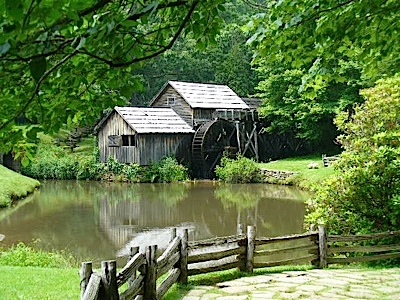
Help the Blue Ridge Parkway Foundation raise the money necessary to repair Mabry Mill's historic waterwheel. Photo by David and Kay Scott.
Historic preservation can be a costly, and regular, routine.
That's why the Blue Ridge Parkway Foundation needs your help to repair the waterwheel of the historic Mabry Mill at Milepost 176 along the parkway.
According to a story in the Foundation's latest newsletter...
Mabry Mill at Milepost 176 is sometimes referred to as "the most photographed structure in the National Park System." While not an official title, there can be no doubt that it is the most photographed structure along the Parkway and one of its most popular stops. The mill appeals in particular to photographers for its simple beauty and connection to a time when waterwheels were commonplace. Maintaining this cherished historical mill takes expert craftsmanship, dedication and money. In order to preserve the structure and keep the mill operational, the waterwheel must undergo extensive repair this year.
The mill complex was built by Ed Mabry beginning in 1903. It began as a blacksmith and wheelwright shop. By 1905 it was in operation as a gristmill. By 1910 the front part of the mill was completed and included a lathe for turning out wheel hubs, a tongue and groove lathe, a planer and a jig-saw. During its heyday, the mill was the heart of the Meadows of Dan community. Ed Mabry and his wife Lizzie not only ground corn, but built and repaired almost everything their neighbors used. When Ed Mabry became ill in the 1930’s, the mill began to deteriorate. The National Park Service acquired the land and mill in 1938 after Ed Mabry died in 1936.
The most popular sight on the Parkway was almost lost to bureaucracy. According to documents in the Parkway archives, the first chief ranger in the area, Mac Dale, saved the mill from destruction. He just happened to be driving past the mill and in his own words, “I did a double take and a fast stop, because right there in front of the mill was a state road department’s maintenance truck and group of men, one with a crowbar and one with a sledgehammer just going through the door into the mill. I inquired and they told me that their orders were to knock down all of the buildings of the group and have them ready so that they could be set on fire and gotten out of the way before the first snow.” Fortunately, Mac was able to convince them to wait until he could contact his superiors to have the highway department issue a revised order and stop the demolition. Talk about being in the right place at the right time!
In 1945, the National Park Service began to restore the mill providing insight into pioneer life and mountain industry in the area. The mill and blacksmith shop were restored in their original locations, and the holding pond was built. Additional sluices were built to send more power to the wheel, allowing visitors to see a working miller demonstrating the milling process. Other structures, including a still, an 1869 cabin and a sorghum mill were either built or relocated to the complex.
By the 1990s, the wooden parts of the mill were deteriorating, and the Parkway’s Historical Preservation Workshop began repairs. The wheel and axle were taken to the workshop at Sandy Flats (featured in the following article). The highly skilled team crafted a new axle and replaced wood around the rim, the spokes and the buckets.
Today, the waterwheel is in need of additional repairs. The buckets are leaking badly, keeping the mill from generating the appropriate power for the miller. The extent of the repairs will not be known until the workshop crew can jack up and inspect the wheel without the water running. If the axle and bearings need repair, the wheel will have to be removed and again repaired at the Sandy Flats workshop. If not, the spokes and buckets will be manufactured in the workshop and replaced on site allowing visitors to view the team at work.
You can participate in preserving the culture and history of the Parkway by helping us raise the needed funds for this work. When Mac Dale saved Mabry Mill from destruction in 1938, he didn’t know it would become an inspiration for photographers and a joy for families… he just knew letting it be destroyed was wrong. Mac Dale took action. Now, you too have the opportunity to take action and preserve this very special place for the next generation.
The total estimated cost for the repairs is $51,000. More information and a donation button can be found at www.brpfoundation.org/mabry
Story Categories:
A copy of National Parks Traveler's financial statements may be obtained by sending a stamped, self-addressed envelope to: National Parks Traveler, P.O. Box 980452, Park City, Utah 84098. National Parks Traveler was formed in the state of Utah for the purpose of informing and educating about national parks and protected areas.
Residents of the following states may obtain a copy of our financial and additional information as stated below:
- Florida: A COPY OF THE OFFICIAL REGISTRATION AND FINANCIAL INFORMATION FOR NATIONAL PARKS TRAVELER, (REGISTRATION NO. CH 51659), MAY BE OBTAINED FROM THE DIVISION OF CONSUMER SERVICES BY CALLING 800-435-7352 OR VISITING THEIR WEBSITE. REGISTRATION DOES NOT IMPLY ENDORSEMENT, APPROVAL, OR RECOMMENDATION BY THE STATE.
- Georgia: A full and fair description of the programs and financial statement summary of National Parks Traveler is available upon request at the office and phone number indicated above.
- Maryland: Documents and information submitted under the Maryland Solicitations Act are also available, for the cost of postage and copies, from the Secretary of State, State House, Annapolis, MD 21401 (410-974-5534).
- North Carolina: Financial information about this organization and a copy of its license are available from the State Solicitation Licensing Branch at 888-830-4989 or 919-807-2214. The license is not an endorsement by the State.
- Pennsylvania: The official registration and financial information of National Parks Traveler may be obtained from the Pennsylvania Department of State by calling 800-732-0999. Registration does not imply endorsement.
- Virginia: Financial statements are available from the Virginia Department of Agriculture and Consumer Services, 102 Governor Street, Richmond, Virginia 23219.
- Washington: National Parks Traveler is registered with Washington State’s Charities Program as required by law and additional information is available by calling 800-332-4483 or visiting www.sos.wa.gov/charities, or on file at Charities Division, Office of the Secretary of State, State of Washington, Olympia, WA 98504.


National parks and their natural resources belong to you. The National Parks Traveler works to ensure you know how these essential places are being cared for.
Sign Up For Our Weekly Newsletter
Unsubscribe at any time.
INN Member

The easiest way to explore RV-friendly National Park campgrounds.

Here’s the definitive guide to National Park System campgrounds where RVers can park their rigs.
Our app is packed with RVing- specific details on more than 250 campgrounds in more than 70 national parks.
You’ll also find stories about RVing in the parks, tips helpful if you’ve just recently become an RVer, and useful planning suggestions.

