
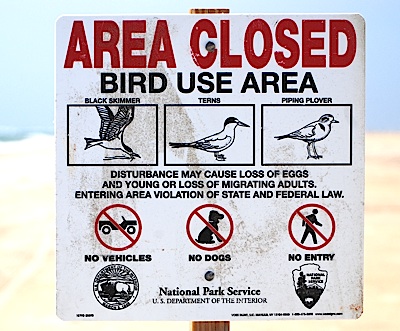
A congressman from North Carolina is making a second run at having the off-road vehicle regulations at Cape Hatteras National Seashore tossed out. NPT file photo.
A congressman from North Carolina is making a second bid to force the National Park Service to reverse itself on managing people, birds, and sea turtles at Cape Hatteras National Seashore.
Rep. Walter Jones recently reintroduced H.R. 819 - the Preserving Access to Cape Hatteras National Seashore Recreational Area Act. The bill is tentatively scheduled for a hearing before the House Natural Resources Subcommittee on Public Lands and Environmental Regulation on March 14th. Congressman Jones introduced the bill in the last Congress and it passed the House of Representatives, but the Senate version failed to make it out of committee.
The bill, if passed by the Congress and signed into law by the president, would overturn the seashore's management plan for off-road vehicles and pedestrians and put in place regulations that were followed under the Interim Protected Species Management Act issued by the National Park Service in 2007.
The bill also would permit future restrictions under the Endangered Species Act, “based on peer-reviewed science and after public comment.” But it would also constrain managers’ choices, requiring that future closures under the Endangered Species Act may “only restrict, by limitation, closure, buffer, or otherwise, pedestrian and motorized vehicular access ... for the shortest possible time and on the smallest possible portions” of the Seashore.
The Act would also require that Cape Hatteras’ restrictions be “no greater than” those in place “for that species at any other National Seashore,” and that pedestrian and vehicular corridors be designated “of minimal distance on the beach or interdunal area around closures implemented” ... “to allow access to areas not closed.”
“This bill is about jobs and the taxpayers’ right to access the recreational areas they own,” said Jones. “It’s about restoring balance and common sense to Park Service management. I would like to thank the Natural Resources Committee for scheduling a hearing and for doing what is right for the people of eastern North Carolina.”
According to the congressman, the Interim Strategy was backed up by a 113-page Biological Opinion issued by the U.S. Fish and Wildlife Service that found that it would not jeopardize the species of concern, namely piping plover and sea turtles.
Similar legislative efforts to overturn park management plans have been launched in the past after public comment periods. In 2008, U.S. Sens. Richard Burr and Elizabeth Dole, both of North Carolina, offered similar legislation to overturn ORV regulations contained within a consent decree that settled a lawsuit over the seashore's lack of ORV regulations. In defending her legislation, Sen. Dole testified before the committee that her constituents were suffering undue economic hardships as a result of the consent decree.
Under that consent decree, the seashore's staff greatly restricted off-road vehicle travel and limited pedestrian travel to protect nesting shorebirds and sea turtles. Opponents of the decree, though, claimed it was over-reaching what reasonably was needed and that the economy that depends on Cape Hatteras was tanking.
Another attempt, also unsuccessful, was made in 2009 to reject the temporary ORV regulations contained in the consent decree.
In its February 2012 final rules announcement, the National Park Service said the rules designate, “ORV routes and authorizes ORV use within the Seashore in a manner that will protect natural and cultural resources, provide a variety of safe visitor experiences, and minimize conflict among users.” The announcement stated that “in general,” ORV use was prohibited off road unless specifically permitted and that an ORV permit would be required.
Story Categories:
A copy of National Parks Traveler's financial statements may be obtained by sending a stamped, self-addressed envelope to: National Parks Traveler, P.O. Box 980452, Park City, Utah 84098. National Parks Traveler was formed in the state of Utah for the purpose of informing and educating about national parks and protected areas.
Residents of the following states may obtain a copy of our financial and additional information as stated below:
- Florida: A COPY OF THE OFFICIAL REGISTRATION AND FINANCIAL INFORMATION FOR NATIONAL PARKS TRAVELER, (REGISTRATION NO. CH 51659), MAY BE OBTAINED FROM THE DIVISION OF CONSUMER SERVICES BY CALLING 800-435-7352 OR VISITING THEIR WEBSITE. REGISTRATION DOES NOT IMPLY ENDORSEMENT, APPROVAL, OR RECOMMENDATION BY THE STATE.
- Georgia: A full and fair description of the programs and financial statement summary of National Parks Traveler is available upon request at the office and phone number indicated above.
- Maryland: Documents and information submitted under the Maryland Solicitations Act are also available, for the cost of postage and copies, from the Secretary of State, State House, Annapolis, MD 21401 (410-974-5534).
- North Carolina: Financial information about this organization and a copy of its license are available from the State Solicitation Licensing Branch at 888-830-4989 or 919-807-2214. The license is not an endorsement by the State.
- Pennsylvania: The official registration and financial information of National Parks Traveler may be obtained from the Pennsylvania Department of State by calling 800-732-0999. Registration does not imply endorsement.
- Virginia: Financial statements are available from the Virginia Department of Agriculture and Consumer Services, 102 Governor Street, Richmond, Virginia 23219.
- Washington: National Parks Traveler is registered with Washington State’s Charities Program as required by law and additional information is available by calling 800-332-4483 or visiting www.sos.wa.gov/charities, or on file at Charities Division, Office of the Secretary of State, State of Washington, Olympia, WA 98504.


National parks and their natural resources belong to you. The National Parks Traveler works to ensure you know how these essential places are being cared for.
Sign Up For Our Weekly Newsletter
Unsubscribe at any time.
INN Member

The easiest way to explore RV-friendly National Park campgrounds.

Here’s the definitive guide to National Park System campgrounds where RVers can park their rigs.
Our app is packed with RVing- specific details on more than 250 campgrounds in more than 70 national parks.
You’ll also find stories about RVing in the parks, tips helpful if you’ve just recently become an RVer, and useful planning suggestions.


Comments
This legislation will return the Interim Plan to Cape Hatteras National Seashore Recreational Area. According to NPS published documents the Final Rule will cost NPS $1.5MM to implement. Legislation to restore the Interim plan will save NPS $1.5MM and offset the cuts by the recent sequestration cuts by Congress and allow CHNSRA to operate with a budget excess that could be used to make improvements. Unfortunately the MANY MILLIONS of taxpayer dollars spent for Southern Environmental Law Center and other ATTORNEYS on the Final Rule cannot be recovered.
This legislation (HR - 819) saves NPS $1.5MM and allows CHNSRA to improve and operate at peak performance for the public. This does make SENSE AND SAVES CENTS!
And this is why national parks are managed by the feds and not the states. Preservation of the seashore and its natural denizens is far more important than a few yabbos who want to drive on the beach.
I believe the cap on attorney fees paid when the feds lose a court case is capped at less than $200,000. So, unless the access groups have spent millions on attorneys (which I doubt), there's not even $1 million in attorney fees to recover, muchless "millions".
I've been told a return to the interim plan would require the NPS to operate at least 3 shifts, 24/7, of personnel at each (smaller) bird and turtle closure to maintain compliance with the law. Bird chicks move to the shoreline at night and would require monitors to install temporary ORV closures until they returned to the backshore. There were more than 200 turtle nests last year and dozens of bird closures. I don't believe >200 more employees would be in the budget.
Cape Hatteras, and the National Park system in general are victims of their success as more and more people visit and degrade the resources. I yearn for the "good old days" of fewer visiters and crowds.
Tight Lines,
Pup
This is not about yabbos or maybe you meant yahhos? This is about our TAXPAYER money being wasted on attorneys and continual legal actions that are sucking out the ability of NPS to manage lands across the country.
In fact, Cape Hatteras National Seashore Recreational Area now has areas that are Vehicle and People free unless you are an NPS employee. Interestingly enough NPS personnel drive on the beach and enter any and all of these areas with their vehicles. ARE THE BIRDS AND TURTLES ONLY AFRAID OF THE TAXPAYERS VEHICLES?
I confess..I would like everyone to access the beaches like has been done for the last 100 years......on foot, on horseback, by wagon or by vehicle all the while preserving the flora and fauna like the residents have for the last 600 years.
PUP........You are misinformed about the Interim Plan. There is no NPS Park that requires 24/7 monitoring of any endangered or threatened species and it was never done at Cape Hatteras for all the years the Interim Plan was in place.
In the case of CHNSRA the closures at piping plover (threatened) nesting areas is larger that the protected area around the President of the United States. In many other Seashores like Fire Island, Cape Cod, Assateague the closures for piping plovers are minimal/arbitrary and do not close the beach from dune to the water........ Only at Cape Hatteras where we have 6-10 birds nesting each year is this excessive measure in place. In the case of turtle nesting.....Cape Hatteras is the ONLY unit of NPS that does not remove turtle eggs to safe locations to prevent predation or loss by storm/vehicle. Cape Hatteras has the highest mortality rate of turtle loss in the Park system due to their stubborn refusal to relocate the nests.
Pea Island National Wildlife Refuge, which is in the middle of CHNSRA, has one of the highest hatching success rates in the US due to relocation of nests when in peril. Hatteras Islanders comprise a majority of the turtle watch volunteers and assist in the nest relocation at Pea Island.
In fact.......no turtle has ever been killed or injured by any vehicle at Cape Hatteras except for one killed on Ocracoke Island inside a turtle closure. It is suspected that an NPS vehicle in a predawn inspection unknowingly ran over the turtle.
Fees paid when feds lose a case may be $200,000 in taxpayer money. What is important is that there is NO cap on what NPS can spend to defend a case. The out of pocket amount spent by taxpayers to fight NPS (unlimited tax dollars) is staggering. NPS is in litigation all over the US.... Yelowstone, Yosemite, Delaware Water Gap, Gateway in CA, Grand Canyon to name a few. I would love to see the NPS budget for litigation........it must be enormous!
What taxpayer monies are being "continually wasted on attorneys"? SELC isn't getting a taxpayer funded check every day. If the judge ordered (I don't know that he did) their costs be recovered for their efforts prior to the Consent Decree, then that's all they have or will ever recover to a maximum amount of less than $200,000. They have almost 10 years invested so that comes out to less than $20,000/year for several attorneys.
And yes, generally all wildlife is less disturbed by one vehicle a few times a day versus several hundred vehicles driving back and forth 24/7. Common sense.
Tight lines,
Pup
The federal government has salaried attorneys who get paid whether they're defending a case or not.
It would be an excessive (unrequired) measure if there were 100s of pairs nesting all over the place rather than just a dozen or so.
The NPS is mandated by law to protect the resource. The Interim Plan did not compy with the law (hence the lawsuit). If there are vehicles driving at night, through nesting areas without monitors present to monitor for and prevent chick and turtle hatchling losses to ORVs, they would be in violation of the law.
Cape Lookout (nor many other federal and state units) doesn't relocate all their nests either. You are obviously the one misinformed.
Suspected by whom exactly? People who wish to slander/libel NPS employees and anonymously accuse them of being criminals?
Tight lines,
Pup
S. 486, to authorize pedestrian and motorized vehicular access in Cape Hatteras National Seashore Recreational Area, and for other purposes.
The description of this bill is misleading. This bill is about establishing ORVs as the primary means of access to CHNS. The bill was written by the local congressman with the help of local pro ORV politicians.
If the bill passes it would:
* eliminate the new ORV vehicle safety regulations formed under the current ORV rule
* increase ORV and pedestrian recreational conflicts in CHNS
* reduce the amount of vehicle free beach that can be reasonably accessed by foot now available under the current rule
* increase the seasonal amount of ORV access in front of the villages, creating a safety issue for pedestrians
* leave the Park without a written defensible ORV management plan
Before the final rule CHNS did not have an ORV plan and park mangers were inconsistent in how ORVs were managed. There were no designated year round designated vehicle free areas in the Park. Vehicle free areas were available for visitors only at the discretion of local Park mangers, not permanently designated and subject to change. ORV organizations continue to lobby for less vehicle free areas and more ORV areas in the Park. S. 486 would revert the management of ORVs in the Park to the Interim Protected Species Management Plan, referred to as the "Interim Plan" in the bill. This plan is not an ORV plan, was formed with minimal public input and designed to temporarily addresses ORV management with respect to the Park's protected species until the final ORV rule could be established. It does not in any way manage recreational conflicts or safety concerns between ORVs and pedestrians or address the profound changes the Seashore has undergone in the last 40 years. .
S. 486 disregards the testimony gathered from public comments under strict NEPA guidelines that were submitted, considered and implemented by the NPS for the current ORV rule concerning pedestrian issues as they pertain to ORV management.
If the authors of S. 486 were interested in improving access for all they would have written a bill that addressed just that and let the Park's final rule deal with other issues. Unfortunately this poorly written bill which is still in National Parks Subcommittee has a good chance of making it to the Senate floor.