

Do the thick cedar swamps of Congaree National Park harbor any Ivory-billed woodpeckers? Photo of Cedar Creek by Kirby Adams.
"Ivory-billed Woodpecker."
That's all you need to say to a bird lover to stir some strong emotions. Once common across the southeastern United States, these majestic woodpeckers, as large as a red-tailed hawk, are now most likely extinct.
The loss is inarguably a direct result of habitat destruction, and hence a lesson in how quickly and quietly development can wipe an animal out of existence. The last sighting of an Ivory-billed Woodpecker in the United States that everyone agrees is authentic was in 1944.
Rumors of sightings have surfaced since, most notably with a 2005 publication about a sighting in Arkansas the year prior. The birding community is deeply divided over the authenticity of those reports and subsequent ones from Florida. No unambiguous photos, videos, or recordings have appeared to back up the claims.
It seems likely the bird is gone forever.
But still, who doesn't want to believe a few pairs still survive deep in a remote wooded tract of the South? I know I do, and it was on my mind when I paddled Cedar Creek through Congaree National Park.
Ornithologists often mention, when pressed for an opinion, a few possible areas where a small population of Ivory-billeds could be refuged. Among those, the floodplain of the Congaree River is often a candidate. No one is saying it's at all likely, but if a few of the woodpeckers have miraculously survived, that's a place they may like to live. Within its confines, Congaree National Park harbors the largest intact expanse of old growth bottomland hardwood forest in the southeastern United States.

Are any Ivory-billed woodpeckers alive in Congaree National Park?
If you want to hide a nearly-extinct bird, that's where you'd do it.
Granted, the Ivory-billed woodpecker is not easy to hide. Its nickname has long been the "Lord God Bird" because, supposedly, when people first saw one they would explain, "Lord God, look at that bird!"
Needless to say, I didn't find an Ivory-billed along Cedar Creek. What I did find was a lot of other woodpeckers. There are eight species of woodpecker you can expect to see in the Southeast, and all eight are present in Congaree National Park.
The Red-headed, Downy, Hairy, Red-bellied, and Pileated woodpeckers are all residents of the park, along with Northern Flickers and, during the winter, Yellow-bellied Sapsuckers.
The Pileated is a large woodpecker with features similar to its gigantic cousin, the Ivory-billed. Most, if not all, reports of Ivory-billed sightings are likely misidentifications of Pileated Woodpeckers. While the proliferation of the Pileated is a testament to their adaptation to human-altered environments (you can find them in towns now!), the Ivory-billed was clearly not so lucky or adaptable.
The eighth woodpecker on the list is also less adaptable, but perhaps a little bit luckier in that we've recognized its peril and are taking measures to protect it. That bird is the Red-cockaded Woodpecker. At one point, tens of millions of acres of Longleaf Pine forests covered the Southeast. Today, only a few remnants of this preferred Red-cockaded habitat remain. The current estimate of roughly 10,000 surviving birds isn't even 1 percent of the original population before the destruction of the Longleaf forests.
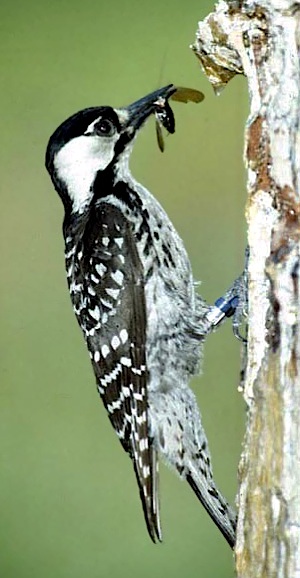
Red-cockaded woodpeckers are relatively common in Congaree. U.S. Forest Service photo.
Red-cockaded Woodpeckers are listed as a federally endangered species. By the time the Endangered Species Act was passed in 1970, the Ivory-billeds were long gone, but the act arrived just in time to save the Red-cockaded.
Slowly, the birds have adapted to trees other than their favored Longleaf Pine, and spotting one among the towering Loblolly Pines of Congaree is not unlikely for the careful observer.
March, April, and May, when the birds are courting and excavating nest cavities, seem to be the best months for finding one in the national park.
Of course, there's more to Congaree's birding scene than woodpeckers. After all, it was designated as a Globally Important Bird Area by the Audubon Society in 2001. Other good sightings this time of year can include the Mississippi Kite, a sharp, diminutive bird-of-prey we northerners don't get to see often enough.
More than 170 bird species have been found in the park, a very respectable number for a park that lacks diversity of habitat, being nearly entirely forested.
Had more parkland like Congaree been established before the rampant development of the early 20th century took place, we may still have Ivory-billed Woodpeckers today. As it is, we need to be content with the eight species of woodpecker we actually can see.
But paddling Cedar Creek through the Congaree floodplain, gawking up at the Loblolly Pines, Bald Cypress, and Tupelo, it's hard not to dream of how things used to be. A black and white bird with a red crest swoops across the creek, and you know it's just a Pileated Woodpecker, a common sight here.
Just for a moment though, a birder could be forgiven for allowing himself to imagine that it was something else. That perhaps the Lord God Bird still patrolled this forest.
Story Categories:
A copy of National Parks Traveler's financial statements may be obtained by sending a stamped, self-addressed envelope to: National Parks Traveler, P.O. Box 980452, Park City, Utah 84098. National Parks Traveler was formed in the state of Utah for the purpose of informing and educating about national parks and protected areas.
Residents of the following states may obtain a copy of our financial and additional information as stated below:
- Florida: A COPY OF THE OFFICIAL REGISTRATION AND FINANCIAL INFORMATION FOR NATIONAL PARKS TRAVELER, (REGISTRATION NO. CH 51659), MAY BE OBTAINED FROM THE DIVISION OF CONSUMER SERVICES BY CALLING 800-435-7352 OR VISITING THEIR WEBSITE. REGISTRATION DOES NOT IMPLY ENDORSEMENT, APPROVAL, OR RECOMMENDATION BY THE STATE.
- Georgia: A full and fair description of the programs and financial statement summary of National Parks Traveler is available upon request at the office and phone number indicated above.
- Maryland: Documents and information submitted under the Maryland Solicitations Act are also available, for the cost of postage and copies, from the Secretary of State, State House, Annapolis, MD 21401 (410-974-5534).
- North Carolina: Financial information about this organization and a copy of its license are available from the State Solicitation Licensing Branch at 888-830-4989 or 919-807-2214. The license is not an endorsement by the State.
- Pennsylvania: The official registration and financial information of National Parks Traveler may be obtained from the Pennsylvania Department of State by calling 800-732-0999. Registration does not imply endorsement.
- Virginia: Financial statements are available from the Virginia Department of Agriculture and Consumer Services, 102 Governor Street, Richmond, Virginia 23219.
- Washington: National Parks Traveler is registered with Washington State’s Charities Program as required by law and additional information is available by calling 800-332-4483 or visiting www.sos.wa.gov/charities, or on file at Charities Division, Office of the Secretary of State, State of Washington, Olympia, WA 98504.


Comments
Thanks for a wonderful article about a great park and an awesome bird, Kirby. I'm one of those people who prefer to believe that the ivory-billed woodpecker is not extinct, just exceedingly rare and elusive. (Remember when almost everybody "knew" that the black-footed ferret was extinct?) Every time I visit Congaree I almost instinctively keep my eyes peeled and my ears cocked for the Lord God Bird. It could be there in Congaree, and that's part of the magic of the place.
And thanks to you, Professor, for being part of the local effort to elevate Congaree to a full-fledged park. It may not have the grand vistas, seashores, or waterfalls a park is "supposed" to have, but I think it's one of the most important pieces of preservation the NPS does. A Top 5 Favorite Unit in the system for me!
I too prefer to believe that the Lord God Bird is not extinct - hope springs eternal!
What a great article.Congaree is a gem.
Danny Bernstein
To set the record straight: While I was happy to see this park redesignated Congaree National Park, I cannot take a shred of credit for it. I was just involved in the effort to establish the park back in the 1970s.
Bob, maybe I was just trying not to age you!
Who knows, that effort in 1970 may have been the even more important one. What matters now is that it's protected...and that Traveler readers who have yet to sample it should book a flight to Columbia.
My fiancee's PhD advisor is the one who published the contoversial Florida sighting Kirby references. Given his birding expertise, I'm pretty hopeful that the Lord God Bird may indeed be a Lazarus Species.
(And Congaree is one of our absolute favorite national parks. Paddling Cedar Creek and camping at Wise Lake along the way--a great weekend!)
While I'm not convinced by any evidence I've seen yet, the people making the claims in Arkansas and Florida are by no means wackos, as justinh references. They are skilled in both birding and ornithology. There have been many reports over the years, but most were from folks of questionable repute and skill. These recent events have certainly been different.
And while I'm still in the camp that's 99.5% sure the species is extinct, I continue to have hope. After all, you can't prove absence, only presence!
1. The trees along Cedar Creek are CYPRESS Trees, not Cedar trees, as the first photo caption states.
2. The statement that "Red-cockaded woodpeckers are relatively common in Congaree" is 100% false. They have only been reported to the eBird database on 2 occasions (1 in 2007 and 1 in 2010) in the past 10 years from within Congaree NP! They have been extremely hard to find in Congaree since Hurricane Hugo in 1989. They are regularly missed on the Congaree Christmas Bird Count.
Nathan Dias, Executive Director, Cape Romain Bird Observatory.
If habitat destruction is "inarguably" the reason for the Ivorybill's decline, how do you explain that there are not still some of them in the Congaree? Why did the birds in the Tensas decline so rapidly while Tanner was studying them, before logging began? Why did many areas of Florida have their Ivorybill populations disappear before logging? Because they were hunted by ornithologists and others to the brink of extinction before loggers even arrived.
Read "The Travails of Two Woodpeckers" if you want to learn more. http://www.amazon.com/The-Travails-Two-Woodpeckers-Ivory-Bills/dp/082634...
The "inarguable" fact of habitat destruction repeated over and over by ornithologists and conservationists in general is just a convenient fiction.
Can anyone confirm or debunk a story I heard years ago concerning the setting aside of the Congaree swamp as The Congaree National park via a ploy to make officials believe there was possibly an Ivory Billed Woodpecker in the future park area. I have heard this story a couple of times over the years. Respond to; [email protected]
When I was stationed at Ft. Jackson SC, I rode my bike to Congaree National Park, May 14,1995. I observed a Ivory-Billed Woodpecker on this date. I tried to report it, but nobody believed me. They stated that I observed a Pilieated Woodpecker. I have observed the Pileated Woodpecker and know the difference between the two species. I have been observing birds for most of my life.