
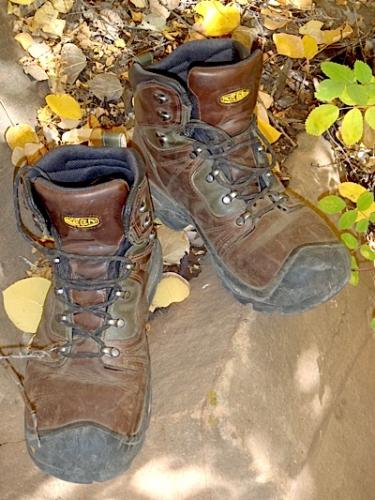
KEEN's Erickson PCT (relaxing after a lengthy trek through Yellowstone) are intended for long-distance treks with a full pack on your back. Kurt Repanshek photo.
The Bechler River Trail approaching Douglas Knob in Yellowstone National Park crosses a wide expanse of grasslands, one that in mid-September we were surprised to find was nearly ankle-deep in water. We were, I came later to find, sloshing through the headwaters of Littles Fork, a tributary of the Bechler River.
Though the trail turned boggy and soggy, it was a perfect test for KEEN's Erickson PCT (MSRP $170), a heavy-weight, full-grain leather boot that was taking over for a pair of midweight, mesh Salomon boots that had lost their water-proofing.
It's been years since I've slipped my feet into a heavy-weight boot, instead opting for the lighter, mesh-lined boots that typically are more comfortable and, with their Gore-Tex or similar linings, can keep your feet dry.
But the Yellowstone trek was envisioned to go roughly 80 miles, climbing up over Grants Pass from Old Faithful, down towards Shoshone Lake before veering to the right and down the tilt that drains Littles Fork, Phillips Fork, and Ferris Fork, among others, into the Bechler River, which practically screams as it wends its way through the park's southwestern corner, and then wrapping east and north before swinging back west to Old Faithful.
I did not want to venture there with a porous boot, no matter how comfy.
Right out of the box, the size 11 boots were a tad hefty (3.4 pounds for a size 9 vs. 2 lbs, 13 ounces for a pair of Salomon Quest 4D GTX), and felt stiff, which wasn't too surprising in light of the full-grain leather uppers. Beneath that upper and out of sight is a liner of KEEN.DRY, the company's proprietary water-proof, and breathable, barrier. Under foot was a thermoplastic urethane shank/thermoplastic urethane torsion plate for stability and protection on rocky trails.
An interesting aspect of the KEENs is their somewhat wide toebox, a roomy enclosure that gives the toes both room to breath and expand when you're under way and pounding the trails with a full pack on your back. A narrow heel cup and somewhat slim midfoot help keep your foot from sliding forward into that toebox and ramming your toes.
Arriving at my doorstep a good month before my departure for Yellowstone, I figured I'd have time to break in the boots and get my feet used to them. I was partially correct. Wearing them around the yard doing chores and up onto the trails of the Wasatch Range for day hikes were pain-free and quickly softened up the uppers.
However, once out on the trail, with a 35-pound pack on, the boots convinced me via some small blisters on my right heel that they still had a little ways to go to be fully broken in.
The solution? During the initial break-in period back home, gradually increase your miles during day hikes and once you think the boots are ready for bigger things to come, add a pack to your back for more day hikes to remove any doubt.
The Ericksons, named for the Leif Erickson Trail in Forest Park in Portland, Oregon (22 miles round trip), proved well-suited for the Yellowstone trek. They were comfortable, survived the slosh past Douglas Knob (8,544 feet) without a leak, and well-protected my toes from those inadvertent rock-kicks on the trail.
If there's something I'd change (aside from taking more time to break them in), it'd be a stouter pair of laces. The ones that came with the boot already are fraying after just a month of use.
Traveler footnote: While Adventure Medical bills its "GlacierGel" blister protection as being waterproof, it doesn't stand up to fording rivers.
Story Categories:
A copy of National Parks Traveler's financial statements may be obtained by sending a stamped, self-addressed envelope to: National Parks Traveler, P.O. Box 980452, Park City, Utah 84098. National Parks Traveler was formed in the state of Utah for the purpose of informing and educating about national parks and protected areas.
Residents of the following states may obtain a copy of our financial and additional information as stated below:
- Florida: A COPY OF THE OFFICIAL REGISTRATION AND FINANCIAL INFORMATION FOR NATIONAL PARKS TRAVELER, (REGISTRATION NO. CH 51659), MAY BE OBTAINED FROM THE DIVISION OF CONSUMER SERVICES BY CALLING 800-435-7352 OR VISITING THEIR WEBSITE. REGISTRATION DOES NOT IMPLY ENDORSEMENT, APPROVAL, OR RECOMMENDATION BY THE STATE.
- Georgia: A full and fair description of the programs and financial statement summary of National Parks Traveler is available upon request at the office and phone number indicated above.
- Maryland: Documents and information submitted under the Maryland Solicitations Act are also available, for the cost of postage and copies, from the Secretary of State, State House, Annapolis, MD 21401 (410-974-5534).
- North Carolina: Financial information about this organization and a copy of its license are available from the State Solicitation Licensing Branch at 888-830-4989 or 919-807-2214. The license is not an endorsement by the State.
- Pennsylvania: The official registration and financial information of National Parks Traveler may be obtained from the Pennsylvania Department of State by calling 800-732-0999. Registration does not imply endorsement.
- Virginia: Financial statements are available from the Virginia Department of Agriculture and Consumer Services, 102 Governor Street, Richmond, Virginia 23219.
- Washington: National Parks Traveler is registered with Washington State’s Charities Program as required by law and additional information is available by calling 800-332-4483 or visiting www.sos.wa.gov/charities, or on file at Charities Division, Office of the Secretary of State, State of Washington, Olympia, WA 98504.


National parks and their natural resources belong to you. The National Parks Traveler works to ensure you know how these essential places are being cared for.
Sign Up For Our Weekly Newsletter
Unsubscribe at any time.
INN Member

The easiest way to explore RV-friendly National Park campgrounds.

Here’s the definitive guide to National Park System campgrounds where RVers can park their rigs.
Our app is packed with RVing- specific details on more than 250 campgrounds in more than 70 national parks.
You’ll also find stories about RVing in the parks, tips helpful if you’ve just recently become an RVer, and useful planning suggestions.


Comments
I wish I had your Job.
It's really more of an avocation, I'm afraid....
I have been to the Bechler Corner once, but only got to experience from Cave falls to Bechler Falls. I was amazed at how thick the forest was at one point. After reading more about the falls in the area and seeing your photo of Colonnade Falls on the Bechler River, I look forward to one day going back and seeing more. For now, I enjoy reading about your adventures.
David, I'm working on a longer piece about our hike. Hope to have it ready for next Friday. That region of the park really is amazing, so totally unlike the rest of Yellowstone.
Just for full disclosure, do you get free samples of items to review, or did the funds come out of your own pocket? Just curious.
I've been thinking of getting a pair of old fashioned heavy duty Norwegian welt boots. Merrell still sells them (made in Italy no less), but my local REI store said they would have to order them. I've seen a few interesting ones from Scarpa.
It varies, y_p_w. Some are demos, as were these boots, some I pick up on my own. Frankly, if gear reviewers had to buy every item to demo, not sure they could afford to do it.
I am looking at buying these boots to replace a pair of Danner mid highs I love. I twisted both of my ankles on a recent trip doen and up the Grand Canyon on 1 day and am still recovering. Looking for a really good over the ankle boot. Found these at my REI and am looking for advice.