
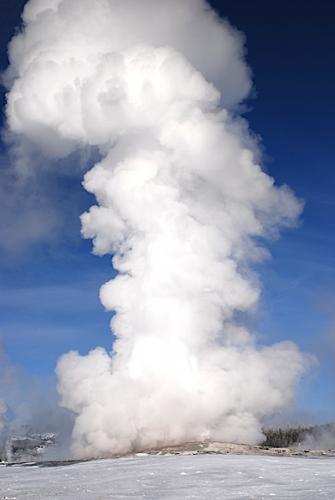
More studies are needed before Yellowstone officials can endorse a long-term plan for winter-use in the park. Old Faithful in winter by Kurt Repanshek.
Yellowstone National Park officials did not fully examine all aspects of winter-use impacts in the park and will delay implementing a final winter plan while more studies are conducted, Superintendent Dan Wenk said Thursday.
While those studies go on, temporary guidelines allowing as many as 318 snowmobiles and 78 snowcoaches per day in the park will remain in effect for the coming winter, he said.
“This has been a very long, arduous process that’s been expensive. And that’s part of my rationale for trying to make sure that we get this right," Superintendent Wenk said during a media conference call. "We could have made a decision to try to plow it ahead and try to fix the issues that came up in public comment. I didn’t believe it was the most prudent way to go.
"I believe the way that we’re proceeding now recognizes the questions, or honors the process of public comment in bringing issues to our attention, and I think it’s the most efficient, most cost-effective way to move forward to try to bring this to a conclusion that will have a sustainable result," the superintendent said.
For more than a decade, at a cost "in excess of $10 million," Yellowstone officials and staff have been trying to develop a feasible winter-use plan that suits both those in favor of recreational snowmobile use in the park and those who believe snowmobiles should be blocked from entering the park. Lawsuits, threats of them, and politics time and again have forced the park staff back to the drawing board.
The latest effort produced a Draft Envionmental Impact Statement of more than 550 pages with seven alternatives ranging from no over-snow visitor traffic in the winter to a variety of mixes of oversnow traffic. But problems with the underpinnings of those alternatives led the superintendent to call for more studies on items ranging from air quality and soundscapes to "best availability technology" requirements for snowcoaches and continued access over Sylvan Pass.
"The public comment period did exactly what we hope public comment will do in a process like this, in that it identified issues that were not addressed as fully as they should be perhaps, or brought to our attention issues that we did not consider," he said.
"Bottom-line, all those things point to the fact that we are not able to get a long-term decision in place prior to the the '11 and '12 winter-use season," said Superintendent Wenk.
The new goal, he said, is to get a long-term plan ready to go for the 2012-13 season.
Among the unresolved questions, Superintendent Wenk said:
* He wanted to know how noise from snowmobiles and snowcoaches actually occurs. "What I’m asking is, is there a better way to look at the size of groups, how many snowmobiles should be allowed per group that enters, should we have snowmobiles travel in groups, or should we have them individually?" he said.
* More work is needed to determine the consequences of keeping Sylvan Pass safely open for over-snow traffic. “There were a lot of questions raised, and we need to do a further analysis of the impacts that are from the actions that we take on Sylvan Pass in terms of to bring down the avalanches," he said. "There were a lot of questions raised about the impacts on wildlife by those actions that we think we need to do further analysis. Whether that will change the outcome or not, I’m not making a predetermination on. But we believe that we have to have more analysis.”
* Park staff did not consider impacts on air quality and soundscapes using 2010 fleet data. "We did not use the right modeling, and so we are going to go back and fix that," the superintendent said.
* Park staff is uncertain whether sound levels prescribed for "best available technology" snowcoaches are achievable.
* The DEIS did not examine the impacts of allowing non-commercially guided snowmobile trips.
The park received comments from nearly 59,000 individuals, and within those there were roughly 179,000 specific comments concerning winter-use in Yellowstone, officials said. Of those, 82,362 specifically called for snowcoach-only travel in the park, they said.
Story Categories:
A copy of National Parks Traveler's financial statements may be obtained by sending a stamped, self-addressed envelope to: National Parks Traveler, P.O. Box 980452, Park City, Utah 84098. National Parks Traveler was formed in the state of Utah for the purpose of informing and educating about national parks and protected areas.
Residents of the following states may obtain a copy of our financial and additional information as stated below:
- Florida: A COPY OF THE OFFICIAL REGISTRATION AND FINANCIAL INFORMATION FOR NATIONAL PARKS TRAVELER, (REGISTRATION NO. CH 51659), MAY BE OBTAINED FROM THE DIVISION OF CONSUMER SERVICES BY CALLING 800-435-7352 OR VISITING THEIR WEBSITE. REGISTRATION DOES NOT IMPLY ENDORSEMENT, APPROVAL, OR RECOMMENDATION BY THE STATE.
- Georgia: A full and fair description of the programs and financial statement summary of National Parks Traveler is available upon request at the office and phone number indicated above.
- Maryland: Documents and information submitted under the Maryland Solicitations Act are also available, for the cost of postage and copies, from the Secretary of State, State House, Annapolis, MD 21401 (410-974-5534).
- North Carolina: Financial information about this organization and a copy of its license are available from the State Solicitation Licensing Branch at 888-830-4989 or 919-807-2214. The license is not an endorsement by the State.
- Pennsylvania: The official registration and financial information of National Parks Traveler may be obtained from the Pennsylvania Department of State by calling 800-732-0999. Registration does not imply endorsement.
- Virginia: Financial statements are available from the Virginia Department of Agriculture and Consumer Services, 102 Governor Street, Richmond, Virginia 23219.
- Washington: National Parks Traveler is registered with Washington State’s Charities Program as required by law and additional information is available by calling 800-332-4483 or visiting www.sos.wa.gov/charities, or on file at Charities Division, Office of the Secretary of State, State of Washington, Olympia, WA 98504.


National parks and their natural resources belong to you. The National Parks Traveler works to ensure you know how these essential places are being cared for.
Sign Up For Our Weekly Newsletter
Unsubscribe at any time.
INN Member

The easiest way to explore RV-friendly National Park campgrounds.

Here’s the definitive guide to National Park System campgrounds where RVers can park their rigs.
Our app is packed with RVing- specific details on more than 250 campgrounds in more than 70 national parks.
You’ll also find stories about RVing in the parks, tips helpful if you’ve just recently become an RVer, and useful planning suggestions.


Comments
I'd be embarrassed if I were the project manager for this one.
But I guess this is the kind of project few people would want to lead.
Dan Wenk has a reputation for solid thinking. This has been a politically charged bombshell for many years, and it certainly seems very wise to take whatever time and effort may be required to find not just a good solution, but one that is excellent.
If decisions are backed by solid scientific data and not merely opinion, they will better stand the test of time. The toughtest part of it will be resisting pressure from politicians and powerful special interests.
And, Matt, when anyone is tasked with something as complex and contoversial as this one, there should be no need for any embarrassment by anyone who gave it their best shot.
Lee, it doesn't sound like this was just the typical BS derailing this project. And I'm not trying to single out the IDT lead. I'm sure they did their best. I've only led projects perhaps 1/10th this complicated and controversial, so I can only imagine what they had to go through.
Perhaps I'm misinterpreting what the article is saying, but after 10 years, 550 pages of EIS and seven alternatives, what came up in this latest round of public comment that made them realize the DEIS was insufficient? It was profound enough to send the project back to the start/middle but it wasn't something they could foresee and address from the start?
I am proud of the park for doing what it said it would do. It listened to the public (some 60,000 public comments) and identified some areas where it can make a sounder and better decision. Like all the public comment processes conducted over the last decade on the subject of winter use in Yellowstone, this latest process has shown that an overwhelmiong percentage of Americans want the NPS to assure that Yellowstone receives the best possible protection. If it takes more work for the NPS to finalize a plan that honors this strong public desire and ensures that the very best science is guiding Yellowstone's stewardship, it's a worthwhile investment.
I really believe that Superintendent Wenk wants Yellowstone to produce the best decision possible and is willing to do what it takes, including this delay, to assure that the plan meets Director Jarvis' three principles upon which he says decisions must be based: accurate fidelity to the law and policy; the best available sound science and scholarship; and in the long-term public interest.
Rick