
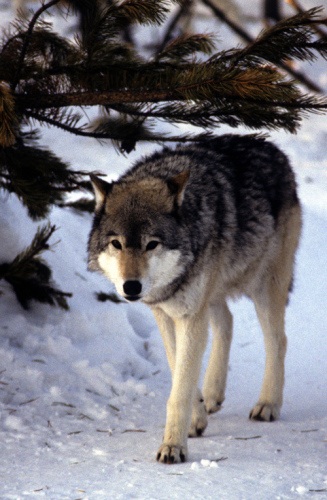
The outcome of wolf meetings today between Interior Secretary Ken Salazar and Wyoming Gov. Matt Mead will tell a lot about the environmental integrity of the Obama administration and the political moxie of the governor. Kurt Repanshek photo.
Earlier this spring, I met with Jon and Deb Robinett, managers of Steve Gordon’s historic ranch, the Diamond G, up the Dunoir Valley near the northeast corner of Grand Teton National Park.
It was an insightful interview as I prepared a story on wolves that recently appeared in the Christian Science Monitor.
As of May, neither Gov. Matt Mead nor his wolf envoy, Steve Ferrell, had made any attempt to contact the Robinetts about their experiences living with lobos. A curious snub, since Gov. Mead has dispatched Mr. Ferrell to solicit opinions from informed stakeholders. He’s crafting a wolf management plan that can pass muster with the federal government.
On Thursday the governor is meeting in Cheyenne with Interior Secretary Ken Salazar and the new director of the U.S. Fish and Wildlife Service, Daniel Ashe. The expressed goal of the meeting is "to continue discussions on developing a sound, science-based wolf management plan for the state."
A prevailing perception is that Mr. Ferrell, former head of the Wyoming Game and Fish Department, has only sought opinions that he and the governor want to hear; that Gov. Mead has no intention of backing statewide trophy game status for wolves. Some say he’s fearful of losing face among anti-wolf hardliners.
That’s unfortunate; it only exposes the folly of macho stubbornness.
In neighboring Montana and Idaho, where wolves are classified as wildlife, not vermin, the federal government approved state management plans and wolves today are delisted.
In Wyoming, Gov. Mead and Mr. Ferrell are said to be pushing a “flex plan.” Wolves would sort of be professionally managed in a portion of western Wyoming at certain times of year, but otherwise subject to slaughter across most of the state.
Wolves, according to a law supported by the Wyoming legislature, could be killed by almost any means, at any time of day, in any month, for any reason—even when they are having zero discernible negative impacts on wildlife or livestock.
Never before has the American public spent years and money recovering a species only to sanction its immediate re-annihilation. The eyes of America will be closely watching Secretary Salazar’s move, and many believe the environmental integrity of the Obama administration will ride on whether he accedes to Gov. Mead’s demands.
Respected scientists tell me Wyoming’s flex scheme is “harebrained” and unsupported by any credible science, rivaling Montana’s widely-condemned method of dealing harshly with wandering Yellowstone National Park bison.
The Robinetts have lost family dogs, horses and cows to wolves, but they are not advocating that lobos be wiped out. They pragmatically favor trophy game status in Wyoming as the surest way to achieve delisting.
Insiders say the reason Gov. Mead continues to dig in his boot heels is that he’s afraid of burning political capital, even though he knows trophy game status is the right thing to do. In fact, trophy game was the recommendation made more than a decade ago by Wyoming’s top official carnivore experts.
Besides the Robinetts, there’s someone else—a venerable Wyoming sage— whose knowledge the governor and Mr. Ferrell also have evaded. This individual is a beloved figure in Jackson Hole who lived a good portion of her life in Grand Teton National Park. Her name: Louise Murie MacLeod, whose husband, the eminent wildlife biologist Adolph Murie, courageously led America out of the dark ages of predator extermination that Gov. Mead now stands on the precipice of possibly re-entering.
Now in her 99th year, Weezy, a botanist, is sharp of mind and memory. One would think Gov. Mead might pay her a visit. She was, after all, a contemporary of the governor’s late grandfather, Cliff Hansen, a former Wyoming governor and U.S. senator.
Mr. Hansen taught his family to respect the wisdom of elders. Weezy’s perspective, in terms of longevity, is unmatched. She could educate Gov. Mead about courage and the bitter backlash that comes when people say truthful things the political status quo doesn’t want to hear.
While unpopular in the day, Weezy and the Murie clan nobly fought to preserve Grand Teton for future generations. They also spoke out against the irrational cultural hatred of wolves and grizzlies, and they presciently identified the enduring value—economic, spiritual, and biological— of wild ecosystems.
Over decades, as Ade Murie meticulously assembled field notes as part of his biological research, it was Weezy, near Grand Teton headquarters at Moose, who typed them onto paper. Ade Murie’s insights were published in a pioneering study of Yellowstone coyotes, and in two classic books, The Wolves of Mt. McKinley and The Grizzlies of Mt. McKinley.
Mr. Ferrell, Gov. Mead, and Secretary Salazar ought to give them a read. Between Weezy and the Robinetts, there isn’t a citizen trio alive in Wyoming today that better grasps the real reality—not the fairy tale depictions— of wolves.
Gov. Mead, grandson of a rancher who fought the expansion of Grand Teton Park but admitted later he was wrong, finds himself in a similar bind with wolves.
Wyoming long ago could have had a delisted wolf population if leaders had listened to the state’s top Game and Fish Department expert, Dave Moody, who advised trophy game status Wyoming-wide. Instead, Mr. Moody was muzzled.
Gov. Mead can continue to placate anti-conservation, wolf-despising citizens as a way to remain popular or, observers say, he can stiffen his spine and be a solutions-oriented leader. The path he and Secretary Salazar take with wolves will reveal much about the character and integrity of both men.
Story Categories:
A copy of National Parks Traveler's financial statements may be obtained by sending a stamped, self-addressed envelope to: National Parks Traveler, P.O. Box 980452, Park City, Utah 84098. National Parks Traveler was formed in the state of Utah for the purpose of informing and educating about national parks and protected areas.
Residents of the following states may obtain a copy of our financial and additional information as stated below:
- Florida: A COPY OF THE OFFICIAL REGISTRATION AND FINANCIAL INFORMATION FOR NATIONAL PARKS TRAVELER, (REGISTRATION NO. CH 51659), MAY BE OBTAINED FROM THE DIVISION OF CONSUMER SERVICES BY CALLING 800-435-7352 OR VISITING THEIR WEBSITE. REGISTRATION DOES NOT IMPLY ENDORSEMENT, APPROVAL, OR RECOMMENDATION BY THE STATE.
- Georgia: A full and fair description of the programs and financial statement summary of National Parks Traveler is available upon request at the office and phone number indicated above.
- Maryland: Documents and information submitted under the Maryland Solicitations Act are also available, for the cost of postage and copies, from the Secretary of State, State House, Annapolis, MD 21401 (410-974-5534).
- North Carolina: Financial information about this organization and a copy of its license are available from the State Solicitation Licensing Branch at 888-830-4989 or 919-807-2214. The license is not an endorsement by the State.
- Pennsylvania: The official registration and financial information of National Parks Traveler may be obtained from the Pennsylvania Department of State by calling 800-732-0999. Registration does not imply endorsement.
- Virginia: Financial statements are available from the Virginia Department of Agriculture and Consumer Services, 102 Governor Street, Richmond, Virginia 23219.
- Washington: National Parks Traveler is registered with Washington State’s Charities Program as required by law and additional information is available by calling 800-332-4483 or visiting www.sos.wa.gov/charities, or on file at Charities Division, Office of the Secretary of State, State of Washington, Olympia, WA 98504.


Comments
Integrity? Just another word that the President would like attached to himself (without basis). I don't know much about Gov. Matt Mead but the "political moxie" description? The Governor is up against "Mr. Political." The most kind word of many that come to mind. Respectfully
Slaughter and annihilation - strong hyperbole and of course inaccurate. A federal judge has made it clear that the FWS requirement that the entire state of Wyoming be managed as trophy game was arbitrary and capricious. No science to support it.
Dear "Anonymous": Why don't you have the courage to at least use your real name when leaving a post? Trophy game was not ruled "arbitrary and capricious" by all federal judges; in fact only in the court that Wyoming chose to litigate. Moreover, trophy game status was supported by both professional scientists with the U.S. Fish and Wildlife Service and, originally, the professional scientific experts within the Wyoming Game and Fish Department who were muzzled to comform to anti-wolf politics. In fact, a different federal judge found Wyoming's plan to be biologically arbitrary and capricious. "Slaughter" and "annihilation" in carrying out a reduction of wolf numbers—by any means possible—over much of the state, as now mandated by the state legislature, isn't a hyperbolic term. Last time around when wolves were delisted only a few years ago in Wyoming, if you remember, a pair of men in Sublette County ran wolves down on snowmobiles and killed them by driving their machines over the top of them. Will the past be prologue for how wolves are "managed" in the future beyond a relatively small area, outside of Yellowstone in the western third of the state? I would love to get my eyes on a copy of the scientific peer review informing Governor Mead's flex plan. The problem is that it doesn't exist.
Dear Mr. Wilkinson,Just a little "Fair and Balance" added here if you don't mind. Maybe Anonymous isn't fishing for street cred to appeal to the New York Liberals that might trip over themselves to contribute to this or other "small non-profits." The visual of someone running over a wolf with their snowmobile is, I believe, on par with what a pack of wolves do on a daily basis to their preferred dinner au jour. I do know they take a lot more elk and moose than they do lady joggers referring to the young lady jogger at Chignik, Ak. If you are going to get all teary eyed you might shed a little for the other unfortunates in the food chain. Not sure if I pushed the envelope here to being accepted in polite conversation but it's sure as heck, real!
BOISE, Idaho (July 7, 2011) - U.S. Department of the Interior Secretary Ken Salazar tentatively agreed today to a wolf management plan for Wyoming that will allow wolves to be shot on sight across most of the state. In a joint press conference with Wyoming Gov. Matt Mead and U.S. Fish and Wildlife Service Director Dan Ashe, Sec. Salazar said the Interior Department “agrees in principle” to allowing wolves to be killed without a permit for most of the year across most of state.
Random Walker, I took a look at that release from Defenders, and then took a look at the governor's release, and it seems that Defenders took a little leeway with its interpretation. The release I read from Wyoming didn't mention anything "about wolves being shot on sight across most of the state," let alone Salazar agreeing with that.
Here's what seems to be the key passage from the state's release:
Exactly what Salazar agreed to remains a bit murky, at least in the state's release.
How can we contact Mr.Salazar to give an opinion about the wolf situation??
"Westerner", I'll say the same to you that I said to "Anonymous": Have the courage to use your real name. Let readers know who you are and what your credentials/bias are to comment. Stop being a troll. You may find it noble that people run down wolves on snowmobiles and kill them with their machines for the sure thrill of it. You also seem compelled to make exaggerated claims about wolves. I have written about wolves as a journalist for a quarter of a century and stand behind the information I present. Let us again revisit basic facts: 1. Regarding the risks wolves pose to human safety (so small, confirmed by hundreds of years of history, as to NOT be considered a real threat to humans in the woods); 2. Re: Impacts on wildlife and livestock: significant in some areas, not so in others, again confirmed by scientific facts. In my childhood province of Minnesota, where today there are several million people living in a state with nearly 4,000 wolves and, in prime wolf country, 12,000 farms, few people there resort to the kind of wolf hysteria or cower in fear as Westerners do. No farmers have been driven out of business by wolves or come even close to it and decades of scientific study shows that wolves are not killing off game animals. In the West, there needs to be honest, rational conversations about real wolves, not the mythological, imagined kind floating around in human imaginations. Environmentalists, too, need to make an honest acknowledgment of real wolf impacts. In this new age of blogging, part of the problem on net-based forums are people able to write under anonymous identities and pseudonyms, making claims that cannot be substantiated and are seldom fact-checked by the site host (Kurt Repanshek, here, being an old Associated Bureau chief does an excellent job of weeding out trolls). Free speech ought to be based on truth. Many anonymous commentators simply say things to stir up trouble. This happens less in newspapers because people who pen letters to the editor have to sign their names to what they write and can be held accountable. I think there would be a lot less hyperbole and we'd have a lot more meaningful conversations about wolves, if people had the courage to stand behind their real identities and their own words. So "Westerner," stop being a troll and step into the light of day where we can see your eyes. Then let's have an honest chat about wolves.
I am so tired of AP and other "news" media reporting that "wolves may be shot on sight" outside YNP, GTNP and some wilderness areas.
READ THE WYOMING STATUTE: 23-3-103(a) which states predatory animals (in Wyoming, the wolf is classified not as wildlife, but as a predator) may be taken "in any manner and at any time."
In other words, where wolves are not protected in Wyoming, they may be killed IN ANY MANNER YEAR-ROUND: they may be run over by snowmobiles, pups in their dens may be burned alive with gasoline, shark hooks may be baited and hung from trees in order to catch a wolf through it's mouth, their leg tenons may be cut and dogs allowed to shred them alive and so on. These methods, and others, have been used in the past and will be used in the future if the law is not changed.
If you're outraged that the feds would even remotely consider accepting the above methods of killing wolves, which they have, and then delist them in Wyoming, I suggest you raise hell with your Congressional reps.
Mr. Wilkinson:I understand your frustration, I do but you do a disservice to this site when you reference anonymous contributions. I would be willing to put up some money on a bet that there is more truth being presented here by Anon's than.....say 90% of mainstream media and certainly 99.++++% of our President. I mean documented. Seem like things really started going down hill was during king TROLL himself who made lying kinda cute and something our kids could adopt to get what they want, much easier than the hard way of humbled truth. I suspect we might have more in common than one would think. I guess I should feel honored that I wasn't weeded out which gives a certain amount of validation. I will say that I believe there should be a more civil and respectful conversation dealing with non-politically motivated managers. The people on the ground rather than the likes of many eco-terrorists that seek to just destroy the private sector because their stuck in their arrested development and paid to stay there. Gotta roll but would like to visit more. But Trolls? One just has to look to Washington DC. People their define the word and they think they know best, lol!
"Westerner": If you are unwilling to stand behind your own words with your own name, and must make excuses to justify using a pseudonym, it says much about your lack of confidence in being associated as a real person with what you write or say. Are you ashamed to have people know who you are? Why are you a coward?
Okay, Mr. Wilkinson, I'll out myself. I'm Nancy Pelosi, geez. You couldn't have gotten rid of Richard Nixon without Deep Throat. He a coward, troll? Kurt has a very good site here where many can get a significant amount of truthful dialogue or at least be on your way to it by being able to be post without some thought police ruining one's career. Referencing our President, "We reward our friends and punish our enemies." Need I say anything more? Great site, Kurt, cowards, trolls and all:).
Thanks Todd
The bottom line here is why have we spent the time and money to help the wolf population recover, to only kill them off? Regardless of what number is set as an "appropraite" number of wolves, we have brought them back into this ecosystem (successfully) only to kill them off. Seems kinda sadistic, don't ya think? The hysteria over wolves blows my mind, why must we dominate the land, why can't we live within it? Of course the number one way to solve this problem out west, along many other wildlife related issues...stop eating beef! Cows have more control over humans than we would like to admit.
Not everyone can (or want to) shuffle paper and b.s. for a living. Serious parallel universe we're talking about. Is that what NPS is cultivating or benefits from? Living in the extremes is not reality. Kill them all or save them all into perpetuity? Why don't we just ALL get off the planet and everything will be just fine:). There's a lot of humbling and breakthroughs (hopefully) in our horizon, lol!
they're simply wild creatures doing what's in their nature, as they've done for centuries. some are just too quick to rule 'kill' as a quick solution to just about anything anymore. there are too many humans populating the world, just because there wolves, and have gotten' bad stigma of the years doesn't mean the should be wiped off the planet. at this rate, we'll be extremely lucky, if that, to have any wild life left in the world. let the wild be wild. how about these farmers', and citizens build better barriers' to protect their livestock, and pets from the wolves, and other dangerous wild creatures, and maintain those barriers', and not cause more needless death of what's left of the wilds of this planet.