
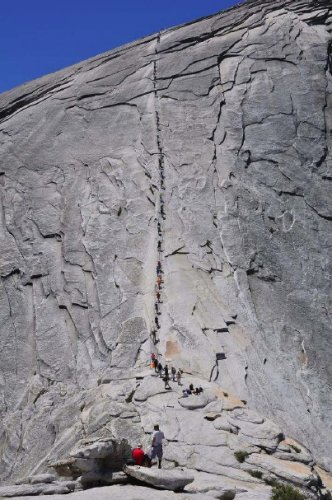
Overall safety for those hikers heading to the summit of Half Dome apparently was not enhanced by a permit system implemented for weekend and holiday hikers, according to a review of last summer's hiker traffic. NPS photo.
A permit system implemented for hikers heading to the summit of Half Dome in Yosemite National Park does not appear to be improving overall safety conditions, according to a report that analyzes this past summer's hiking numbers.
While the permit system for folks hoping to summit Half Dome on weekends and holidays did indeed tamp down those crowds, it also had the "unintended consequence" of moving the crowds to weekdays, when permits are not required, according to a review of hiker traffic.
In the end, the study concludes, "these results suggest that the objectives of visitor safety and acceptable experiential conditions on the cable route cannot be provided with a daily visitor use permit system implemented only on some, but not all, days of the week."
Half Dome long has attracted throngs of hikers -- some experienced, some not, some well-equipped for the task, some not -- and at times there have been accusations that the heavy, unregulated traffic to the top of the iconic dome has played a role in some accidents on the dome's steeply pitched shoulder.
Yosemite officials currently are working on a long-term management plan for the route to the top of Half Dome, but until that is in place they have instituted a permit system for Fridays, Saturdays, Sundays, and federal holidays whenever the cables are up. That system restricts to 400 the number of permits that can be issued for any one of those days.
This past summer the average number of hikers heading up Half Dome on weekends was right about 300 per day, a tally nearly 100 fewer than the average weekday traffic load of 416 hikers noted during the 2008 season, according to the Half Dome Trail Visitor Use Monitoring Report just released by the park.
Weekday use, however, witnessed a sizable increase, averaging 635 hikers per day, a rate approaching weekend traffic (about 692/day) on Half Dome in 2008 and much greater than the 2008 weekday average of 416 hikers per day, the report noted.
"Thus, it appears that an unintended consequence of the permit system was the interchange of use levels from weekend to weekdays," the authors wrote.
And those weekday numbers exposed many hikers to potentially dangerous crowding on the 400-foot cable-assisted route to the top of the dome, the very situation park officials hoped to alleviate on weekends, which historically saw the heaviest hiker traffic, with the permit system.
The monitoring report (attached below) noted that an "unimpeded visitor travel" threshold of just 30 people at any one time on the cables leading up the dome's shoulder was exceeded 15 percent on weekends under the permit system, but that on weekdays when permits were not required that limit was surpassed 65 percent of the time.
A higher "threshold," of 70 people on the cables at any one time, a number "when visitors perceive safety issues and unacceptable experiential conditions," was not exceeded on sampled weekend days, but was surpassed almost a quarter of the time on weekdays, the report added.
The busiest day on the way to the top of Half Dome appears to be Mondays, when an average 732 hikers headed up Half dome, the report notes. The slowest days were Sundays, when the average was just shy of 275 hikers.
Not surprisingly, in light of the increased number of hikers on non-permit days, those who either avoided the permits or couldn't get one spent more time on the cabled route to the summit than those who landed permits. On permit days those heading up the route, arguably the scariest and most dangerous part of the hike, spent 28 minutes working their way to the summit, while on non-permit days hikers spent nearly 41 minutes, on average, on the cables, the report points out.
And yet, those who spent the most time getting to the summit of Half Dome on average spent a shorter amount of time there (48 minutes, 235 seconds) than those with permits (52 minutes, 54 seconds) who reached the top more quickly.
The difference in traffic on permit days vs. non-permit days also had a tremendous effect on hikers traveling the roughly 3 miles of trail from Nevada Falls to Half Dome Junction. While permit days placed 68 hikers per hour on this segment, on non-permit days that number ballooned to 117 hikers per hour, according to the report.

Story Categories:
A copy of National Parks Traveler's financial statements may be obtained by sending a stamped, self-addressed envelope to: National Parks Traveler, P.O. Box 980452, Park City, Utah 84098. National Parks Traveler was formed in the state of Utah for the purpose of informing and educating about national parks and protected areas.
Residents of the following states may obtain a copy of our financial and additional information as stated below:
- Florida: A COPY OF THE OFFICIAL REGISTRATION AND FINANCIAL INFORMATION FOR NATIONAL PARKS TRAVELER, (REGISTRATION NO. CH 51659), MAY BE OBTAINED FROM THE DIVISION OF CONSUMER SERVICES BY CALLING 800-435-7352 OR VISITING THEIR WEBSITE. REGISTRATION DOES NOT IMPLY ENDORSEMENT, APPROVAL, OR RECOMMENDATION BY THE STATE.
- Georgia: A full and fair description of the programs and financial statement summary of National Parks Traveler is available upon request at the office and phone number indicated above.
- Maryland: Documents and information submitted under the Maryland Solicitations Act are also available, for the cost of postage and copies, from the Secretary of State, State House, Annapolis, MD 21401 (410-974-5534).
- North Carolina: Financial information about this organization and a copy of its license are available from the State Solicitation Licensing Branch at 888-830-4989 or 919-807-2214. The license is not an endorsement by the State.
- Pennsylvania: The official registration and financial information of National Parks Traveler may be obtained from the Pennsylvania Department of State by calling 800-732-0999. Registration does not imply endorsement.
- Virginia: Financial statements are available from the Virginia Department of Agriculture and Consumer Services, 102 Governor Street, Richmond, Virginia 23219.
- Washington: National Parks Traveler is registered with Washington State’s Charities Program as required by law and additional information is available by calling 800-332-4483 or visiting www.sos.wa.gov/charities, or on file at Charities Division, Office of the Secretary of State, State of Washington, Olympia, WA 98504.


Comments
I am 100% in favor of 'every day' using the permit system. Talking to lots and lots of visitors during both the weekend and the week days last season gave me the impression of how much more enjoyable the experience was with a permit. Just because it is there does not mean we have to continue to allow unlimited access, jeopardizing both experienced and unexperienced hikers/climbers. It is also unfair to search and rescue groups, who will respond to accidends, especially with the local clinic having problems of their own.
Dawn
Did you talk to any of the people who were denied the experience because they could not get a permit? Did you talk to the people who planned appropriately on non permit days and were able to have a perfectly wonderful experience?
I was predicting that average weekday traffic up the cables was going to be more than the average weekend traffic. It wasn't that hard to figure out - that those who would make this trip on short notice (or who couldn't secure a permit) would shift to the non-permit days. If they really want to do something, they''ll need permits for all days that the cables are up.
The safety issue is nonsense -- the overall record on the cables is far, far better than the record, for example, of the Merced River, which is by far the worst "killer" in the park (if you don't count automobiles). More people have died going over the various waterfalls. This is just another example of the NPS trying to intrude more and more into park visitor's -- strike that -- make that park OWNER's experience. If they must have a permit system then the permits should be sold (say, $50 a piece) and the money spent in the park.
The NPS is trying to preserve and manage Half Dome, as per the requirements set forth in their Organic Act, not trying to intrude on visitor experience. Yes, we as the public are the owners, but that does not mean that we are the managers. The general public, left to their own wills, are likely left unsafe and unwilling to preserve this amazing experience for future generations. I do agree that permits should be more pricey and should be implemented for every day if they want to make a real difference in hiker traffic.
~Concerned Natural Resource Student
Ray has seriously good points. Since 1919 when the cables were put up, only 2 people have fallen to their deaths when the cables are up for summer use. One in June 2007 can be attributed to fatigue and exhaustion. The other death was in June 2009 and was a direct result of weather. A woman fatally fell in Nov 2006 when the cables were laid down for the winter and the rock was wet; the same thing happened to a woman in April 2007 - same scenario. 2010 saw no fatalities – so the permits worked (?). Considering upwards of 50,000 do the hike annually, the record is very good. Many people just do not belong there – this is an extremely strenuous hike and the number in tennis shoes with little water and no preparation is amazing. But we cannot legislate stupidity. We can plan on permits everyday in 2011. Expensive permits would eliminate the “day skiers” who grab a 12-oz water bottle and head up.
Looks like permits will be necessary for every day in 2011. A daily limit of 400 will make for a safer and more enjoyable experience. They should continue to be free, and there should be 100/day available without an advance reservation. The permit process can weed out unprepared hikers by informing hikers of recomended equipment and physical readiness.
I'm not sure that a permit system is the best solution. However, if a permit system is going to be used then some sort of fee structure makes a lot of sense.