
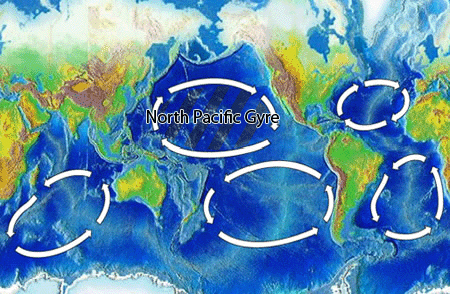
The North Pacific Gyre. Photo via Wikipedia.
An enormous trash-laden vortex in the North Pacific Ocean delivers plastic debris to Hawaiian Archipelago shorelines, making beach cleanups a never-ending task at Kalaupapa
National Historical Park. Like the urban-industrial air pollution that drifts downwind to afflict many mainland national parks, the marine debris that drifts into the Hawaiian parks from this trashy gyre is an unwelcome invader that the park is helpless to exclude. That's not to say that the problem is insoluble.
Kalaupapa National Historical Park is located on Molokaʻi, a small island just north of Maui. The park was established in 1980 to preserve and interpret the remains of the Kalaupapa Leper Settlement (a National Historic Landmark) and related facilities that were operated from 1866 to 1969 for the care and treatment of Hawaiians suffering from Hansen's disease (leprosy).
Historically known as leper colonies, such settlements were typically situated in remote places in order to isolate victims from the general populace as much as practicable. The northern coast of Molokai's Kalaupapa Peninsula certainly was -- and is -- a remote location. The Kalaupapa settlement sits on a narrow strip of land at the base of cliffs that soar more than 3,000 feet above the sea (roughly the height of Yosemite's El Capitan) and render the place utterly inaccessible by road. At peak operation, Molokai's Hansen's disease settlement was home to around 1,200 men, women and children who lived in what amounted to an island prison.
Marine Trash Comes Ashore
The rest of the world may have a tough time traveling to Kalaupapa, but trash from the rest of the world does not. A single beach cleanup at Kalaupapa National Historical Park last year yielded 300 pounds of trash. This trash, mostly plastic debris, originated far away and was delivered to these shores by wind and waves. It is a common occurrence in many years, and it doesn't happen in just this tiny corner of the Hawaiian Archipelago. On the surfer's paradise that is the north shore of O'ahu, the beach cleanups during 2009 -- representing the collective efforts of 474 volunteers -- yielded four tons of trash and 89,253 separate debris items. Elsewhere, untold amounts of trash continue to wash ashore, much of it ending up in hard-to-get-to places.
The North Pacific Garbage Patches
The source of this shoreline trash is a marine zone that has been dubbed the "East Pacific Garbage Patch," and the delivery system is a set of ocean currents and winds called the North Pacific Subtropical Convergence Zone (STCZ). Most Americans have never heard of these phenomena, or of the problems associated with them, but there's a good chance we'll all be hearing a good deal more about them in years to come.
Over the oceans in subtropical latitudes there are high pressure cells -- great masses of subsiding air -- that move with the seasons, shifting poleward in summer and equatorward in winter. Wind and water currents associated with these high pressure cells move counterclockwise, creating gyres (vortexes) of gigantic size. The North Pacific Subtropical Gyre covers millions of square miles of the North Pacific. Similar gyres exist in the South Pacific, the Indian Ocean, and both the North Atlantic and the South Atlantic.
The North Pacific Subtropical Gyre is actually two great vortexes. One lies to the east and north of the Hawaiian Archipelago (that is, in the direction of California) and the other lies to the west and north (stretching in the direction of Japan.) Both trap huge amounts of floating trash that has been washed or thrown into the sea. The two gyres are commonly referred to as the East Pacific Garbage Patch and the West Pacific Garbage Patch.
Plastic debris is especially abundant because it floats well and is very slow to degrade. However, nobody really knows how much of what kind of trash is in these oceanic garbage patches, or even how much area the patches cover. In fact, the name “garbage patch” is misleading. The trash concentrations are mobile, and also lack clear definition and uniformity. Most of the debris is so small it can't be seen from boats or via satellite imagery and aerial photographs. The water in the gyres also contains high concentrations of chemicals released by the decomposition of the trash, and these might even prove more harmful than the floating debris.
The North Pacific Subtropical Convergence Zone
Connecting the two gyres and their vast collections of debris and chemicals is a 6,000 mile-long system of westward-flowing winds and ocean currents called the North Pacific Subtropical Convergence Zone (STCZ). The STCZ further concentrates floating trash and moves it to the vicinity of the Hawaiian Islands, where some of it ends up on the beaches.
Like the subtropical highs, the STCZ shifts with the seasons and can normally be found between 30° and 42° N latitude. During El Niño periods, however, the STCZ dips equatorward as far as 28°N. That is significant for the Hawaiian Islands. In straying so far to the south, the STCZ delivers significantly more floating debris to Hawaiian beaches during El Niño periods.
For additional details about Hawaii's marine debris problem, visit this NOAA website.
Problems Large and Small
The floating trash and witch's brew of chemicals that the STCZ delivers to Hawaii's nearshore waters and beaches cause many kinds of problems, and littered beaches may be the least of them. Debris entanglements injure or kill many marine birds and mammals every year, including endangered Hawaiian monk seals, sea turtles, seabirds, and whales. How much damage is being done by the biological amplification of harmful chemicals in the food chain remains to be seen, but could very well be severe.
This is not to say that beach litter isn't itself a significant issue. It is unsightly and potentially dangerous. It can be expensive to get rid of, too. At Kalaupapa National Historical Park, where the local landfill is being closed down, the trash collected from the beach will have to be flown or shipped off the island at extra expense.
You Can't Just Address the Symptoms
Unfortunately, no long-term solution is at hand. The oceanic garbage patches are too immense and the mechanical or chemical methods we might be tempted to employ for marine trash removal bear the risk of severely harming wildlife, the zooplankton at the base of the oceanic food chain, and even the phytoplankton that are the vital "grass of the sea." Nothing short of a sea change in our approach to trash generation can hope to resolve the problem of marine debris accumulation. We need to produce less trash and keep it out of the ocean.
Story Categories:
A copy of National Parks Traveler's financial statements may be obtained by sending a stamped, self-addressed envelope to: National Parks Traveler, P.O. Box 980452, Park City, Utah 84098. National Parks Traveler was formed in the state of Utah for the purpose of informing and educating about national parks and protected areas.
Residents of the following states may obtain a copy of our financial and additional information as stated below:
- Florida: A COPY OF THE OFFICIAL REGISTRATION AND FINANCIAL INFORMATION FOR NATIONAL PARKS TRAVELER, (REGISTRATION NO. CH 51659), MAY BE OBTAINED FROM THE DIVISION OF CONSUMER SERVICES BY CALLING 800-435-7352 OR VISITING THEIR WEBSITE. REGISTRATION DOES NOT IMPLY ENDORSEMENT, APPROVAL, OR RECOMMENDATION BY THE STATE.
- Georgia: A full and fair description of the programs and financial statement summary of National Parks Traveler is available upon request at the office and phone number indicated above.
- Maryland: Documents and information submitted under the Maryland Solicitations Act are also available, for the cost of postage and copies, from the Secretary of State, State House, Annapolis, MD 21401 (410-974-5534).
- North Carolina: Financial information about this organization and a copy of its license are available from the State Solicitation Licensing Branch at 888-830-4989 or 919-807-2214. The license is not an endorsement by the State.
- Pennsylvania: The official registration and financial information of National Parks Traveler may be obtained from the Pennsylvania Department of State by calling 800-732-0999. Registration does not imply endorsement.
- Virginia: Financial statements are available from the Virginia Department of Agriculture and Consumer Services, 102 Governor Street, Richmond, Virginia 23219.
- Washington: National Parks Traveler is registered with Washington State’s Charities Program as required by law and additional information is available by calling 800-332-4483 or visiting www.sos.wa.gov/charities, or on file at Charities Division, Office of the Secretary of State, State of Washington, Olympia, WA 98504.

Comments
What a shame, a tragedy really. Your comparison between the gyres and air pollution is quite apt, hadn't thought of that before. I am convinced that we can solve this problem, just like we nearly solved our air pollution and ozone depletion problems in the past. It's going to take a concerted effort in awareness, education, and regulation just like those other problems.
Unless Congress is full of Pacific Garbage Patch Deniers, that is ...
I don't know about you, Barky, but I seriously doubt that Congress will ever decide to "do something" about the Great Pacific Garbage Patch, or even debate the issue. If the problem of marine trash is ever resolved, it'll be because of fundamental changes in the way countries all over the world use matter and energy resources. When we actually make the transition from the current "throwaway" approach to a sustainable earth model -- an evolutionary process that has scarcely gotten underway -- we'll employ "use less and waste less" strategies and the amount of trash and harmful chemicals entering the water, atmosphere, and soil will plummet.
Troubles. You might think that we know everything. Many people think that science is coming to a complete understanding of various things. We might consider trash to be a basic, well know issue. What new is there to learn about trash.
Well, the trash in these zones has been studied for many years. Pieces collected, cataloged etc. The interesting part is that we don't understand the trash zones. They have been around a long time. They have not grown significantly, and they have not shrank any either. Attempts have been made to catalog and identify the sources of the trash and so far there is not clear indication of where it has come from. It may be the US, but it is just as likely that it is from the rest of the world too. They truly are a great mystery.
As for congressional action... first, no point in spending money on it (except for research) until we understand it. Many environmental issues have been "solved" before we understood them and we either wasted the money, or actually made it worse. Secondly, without global action, no solution would actually solve it. We may think that we in the US are to blame for every ill in the world, but in many cases we take better care than other countries. (ie China produces 1000's of times more trash and pollution that we do)
Bob, I guess the reason why I have some hope this can be corrected is because it can actually be seen.
IMO, part of the reason Congress won't act on climate change is because we don't feel the effects with any of the Big 5 Senses. We can't smell it, taste it, see it, feel it, or hear it. Granted, there is plenty of other evidence out there, but parsing that evidence requires understanding fundamental concepts of physics, thermodynamics, etc. that escapes most people.
We're lucky we passed worldwide laws on ozone-depleting chemicals, for that problem was also not directly obvious.
However, the Garbage Patch is something that can be witnessed. It's hard to deny it, it's right there, all you have to do is take a boat and cast a fine net.
In a sensible world (I know, a big stretch) but if you can see and measure a problem, and find the cause, you can correct it. The world has done it in the past with CFCs, DDt, and other toxic elements, and the world has managed to correct the damage (even the ozone hole appears to be closing).
Of course, it is Christmastime, so optimism is running high. :-)
Mahalo and Thank you for bringing this issue to the attention of many. Currently, we find that there are actually 11 major Plastic Pollution Vortex or gyres in the Oceans of our Earth.
Plastic is appearing in every single Ocean sample including those in the lower Atlantic as well as in the North Sea and Antarctic Sea.
Simple solutions exist which we can implement now: We can REFUSE single use and disposable plastics in our daily lives.
Visit www.plasticpollutioncoalition.org where you can sign the pledge to refuse and join us.
Great opportunity to just pick it all up at a concentrated local. Get on with it! I'll volunteer, daily, just get me there! I'm serious! Should be a few others that would join me!
Here in Alaska it is estimated that there is one ton of garbage per lineal mile; and we've a lot of coastline. On Namorik Atoll in the Southern Marshalls in 1986 I counted 1 piece of plastic every square meter of beach. And when I left Chu Lai Vietnam in 1966, there must have been a million cigarette filters strewn in the sand on what were pristine beaches. Go to my homepage and begin in Antarctica (bottom of the archives) where a great recycling program is in force. Also, Prince of Wales Island photo-documents some of the beaches near Kassan.