
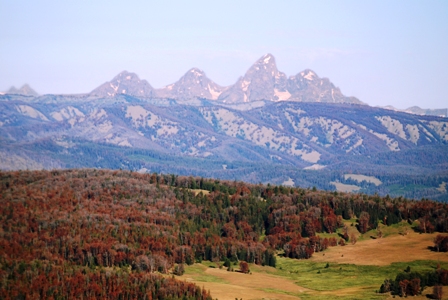
A forest of red between Dubois, Wyoming, and Grand Teton National Park shows the impact mountain pine beetles are exacting on the Greater Yellowstone Ecosystem. NPT file photo.
U.S. Fish and Wildlife Service officials announced Tuesday that the agency will take a longer, more extensive look at whether whitebark pine trees, a key food source for some grizzly bear populations as well as birds and squirrels, need protection under the Endangered Species Act.
In a notice published in the Federal Register the agency acknowledged that substantial scientific and commercial information indicates that such a listing is merited.
Whitebark pines are a member of the "stone" pine family. It grows in the very highest reaches of Yellowstone, Glacier, Rocky Mountain, Yosemite, Sequoia and Kings Canyon national parks. These high-elevation trees produce a calorie-rich nut that grizzly bears in the greater Yellowstone ecosystem like to feast on in the fall. It's a nut that also feeds red squirrels and the Clark's nutcracker.
The sheer stature of the tree also helps maintain watersheds. In winter its bulk serves as natural snow fences, and in spring that same bulk helps shield the resulting snowbanks from the sun, thus allowing for a relatively slow and even snow melt.
Scientists regard the tree as a “foundation species” because it creates the conditions necessary for other plants and animals to get established in harsh alpine ecosystems. But the tree is in danger these days from non-native diseases, such as blister rust, and insects such as the mountain pine beetle, which are beginning to flourish in the trees' habitat thanks to climate change.
Back in February the Natural Resource Defense Council sued the Fish and Wildlife Service for failing to act on a year-old request that ESA protection be bestowed on the pines. At that time, Louisa Willcox, NRDC's senior wildlife advocate based in Montana, said that "What happens to whitebark pine will have sweeping effects on the entire high mountain forest ecosystems of the Northern Rockies. Of particular concern is the future of Yellowstone’s threatened grizzly population, which relies on the high-fat seeds of whitebark pine as a primary food source. Fewer whitebark pine seeds lead to higher numbers of grizzly bear deaths and lower reproductive success among females.”
The rate of the whitebark pine tree’s disappearance has increased significantly in recent years and raised concern from the scientific community, according to NRDC.
Under its announcement Tuesday, the Fish and Wildlife Service agreed to conduct a year-long review of scientific and commercial information on the species. Here is a summary of the ruling:
We, the U.S. Fish and Wildlife Service, announce a 90-day finding on a petition to list Pinus albicaulis (whitebark pine) as endangered or threatened under the Endangered Species Act of 1973, as amended and to designate critical habitat. Based on our review, we find that the petition presents substantial scientific or commercial information indicating that listing P. albicaulis may be warranted. Therefore, with the publication of this notice, we are initiating a review of the status of the species to determine if listing P. albicaulis is warranted. To ensure that this status review is comprehensive, we are requesting scientific and commercial data and other information regarding this species. Based on the status review, we will issue a 12-month finding on the petition, which will address whether the petitioned action is warranted, as provided in section 4(b)(3)(B) of the Act.
Story Categories:
A copy of National Parks Traveler's financial statements may be obtained by sending a stamped, self-addressed envelope to: National Parks Traveler, P.O. Box 980452, Park City, Utah 84098. National Parks Traveler was formed in the state of Utah for the purpose of informing and educating about national parks and protected areas.
Residents of the following states may obtain a copy of our financial and additional information as stated below:
- Florida: A COPY OF THE OFFICIAL REGISTRATION AND FINANCIAL INFORMATION FOR NATIONAL PARKS TRAVELER, (REGISTRATION NO. CH 51659), MAY BE OBTAINED FROM THE DIVISION OF CONSUMER SERVICES BY CALLING 800-435-7352 OR VISITING THEIR WEBSITE. REGISTRATION DOES NOT IMPLY ENDORSEMENT, APPROVAL, OR RECOMMENDATION BY THE STATE.
- Georgia: A full and fair description of the programs and financial statement summary of National Parks Traveler is available upon request at the office and phone number indicated above.
- Maryland: Documents and information submitted under the Maryland Solicitations Act are also available, for the cost of postage and copies, from the Secretary of State, State House, Annapolis, MD 21401 (410-974-5534).
- North Carolina: Financial information about this organization and a copy of its license are available from the State Solicitation Licensing Branch at 888-830-4989 or 919-807-2214. The license is not an endorsement by the State.
- Pennsylvania: The official registration and financial information of National Parks Traveler may be obtained from the Pennsylvania Department of State by calling 800-732-0999. Registration does not imply endorsement.
- Virginia: Financial statements are available from the Virginia Department of Agriculture and Consumer Services, 102 Governor Street, Richmond, Virginia 23219.
- Washington: National Parks Traveler is registered with Washington State’s Charities Program as required by law and additional information is available by calling 800-332-4483 or visiting www.sos.wa.gov/charities, or on file at Charities Division, Office of the Secretary of State, State of Washington, Olympia, WA 98504.


National parks and their natural resources belong to you. The National Parks Traveler works to ensure you know how these essential places are being cared for.
Sign Up For Our Weekly Newsletter
Unsubscribe at any time.
INN Member

The easiest way to explore RV-friendly National Park campgrounds.

Here’s the definitive guide to National Park System campgrounds where RVers can park their rigs.
Our app is packed with RVing- specific details on more than 250 campgrounds in more than 70 national parks.
You’ll also find stories about RVing in the parks, tips helpful if you’ve just recently become an RVer, and useful planning suggestions.


Comments
Kurt - Could you site the specific scientific study that has conclusively tied the spread of the mountain pine beetle to climate change.
Anonymous, I've read through a lot of scientific papers, and the authors always seem to couch their conclusions with many qualifiers so as to stop short of agreeing 100 percent on something.
With that said....Attached to the story at the following link is NRDC's petition, and it references various studies.
/2008/12/nrdc-calls-endanagerd-species-act-protection-whitebark-pine-tree
Also, this link goes to a paper by Dr. Jesse Logan, a now-retired U.S. Forest Service entomologist who long has tracked pine beetles:
http://www.google.com/url?sa=t&source=web&cd=4&ved=0CCoQFjAD&url=http%3A...
And here's a link to a paper, co-authored by Dr. Logan, in actionbioscience.org:
http://www.actionbioscience.org/environment/loganmacfarlane.html
Then how do they explain the outbreaks in the 1940s, in 1909, and even prior to the twentieth century.
According to Veblen in a publication published under the auspices of Colorado State University, The University of Idaho, The Colorado State Forest Service and The Colorado Forest Restoration Institute:
There is no evidence to support the idea that
current levels of bark beetle or defoliator activity
in Colorado’s lodgepole pine and spruce-fir
forests are unnaturally high. The outbreaks now
taking place in Colorado are similar in intensity
and ecological effects to previously documented
outbreaks in the Rocky Mountains. For example,
mountain pine beetle outbreaks killed millions of
lodgepole pine trees over thousands of square
miles in the Cascade and Rocky Mountains
during the 1960s, 1970s, and early 1980s (Lynch
2006; chapter 4); and a spruce beetle outbreak
in the 1940s killed spruce trees over much of the
White River Plateau in western Colorado.
Historic photos and tree-ring evidence also
document extensive insect outbreaks prior to the
20th century (Baker and Veblen 1990, Veblen et
al. 1991, Veblen et al. 1994, Swetnam and Lynch
1998, Eisenhart and Veblen 2000, Veblen and
Donnegan 2006). Thus, insect outbreaks are a
natural occurrence in almost all of the different
kinds of forests in Colorado. Outbreaks do not
occur very frequently; the time interval between
successive outbreaks in any given area is
usually measured in decades. Nevertheless,
outbreaks can be expected periodically in almost
any place in the state where forests are found.
http://www.colorado.edu/geography/class_homepages/geog_5161_ttv_s09/Romm...
No couching of conclusions there.
Anonymous, all I'll suggest is that you read the papers I referenced, some of which touch on your concerns.
Thanks, Kurt, for this great article. To further address anonymous' question I would just add that the excerpt anonymous has cited refers to lodgepole pine and spruce-fir which have historically seen many mountain pine beetle outbreaks. Outbreaks in whitebark pine's range have been rare and occurred during brief warming periods in the past. With the current increasing temperatures, mountain pine beetles have expanded their range beyond usual elevational limits. This combined with a lack of defenses from whitebark pine has allowed mountain pine beetles to move further and faster than researchers had predicted. We discuss the history of mountain pine beetle outbreaks and the current conditions in our petition which can be accessed here: http://docs.nrdc.org/legislation/files/leg_08120801a.pdf
Anonymous,
There is no question that trees have long survived beetle infestation in the past, but those past occurances were shorter in duration. You also can't compare logepole, spruce, doug fir, etc, to whitebark pine trees which have NOT co-evolved with mountain pine beetle (as the above stated trees have). Whitebark pine exists in high-elevation exclusively. These environments are so inhospitable, that mountain pine beetles (until now), have not been able to live in those conditions (e.g., extremely cold temps). But snotell data and climatic readings show warming high elevation temps which are allowing these beetles to survive at high elevation and because whitebark pine has NOT co-evolved with beetles, they have no defense mechanisms, such as pitch tubes, that can protect them against beetle attacks. The "somewhat" good news is that some whitebark pines have shown some resistance, but they are few and far between. Also, there is a species of whitebark pine called krumholtz, which are dwarf whitebark pines that are too small to be of any use to mountain pine beetle. The future of whitebark pine may lay in the krumholtz. Regardless, more research needs to be done to save these important environments, and ESA listing is a first step in getting the needed resources to study what might be done to save this species. I agree with Kurt...read the studies that he referenced...they will probably answer all of your questions.
Anonymous, your Veblen quote discusses A) the state of Colorado, which includes very little, if any, Whitebark, and B) lodgepole pine and spruce, which are very different from Whitebark Pine.
The current infestation of Whitebark is unprecedented in recorded history, and you don't have to be a scientist to observe this. There are simply no expansive stands of older Whitebark snags that would indicate massive mortality like the Whitebark are undergoing today.
Certainly there were outbreaks of mountain pine beetle in Whitebark in the '30s and '70s, but nothing like what's happened in the last decade. Moreover, Dr. Logan's climate models predicted this outbreak long ago. Very simply, warmer winter temperatures and longer summers have created overwhelmingly favorable conditions for a widespread pine beetle infestation in a high alpine tree species that used to be able to rely on cold temperatures to keep beetles at bay.
David and Sylvia,
David you made a good point regarding my citation bing related to lodgepole as opposed to whitepine thought many in CO have used the same "climate change" argument to explain our current pine beetle outbreak. However, even he NRDC document itself cites extensive breakouts of the mountain pine beetle in whitepine forest from 1909 into the 1930s. Was that due to "climate change"? Or was it just due to normal variations in weather conditions?
Anonymous,
Since David nor Sylvia replied to your question I'll take a stab at it.
First, historical winter temperatures in whitebark pine habitats were frequently cold enough to kill all mountain pine beetle life stages everywhere but in the most protected sites, for example in the tree bole beneath the insulating snow cover. Second, summer temperatures typically did not provide enough heat increment to complete an entire life cycle in one year (univoltineism). The combination of cold temperature, winter mortality, and cool summer temperatures served to keep mountain pine beetle populations in check. With the advent of a warming climate: (1) winter temperatures have become mild enough to allow substantial overwinter survival of all life stages; and (2) there is sufficient summer thermal energy to complete an entire life cycle in one year. Historically, the simultaneous occurrence of these necessary conditions occurred only infrequently in high elevation whitebark pine forests. And when this did occur in the 1930’s and 1970’s it was short-lived only lasting a couple of seasons, at most.
With the advent of anthropocentric global warming in the past few decades, the ecological relationship between mountain pine beetle and whitebark pine has undergone a fundamental shift. We now consistently observe large numbers of successfully attacked whitebark pine trees in late spring/early summer. Apparently, re-emerging parent adults from the previous summer, perhaps augmented by an early phase emergence of new brood adults, are responsible for this mortality. Winters are becoming mild enough that even adult beetles, a freeze intolerant stage, are surviving. These surviving beetles, at even relatively low densities, have been able to successfully attack new whitebark pine trees. The shift from non-overlapping, semivoltine (life cycle requiring two years to complete) generations to overlapping, bi-modal, univoltine (life cycle completed in a single year) generations with a concomitant increase in reproductive potential. This shift I believe is being driven by climate change and not normal variation in weather conditions.
Also consider the effects of high elevation snowmobiling to young whitebark pines, some cannot be seen under the snow....