
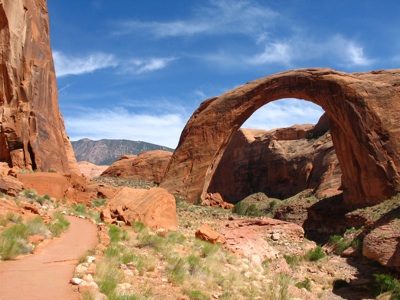
Rainbow Bridge will mark 100 years as a national monument on May 30. NPS photo by Jonathan Parker.
Though Native Americans have been gathering at Rainbow Bridge for at least 10,000 years, it's only been a century since the stone bridge along the Utah-Arizona border has been recognized as a national monument.
On Sunday, May 30, the centennial of the monument will be marked by the National Park Service. The occasion of the commemoration affords an opportunity to examine the rich heritage and cultural and natural history of this iconic image of the American
Southwest.
Precisely when the first human being stood in awe of Rainbow Bridge might never be known, but it is likely that the peoples of the Southwest have been interacting with the bridge for at least 10,000 years, according to Chuck Smith, the district ranger assigned to the monument. Five contemporary tribes or nations claim Rainbow Bridge as a site that is integral to their heritage and cultural identity, and the lineage of these groups tracks back through time to this distant point, notes Ranger Smith.
Here, as told by Ranger Smith, is a look at the "recent" history of the monument:
What has been established is a clear story of the Anglo discovery of Rainbow Bridge. The story begins in 1907 with word from a local Navajo man of a colossal natural bridge near the Colorado River below Navajo Mountain. This information eventually reached and intrigued Byron Cummings, a University of Utah dean and professor who was even then petitioning for the establishment of Utah’s first national monument, Natural Bridges, in 1908.
Collaborating with federal surveyor William Douglass, Cummings organized an exploration party that included himself, Douglass, a local trader and guide named John Wetherill, a Paiute guide named Nasja Begay, and a Ute Mountain Ute guide named Jim Mike. Eight other men from both the University of Utah and Douglass’ group took part in the expedition.
What lay ahead for these men, who possessed remarkable grit and determination, was a four-and-a-half day pack train sojourn through the rugged, hot wilderness of Arizona and Utah en route to the purported bridge. Their search was not in vain, for shortly before noon, August 14, 1909, Cummings rounded a bend in Bridge Canyon and blurted out: “Eureka, there she is.”
The struggles and challenges the Douglas/Cummings discovery party would endure assured the proclamation of Rainbow Bridge National Monument 8 ½ months later. Although their lofty goal was to have this colossal bridge set aside as a national monument, if it did indeed exist, their saga doesn’t come close to telling the whole story of how Rainbow Bridge in far southern Utah received protected status.
The early 20th century marked a period of excitement for people concerned about preservation of the nation’s cultural and natural resources. In that conservation conscious environment, the idea of sustained support for preserving our national treasures resonated well with public opinion. In 1906, Congress passed the Antiquities Act. The Act’s creators saw to it that the Act went beyond saving Antiquities from plunder but further gave the President the authority to proclaim historic landmarks, prehistoric structures, and objects of scientific interest as national monuments.
Several bureaus or agencies collaborated, compromised, bickered, and fought over not only what would qualify sites for protected status but then further, who would preside over these newly established National Monuments. The word scientific was carefully selected then fought for and provided greater latitude for the pen of the President.
The first national monument, Devils Tower in Wyoming, was proclaimed by Theodore Roosevelt on September 24, 1906. Byron Cummings and William Douglas new well the value of the Antiquities Act having surveyed the area of Natural Bridges in 1907 which subsequently, due to their efforts, received National Monument status the following year; Utah’s first national monument. By the end of 1908, Roosevelt had declared another sixteen monuments, including Gila Cliff Dwellings and Grand Canyon.
On May 30, 1910, due to its value as a “scientific example of eccentric stream erosion” President William Howard Taft signed the Proclamation which designated the 160-acre Rainbow Bridge National Monument. The presidential authority granted by the Antiquities Act does not come easy or without controversy, however almost every president since, has found reason to invoke the Antiquities Act to protect important cultural and natural resources.
Perhaps no other unit of the National Park System was once so remote and inaccessible, only to become so very easily reached via the waters of Lake Powell. This accessibility, although welcome, magnifies the importance of preserving Rainbow Bridge and its many stories for future generations of visitors.
National Park Service staff and partners are hosting a series of events to commemorate the bridge’s 100th anniversary. The centennial provides an opportunity to tell the stories of some of the early explorers, many of whom left eloquent descriptions of their encounter with Rainbow Bridge and of life along the trail. It is also a time to explore the spiritual and cultural significance of Rainbow Bridge.
For a list of upcoming events and activities, periodically check the Rainbow Bridge website, www.nps.gov/rabr, for updates.
Story Categories:
A copy of National Parks Traveler's financial statements may be obtained by sending a stamped, self-addressed envelope to: National Parks Traveler, P.O. Box 980452, Park City, Utah 84098. National Parks Traveler was formed in the state of Utah for the purpose of informing and educating about national parks and protected areas.
Residents of the following states may obtain a copy of our financial and additional information as stated below:
- Florida: A COPY OF THE OFFICIAL REGISTRATION AND FINANCIAL INFORMATION FOR NATIONAL PARKS TRAVELER, (REGISTRATION NO. CH 51659), MAY BE OBTAINED FROM THE DIVISION OF CONSUMER SERVICES BY CALLING 800-435-7352 OR VISITING THEIR WEBSITE. REGISTRATION DOES NOT IMPLY ENDORSEMENT, APPROVAL, OR RECOMMENDATION BY THE STATE.
- Georgia: A full and fair description of the programs and financial statement summary of National Parks Traveler is available upon request at the office and phone number indicated above.
- Maryland: Documents and information submitted under the Maryland Solicitations Act are also available, for the cost of postage and copies, from the Secretary of State, State House, Annapolis, MD 21401 (410-974-5534).
- North Carolina: Financial information about this organization and a copy of its license are available from the State Solicitation Licensing Branch at 888-830-4989 or 919-807-2214. The license is not an endorsement by the State.
- Pennsylvania: The official registration and financial information of National Parks Traveler may be obtained from the Pennsylvania Department of State by calling 800-732-0999. Registration does not imply endorsement.
- Virginia: Financial statements are available from the Virginia Department of Agriculture and Consumer Services, 102 Governor Street, Richmond, Virginia 23219.
- Washington: National Parks Traveler is registered with Washington State’s Charities Program as required by law and additional information is available by calling 800-332-4483 or visiting www.sos.wa.gov/charities, or on file at Charities Division, Office of the Secretary of State, State of Washington, Olympia, WA 98504.


National parks and their natural resources belong to you. The National Parks Traveler works to ensure you know how these essential places are being cared for.
Sign Up For Our Weekly Newsletter
Unsubscribe at any time.
INN Member

The easiest way to explore RV-friendly National Park campgrounds.

Here’s the definitive guide to National Park System campgrounds where RVers can park their rigs.
Our app is packed with RVing- specific details on more than 250 campgrounds in more than 70 national parks.
You’ll also find stories about RVing in the parks, tips helpful if you’ve just recently become an RVer, and useful planning suggestions.


Comments
I have never visited Rainbow Bridge via the Lake Powell access. I did, however, hike into the monument following the old "Teddy Roosevelt" trail, so called because it was reportedly the trail he followed when he visited Rainbow Bridge long before a visit by a President to a park service area was considered to be a "photo op". The hardest part of the trail is to find the trail head, located on the Navajo reservation. Even though we had pretty good directions, we had to stop about four people to ask where it was. It is a beautiful hike. I remember it taking two days in and a day and a half out.
Rick
Without good proof, I doubt the validity of the 10.000 years. The Navajo sandstone is pretty soft and the bridge should not be much older than 1000 years as it is now.
MRC, for what it's worth, an Australian expert on dating has placed a tentative age of 7,000-9,000 years on the Great Gallery petroglyphs in Canyonlands National Park and they're on sandstone, as well.
Of course, they don't have as much gravity working against them as the bridge does.
But you raise an interesting question: How old are arches such as Landscape Arch in Arches National Park, Kolob Arch in Zion National Park, and the three arches at Natural Bridges National Monument?
In 1957 when I was 18 I was privileged to visit Rainbow Bridge with my parents and John Aubouchon, then the superintendent of the Monument. He had come to Rainbow Lodge with an Indian crew to help the owners sift through the ruins of the Lodge which had burned to the ground several days earlier. We drove in to the Lodge with plans to pack in to the Bridge only to find the wrangler had left the country during or just after the fire and trips to the Bridge were cancelled.
My Dad, a cowboy in an earlier life, and the Superintendent, wrangled up a pack string and some saddle animals. We loaded our gear, feed for the animals, and some supplies the Superintendent needed to take to the Bridge and the four of us headed off down the Rainbow Lodge trail. On arriving at the Bridge corral and campground the book was retrieved from its case and we found proof of Dad's earlier visit to the Bridge in the 1920s in the form of his signature on the same page which President Teddy Roosevelt had signed several years earlier.
We signed the register--the final four signatures in the book--not many pages after my Dad's earlier signature. Then Superintendent Aubouchon packed it away for the trip back to the Lodge the following day. Because of its historic value and the pending completion of Glen Canyon Dam and filling of Lake Powell, the Superintendent said the book was going to be retired to the NPS Archives to presevre and protect it. If memory serves me, the visitors were numbered sequentially and by 1957 the total number of signers was about 3,400. It was a rare thing to be able to sign sch a venerable and historic visitor register.
After feeding and watering the stock, we cooked supper and bedded down for the night. The next day, after hiking up and down Bridge Canyon and photographing the Bridge, my Dad helped Mr. Aubouchon deal with some maintenance issues at the campground, after which we loaded up the pack animals and headed back to the Lodge.
The fire was the end of the Rainbow Lodge operation. The elderly owners were devastated by the fire and lost all their possessions and prized collection of baskets and blankets. The NPS crew was able to sift a considerable amount of burned cash and coin out of the ruins which Mr. Aubouchon collected and took with him the next day for safekeeping.
I wonder where that book came to rest?
Barry: According to a reference library source, the Rainbow Bridge register books were initially "housed in the archives at Lake Powell [sic] National Recreation Area headquarters at Wahweap." Where they are now, I do not know. If I were you I'd contact Glen Canyon National Recreation Area and ask if the Rainbow Bridge register books are in the park's archives.
The Music Temple register books (1938-1961), which were also rescued before Glen Canyon was flooded, are in the Special Collections of the J. Willard Marriott Library, University of Utah.