
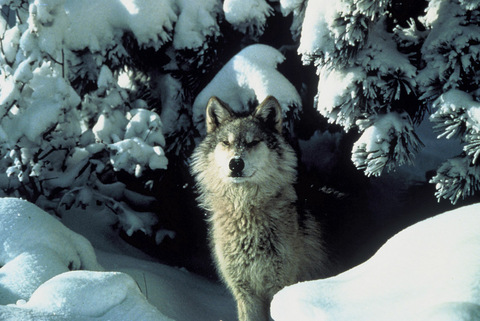
Independent reviewers are questioning portions of a wolf management plan being developed by Washington state wildlife officials. Photo by Tracy Brooks/Mission Wolf / USFWS.
Wolf population targets laid out in a draft management plan by Washington Department of Fish and Game officials are too low to sustain a viable population, according to some independent scientists who reviewed the proposal.
Wolves were classified as an endangered species across the state of Washington by the federal government in 1973 and by the state government in 1980. In 2009 the predators were delisted under federal law for the eastern third of Washington, though they remain listed as endangered in the western two-thirds of the state. Well aware that wolves likely will begin to spread across their state, Washington officials are drawing up a management plan that will allow wolves to be delisted as an endangered species statewide...but prevent them from growing too robustly in number.
The Washington State Department of Fish and Wildlife, under a draft environmental impact statement examining the management plan, is proposing a goal of 15 breeding pairs to justify removal of the species from protection under that state's Endangered Species Act. But officials with the National Parks Conservation Association have questioned those population targets, and their concerns are now being supported by an independent review.
“The majority of the scientific reviewers agree with NPCA that a higher number of breeding pairs is needed to produce a sustainable wolf population in Washington,” said David G. Graves, the NPCA's Northwest field representative.
According to NPCA officials, some scientists who conducted an independent peer review of the state's DEIS found that its population recommendations are not biologically defensible and will not ensure the ‘reestablishment of a self-sustaining population of gray wolves in Washington.’
As one reviewer puts it, the current population goal of 15 breeding pairs “does not flow from the result of scientific evaluation.” A second reviewer states, “…we might anticipate that the state should support somewhere between 320 and 668 wolves.” Finally, a third reviewer says, “Wolf populations currently living in Wisconsin and Michigan are at levels of 626+ and 580+ wolves (winter 2009) respectively, in states that have human population densities similar to Washington…”
The reviewers also said that an adjustment of the population goals and other minor changes (such as addressing how interaction with other wolf populations would be maintained or restored) can result in a scientifically defensible plan, the parks advocacy group said.
“The blind scientific peer review is vitally important and should be closely considered in crafting the final version of the wolf plan for the state of Washington,” said Mr. Graves.
The review panel's comments are attached below.
Research indicates that healthy wolf populations can benefit local communities. The University of Montana recently estimated that Yellowstone National Park wolves generate $35 million in economic benefits every year for local communities. This money comes from tourist spending directly related to wolves, including wolf tours and related services, such as lodging and meals.
Scientists also believe the return of the gray wolf to the Olympic peninsula would lead to cleaner water and healthier ungulate populations, NPCA said. In Olympic National Park, stream and river habitat has been damaged from elk overgrazing. This damage is limited in other parks, such as Yellowstone, where wolves are present to control and manage the elk population, the group said.
In January, members of the Washington State Legislature and local Washington community leaders sent a letter to the Washington Department of Fish and Wildlife (WDFW) urging it to restore a healthy and vibrant wolf population to Washington State. The letter included five members of the state Senate, 15 members of the state House of Representatives and 13 community leaders, including Paula L. Houston, Executive Director of the Mathews East Madison YMCA, Bob Kelly, Policy Director for the Nooksack Indian Tribe, and Peter Jackson of the Henry M. Jackson Foundation.

Story Categories:
A copy of National Parks Traveler's financial statements may be obtained by sending a stamped, self-addressed envelope to: National Parks Traveler, P.O. Box 980452, Park City, Utah 84098. National Parks Traveler was formed in the state of Utah for the purpose of informing and educating about national parks and protected areas.
Residents of the following states may obtain a copy of our financial and additional information as stated below:
- Florida: A COPY OF THE OFFICIAL REGISTRATION AND FINANCIAL INFORMATION FOR NATIONAL PARKS TRAVELER, (REGISTRATION NO. CH 51659), MAY BE OBTAINED FROM THE DIVISION OF CONSUMER SERVICES BY CALLING 800-435-7352 OR VISITING THEIR WEBSITE. REGISTRATION DOES NOT IMPLY ENDORSEMENT, APPROVAL, OR RECOMMENDATION BY THE STATE.
- Georgia: A full and fair description of the programs and financial statement summary of National Parks Traveler is available upon request at the office and phone number indicated above.
- Maryland: Documents and information submitted under the Maryland Solicitations Act are also available, for the cost of postage and copies, from the Secretary of State, State House, Annapolis, MD 21401 (410-974-5534).
- North Carolina: Financial information about this organization and a copy of its license are available from the State Solicitation Licensing Branch at 888-830-4989 or 919-807-2214. The license is not an endorsement by the State.
- Pennsylvania: The official registration and financial information of National Parks Traveler may be obtained from the Pennsylvania Department of State by calling 800-732-0999. Registration does not imply endorsement.
- Virginia: Financial statements are available from the Virginia Department of Agriculture and Consumer Services, 102 Governor Street, Richmond, Virginia 23219.
- Washington: National Parks Traveler is registered with Washington State’s Charities Program as required by law and additional information is available by calling 800-332-4483 or visiting www.sos.wa.gov/charities, or on file at Charities Division, Office of the Secretary of State, State of Washington, Olympia, WA 98504.


National parks and their natural resources belong to you. The National Parks Traveler works to ensure you know how these essential places are being cared for.
Sign Up For Our Weekly Newsletter
Unsubscribe at any time.
INN Member

The easiest way to explore RV-friendly National Park campgrounds.

Here’s the definitive guide to National Park System campgrounds where RVers can park their rigs.
Our app is packed with RVing- specific details on more than 250 campgrounds in more than 70 national parks.
You’ll also find stories about RVing in the parks, tips helpful if you’ve just recently become an RVer, and useful planning suggestions.


Comments
Yes here in Wisconsin we have a wolf population that's gone way up and hunters are complaining about it a lot, claiming that it has helped decimate the deer population, although that seems to be a questionable assertion.
You say "some scientists" - when the number is 2 (out of 3) in the peer review. It would be nice for once to have factual reporting on the wolf issue instead of bias in the media.
It is misleading to write that the State's Draft EIS Wolf Conservation and Management Plan sets a "population goal of 15 breeding pairs". It sets a minimum benchmark for delisting from sensitive status of 15 breeding pairs (corresponding to a wolf population of 75 to 150). WDFW mentions a "target population" of 300 to 500 wolves in its public meetings. This is much larger than the impression readers are left with above.
Both USFWS and NPS decline to comment on this draft plan. WDFW reports that the USFWS is leaning towards a larger regional view, employing translocation between the 4 regions in WA, 2 in OR, with larger populations in ID and perhaps BC to ensure genetic diversity. This strategy would also address the concerns expressed by 2 of the 3 reviewers. But interstate translocation is beyond the scope of this state plan.
NPCA's statement that "In Olympic National Park, stream and river habitat has been damaged from elk overgrazing" is based on only one publication, which is unsupported or contradicted by others. No scientific consensus has yet emerged on this issue. To state "Scientists believe..." it is misleading.
(Wolves cannot be released in Olympic NP until a federal EIS is issued. This is some years away. We may hope a scientific consensus emerges by then. But Olympic is only 1 of the 4 regions in the WA state plan.)
Until then, please realize this is a polarized issue, and uncritically reprinting the press releases of any one advocacy group just perpetuates the polarization. This may be a case of "the perfect is the enemy of the good". Is it in the wolves best interest that we wait more years until we have what NPCA regards as a perfect plan? Or start now with a good one?
Rod, I hadn't heard mention of that target population tally of 300 to 500 wolves, but that seems both contrary to what the DEIS mentions and highly unattainable if delisting would occur with 15 breeding pairs.
If one uses Yellowstone as a benchmark -- and that's probably overly optimistic given the protected landscape and the high prey densities -- getting to 300 wolves with just 15 breeding pairs just doesn't seem possible. In 2008 the park counted 14 packs and yet the total wolf population was fewer than 200 wolves.
I'm on the road, so don't have my notes handy, but I believe the average pack size in Yellowstone is only around 8 animals, so to reach a "target population" of 300-500 individuals with a goal of 15 breeding pairs, you'd need packs of greater than 20 animals, and I don't think that's attainable or realistic.
In any of the meetings you attended did anyone question the "target population" number versus the delisting trigger of 15 breeding pairs?
As for Olympic National park, I could be mistaken, but my understanding is that if wolves show up on their own the Park Service would not have to prepare an EIS. Rather, they'd be obligated to manage the wolves under the ESA.
The ultimate stable "target" wolf population (300 to 500?) will be determined by prey populations and habitat. It is likely 2 to 3 times higher than the minimum sustainable wolf population (75-150?) proposed by WDFW for delisting from sensitive status. (That does not mean each pack has 2-3 times more individuals, but that there are eventually expected to be 2-3 times more packs than the minimum for delisting. Also realize that it is difficult to "take a census" of all wolves in remote wilderness areas. Delisting is based only on those known for certain to be successful breeding pairs for at least 3 years; more will be out there, uncounted or only breeding 2 out of 3 years, etc. The difference between the known census and actual population will diverge over time, because only those wolves originally introduced are radio-collared and easily located.)
"In any of the meetings you attended did anyone question the "target population" number versus the delisting trigger of 15 breeding pairs?" Yes. The purpose of the Draft EIS is to elicit public comment and define issues where further science is needed, and this is a major one.
"As for Olympic National park, I could be mistaken, but my understanding is that if wolves show up on their own the Park Service would not have to prepare an EIS. Rather, they'd be obligated to manage the wolves under the ESA." I think that's true, but moot. A glance at the map shows two insurmountable barriers to wolf migration: Puget Sound / Strait of Juan de Fuca, and the Puget Lowlands / Interstate 5 corridor of towns and farms from Olympia to Vancouver. Indeed, it is thought at wolves will not naturally find their way back into the Southern Cascades (south of Interstate 90 / Snoqualmie Pass), let alone the coastal mountains or Olympics. Deliberate trapping and reintroduction would be required.
Wolf reintroduction requires broad public acceptance. Any successful plan involves politics and will necessarily be a compromise. It is my observation that WDFW is more capable of forging this compromise than is NPCA, or NPS itself. The experience in ID, MT and WY has been contentious and the results (in elk and moose populations and range) yet unclear. And WA's plan will be imperfect. To put it bluntly: if wolves cannot be delisted early so problem wolves can be shot, then there will be major problems, opposition, and perhaps there won't be wolves here.
Ultimately, wolf and elk populations and range will be determined not by us, but by biology and ecology. So perhaps the best we can do is start with the imperfect, and let nature take its course. The one attribute most required for success, and least found in the emotional polarization, is simply... humility.