
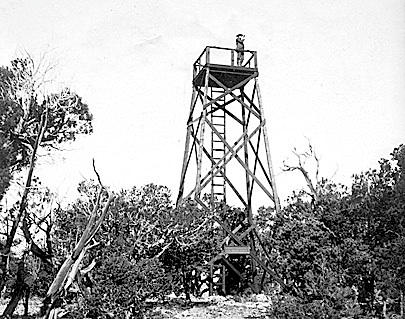
Four fire lookout towers in Grand Canyon National Park, including one trod upon by the writer Ed Abbey, have been added to the National Historic Lookout Register. This U.S. Forest Service photo is of the original Fire Lookout Tower at Hopi Point. Circa 1909
Would Ed Abbey approve?
A Grand Canyon National Park fire lookout tower he spent quite some time on has been added to the National Historic Lookout Register.
The tower in question, the North Rim Lookout, was built in 1928 and moved to its current location by the Civilian Conservation Corps in 1933. Mr. Abbey, who chronicled his disgust with the taming and paving of wildlands in numerous writings, including Desert Solitaire and The Monkey Wrench Gang, spent countless hours in the late 1960s and early 1970s atop the tower panning the landscape for telltale wisps of smoke.
In all four historic fire lookout towers in the park -- two on the North Rim, two on the South Rim -- recently were listed on the National Historic Lookout Register, which is a cooperative effort of the Forest Fire Lookout Association, the National Forestry Association, the National Woodland Owners Association, the U.S. Forest Service, state forestry departments and Department of Interior agencies. The purpose of the National Historic Lookout Register is to identify historic lookout towers that have played an important role in forest conservation.
These towers were an important part of the early fire-fighting efforts of Grand Canyon National Park. The national park's towers are part of a broad network of fire lookout towers and associated support buildings and structures in the American Southwest built in the late 19th through 20th centuries. Early park managers were extremely concerned about locating and extinguishing fires in the 1920s to the 1960s.
Today all four of these towers are inactive, which reflects the shift in fire control policy from one of immediate suppression of all fires to using an array of fire management actions including prescribed burns, wildland use fires, suppression, and incorporating fire as a natural ecosystem process to restore natural forest conditions.
The U.S. Forest Service first constructed wooden lookout platforms at Hopi Point and Grandview Point on the South Rim and on Bright Angel Point on the North Rim prior to the establishment of Grand Canyon National Park in 1919. The National Park Service improved this early lookout system by replacing the wooden platforms with steel frame towers at Bright Angel Point and Hopi Point, and by building the Signal Hill and Kanabownits towers. The Civilian Conservation Corps built tree towers on the North and South Rims in the mid-1930s. The National Park Service improved emergency communications by installing new phones and establishing a central dispatch at Grand Canyon Village during the 1920s. These lookouts were a part of a very efficient fire suppression program: fires rarely burned more than one hundred acres in the park each year until modern fire management guidelines were initiated.
The Kanabownitz tower, also on the North Rim was constructed in 1940 by the CCC in one of the last major projects they completed in the park. The Hopi tower was constructed near Hopi Point in 1927 and probably replaced an earlier tower there that was a wooden crow’s next and likely was the first fire tower in Arizona. The Signal Hill tower is near Pasture Wash on the South Rim was constructed in 1929.
Story Categories:
A copy of National Parks Traveler's financial statements may be obtained by sending a stamped, self-addressed envelope to: National Parks Traveler, P.O. Box 980452, Park City, Utah 84098. National Parks Traveler was formed in the state of Utah for the purpose of informing and educating about national parks and protected areas.
Residents of the following states may obtain a copy of our financial and additional information as stated below:
- Florida: A COPY OF THE OFFICIAL REGISTRATION AND FINANCIAL INFORMATION FOR NATIONAL PARKS TRAVELER, (REGISTRATION NO. CH 51659), MAY BE OBTAINED FROM THE DIVISION OF CONSUMER SERVICES BY CALLING 800-435-7352 OR VISITING THEIR WEBSITE. REGISTRATION DOES NOT IMPLY ENDORSEMENT, APPROVAL, OR RECOMMENDATION BY THE STATE.
- Georgia: A full and fair description of the programs and financial statement summary of National Parks Traveler is available upon request at the office and phone number indicated above.
- Maryland: Documents and information submitted under the Maryland Solicitations Act are also available, for the cost of postage and copies, from the Secretary of State, State House, Annapolis, MD 21401 (410-974-5534).
- North Carolina: Financial information about this organization and a copy of its license are available from the State Solicitation Licensing Branch at 888-830-4989 or 919-807-2214. The license is not an endorsement by the State.
- Pennsylvania: The official registration and financial information of National Parks Traveler may be obtained from the Pennsylvania Department of State by calling 800-732-0999. Registration does not imply endorsement.
- Virginia: Financial statements are available from the Virginia Department of Agriculture and Consumer Services, 102 Governor Street, Richmond, Virginia 23219.
- Washington: National Parks Traveler is registered with Washington State’s Charities Program as required by law and additional information is available by calling 800-332-4483 or visiting www.sos.wa.gov/charities, or on file at Charities Division, Office of the Secretary of State, State of Washington, Olympia, WA 98504.
INN Member

The easiest way to explore RV-friendly National Park campgrounds.

Here’s the definitive guide to National Park System campgrounds where RVers can park their rigs.
Our app is packed with RVing- specific details on more than 250 campgrounds in more than 70 national parks.
You’ll also find stories about RVing in the parks, tips helpful if you’ve just recently become an RVer, and useful planning suggestions.


Comments
Interesting article about the towers @ GCNP. I spent weekends in the Hopi Point Lookout from 4/69-9/69. I was finishing my sophomore year at Northern Arizona University School of Forestry. We had an 8 week forestry summer camp from beginning in June. The lookout assingment worked well with that schedule. When summer camp was over I was on the lookout on weekends and was a smoke chaser during the week. This was the same time Ed Abbey was on North Rim Lookout and Stephen Pyne was chasing smokes on the North Rim.
I lived in the primitive cabin at the base of the lookout. I hate to say this but I had the most beautiful view in the world and after a while it became as wallpaper. My attention was focused on an arc that went West to South East and rarely to the North. The North Rim was higher than the South Rim and it was difficult to spot smokes there.
The main things I remember about my lookout experience were the thunderstorms. About late morning, build up would start to the West of the tower an move in an arc around to South and then to the East, spitting out yellow tongues of fire as it went. Usually, the storms were saturating given that it was monsoon season, but when I saw virga, I knew we were in trouble and I needed to be extra vigilent. Sometimes Ma Nature would pull a fast one. Insteat of making the usual arc, the storms would come directly East and I knew I would be spendind a couple of hours on the insulated stool and out of touch with the rest of the world. Yes, the tower was hit several times. Initially, the firefinder would kind of glow electrically and then boom, the tower was hit. I could feel the electricity all around me. It's kind of like the static you feel when you rub your feet against a carpet but taken to the Nth degree.
The tower was only 150 feet or so off the main road but management didn't encourage visitors. I found a huge wooden sign for the tower attatched to two large poles and planted it out by the main road after work one evening. The next morning the District Ranger came to the tower and said that while he appreciated what I was trying to do, he prefered I not encourage visitors. He had it taken down the same day. I read William Shirer's Rise and Fall of the Third Reich and several other tomes, gained 30 pounds, and learned to like country music that summer. KAFF was the only radio station I could pick up.
Perhaps the two worst things that summer were being sent to chase down two smokes on two consecutive days and discovering they were helicopter crashes with multiple fatalities each. Went on some other fires, nothing too big, and missed the Woodstock Music Festival in New York. In a way it was kind of boring because I spent my previous three fire seasons on an Interagency Hotshot Crew in California. However the job met my needs, I enjoyed the people I worked for and I was able to parlay it into a great job at the National Interagency Fire Center several years later.