
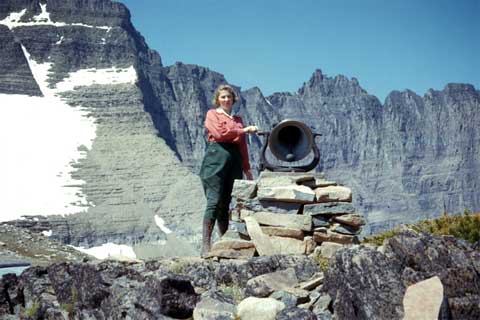
An unidentified woman - and a bell - on Piegan Pass in Glacier National Park in 1942. Photo courtesy of the Glacier National Park historical collection.
Julie Andrews made some Austrian mountains come alive with the sound of music, but for seventeen years visitors to the backcountry in Glacier National Park played a different kind of tune. That ringing sound heard in some pretty remote sections of the park wasn't exactly melodious, since it was limited to a single note from a large bell, but it was apparently pretty dramatic.
Visitors who crossed several mountain passes in Glacier between the fall of 1926 and the autumn of 1943 could "celebrate" their accomplishment by stopping to ring a large locomotive bell permanently installed at those locations. While the idea seems pretty bizarre—or even inappropriate—to us today, it apparently was a big hit with an earlier generation.
Travel to the interior of the park was by foot or horseback, and it was many a mile to the nearest railroad track, so how did large locomotive bells wind up in such unlikely locations? The answer provides some insight into the development of Glacier and to attitudes about parks and tourism in the 1920's and 30's.
In those early years of the national park system, travel for strictly recreational purposes was an idea that was starting to catch on, and there was a conscious effort to encourage visitation to parts of the West which had previously been unknown to most Americans. Companies like the Great Northern Railway and the Glacier Park Hotel Company played a major role in developing and promoting Glacier as a destination.
Information from the National Register of Historic Places notes:
Four years after the passage of the Glacier National Park enabling legislation (1910), the Glacier Park Hotel Company (a subsidiary of the Great Northern Railway) had constructed an elaborate European-style hotel-trail-chalet network. Park facilities and attractions were designed to appeal to traveling America’s new-found interest in the West and long standing interest in Europe…. Tourists traveled by horseback, with cowboy guides.
Although the United States Department of the Interior was responsible for development of the park’s tourist-trail system, first park superintendent Logan noted that such a “big enterprise…can not be carried out on a large scale unless one has ample means at his command, which I do not.” The Great Northern Railway thus assumed responsibility for much of the trail program, and was reimbursed for costs as federal funds became available.
So how do bells in the mountains fit into this scenario? Information from Donald H. Robinson's administrative history of Glacier helps unravel the mystery:
In August 1925 W. R. Mills, then advertising agent of the Great Northern Railway, and H. A. Noble, manager of the Glacier Park Hotel Company, made a request of the park superintendent for permission to place locomotive bells on the summits of the following passes in the park: Swiftcurrent, Logan, Siyeh, Gunsight, Cut Bank, Stoney Indian and at Grinnell Glacier. This request was based upon an old Swiss custom of having bells on the mountain tops and passes, and the desire to give the visitors hiking or riding through the park the unusual experience of ringing these loud, clear bells high in the mountains.
The request was passed on to the office of the Director of the National Park Service, who did not approve of the idea but was somewhat loath to say so at the time, so the decision was postponed. Mr. Noble continued to press for the bells, and finally in September of 1926 the request was granted for at least two bells to be established in these passes.
Within the next two months the company had placed three of them on Swiftcurrent, Piegan and Siyeh passes. These bells were bought by the Hotel Company at a cost of $194.27 each plus packing, shipping and the expense of placing them. They were very beautifully toned and created a considerable amount of interest among the people who crossed these passes and heard them ring.
A fourth bell was placed on Mt. Henry, where the Glacier Park-Two Medicine Trail crosses Scenic Point, high above Lower Two Medicine Lake, in the summer of 1929. These four bells remained in place until the fall of 1943, when they were removed by the Hotel Company and turned in during a World War II scrap metal drive.
Anyone who actually heard these bells ring in the backcountry of Glacier would now be in their seventies or older, so this story is part of an almost forgotten chapter from the park's history. Perhaps we can thank the national zeal to collect scrap metal during World War II for avoiding what would certainly be a controversy if the bells had remained into more recent times.
Story Categories:
A copy of National Parks Traveler's financial statements may be obtained by sending a stamped, self-addressed envelope to: National Parks Traveler, P.O. Box 980452, Park City, Utah 84098. National Parks Traveler was formed in the state of Utah for the purpose of informing and educating about national parks and protected areas.
Residents of the following states may obtain a copy of our financial and additional information as stated below:
- Florida: A COPY OF THE OFFICIAL REGISTRATION AND FINANCIAL INFORMATION FOR NATIONAL PARKS TRAVELER, (REGISTRATION NO. CH 51659), MAY BE OBTAINED FROM THE DIVISION OF CONSUMER SERVICES BY CALLING 800-435-7352 OR VISITING THEIR WEBSITE. REGISTRATION DOES NOT IMPLY ENDORSEMENT, APPROVAL, OR RECOMMENDATION BY THE STATE.
- Georgia: A full and fair description of the programs and financial statement summary of National Parks Traveler is available upon request at the office and phone number indicated above.
- Maryland: Documents and information submitted under the Maryland Solicitations Act are also available, for the cost of postage and copies, from the Secretary of State, State House, Annapolis, MD 21401 (410-974-5534).
- North Carolina: Financial information about this organization and a copy of its license are available from the State Solicitation Licensing Branch at 888-830-4989 or 919-807-2214. The license is not an endorsement by the State.
- Pennsylvania: The official registration and financial information of National Parks Traveler may be obtained from the Pennsylvania Department of State by calling 800-732-0999. Registration does not imply endorsement.
- Virginia: Financial statements are available from the Virginia Department of Agriculture and Consumer Services, 102 Governor Street, Richmond, Virginia 23219.
- Washington: National Parks Traveler is registered with Washington State’s Charities Program as required by law and additional information is available by calling 800-332-4483 or visiting www.sos.wa.gov/charities, or on file at Charities Division, Office of the Secretary of State, State of Washington, Olympia, WA 98504.


National parks and their natural resources belong to you. The National Parks Traveler works to ensure you know how these essential places are being cared for.
Sign Up For Our Weekly Newsletter
Unsubscribe at any time.
INN Member

The easiest way to explore RV-friendly National Park campgrounds.

Here’s the definitive guide to National Park System campgrounds where RVers can park their rigs.
Our app is packed with RVing- specific details on more than 250 campgrounds in more than 70 national parks.
You’ll also find stories about RVing in the parks, tips helpful if you’ve just recently become an RVer, and useful planning suggestions.


Comments
Jim--
If this story has not yet been featured on NPT, I hope you or Bob will do one on the Firefall in Yosemite. It was an attraction for years until park management decided it was an inappropriate park activity. I agree with that decision but its history should be fascinating. I transferred to Yosemite not long after the last "let the firefall fall" was sounded. (At least that was what I always heard someone announced before the embers were pushed over Glacier Pointl.)
Rick Smith
Your age is showing, Rick. Yosemite's firefall was discontinued in 1968! Thanks for jogging my memory. I've got an article on the firefall in my "Gone But Not Forgotten" queue.
Bob--
Please do not mention "age". It is a subject I would like to ignore.
Rick Smith
Pardon my ignorance, but why would the ringing of the bell be considered inappropriate?
Your question is an excellent one!
Whether or not these bells in the backcountry would be considered "appropriate" today is a philosophical question, and involves the same opinions we see voiced on a lot of topics posted on the Traveler.
People who visited – and managed – the parks in the 1920's grew up in a time when the "Wild West" was still very much a reality, and I suspect that for many of them, "wildness" was something simply waiting to be "civilized." The National Register information I found about the early development of Glacier noted "a conscious attempt to emulate European culture." In that context, these bells don't seem out of place.
In today's world, it's increasingly hard to find places where it's possible to have an hour or a day – or more - away from the sights, sounds and smells of modern society. That's not a big deal for some people, but it has great value to others. I was amazed many occasions about how far sound can carry in the out-of-doors, and I'm sure these locomotive bells could be heard for miles.
An occasional "ring" of those bells sounds like a fun and harmless novelty to many people, but to others who have spent hours or even days on the trail in the quest of a little escape from "civilization," a regular dose of clanging bells would soon wear thin. How many "rings" a day would be too many in that context – ten, fifty, a hundred? There would occasionally be the guy who just couldn't resist standing there and clanging the bell non-stop for several minutes!
So, like many similar questions, whether these bells would be "inappropriate" today is in the ear of the beholder.