
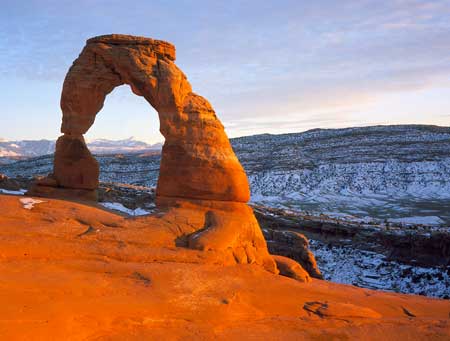
Delicate Arch and the surrounding landscape, Arches National Park. NPS photo.
If you want to enjoy some of those iconic views from places like Arches National Park and Canyonlands National Park, you'd probably be wise to plan your trip sooner rather than later.
While most Americans and their elected officials have been mesmerized by the economic crisis and the upcoming election, enormous changes in the management of public lands in Utah are afoot. The effects on a number of national parks could be substantial.
During the past two months, the Bureau of Land Management (BLM) has revised six land management plans (RMP's) covering 11 million acres of Utah canyon country. These lands surround Arches, Canyonlands and Capitol Reef national parks, Dinosaur National Monument, and other sites that attract visitors from all over the world.
In much the same way that city zoning plans identify which areas are appropriate for industrial use and which should be set aside for parks, these RMP's will determine how the BLM manages these public lands—including 5 million acres of proposed wilderness—for decades to come.
BLM is supposed to manage these lands for "multiple use," an admittedly difficult job when interest groups with widely divergent opinions clamor for their piece of the action. Unfortunately, the new management plans appear to be heavily skewed in favor of oil, gas and mining development and off-road vehicle use.
Among those speaking out this week were Jim Baca, former BLM State Director for Utah and former Mayor of Albuquerque and members of the Southern Utah Wilderness Alliance (SUWA). According to SUWA, the new plans will open nearly 80 percent of the 11 million acres of public land to oil and gas development and off-road vehicle users.
Baca says the revised plans had been pushed by top managers in the BLM Washington office and at Interior. A SUWA statement provides a startling summary of the process:
The BLM released these six Utah plans in a dizzying flurry—one plan almost every week from August 1 to September 5, 2008. Although each plan technically has a 30-day protest period, the reality is that with only seven days separating the release dates, the public has only one week between each protest deadline to review and digest the plan and submit a protest letter to the BLM, detailing concerns and inadequacies in the plans. At over 1,000 pages each, it is simply an impossible task.
However, as the lifespan of these plans is 15-20 years, the long-term ramifications of the plans are significant – they control the destiny of the world-renowned canyon country of southern Utah for the next generation.
That push shouldn't be a surprise in the waning days of the current administration, especially in view of the current cry to "Drill, Baby, Drill." However, SUWA data suggests there's no compelling need to rush through vast numbers of new oil and gas leases that would be unlikely to be developed for years.
At the end of fiscal year 2006, while the industry held over 4.6 million acres of oil and gas leases on BLM lands in Utah, just over 1 million acres of those leased lands were actually in production. The rest were simply being "bankrolled" by leaseholders.
The group also cites figures from an industry trade magazine, Rocky Mountain Oil Journal: "As of April 18, 2008, there were only 41 drill rigs operating in Utah (compared to 122 in Colorado, 68 in Wyoming, and 82 in New Mexico). It’s this kind of shortage of drilling equipment and personnel that is causing a bottleneck in production, not environmental regulation or BLM delays."
It's often a challenge to grasp the implications of plans covering such vast areas, so let's take a closer look at what's in store for the Moab area, which includes land around Arches and Canyonlands.
Phil Brueck is a second-generation NPS manager who knows the Utah parks from years of first-hand experience. Now retired, his last assignment was as deputy superintendent for the Southeast Utah Group, which included management oversight for Canyonlands, Arches, Natural Bridges National Monument and Hovenweep National Monument.
In comments this week, he provides a clear summary of what's at stake:
Within the vast, internationally renowned landscapes of Utah lie small islands that are the national parks; the adjacent BLM lands often form the backdrop or context for these areas. It is BLM land that we see through the “Windows” at Arches NP; we admire the BLM cliffs and monuments as we gaze outward from the Delicate Arch area. The views from the Island in the Sky in Canyonlands NP would be minor if it were not for the grand sweeping views of BLM land down in the erosion basin. Picture oil and gas development, and Potash mining within each of these viewsheds.
It is BLM land that entices us into the Needles District of Canyonlands NP through the leafy charm of Indian Creek, along the stunning Wingate Cliffs and under the Six Shooter peaks. Part of the Canyonlands experience is the challenge of traversing the remote wilderness-like BLM lands in order to visit the Maze District on the west side. Here lie tracts of lands containing potential impacts from tar sands, uranium prospecting and mining.
Brueck also notes that it is very difficult in today’s world to get away from high ambient noise levels and experience true natural quiet—a quality valued by undeveloped areas in national parks.
Under the six new plans, 19,800 miles of off-road vehicle routes would be officially designated for motorized travel. That figure is not a misprint. Brueck comments that "many of these routes ‘dead-end’ at park boundaries, thus increasing (and somewhat encouraging) illegal use continuing across park boundaries into the parks. In the time that I worked in southeastern Utah, the expansion of tracks and routes from illegal off-road use, particularly on the northeast side of Arches and near the Needles area of Canyonlands, was astonishing to experience."
The reality is that, needed or not, oil and gas leasing will continue and ORV users will continue to push for more miles of roads. Groups opposed to the new plans recognize those facts, but argue that better balance between development and protection of areas with prime scenic values and natural and cultural resources is needed.
The BLM has previously identified 2.8 million acres within areas covered by the plans which still possess wilderness values. Under these plans, 91 percent of those areas would be opened to ORV use. Conservation groups note that even if BLM had recommended protection for all of the wild land it has previously identified, 86 percent of the proposed oil and gas wells could still be drilled. Under the new plans, the BLM proposes protection for only 16 percent of these roadless lands.
The BLM appears determined to forge ahead and issue final decisions on these plans within the next two months, despite written protests from conservation groups and more than 90 members of Congress.
Perhaps our greatest cause for alarm should be that political appointees at Interior feel complete freedom to pursue their agenda, shortcutting long-established procedures for reasoned review and meaningful public input, completely insulated from congressional or public oversight.
If you plan to enjoy the current stunning view on some prime pieces of your public lands, don't wait too long.
Story Categories:
A copy of National Parks Traveler's financial statements may be obtained by sending a stamped, self-addressed envelope to: National Parks Traveler, P.O. Box 980452, Park City, Utah 84098. National Parks Traveler was formed in the state of Utah for the purpose of informing and educating about national parks and protected areas.
Residents of the following states may obtain a copy of our financial and additional information as stated below:
- Florida: A COPY OF THE OFFICIAL REGISTRATION AND FINANCIAL INFORMATION FOR NATIONAL PARKS TRAVELER, (REGISTRATION NO. CH 51659), MAY BE OBTAINED FROM THE DIVISION OF CONSUMER SERVICES BY CALLING 800-435-7352 OR VISITING THEIR WEBSITE. REGISTRATION DOES NOT IMPLY ENDORSEMENT, APPROVAL, OR RECOMMENDATION BY THE STATE.
- Georgia: A full and fair description of the programs and financial statement summary of National Parks Traveler is available upon request at the office and phone number indicated above.
- Maryland: Documents and information submitted under the Maryland Solicitations Act are also available, for the cost of postage and copies, from the Secretary of State, State House, Annapolis, MD 21401 (410-974-5534).
- North Carolina: Financial information about this organization and a copy of its license are available from the State Solicitation Licensing Branch at 888-830-4989 or 919-807-2214. The license is not an endorsement by the State.
- Pennsylvania: The official registration and financial information of National Parks Traveler may be obtained from the Pennsylvania Department of State by calling 800-732-0999. Registration does not imply endorsement.
- Virginia: Financial statements are available from the Virginia Department of Agriculture and Consumer Services, 102 Governor Street, Richmond, Virginia 23219.
- Washington: National Parks Traveler is registered with Washington State’s Charities Program as required by law and additional information is available by calling 800-332-4483 or visiting www.sos.wa.gov/charities, or on file at Charities Division, Office of the Secretary of State, State of Washington, Olympia, WA 98504.


National parks and their natural resources belong to you. The National Parks Traveler works to ensure you know how these essential places are being cared for.
Sign Up For Our Weekly Newsletter
Unsubscribe at any time.
INN Member

The easiest way to explore RV-friendly National Park campgrounds.

Here’s the definitive guide to National Park System campgrounds where RVers can park their rigs.
Our app is packed with RVing- specific details on more than 250 campgrounds in more than 70 national parks.
You’ll also find stories about RVing in the parks, tips helpful if you’ve just recently become an RVer, and useful planning suggestions.


Comments
The issue of viewscapes is a very interesting one. Almost by definition, a "viewscape" involves how to handle lands that were *not* designated as National Park lands. For example, if you protect certain areas as National Park land to protect the "viewscape" from a given point - you've then instantly created new lands with additional threatened viewscapes based on the new boundaries. Is the solution some kind of "bufferland" designation? If not - what other options are there for the lands surrounding the 391* (or so) National Parks out there?
I would think the issue of how adjacent lands are managed can be based on a definition in the planning of what the resource-to-be-protected is.
Also, recognizing that communities near protected areas often decide they live in a region with distinctive character, and want to retain that special character. As we have learned in the National Heritage Corridor program, these communities often see that special character as an asset: an economic asset and a point of pride and quality of life. Local communities could develop a coordinated protection plan, based on identification of what matters to them. They could protect their regional character through the local and state tools available. The federal government should provide assistance to local governments and organizations who are willing to voluntarily help protect nationally distinctive resources.
It does not necessarily follow that the adjacent lands protection would ITSELF require the next tier of protection, thus triggering the NEXT tier, as Sebatis implies. This should all be defined in the plan. The plan needs to define in its Vision Statement what qualities they want their region to retain in 20 years or more, and then identify the common actions they could take to achieve that quality of life.
For example, if you were to define the views available from the Blue Ridge Parkway, you could identify those zones on maps. You could recognize that the Parkway attracts needed tourism because of those views, and retainin that tourism is seen as a local advantage by the local communities. You could identify land use or zoning standards necessary to retain the views from the Ridge. The local communities may also be interested in retaining village centers and farm country, and would encourage the federal and state government to enhance services so that these communities can better benefit from the tourism than they do now.
But it would not follow that views from the adjacent lowlands and hills East of the Ridge would also require viewshed protection from developments further east.
What it takes is defining what the resource is, and what protection strategy is needed.
One of the problems with encouraging local protection is whether the local community's desires mesh with the values of the neighboring national parks.
The gateway to Arches and Canyonlands is Moab, which rakes in quite a bit of economic development from the off-road vehicle community and doesn't want to see that evaporate. The surrounding counties, meanwhile, look to energy development on public lands butting up to the parks for much of their tax revenues, along with spending from the ORV enthusiasts.
The trick is finding a happy middle ground for all involved. It's one that hasn't really been accomplished so far.