
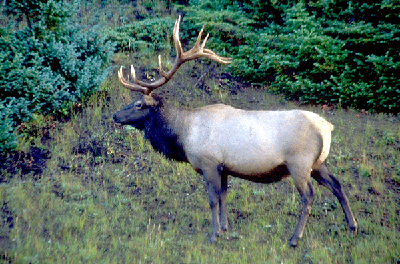
Decisions on hunting elk in Theodore Roosevelt and Wind Cave national parks not expected this year. NPS photo.
Don't expect a final decision this year on how the booming elk populations at Theodore Roosevelt or Wind Cave National Parks will be brought under control. National Park Service officials say they don't expect to have the National Environmental Policy Act process completed before year's end for either park.
In each case, officials for the parks say the draft environmental impact statements are large, complicated documents. The Wind Cave DEIS ran to nearly 400 pages, and Theodore Roosevelt officials expect their DEIS to run close to 500 pages.
Over-population of elk, while perhaps attractive to some visitors who long to see these antlered ungulates, present problems for the parks. The elk can be voracious, quickly over-browsing areas. And without their natural predators, (i.e. wolves), there's little to keep their populations from continuing to boom, short of hunting.
In Rocky Mountain National Park, which has a similar elk problem, officials earlier this year opted to try birth control as well as sharp-shooters, adverse conditioning, and even herding to beat down the herds. Will those ploys be successful? The folks at WildEarth Guardians don't think so, and would like to see the park first turn to wolves to better manage elk populations.
At Wind Cave, one solution park officials are considering is the construction of fences to keep elk out of the park during hunting season. That way they'd be prey for hunters, who currently are prohibited from hunting in the park.
Now, back in April 2007 I somewhat facetiously suggested that the Park Service solve its elk problems by auctioning off hunting permits. That would not only cull the herds and generate some sorely needed dollars for the parks, but it could be better managed than an open hunting season in the parks.
Of course, there are many national park advocates who vehemently oppose any hunting in the parks, saying it would be practically sacrilegious.
"The no-hunting rule in national parks is so deeply engrained into our national consciousness (not to mention American law) that to permit it now would be like allowing 10 men on a professional baseball team, or redefining the marathon as a 42-mile race," Clay Jenkinson, the Theodore Roosevelt scholar-in-residence at Dickinson State University, wrote earlier this year.
Of course, there are units of the National Park System where hunting is allowed, but those are typically National Recreation Areas, preserves, and even some national seashores, such as Cape Cod National Seashore.
While Interior Secretary Dirk Kempthorne, who was in North Dakota earlier this week, voiced his openness to consider a public elk hunt in Theodore Roosevelt, he might not be in office by the time the Park Service gets around to making its final decision.
Story Categories:
A copy of National Parks Traveler's financial statements may be obtained by sending a stamped, self-addressed envelope to: National Parks Traveler, P.O. Box 980452, Park City, Utah 84098. National Parks Traveler was formed in the state of Utah for the purpose of informing and educating about national parks and protected areas.
Residents of the following states may obtain a copy of our financial and additional information as stated below:
- Florida: A COPY OF THE OFFICIAL REGISTRATION AND FINANCIAL INFORMATION FOR NATIONAL PARKS TRAVELER, (REGISTRATION NO. CH 51659), MAY BE OBTAINED FROM THE DIVISION OF CONSUMER SERVICES BY CALLING 800-435-7352 OR VISITING THEIR WEBSITE. REGISTRATION DOES NOT IMPLY ENDORSEMENT, APPROVAL, OR RECOMMENDATION BY THE STATE.
- Georgia: A full and fair description of the programs and financial statement summary of National Parks Traveler is available upon request at the office and phone number indicated above.
- Maryland: Documents and information submitted under the Maryland Solicitations Act are also available, for the cost of postage and copies, from the Secretary of State, State House, Annapolis, MD 21401 (410-974-5534).
- North Carolina: Financial information about this organization and a copy of its license are available from the State Solicitation Licensing Branch at 888-830-4989 or 919-807-2214. The license is not an endorsement by the State.
- Pennsylvania: The official registration and financial information of National Parks Traveler may be obtained from the Pennsylvania Department of State by calling 800-732-0999. Registration does not imply endorsement.
- Virginia: Financial statements are available from the Virginia Department of Agriculture and Consumer Services, 102 Governor Street, Richmond, Virginia 23219.
- Washington: National Parks Traveler is registered with Washington State’s Charities Program as required by law and additional information is available by calling 800-332-4483 or visiting www.sos.wa.gov/charities, or on file at Charities Division, Office of the Secretary of State, State of Washington, Olympia, WA 98504.


National parks and their natural resources belong to you. The National Parks Traveler works to ensure you know how these essential places are being cared for.
Sign Up For Our Weekly Newsletter
Unsubscribe at any time.
INN Member

The easiest way to explore RV-friendly National Park campgrounds.

Here’s the definitive guide to National Park System campgrounds where RVers can park their rigs.
Our app is packed with RVing- specific details on more than 250 campgrounds in more than 70 national parks.
You’ll also find stories about RVing in the parks, tips helpful if you’ve just recently become an RVer, and useful planning suggestions.


Comments
I'm not sure that in extraordinary circumstances allowing hunters to help the NPS cull elk herds is such a bad idea. As a Denverite and frequent visitor to Rocky Mountain National Park, the elk are so abundant and unafraid of people that I've seen visitors walk up to grazing elk near a Trail Ridge Road overlook and pet them. I'd rather the NPS use their sharpshooters and birth control, but when the elk are wreaking such great havoc on Rocky's ecosystem and visitors are displaying such ignorance in the face of fearless elk, drastic measures must be taken. I'm no fan of hunting in national parks, but perhaps in extraordinary circumstances such as these, a few hunting permits should be issued to the public. I don't think extraordinarily rare hunting permits would be an affront to national parks as institutions. I think it's a step toward increasing the viability and sustainability of those parks and their ecosystems. Releasing wolves into the parks is a mistake unless managers of the public lands surrounding the parks are prepared for wolves in their territory. I think that may be wise in the long run, but I don't think the public and the Park and Forest services are ready for that yet.
Kurt,
To look at hunting as a tool for Park-management is an intriguing if elusive proposition. It obviously has considerable potential, but thorny problems. It is laudable that you take on this challenging topic.
I also read your previous somewhat tongue-in-cheek suggestion to charge high fees for in-Park hunts .
To put the hunting-idea into action will take a change in the conditioning of the public, and it will take a similar change in Park officialdom. The first might be both the more important and the more practical. (The second can be done by fiat.)
This might be the place to note, that rural residents in or near Parks in Alaska are allowed to hunt (and trap) Park animal populations. This is a base of experience that could serve as a valuable reference.
It is noteworthy that we so readily look upon these two particular excess-elk situations, as a context to explore the question of hunting as a policy-consideration applicable to Parks in general.
If the ice is broken in some places for certain reasons, then it should become easier to use hunting under other circumstances.
Hunters dress the carcass and leave the high-quality "gut-ball" on the site. These are a bonanza for a variety of wildlife, but bears especially benefit. Wildlife populations quickly learn the timing of hunting seasons, and integrate the offal into their annual cycle.
Few hunters in the conterminous States are accustomed to hunting in off-road situations. Large game is carefully brought down reasonably near a road. (Shooting a 500 pound animal in a location where it will have to be backpacked many miles is a mistake one rarely repeats.) To hunt the backcountry of our larger Parks will require other methods. Snowmobiles or ATVs might be recommended.
It is common that 'Park animals' are actually partly Park-residents, and partly reside in State or Forest Service or Private lands. This is acknowledged in discussing the present elk-problems. Less directly acknowledged, is that combining the wildlife management agencies of the extra-Park component, with the Park management would be more ecologically valid that assigning animals to one or another based on an arbitrary (and usually invisible) line in the woods.
I would be doubtful of the prospect for wider use of hunting in the Parks, but we do live in exciting times: changes are taking place, and it is possible that some of these could include the many hunters of our nation.
Ted,
Correct me if I'm wrong, but the Alaska hunts you cite primarily are subsistence-based, no? It's been an ingrained way of life for long before the Park Service was even thought of, and many of those parks rose up in recent history around traditional hunting grounds for the locals, as opposed to parks in the Lower 48/conterminous states that long have existed and which long have been out-of-bounds for hunting.
While I'm not so sure getting the general public to sign off on the hunts would be a big deal -- especially not in light of recent surveys that show 69% of those polled favor drilling for oil both in the Arctic National Wildlife Refuge and off-shore -- I do wonder about the problems those gut piles you mention would create.
Would hunters take their elk deep in the backcountry and leave the gut piles there, away from hiking trails? Doubtful, I'd think.
As a result, would you have to close parks to the general public during and for a period of time following hunts to allow bears to clean up the gut piles? Or would they be largely inconsequential?
I do wonder about the feasibility of returning wolves into some of these parks to control the ungulate populations. They've seemed to do a reasonable job in Yellowstone, although elk numbers are probably still too high.
Kurt,
That is correct: the hunting, trapping, fishing, firewood-cutting and other patterns of usage in Alaska Parks take place under formal subsistence regulations (by Act of Congress). However, that such usage was traditional in the territory of the new sub-arctic Parks, and was not traditional in the territories of temperate-zone Parks in the conterminous States, would be incorrect.
Subsistence lifestyles were dominant in all rural regions of the early United States, and persisted strongly after the advent of Industrialization and cash economies, in many areas both remote and merely rural. Individuals & communities made a conscious effort to retain the independence and self-reliance of what were in reality subsistence practices directly comparable to those of Alaska.
Hunting today all across the United States is primarily the informal continuation of subsistence lifestyles. That is, hunting is not "sport" for most practitioners (though they certainly enjoy it), but rather is the preservation of the lifestyle and philosophy of our grandparents - same as has been codified as subsistence-law, in Alaska.
Indeed, the reason why Parks banned hunting & firearms, is substantially that Park-territories were the accustomed hunting-grounds of residents of the territory, practically none of whom were 'sportsmen'. They simply continued to hunt, as generations before them had, and came into conflict with the authorities.
Take for example Olympic National Park, established in 1938. In recent months, fisher (a fur-bearer of the weasel family) have been reintroduced there. Pre-Park trapping pressure was sufficiently heavy & thorough, that fisher had been extirpated. The Olympic Mountains were not a rarely-visited, virtually untouched wilderness. It was a wilderness, but one under intensive subsistence use.
No, it really is not the case that a unique & special pattern of usage in Alaska creates a justification for subsistence provisions that pertains only in their case, and that these patterns of usage and lifestyle-values were not present in the southern States when Parks were instituted. Actually, they were, and there remains a potent component of them even today.
[hr]
Gut-piles from hunting are rarely encountered, because they are consumed very rapidly. When a hunter removes the entrails, the animal is healthy and the offal is fresh and of peak value to wild animals. Conversely, when a large animal dies near the end of a hard winter (or more often, during the beautiful spring) or of old age, it is emaciated and the guts tend to spoil in the carcass, both of which reduce their value for scavenging.
(Entrails are the choice component for predators, and are the first part eaten. Dominant wolves eat into the belly first, while lesser individuals chew on other parts (and shift to the guts at the earliest opportunity). Gut-piles are not after-thoughts, but are the prefered & best part, in the view of carnivores & omnivores.)
Actually, in terms of distress to visitors & hikers, it is the 'natural' death that creates the greater visual impact, and remains conspicuous for a much longer period of time. When over-populated or over-aged elk expire, the carcass is of low value, may decompose too much before it is scavenged, and offers a visual and olfactory impact much larger than an excised gut-ball.
[hr]
Wolves would be the perfect solution for many wildlife problems, if the circumstances were different. But a wolf-pack will not stay put and focus on a specific excess population. Instead they disperse rapidly (and the greater the excess of prey-food, the faster the reproduction & subsequent (forced) dispersal), and worse - turn their attention to other animals.
Wolf-proponents advertise that a standing offer is available, to compensate a rancher for the loss of livestock. However, across much of the region where wolves are now becoming reestablished, ranching-country is heavily interspersed with rural residences (long has been), and much of the livestock on these holdings is recreational, rather than purely commercial.
A horse, for example, can be very attractive to wolves. Often, it is owned by a youngster, who loves it. The flight-reflex of a horse under wolf-attack will often lead to grave injuries, even if the aftermath does not indicate predation. To reassure horse-owners that they will receive fair market value for the meat of their animal is a serious public relations error.
This is probably the greatest downfall of wolf-introduction - and a serious oversight of advocates - that predators come onto private residences and attack pets and hand-raised ... members of the household. This is where wolves really lose support.
Someday we'll finally realize that the introduction of more carnivores into the ecosystem is the only long-term answer that will work. Yes, Fluffy and Mr. Ed are part of the food chain too.
Jon,
I expect that we will see many more carnivores, and perhaps with a delay, the full complement of major carnivores/omnivores, most everywhere.
But I doubt we'll get there by throwing Fluffy to the wolves.
Instead, we'll get there by hunting & killing 10% of the wolves, grizzlies, cougar and black bears each year. Roughly.
Hunt-conditioning is the missing component in most conterminous management plans ... but it will be easily enough implemented, once we get serious about having them, and living with them. We're headed there.