
How's that saying go, the more things change, the more they stay the same? That certainly seems to be the truth in the case of national parks jammed with automobiles.
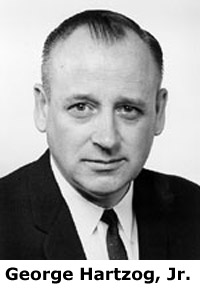
In 1971 the writer John McPhee wrote a profile for The New Yorker of George Hartzog, who at the time was just the seventh director of the National Park Service. The story, obviously pieced together with a series of interviews conducted over more than a few days, moves from the director's Washington office, to Capitol Hill, to Sandy Hook (before Gateway National Recreation Area existed) even to the Buffalo National River (before it gained its "national" status, that is).
Along with providing some wonderful insights into both Director Hartzog and the politics involved in running the National Park Service, Mr. McPhee's article, simply titled Ranger, sheds light on what Director Hartzog thought of car-crammed national parks. The case at hand involved Yosemite National Park.
...the Yosemite's problem is population pressure as expressed in the invading automobile, and if solutions can be found there, where the pressure is most intense, the solutions may be applied throughout the National Park System. Yosemite Valley has a flat floor and sheer granite walls. It is about six miles long, and has been penetrated by a roadway from the west. Driving into it is like driving up through a drain and out into an exaggerated bathtub. The vertical walls of the valley in places are three thousand six hundred feet high, and for an automobile there is only the one way in and out. With its pluming waterfalls, its alpine meadows, and its granite pinnacles, the Yosemite is in all likelihood the most exquisite cul-de-sac on earth, and each year about seven hundred thousand cars go in there.
"The automobile as a recreational experience is obsolete," Hartzog says. "We cannot accommodate automobiles in such numbers and still provide a quality environment for a recreational experience." Accordingly, (Supt Lawrence) Hadley will ask Congress for three hundred thousand dollars so he can close at least a part of the valley to automobiles and carry people through the closed area in chartered buses. Hartzog says that eventually he would like to block cars from the valley altogether and possibly build a funicular that would lower people into the Yosemite from the rim. To transport people around the valley floor, he contemplates the use of electric trains, which would run on rubber tracks. As Hadley and Hartzog talk, it becomes increasingly apparent that everything they are saying rests on the assumption that the visiting public has the right to be carried from place to place -- that the right to vehicular transportation, privately or publicly provided, now comes under less question than the right to freedom of assembly or freedom of speech.
..."We want to give people a park experience, not a parkway experience. We need to limit access to parks and wilderness. We've simply got to do something besides build roads in these parks if we're going to have any parks left. We need controlled mechanical access. We can put parking lots outside the parks, then take people in with public transportation. When you get too many people, simply shut off the machinery. If we get rid of the automobile, we can have more people."
You can find the rest of the article in Pieces of the Frame, a collection of Mr. McPhee's articles that also includes a wonderful piece on canoing rivers and one on firewood.
Story Categories:
A copy of National Parks Traveler's financial statements may be obtained by sending a stamped, self-addressed envelope to: National Parks Traveler, P.O. Box 980452, Park City, Utah 84098. National Parks Traveler was formed in the state of Utah for the purpose of informing and educating about national parks and protected areas.
Residents of the following states may obtain a copy of our financial and additional information as stated below:
- Florida: A COPY OF THE OFFICIAL REGISTRATION AND FINANCIAL INFORMATION FOR NATIONAL PARKS TRAVELER, (REGISTRATION NO. CH 51659), MAY BE OBTAINED FROM THE DIVISION OF CONSUMER SERVICES BY CALLING 800-435-7352 OR VISITING THEIR WEBSITE. REGISTRATION DOES NOT IMPLY ENDORSEMENT, APPROVAL, OR RECOMMENDATION BY THE STATE.
- Georgia: A full and fair description of the programs and financial statement summary of National Parks Traveler is available upon request at the office and phone number indicated above.
- Maryland: Documents and information submitted under the Maryland Solicitations Act are also available, for the cost of postage and copies, from the Secretary of State, State House, Annapolis, MD 21401 (410-974-5534).
- North Carolina: Financial information about this organization and a copy of its license are available from the State Solicitation Licensing Branch at 888-830-4989 or 919-807-2214. The license is not an endorsement by the State.
- Pennsylvania: The official registration and financial information of National Parks Traveler may be obtained from the Pennsylvania Department of State by calling 800-732-0999. Registration does not imply endorsement.
- Virginia: Financial statements are available from the Virginia Department of Agriculture and Consumer Services, 102 Governor Street, Richmond, Virginia 23219.
- Washington: National Parks Traveler is registered with Washington State’s Charities Program as required by law and additional information is available by calling 800-332-4483 or visiting www.sos.wa.gov/charities, or on file at Charities Division, Office of the Secretary of State, State of Washington, Olympia, WA 98504.
INN Member

The easiest way to explore RV-friendly National Park campgrounds.

Here’s the definitive guide to National Park System campgrounds where RVers can park their rigs.
Our app is packed with RVing- specific details on more than 250 campgrounds in more than 70 national parks.
You’ll also find stories about RVing in the parks, tips helpful if you’ve just recently become an RVer, and useful planning suggestions.


Comments
Don't forget, Stephen Mather was a mjor advocate for roads in parks and saw roads as a key to getting visitors to parks and increasing the public support for the National Park idea. Both the Sierra Club and AAA, as well as numerous regional and local governments, supported road construction such as the Going to the Sun Highway in Glacier. Now we have an overpass and stoplights at Old Faithful.
Well its a little overblown to say that "the automobile as a recreational experience is obsolete." The Blue Ridge Parkways is one of two National Parks devoted to the automobile as a recreational experience, and remains one of the most-visited Units in the National Park System. What works in a Parkway however, or at Colorado National Monument, does not necessarily work in Yosemite Valley. Yosemite already has one of the best bus systems in the Park System, and hopefully they can take it the whole way in removing those unsightly parking spaces from the rest of the Valley...
Are you implying that Colorado National Monument is one of only two national parks "devoted to the automobile as a recreational experience"? I find that statement somewhat curious, not just because COLM offers hiking (14 trails totaling 40 miles), bicycling, and other recreational opportunities of the nonmotorized variety, but because many other parks have heavily invested in windshield touring. That said, COLM's 23-mile long Rim Rock Drive, with it's three neat tunnels and spectacular vistas, remains one of the more scenic drives in the National Park System.
Oh no - not at all! Sorry for the misleading post. The two National Parks "devoted to the automobile as a recreational experience" are of course the Blue Ridge and Natchez Trace Parkways*. I picked out Colorado National Monument as just one example where the automobile as a recreational experience is also a part of a larger mix of recreational experiences, and the auto-touring works within the overall mission of the Park - unlike auto-touring in Yosemite Valley. Obviously, many other National Parks successfully include auto-touring as a significant part of the recreational experience including Yellowstone, Glacier, and Gettysburg (or pretty much any of the military Parks) - among many others.
Sabattis
* - I didn't include the George Washington Memorial Parkway in this category because you can at least make the case that it is not devoted to auto-touring by virtue of things like Great Falls Park and the Mount Vernon Trail. That, and the fact that it is used far more heavily for commuting than auto-touring anyways.
I would submit that Yellowstone is also a national park devoted to the automobile as a recreational experience. The road system was specifically designed to get cars to each of the primary park resources (the falls, Old Faithful, Norris Geyser Basin, Mammoth, etc.). Enormous parking lots cover acres of land in these destination sites and the overwhelming majority of visitors do not venture more than 100 yards from their cars. Numerous guides are printed to direct visitors to auto touring the park and waysides in pull outs are designed to be read from the car. Pretending that this park is not primarily a auto visit experience for the majority of visitors is to ignore reality.