
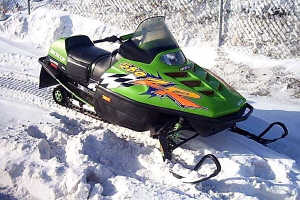
Up to 720 snowmobiles, like this '97 Arctic Cat, will be allowed in Yellowstone each day during the winter.
What do the National Park Service hierarchy and members of the U.S. Senate Appropriations Committee know about snowmobiles and their impacts that Yellowstone's scientists, the Environmental Protection Agency, and seven former NPS directors don't know?
I ask that question because the Appropriations Committee late last week marked up the Interior Department's budget and, while boosting funding over the president's proposal, it also agreed that upwards of 720 snowmobiles a day should continue to cruise Yellowstone in winter.
While the snowmobile provision was included in the last three Interior Department budgets courtesy of Senator Conrad Burns of Montana, he no longer strides the Senate halls as a member, as he was voted out of office last fall. However, NPS officials reportedly asked that the language be retained this year.
Part of the rationale, I believe, is that without such language no snowmobiling would be allowed in Yellowstone or Grand Teton next winter unless the current draft Environmental Impact Statement and its preferred alternative, or a version thereof, become law of the parks' wintry landscapes before December.
What I continue to struggle to understand is how the Park Service can stay behind such a faulty proposal, one that:
* goes against science;
* against the agency's own Management Policies;
* against Interior Secretary Dirk Kempthorne's proclamation that, "(W)hen there is a conflict between conserving resources unimpaired for
future generations and the use of those resources, conservation will be
predominant," and;
* against the hundreds of thousands of Americans who over the past seven years have voiced a decided opposition to snowmobiles in Yellowstone.
What generates further head scratching, in light of the extensive and longstanding public opposition, is that a letter-writing campaign by only about three dozen or so businesses in gateway towns surrounding Yosemite National Park convinced NPS Director Mary Bomar to cancel a proposed increase in Yosemite's entrance fees.
In the Yosemite matter park spokesman Scott Gediman said that the Park Service "heard loud and clear that these groups were against" the fee increase. So are we to assume the public comment on the Yellowstone snowmobile issue hasn't been heard?
As for the Senate Appropriations Committee's work on the Interior budget, it authorized $2.46 billion for the Park Service in fiscal 2008, or $172 million over current funding levels and $98 million over the president's request. In the agency's operations budget, the committee authorized $1.96 billion in spending, which would allow the hiring of 3,000 additional rangers.
The committee also fully funded the $100 million Centennial Initiative, and moved to strike a rider attached last fall to the Defense Department funding bill by Rep. Duncan Hunter that would prevent the Park Service from removing non-native elk and deer from part of Channel Islands National Park.
As for the proposed $3 billion Centennial Initiative, I'm told that while the committee approved the president's $100 million request toward that goal, it did not provide an additional $100 million that would be used to match up to $100 million in private donations.
Story Categories:
A copy of National Parks Traveler's financial statements may be obtained by sending a stamped, self-addressed envelope to: National Parks Traveler, P.O. Box 980452, Park City, Utah 84098. National Parks Traveler was formed in the state of Utah for the purpose of informing and educating about national parks and protected areas.
Residents of the following states may obtain a copy of our financial and additional information as stated below:
- Florida: A COPY OF THE OFFICIAL REGISTRATION AND FINANCIAL INFORMATION FOR NATIONAL PARKS TRAVELER, (REGISTRATION NO. CH 51659), MAY BE OBTAINED FROM THE DIVISION OF CONSUMER SERVICES BY CALLING 800-435-7352 OR VISITING THEIR WEBSITE. REGISTRATION DOES NOT IMPLY ENDORSEMENT, APPROVAL, OR RECOMMENDATION BY THE STATE.
- Georgia: A full and fair description of the programs and financial statement summary of National Parks Traveler is available upon request at the office and phone number indicated above.
- Maryland: Documents and information submitted under the Maryland Solicitations Act are also available, for the cost of postage and copies, from the Secretary of State, State House, Annapolis, MD 21401 (410-974-5534).
- North Carolina: Financial information about this organization and a copy of its license are available from the State Solicitation Licensing Branch at 888-830-4989 or 919-807-2214. The license is not an endorsement by the State.
- Pennsylvania: The official registration and financial information of National Parks Traveler may be obtained from the Pennsylvania Department of State by calling 800-732-0999. Registration does not imply endorsement.
- Virginia: Financial statements are available from the Virginia Department of Agriculture and Consumer Services, 102 Governor Street, Richmond, Virginia 23219.
- Washington: National Parks Traveler is registered with Washington State’s Charities Program as required by law and additional information is available by calling 800-332-4483 or visiting www.sos.wa.gov/charities, or on file at Charities Division, Office of the Secretary of State, State of Washington, Olympia, WA 98504.


National parks and their natural resources belong to you. The National Parks Traveler works to ensure you know how these essential places are being cared for.
Sign Up For Our Weekly Newsletter
Unsubscribe at any time.
INN Member

The easiest way to explore RV-friendly National Park campgrounds.

Here’s the definitive guide to National Park System campgrounds where RVers can park their rigs.
Our app is packed with RVing- specific details on more than 250 campgrounds in more than 70 national parks.
You’ll also find stories about RVing in the parks, tips helpful if you’ve just recently become an RVer, and useful planning suggestions.

