
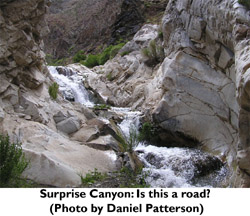
 There's a unique side canyon that spills out of Death Valley National Park that's surprisingly lush with cottonwoods, willows, daisies and even waterfalls. It's a place so unique in this otherwise parched landscape that it's known simply, but succinctly, as Surprise Canyon.
While the head of the canyon is within the park's borders, thanks to an extension Congress approved in 1994, the lower portion cascades down U.S. Bureau of Land Management land. Once upon a time, Surprise Canyon led miners into the hills around Panamint City.
Off-roaders "discovered" the canyon in the late 1980s and, through a mix of winches and rock piles, coaxed their rigs up the canyon, climbing four waterfalls in the process. Well, along the way to having a good ol' time these boys rolled a couple of their rigs, dumped oil, gas and who knows what else, and generally chewed up the landscape.
Six years ago conservation groups sued the BLM over this "fun," charging that the agency had failed to evaluate the impacts on Surprise Canyon and its flora and fauna. In 2001, the BLM closed the route through Surprise Canyon to motorized travel. A year later the Park Service closed the upper section.
Today, though, lawyers are back in court, jockeying to see whether Surprise Canyon will remain closed or be reopened to four-wheelers.
"The public shouldn't be forced to see Surprise Canyon's tremendous natural values destroyed by a handful of off-road vehicle users, especially when there are so many off-roading opportunities available elsewhere in the Mojave desert," says Howard Gross, program manager of the National Parks Conservation Association that has joined other conservation groups to fight a bid by off-roaders to gain access to the canyon.
The off-roaders' lawsuit, filed last month, contends in part that the canyon's sheer walls and creek-bed are in actuality a "constructed highway" that they have a right to under a Civil War-era statute known today simply as R.S. 2477. Under that statute, initially created to further western expansion, some states, counties and off-road groups have claimed that washes, two-tracks, even hiking trails are "highways" that they are entitled to travel.
"In many cases, off-road interests have viewed R.S. 2477 as a way to undermine effective protection of wildlife habitat, wilderness and other values of public lands," says Mary Wells of the California Wilderness Coalition that has joined NPCA, The Wilderness Society, the Center for Biological Diversity, the Sierra Club, and Public Employees for Environmental Responsibility in a bid to intervene in the lawsuit the off-roaders brought against the BLM.
Chris Kassar, a wildlife biologist for the Center for Biological Diversity, says preserving the canyon and its riparian qualities "is critical to the recovery of the Inyo California Towhee and the conservation of other imperiled species such as the Panamint Alligator Lizard. Allowing off-roaders back into Surprise Canyon will set back recovery by decades by increasing soil erosion and polluting the waters of the creek."
A copy of National Parks Traveler's financial statements may be obtained by sending a stamped, self-addressed envelope to: National Parks Traveler, P.O. Box 980452, Park City, Utah 84098. National Parks Traveler was formed in the state of Utah for the purpose of informing and educating about national parks and protected areas.
Residents of the following states may obtain a copy of our financial and additional information as stated below:
- Florida: A COPY OF THE OFFICIAL REGISTRATION AND FINANCIAL INFORMATION FOR NATIONAL PARKS TRAVELER, (REGISTRATION NO. CH 51659), MAY BE OBTAINED FROM THE DIVISION OF CONSUMER SERVICES BY CALLING 800-435-7352 OR VISITING THEIR WEBSITE. REGISTRATION DOES NOT IMPLY ENDORSEMENT, APPROVAL, OR RECOMMENDATION BY THE STATE.
- Georgia: A full and fair description of the programs and financial statement summary of National Parks Traveler is available upon request at the office and phone number indicated above.
- Maryland: Documents and information submitted under the Maryland Solicitations Act are also available, for the cost of postage and copies, from the Secretary of State, State House, Annapolis, MD 21401 (410-974-5534).
- North Carolina: Financial information about this organization and a copy of its license are available from the State Solicitation Licensing Branch at 888-830-4989 or 919-807-2214. The license is not an endorsement by the State.
- Pennsylvania: The official registration and financial information of National Parks Traveler may be obtained from the Pennsylvania Department of State by calling 800-732-0999. Registration does not imply endorsement.
- Virginia: Financial statements are available from the Virginia Department of Agriculture and Consumer Services, 102 Governor Street, Richmond, Virginia 23219.
- Washington: National Parks Traveler is registered with Washington State’s Charities Program as required by law and additional information is available by calling 800-332-4483 or visiting www.sos.wa.gov/charities, or on file at Charities Division, Office of the Secretary of State, State of Washington, Olympia, WA 98504.
INN Member

The easiest way to explore RV-friendly National Park campgrounds.

Here’s the definitive guide to National Park System campgrounds where RVers can park their rigs.
Our app is packed with RVing- specific details on more than 250 campgrounds in more than 70 national parks.
You’ll also find stories about RVing in the parks, tips helpful if you’ve just recently become an RVer, and useful planning suggestions.


Comments