
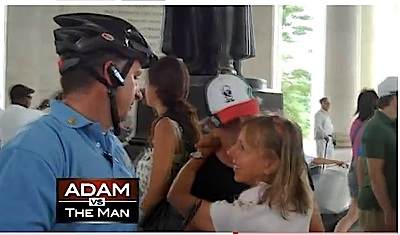
A group of visitors to the Jefferson Memorial was arrested last Saturday for dancing inside the memorial. Images pulled from Adam vs. the Man video.
The words of Thomas Jefferson, some written more than 200 years ago, have shaped American ideals. Today, many of these impressive, stirring words adorn the interior walls of his memorial. The Thomas Jefferson Memorial stands as a symbol of liberty and endures as a site for reflection and inspiration for all citizens of the United States and the world.
Those words are on the homepage of the National Park Service's website for the Jefferson Memorial. But does the memorial stand "as a symbol of liberty and endure as a site for reflection and inspiration for all citizens of the United States and the world"? Some might wonder following an incident this past Saturday at the memorial in which U.S. Park Police brusquely -- some might say excessively, what with the use of chokeholds and knees pinning heads to the memorial's floor -- arrested a number of visitors in the memorial for ... quietly dancing.
Thomas Jefferson, our country's third president, valued liberty highly, as a review of his quotations attests:
"I would rather be exposed to the inconveniencies attending too much liberty than to those attending too small a degree of it."
"The boisterous sea of liberty is never without a wave."
"..I have sworn upon the altar of god eternal hostility against every form of tyranny over the mind of man."
That last entry comes from an inscription within the memorial, an irony that can't be escaped in the wake of the arrests.
When did dancing become a sign of protest, and when was it outlawed in the memorial? How do you measure reasonable force vs. excessive force when police are arresting those behind passive acts of civil disobedience? Would those questions, which might come to mind after watching the following video, have been moot if the Park Police had simply ignored the dancers?
Now, the dancing was not spontaneous, and likely had its roots in a similar incident in 2008 when Mary Oberwetter was arrested in the memorial for dancing in celebration of Thomas Jefferson's birthday.
Ms. Oberwetter's lawsuit against the National Park Service, for a violation of her First Amendment rights, was initially dismissed by a federal judge and her appeal of that also failed, on this past May 17. In its ruling, the U.S. Court of Appeals for the D.C. Circuit held that the Jefferson Memorial should have a “solemn atmosphere" and that silently dancing was an inappropriate form of expression there.
Furthermore, the appellate judges agreed with the lower court that the interior of the open-air memorial is "not a public forum," and so any demonstrators must first obtain a permit. Demonstrations that require permits in the Park Service's National Capital region are defined as "picketing, speechmaking, marching, holding vigils or religious services and all other like forms of conduct which involve the communication or expression of views or grievances, engaged in by one or more persons, the conduct of which has the effect, intent or propensity to draw a crowd or onlookers. [The] term does not include casual park use by visitors or tourists which does not have an intent or propensity to attract a crowd or onlookers."
Against those regulations, the appellate court wrote:
Although silent, Oberwetter’s dancing was a conspicuous expressive act with a propensity to draw onlookers. True, it occurred close to midnight on a weekend, making it less likely that a crowd would gather. But the question is not whether her dancing was likely to attract attention at that particular time. As with the other prohibited activities of “picketing, speechmaking, marching, [and] holding vigils or religious services,” expressive dancing might not draw an audience when nobody is around. But the conduct is nonetheless prohibited because it stands out as a type of performance, creating its own center of attention and distracting from the atmosphere of solemn commemoration that the Regulations are designed to preserve.
Furthermore, the judges added:
National memorials are places of public commemoration, not freewheeling forums for open expression, and thus the government may reserve them for purposes that preclude expressive activity. Oberwetter points out that the Jefferson Memorial is located within the National Park system, and that public parks are quintessential examples of traditional public forums. Even so, we have recognized that our country’s many national parks are too vast and variegated to be painted with a single brush for purposes of forum analysis. “Presumably, many national parks include areas—even large areas, such as a vast wilderness preserve—which never have been dedicated to free expression and public assembly, would be clearly incompatible with such use, and would therefore be classified as nonpublic forums.”.... In creating and maintaining the Jefferson Memorial in particular, the government has dedicated a space with a solemn commemorative purpose that is incompatible with the full range of free expression that is permitted in public forums.
What would Thomas Jefferson think?
Story Categories:
A copy of National Parks Traveler's financial statements may be obtained by sending a stamped, self-addressed envelope to: National Parks Traveler, P.O. Box 980452, Park City, Utah 84098. National Parks Traveler was formed in the state of Utah for the purpose of informing and educating about national parks and protected areas.
Residents of the following states may obtain a copy of our financial and additional information as stated below:
- Florida: A COPY OF THE OFFICIAL REGISTRATION AND FINANCIAL INFORMATION FOR NATIONAL PARKS TRAVELER, (REGISTRATION NO. CH 51659), MAY BE OBTAINED FROM THE DIVISION OF CONSUMER SERVICES BY CALLING 800-435-7352 OR VISITING THEIR WEBSITE. REGISTRATION DOES NOT IMPLY ENDORSEMENT, APPROVAL, OR RECOMMENDATION BY THE STATE.
- Georgia: A full and fair description of the programs and financial statement summary of National Parks Traveler is available upon request at the office and phone number indicated above.
- Maryland: Documents and information submitted under the Maryland Solicitations Act are also available, for the cost of postage and copies, from the Secretary of State, State House, Annapolis, MD 21401 (410-974-5534).
- North Carolina: Financial information about this organization and a copy of its license are available from the State Solicitation Licensing Branch at 888-830-4989 or 919-807-2214. The license is not an endorsement by the State.
- Pennsylvania: The official registration and financial information of National Parks Traveler may be obtained from the Pennsylvania Department of State by calling 800-732-0999. Registration does not imply endorsement.
- Virginia: Financial statements are available from the Virginia Department of Agriculture and Consumer Services, 102 Governor Street, Richmond, Virginia 23219.
- Washington: National Parks Traveler is registered with Washington State’s Charities Program as required by law and additional information is available by calling 800-332-4483 or visiting www.sos.wa.gov/charities, or on file at Charities Division, Office of the Secretary of State, State of Washington, Olympia, WA 98504.


Comments
Dancing thre may be illegal, but the cops have discretion and it is obvious from the half hearted "dancing" that it would have been over in minutes. Even if arrests were necessary the police were too physical in this situation. Judo throws?
Come on guys, we have had protests all over the city, we as police officers know that they are only dancing and dancing is protected uner the first amendment.
As a cop in DC I have seen much worse in the 1970's and we didn't lock them up or throw them on the ground for dancing. These are our people for God's sake.
He didn't get body slammed for dancing.. He was resisting arrest. If you dont go peacefully with the police wtf do you think is going to happen, they are not going to through pillows or flowers at you.. Maybe a elbow to the face. Wake up spoiled self entitled brats, Jefferson Memorial isn't a dance party place. Its a place for respect, insperation, and to learn about historic events, not to dance. I'm slightly disappointed they didnt do that to everyone else.
When you go against Authority, expect the battle
The people who did this planned this out and were doing this on purpose to get this on camera and claim that they're patriots for free speech, freedom of expression and what not.. They aren't. they're just a bunch of liberals wasting the time and energy of officers that would rather just be patrolling the area instead of arresting someone.
Those cops should be arrested for drawing attention to themselves since that's what's illegal.
So the law is "don't do anything that would draw attention to yourself at the memorial". Which means don't do anything the cops don't want you to, since you could blow a bubblegum bubble and they could say it drew their attention. Or you could dance or pose for a photo, or sing or do a cartwheel or even just stretch your hands to the sky or otherwise express an emotion and it would be probable cause or justifiable arrest, since emotions draw attention. What if you were to cry as you thought about how stifled and suppressed our nation is that at a memorial for Thomas Jefferson who valued freedom, who is a symbol and hero of freedom, that at that very memorial for him expressions of emotion are outlawed to such an extreme degree that even crying could be something you could be arrested for. A sad fucking state indeed. And that some people think this is normal or they are happy to see the dancers shut down, they want to see emotion locked behind bars and fined and hidden and repressed. Joy to guns and killing and repressing your emotions until you buy an automatic weapon and go to your local school and gun down the young children there to save them from growing up and being exposed to such a sad state of humanity where they will learn to despise their fellow human and hide all emotions for fear of being arrested for displaying something "inappropriate". The comments on here supporting this repression are no surprise, though. It is this culture that creates this distance, this hate and detachment, this desire for order in the chaos to the point that they are willing to give up basic human behavior and stifle freedom. It's no wonder the killings continue and no one gives a fuck.
hmmmm --- a very wise man wrote that "Foul language is the pitiful attempt of a feeble mind to express itself forcefully."
When you back talk the police, refuse to comply with heir orders, resist arrest, etc., you are asking for trouble. These people were idiots and were asking for it. No I do not think dancing anywhere should be a crime as long as it is done resoectfuly, but the rules are the rules and people need to respect authority PERIOD!
....said the population of Germany in 1939.
Yes! Judo throws! When you are given a lawful command by a police officer and you refuse to comply....offender beware.
Some places are more appropriate for celebrations. A few years ago I participated in a wedding on the west lawn of the Jefferson Memorial, a nice spot with a view of the memorial building and the Tidal Basin. The National Park Service issues permits for that site.
Licensing: When the government takes away your rights and then sells them back to you. Jefferson would be heartbroken.
Jefferson? A Virginia gentleman with an eye for the ladies? Against dancing? Please.
"A Puritan lives in constant fear that someone, somewhere, may be having a good time."
As long as no one was blocking an exit and they have their clothes on, let them dance away! This is, of course, from someone, who, along with my fellow group exuberant group of high school Girl Scouts, got yelled at for running up the steps of the Supreme Court building about 8 p.m. after the building was closed over a quarter century ago. It still hurts, even now.
I suppose I ought to go turn myself in, since I've danced (to the music) on the Arch grounds, and to fiddle music on Ozark Riverways. I didn't have a permit either time.
They weren't at Arlington, dancing on JFK's grave or before the Tomb of the Unknowns, or inside the National Cathedral. Those could and would reasonably be considered inappropriate behavior, IMO, but at the memorial for Uncle TJ? Let the party begin!
In any event, NPS sort of pulled a public relations rock here, IMHO. How much is all this bad PR costing in terms of public support? Better to let a few crazies wear themselves out for a few minutes. After all, who really owns the Mall? On a scale of the 1960s to 2011, this just doesn't even register.
Well it depends. All citizens have a right to enjoy the memorial. If a group of Girl Scouts had made the trip from Washington State to Washington DC and went to the memorial to honor Jefferson and quietly discuss his contributions to America and some group of dancers were interfering with their right to enjoy the memorial then it is not OK.
These individuals came only to cause trouble and draw attention to themselves. The fact that the leader has a website only shows that. If I was a visitor to the Memorial I would not want this activity of dancing and kissing going on before me. The individuals were warned and they just wanted to provoke an incident. That is what is destroying this country to much tolerance for absolutes and this just shows that.
You would seem to be one of those liberals intent on perfecting the 'nanny state'. I hope you never achieve such a dream as even yourself would deeply regret it!
Your right sir. People kissing or slow dance in public is just a vile act of terrorism and against everything America stands for. I also suggest we arrest anyone with Obama or palin shirts and Any other form of political expression should either be forced to strip or down or go to jail. Obviously stripping down should send you directly to jail. Any sort of singing via from child or adult in jail too. Long hair also an offense, and individuals thar are Muslims. Obviously the officer should be unable to explain what law you are being arrested for and generally waste I mean correctly use tax payer money.
Obviously at no point should anyone just be escorted off the site with a warning, placing in handcuffs because the officer is annoyed is the correct response. Remember at no point are any of the individual have rights or pay taxes that pay for these officers.
Dissent is the highest form of Patriotism.
These unwaranted restrictions are being promulgated by the type judges who think that it is ok to put "In god we trust" inside a courtroom and on currencies, acts that are clear violations of the letter and spirit of the US Constitutions!
You mean like the absolute regulation and enforcement of a no dancing rule?
Yeah, that's what this country needs ;more doing what you're told to do. Because, you know, that worked so well for our ancestors in colonial America.
My right to swing my arm ends at your nose. Dancing hurts no one. This is authoritarianism for the sake of being in charge and forcing people to obey. Full stop. There is no other purpose.
Air of solemnity. That's hogwash. Why do they get to decide how I honor of finding fathers? Or finding fathers were as celebratory as they come. They met in taverns, for crying out loud.
They might have been out to provoke a response but they deliberately did a non-threatening, nonviolent, quiet thing, to show how even that can get you judo slammed on the floor with 4 police officers on top of you in America. Watch the video notice how they purposely weren't resisting, but the police were still repeatedly screaming, "Stop resisting! Stop resisting!" Did you notice how the only thing they were shouting was their own rights? Don't try and let the police off on this one, dancing gets treated this way in Saudi Arabia for Christ sake!
I agree. By the responses to the officer warning them not to dance, you can tell that they WANTED to cause a disturbance. Then, they post these videos and say the police are the bad people here?? That's the comical part to me, but so many jump on their wagon and defend them, while bashing the police! I hope that those bashing never need the help of an officer.. They should be required to call someone who only wants to cause a disturbance in their time of need!
Thomas jefferson disagrees with you. He said: "I would rather be exposed to the inconveniencies attending too much liberty than to those attending too small a degree of it."
The right to freedom is not regulated by if someone finds an act annoying. If that was the case you'd be violating my freedom right now.
Yeah, there's just too much tolerance in this country! MAKE AMERICA GREAT AGAIN!!!
Amen to that. Such a shame people have to cause a scene and throw a fit when it does nothing for them.
"A Puritan lives in constant fear that someone, somewhere, may be having a good time."
I find no proof that they had planned what happened, either their actions or anyone else's. That would actually be an unfactual statement.
I am distrubed by reading your comments. It's a catch 22. They were there because we as free Americans should not be arrested for dancing or kissing in public spaces. There are appropriate places to do these things, but the fact that there is a law against it is the problem. Their arrest was justifiable because they were in fact protesting, but that doesn't mean that the law itself is right. It is a small but wrong step towards taking away our first amendment rights.
I'm in stunned silence! Why have we become a police state?
You obviously stunt l don't understand the definition of police state. Read the article before making stupid commentary.
I have no opinion about the legitimacy of the law, but I feel that as they were warned and continued then they deserve to be arrested. The resisting of arrest ruined any point they were making. If they would have quietly allowed themselves to be arrested then it would have gone a lot farther for me that they were trying to make a point. As it is they all came off as trouble starters and not protesters. I feel they earned every thing they got once they started arguing and and physically resisting.
The participants were fairly warned, and repeatedly. They were clearly there to provoke an incident. The law has been reitterated clearly for them, and repeatedly.
Were I visiting at that time, I wouldn't want to visit the Jefferson or any of the US state park monuments in the DC Area and have out-of-place dancing happening around me.
These people were clearly there to dance purely because it's Inappropriate, unwelcome and deemed illegal expression. The law of the parks states clearly that these monuments are not considered Public Areas for protest or self-expression, but for historical visitation and solemn appreciation. How do you arrive at a place for solemn appreciation and discover visitors who are dancing and otherwise choosing to draw attention to themselves. Not considerate of the other park visitors at all.
A Police state? they would not have gotten such repeated fair warning in "police state" people...you think protestors in China or Singapore would ever get repeated fair warning that what they are about to do is a breech and against the law? You think these characters and provocateurs and instigators would not have been tazed in any real Police State? Heck ya, they would have. Tazed to unconsciousness, baby!
They would not have been warned and they would not have been merely subdued with necessary trips and holds.
The people who were there to "dance" knew what they were doing was illegal and inappropriate.
They would be better served by finding something more constructive to do with your anger.
unreal, so hypocritical...Thomas Jefferson committed high treason against his country, based on moral beliefs yet we celebrate this with monuments to his life and works. If people want to protest by dancing good for them, there was no harm. does someone seeking attention really bother you if you aren't giving them attention? anyone who cant see that this is just ridiculous, and bitter person. know your hi sorry people.
Without resisting arrest we would never have had the civil rights movement. It is not just the right but the responsibility of every American citizen to stand up for - and protest, peacefully - against unjust laws. Passively accepting the garbage the officers were throwing out - without even having the decency to cite what law the dancers (I hardly call them protesters) were breaking would be an act of cowardice before injustice. Every one of those officers should have been reprimanded, whereas the people dancing harmed no one.
This is a national park and as such is supported by tax payers dollars. I as a tax payer believe in the freedoms granted to all citizens under the constitution. If these people had been causeing a commotion or interfering with the rights of others visiting this memorial then perhaps this would be warranted . It is not up to the government to run the people ...it is the people who run our government...by the people and for the people and I am outraged at the lack of respect for our freedoms. This memorial should not be a religious shrine , a place that people venerate as if it memorializes some God. There is no divine presence there just an image or idol of a past president...a man . To arrest these people whilst allowing the protests / riots in opposition of President Trump is utter tyranny . The declaration of independence holds a very important clause : That whenever any Form of Government becomes destructive of these ends, it is the Right of the People to alter or to abolish it, and to institute new Government, laying its foundation on such principles and organizing its powers in such form, as to them shall seem most likely to effect their Safety and Happiness. Prudence, indeed, will dictate that Governments long established should not be changed for light and transient causes; and accordingly all experience hath shewn that mankind are more disposed to suffer, while evils are sufferable than to right themselves by abolishing the forms to which they are accustomed. But when a long train of abuses and usurpations, pursuing invariably the same Object evinces a design to reduce them under absolute Despotism, it is their right, it is their duty, to throw off such Government, and to provide new Guards for their future security. It was the reasons the colonies fought for freedom from oppresive British rule and it is the same be the reason" We the people will rise up and fight the despotism and tyranny, the abuses and ussurpations that are strangling the life from our constitution and denying us our unalinable rights. Life,liberty and the pursuit of happiness and dancing is an exhibition of all three of these rights. Thomas Jefferson not only knew this , but left his signature to attest to his aproval of this.
Allow me to put some perspective on this:
If you protest the arrest of someone caught shoplifting (a victimless crime!) by shoplifting - guess what's gonna happen?
If you want to demostrate on public lands, you'se gonna need a permit.
As McCoy said: "How can you get a permit to do a dam illegal thing?"
As god is my witness, I loathe attention-whores more than Illinois Nazis.
How is shoplifting a victomless crime? Your argument is invalid.
Shoplifting is not victimless. The store is the victim.
How about some background info on Adam vs The Man? This sounds a lot like the so-called free speech movement of the 60's. What are they protesting? What's their reason for this?
One line of the Oberwetter decision says a lot: "In creating and maintaining the Jefferson Memorial in particular, the
government has dedicated a space with a solemn commemorative purpose
that is incompatible with the full range of free expression that is
permitted in public forums."
This is from the Adam vs The Man website: "Tonight on ADAM VS THE MAN with Adam Kokesh: Welcome to – THE – ADAM VS
THE MAN – SCHOOL’S OUT FOR SUMMER special! Congratulations to all of our
viewers completing a term of forced government indoctrination. Adam is
here to help you unlearn what you have learned and start learning about
what really matters. NEVER let your schooling – get in the way of your
education. Stefan Molyneux
joins Adam to explain how “children are people, too,” Students for
Liberty is in studio for a jobs forecast (it’s not going to be raining
jobs) – we’ll play “IS IT A SCHOOL, OR IS IT A PRISON” and we’ve got
Brett Veinotte of the “School Sucks” Podcast! And dancing! And singing! School’s out, but class is in!"
Sounds to me like some kind of immature attention getting effort by someone who has some kind of bone to pick with someone. There is obviously some background information that is missing from the article here and in the video.
You disagree with him, so what. Does this anyone the right to body slam, choke, assault, arrest, and detain a fellow citizen? They were harming no one.
"This sounds a lot like the so-called free speech movement of the 60's." --- or maybe it is just like the "so-called" civil liberties movement at lunch counters during the 50's and 60's.... this is dangerous ground you tred on when you start picking and choosing who's free speech and expression is "okay"
yes, they have the right. These guys were not going peacefully. They were resisting arrest. If they were making a peaceful protest, they turn, willingly and put their hands behind their backs. These protesters were not peacefully there to dance. They were angrily there to resist arrest because They Felt They Were Being Wronged. That's not a peaceful protest.
IMHO, MLK would be ashamed.
This is a sad day when you can be assaulted and detained for dancing in a memorial built to honor one of the greatest advocates of liberty and free expression the world has witnessed.
Those those who think this police action is justified:
Timid men prefer the calm of despotism to the tempestuous sea of Liberty. – Thomas Jefferson
I read a whole bunch of gobbledegook on the website. Doesn't seem to make much sense but seems to be either a radical right or radical left political site. Here's another example:
"Tonight on ADAM VS THE MAN with Adam Kokesh: Thank you, thank you, thank
you. According to Metro spokesman Dan Stessel as quoted in the
Washington Post after we were told that no one from the Metro Authority
would be speaking to the media until after the investigation, “We’ve
certainly heard from the public about it.” And it has been announced
that the absurd assault charges against the victim of the wheelchair
police assault have been dropped. Adam has more on that and talks to Tim
Cox from GOOOH to explain how G – O – O – O – H (get out of our house) is NOT actually pronounced “goo.” Rand Paul,
despite being the subject of absurd attacks from silly lefties is
standing up for their rights too! He’s been doing his best to stop the
unPATRIOT ACT and Utah goes for the gold! Money that is. Adam catches up
with Stefan Molyneux to
explain how this means the end of democracy (that’s a good thing.) LONG
LIVE THE REPUBLIC! That is, until the necessary evil of government is no
longer necessary. You’re watching ADAM VS THE MAN."
Anonymous, there is obviously much more behind this video. It's very easy to edit video to make the cops look like total bad guys.
I'd very much like to hear the entire story. Unedited.
While I get the people were there for that reason, trying to stir things up and make an anti-government video, I am not sure I understand why the officer could not or would not cite what law was being broken. Also, near the end the officer told the cameraman you're not allowed to video in here. Really? I've always had my video camera on vacation trips to the DC monuments. Was I breaking a law without knowing it?
Well here I go again.
One question after viewing the video and reading the comments: What happened to good old COMMON SENSE ?
This has become my favorite phrase recently in light of all the regulations, policies, litigations and best available science.
I got to tell you that in my opinion, it's a TIE.
I think both sides had some good points (and as many of you know, I am a little miffed with the NPS right now) and both sides wound up looking stupid. So it's a wash. Both sides had the opportunity to come out a winner if only either had used a little COMMON SENSE.
Lee,
I hope you messed up on your attempt to enlighten us about "Adam" because I didn't understand much of it. But, I'm probably not supposed to.
Ron (obxguys)
Medea Benjamin, Adam Kokesh, and Co. got exactly what they wanted with their publicity stunt: lots of publicity, arrests, and unwarranted sympathy for their claim that they live in a police state.
Civil disobedience results in arrests. If you don't get arrested, you've failed. If you resist when an officer attempts to make an arrest, pain is a likely result. Especially if the officer you're resisting is smaller and less physically strong than you are. (That's why bars hire bouncers who are built like refrigerators.)
Read the D.C. Circuit Court ruling from May 17, 2011, if you want to know what led to the disturbance.
PS. It was most assuredly _not_ a flash mob.
Don't feel to sorry for these folks geting arrested. They do it on a regular basis. They are part of the group Codepink and have staged demonstrations may times that have gotten them arrested. They are not innocent victims. Seems ironic that they are complaining about being in a police state, but if their Marxist/Communist/Socialist political views are implemented they would really have a police state.
One person was in a Code Pink shirt, but I assure this was not organized by Code Pink. Adam Kokesh, one of the main organizers is a verteran of Iraq who now opposes the war. He ran for congress in 2010 as a Republican in New Mexico. His positions are mostly libertarian, anti-war, and pro liberty.
Pages