
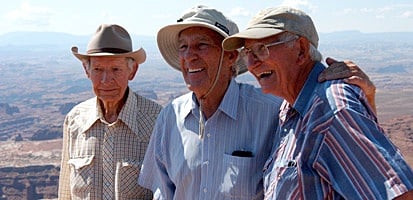
In 2006 (top photo) Stewart Udall returned to Canyonlands National Park to recall the park's establishment. Joining him were two other conservation giants from the area, Ken Frost (to Udall's right), and Ken Sleight. During his tenure as Interior secretary during the Johnson administration, Secretary Udall joined Lady Bird Johnson for a raft trip in Grand Teton National Park. NPS photos.
If you've ever enjoyed a national park, hiked down a trail, backpacked into wilderness, or paddled a wild and scenic stream, pause and give a minute of thanks for Stewart L. Udall.
One of the most aggressive Interior secretaries of recent decades when it came to conserving landscapes as parks, monuments, wildlife refuges, national seashores, and wild and scenic rivers, Mr. Udall presided over a vibrant chapter of U.S. conservation during the 1960s. Along with seeing the establishment of Canyonlands, North Cascades, Redwood, and Guadalupe national parks, the Democrat whose roots ran deep in the Southwest helped shepherd The Wilderness Act, the National Wild and Scenic Rivers Act, the National Trails System Act, and the Endangered Species Act into the country's environmental consciousness.
When he passed away at his Santa Fe, New Mexico, home on March 20 at the age of 90, Mr. Udall's conservation ethics were once again thrust into the forefront of environmental activism as a symbol of what can be done with enough determination and desire. Though the late David Brower was unsuccessful in pleading with Secretary Udall not to plug the Colorado River with the Glen Canyon Dam, the secretary had so many achievements in land and water conservation that it's perhaps reasonable to forgive this failing.
As Thomas G. Smith noted in 1995 in John Kennedy, Stewart Udall, and New Frontier Conservation, the president and his Interior secretary approached the management of federal lands with a goal to provide "efficient resource use, public recreation, and the expansion of national parks," goals which the author noted Presidents Truman and Eisenhower had neglected.
"At the same time, they confronted an emerging ecological outlook that stressed wilderness preservation, environmental protection, and the interdependence of all parts of the natural world," Mr. Smith pointed out.
In approaching that mission, Secretary Udall corralled bipartisan support in Washington, something unheard of today.
"Stewart Udall’s adherence to bipartisanship to protect the environment serves as a dramatic contrast to the venomous partisanship that today characterizes the House and Senate Republican leaders," Brent Blackwelder, president emeritus of the Friends of the Earth, noted in applauding his legacy. "Stewart and his brother Rep. Morris Udall (1922-1998) worked with the Republican leaders of their day to solve problems and together, the bipartisan combination set milestones in conserving land, water, and wildlife."
One of the West's foremost political dynasties, the Udalls -- patriarch Levi, who served as chief justice of the Arizona Supreme Court; younger brother Morris, who also served in Congress and ran unsuccessfully for president and; son Tom, a U.S. senator from New Mexico -- grew up on the landscape that through the decades has been the focal point of opposing factions who thought they knew best how those lands should be stewarded. No doubt that familial history helped guide Stewart Udall's hand, both during his congressional tenure and his years as Interior secretary for Presidents Kennedy and Johnson. Though he was a champion of water projects, he also knew when land should be preserved just as it is.
"I had no idea anything like that existed there," he was said to remark in the early 1960s when he was flown over a southeastern Utah landscape that was being eyed for a dam along the Colorado River. "God almighty, that's a national park."
And under Secretary Udall it became one -- Canyonlands National Park.
Canyonlands was just one part of Secretary Udall's legacy. During his time in Washington he:
* Oversaw the addition of four parks, six national monuments, eight seashores and lakeshores, nine recreation areas, 20 historic sites and 56 wildlife refuges....
* Saw President Johnson sign into law the Wilderness Act, the Water Quality Act, the Wild and Scenic Rivers Act and National Trails Bill.
* Helped spark a cultural renaissance in America by setting in motion initiatives that led to the Kennedy Center, Wolf Trap Farm Park, the National Endowments for Arts and the Humanities, and the revived Ford’s Theatre.
* And was a recipient of the Ansel Adams Award, the Wilderness Society’s highest conservation award, and the United Nations Gold Medal for Lifetime Achievement.
Among the units of the National Park System he helped create, in addition to those mentioned above, were Assateague Island National Seashore, Cape Lookout National Seashore, Indiana Dunes and Pictured Rocks national lakeshores, the Hubbell Trading Post National Historic Site, and Padre Island National Seashore.
At the Coalition of National Park Service Retirees, Rick Smith, who chairs the group's executive council, worked for three "distinguished (Interior) secretaries--Udall, (Rogers) Morton, and (Cecil) Andrus."
"His book, The Quiet Crisis, shaped a lot of my thinking about the environmental issues of the time," Mr. Smith said.
"The members of the Coalition of National Park Service Retirees mourn the death of Stewart Udall," he added. "Many of us worked during the time that he was secretary of the Interior. We remember him not only for being the champion of the establishment of many additions to the National Park System, but also as the energy behind the enactment of many of our nation's most important environmental laws, including the Wilderness Act, the Endangered Species Act, the National Trails Act, the Wild and Scenic Rivers Act, and the Land and Water Conservation Act.
"We also appreciated the fact that he was not a secretary isolated in his D.C. office. He got out and did things. His raft trips on the Colorado through Grand Canyon helped save the canyon from dams," continued Mr. Smith. "He was not a stranger in parks. Many of us remember seeing him in the parks in which we worked. In later life, he became a conservation guru, often writing and speaking on behalf of the environment and historic preservation. His contributions were enormous, and like many Americans, we will miss his wise counsel."
Story Categories:
A copy of National Parks Traveler's financial statements may be obtained by sending a stamped, self-addressed envelope to: National Parks Traveler, P.O. Box 980452, Park City, Utah 84098. National Parks Traveler was formed in the state of Utah for the purpose of informing and educating about national parks and protected areas.
Residents of the following states may obtain a copy of our financial and additional information as stated below:
- Florida: A COPY OF THE OFFICIAL REGISTRATION AND FINANCIAL INFORMATION FOR NATIONAL PARKS TRAVELER, (REGISTRATION NO. CH 51659), MAY BE OBTAINED FROM THE DIVISION OF CONSUMER SERVICES BY CALLING 800-435-7352 OR VISITING THEIR WEBSITE. REGISTRATION DOES NOT IMPLY ENDORSEMENT, APPROVAL, OR RECOMMENDATION BY THE STATE.
- Georgia: A full and fair description of the programs and financial statement summary of National Parks Traveler is available upon request at the office and phone number indicated above.
- Maryland: Documents and information submitted under the Maryland Solicitations Act are also available, for the cost of postage and copies, from the Secretary of State, State House, Annapolis, MD 21401 (410-974-5534).
- North Carolina: Financial information about this organization and a copy of its license are available from the State Solicitation Licensing Branch at 888-830-4989 or 919-807-2214. The license is not an endorsement by the State.
- Pennsylvania: The official registration and financial information of National Parks Traveler may be obtained from the Pennsylvania Department of State by calling 800-732-0999. Registration does not imply endorsement.
- Virginia: Financial statements are available from the Virginia Department of Agriculture and Consumer Services, 102 Governor Street, Richmond, Virginia 23219.
- Washington: National Parks Traveler is registered with Washington State’s Charities Program as required by law and additional information is available by calling 800-332-4483 or visiting www.sos.wa.gov/charities, or on file at Charities Division, Office of the Secretary of State, State of Washington, Olympia, WA 98504.

Comments
Beautiful tribute. I have to admire a man who hiked up from the bottom of the Grand Canyon to the top, refusing a mule, at the age of 84. And I especially admire his letter to his grandchildren in 2008 recognizing the far greater challenges to their generation: http://www.hcn.org/issues/367/17613
Stewart Udall's letter to his grandchildren - My generation’s mistakes, your generation’s epic challenge, is required reading.
One aspect of Stewart Udall's legacy was his relentless support as a lawyer representing those affected by exposure to radioactive fallout from atmospheric testing of nuclear weapons during the 1950's and early 1960's and Navajos who worked in uranium mines and who later contracted lung cancer. The following is a quote from Utah Congressman Jim Matheson:
http://matheson.house.gov/press2010/100320b.shtml
Matheson said Utahns will forever remember Udall’s fight on behalf of the victims of exposure to radioactive fallout from the nuclear weapons testing era and against the government cover up regarding the dangers.
“Stewart was the Western lion who roared when he read “top secret” government memos that referred to the people living downwind of the Nevada Test Site as “a low-use segment of the population”, said Matheson. “This was the land and the people that he loved. He knew them as patriotic Americans, who trusted their government. His legal crusade-- on behalf of the families of the Navajos who suffered lung cancer in uranium mining-- helped lead to the truth about the government conspiracy that harmed so many in the small towns of the Southwest.”
“Although the suffering from that era continues to this day, many of us at least have the satisfaction of knowing—thanks to men like Stewart Udall—that democracy can prevail against injustice and duplicity,” said Matheson.
I too feel it is important to call attention to the legacy of Stewart Udall from the work he did fighting for justice for Uranium Miners and atomic test fallout Downwinders. It would have been far harder to get attention and action to the endless problems with uranium mining, the vast problems left not just to the miners but to the rivers and lands of the west had he not launched his fight for justice for the miners and put the human faces out there on the issues where they belonged.
Likewise his fight for all of us downwinders, helped galvanize the grass roots opposition in what were also the high fallout areas to the MX, have given a serious and vocal road block to ever being able to resume underground nuclear testing, and have increased the attention of grass roots residents to a host of nuclear waste issues.
His lawsuits on behalf of miners and downwinders finally opened the flood gates of truth and forced out the secret documents, and decisions of the Cold War and demonstrated that as a nation, we freely risked our own citizens in the name of the bomb, and cared not who was harmed, and what was contaminated, and then lied about it and tried to keep it hidden for decades.
Few, ESPECIALLY GOVERNMENT OFFICIALS THAT REACHED HIS LEVEL OF INFLUENCE AND POWER, HAVE, OR STILL DO EVEN ATTEMPT TO HAVE THE GUTS, THE COURAGE, TO DO WHAT IS RIGHT, NO MATTER HOW BLACK THE POLICY MAKER'S EYE ENDS UP BEING! HE WILL BE MISSED.
J Truman
Director
Downwinders