
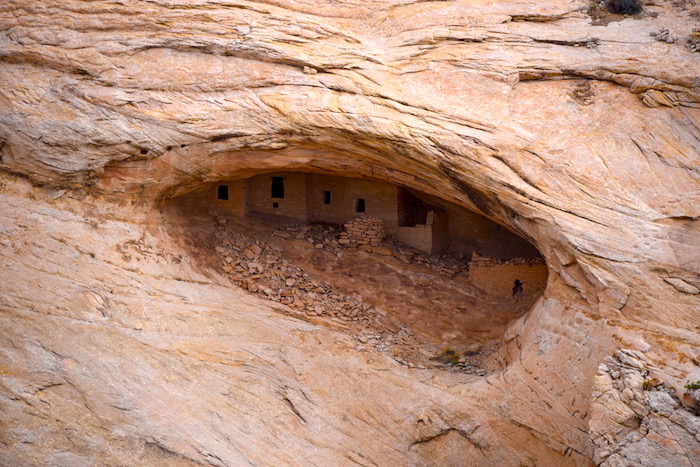
Editor's note: The fate of Bears Ears National Monument in southeastern Utah currently has moved into the legal arena, as groups challenge President Trump's move to shrink that monument as well as nearby Grand Staircase-Escalante National Monument. Contributing writer John Miles recently visited Bears Ears to take measure of its value as a monument, and to muse what might be lost if the president's move is upheld.
When I told a friend in Taos, New Mexico, where I reside, that I was heading over to Bears Ears National Monument in southeastern Utah, his response was pointed.
“We’d better get over there before the oil, gas, and uranium guys trash it!”
He was referring to the Trump administration’s decision to reduce the Bears Ears National Monument by a million acres in response to lobbying by those industries and their Utah politician allies. So off we went on a recent spring day, driving six hours west until we pulled into a dusty parking lot in Butler Wash. We were not the only ones there, squeezing our Subaru in among a half-dozen vehicles from several states.
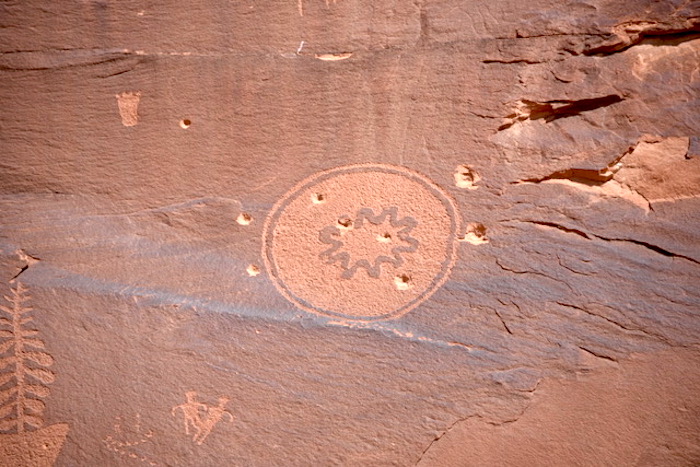
A short hike down into the wash brought us to spectacular rock art panels. Two Kentucky ladies were staring up at the petroglyphs, speculating about the meaning of holes scattered across part of the panel. “Those,” my friend Doug explained, “are bullet holes.”
“Really?” one lady responded. “Who would do such a thing? It’s sacrilegious!”
A half-hour into our visit to this remarkable place we were confronted with the challenges it faces.
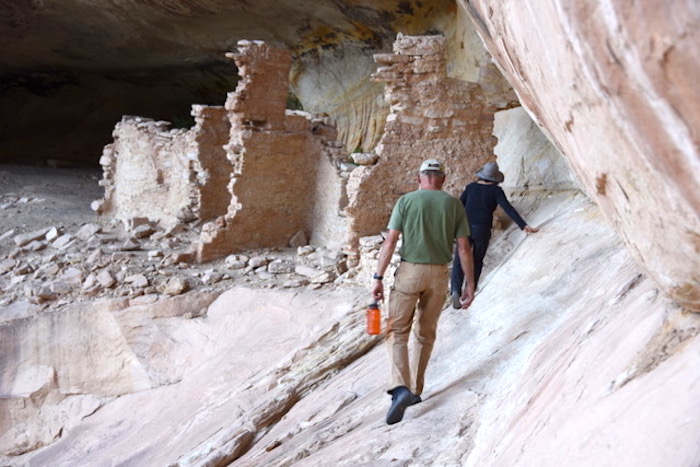
Later we drove up the wash to find a campsite and pulled into another dusty parking area where several cars from the state of Washington were parked. Abundant cow pies were scattered about the campsite. A trail climbed out of the wash and up a beautiful canyon to an extensive ruin. A large group was headed to the ruin ahead of us, so we lounged beneath cottonwoods in a cool riparian area until they returned, then set off. After gingerly crossing moderately steep slabs into the ruin and pondering the wonder of the place, we returned to pitch camp as darkness fell, fitting our tents in around the cow dung. At the next campsite down the wash, partiers laughed and shouted far into the night.
Butler Wash and the rest of Bears Ears National Monument are “managed” by the U.S. Bureau of Land Management and the U.S. Forest Service, but management for recreation appears minimal. There are few campgrounds or toilet facilities, at least in the areas we visited. And people are camping anywhere they choose, as we did. Our friends with whom we shared this trip have visited the area for years and remarked on the greater number of visitors we encountered. If Bears Ears National Monument survives the challenges it faces, considerable investment in recreational infrastructure will be essential to keep this fragile place from being loved to death. Even if the monument reductions President Trump wants stand, the part of Butler Wash we visited will be in one of the two small national monument units he is recommending, so recreation and its impacts will grow.
After a good night’s sleep, we drove further up Butler Wash and set out to visit a few more of the estimated 100,000 archaeological sites in the monument as President Obama established it. We followed a path down into another verdant riparian oasis and climbed a canyon, the walls closing in as we gained elevation.
“You go first, John,” said Doug, as we approached the head of the canyon.
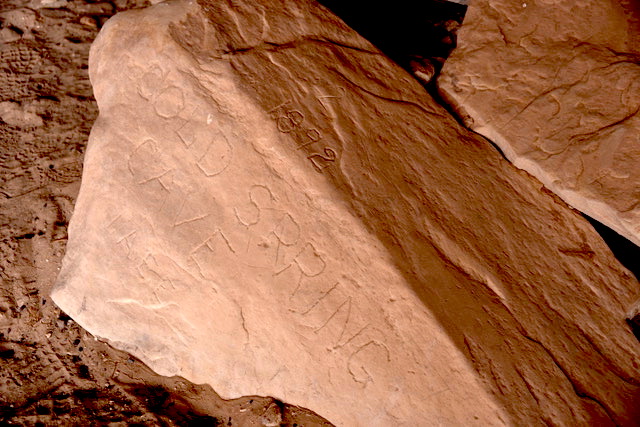
Rounding a corner, I saw a large south-facing alcove in the canyon wall, ruins of an ancient cliff dwelling tucked into it. We poked around, marveling at the masonry, imagining what life must have been like when the Old Ones lived here 800 to 900 years ago. Carved on a rock we found an inscription – 1892 COLD SPRING CAVE I.A.E.E. One-hundred-twenty-six years before our visit, the Illustrated American Exploring Expedition had climbed up here. They were mapping sites, not digging, but others came to dig, some just pot hunting, others studying the archaeology. All of the half-dozen extensive cliff dwellings we visited had been disturbed during the century since those initial visitors from Ohio investigated this place.
Though they are changed, these alcoves with their ruins of ancient dwellings are powerful, remnants of a past stretching back to 11,000 B.C in estimations of modern archaeologists, to “time immemorial” for the descendants of the Old Ones. Our friends like to leave something in these alcove ruins, a token of respect but not something material. They play a few moments of Native American music, flutes, and drums. These quiet interludes of meditation bring to mind a statement from Rose Simpson of the Santa Clara Pueblo, quoted in Archaeology Southwest magazine. “Leave your prayers here. Leave your spiritual consciousness here. But don’t take anything with you. Only thing you can take is what will fill hour heart. That’s all you need.”
Two thoughts came to me as we sat quietly in Cold Spring Cave. One was that if ever there was a place appropriate for protection under the Antiquities Act of 1906, this is it, with its tens of thousands of archaeological sites. Secondly, the campaign to protect this place that resulted in the Obama monument proclamation was led by a tribal coalition, five tribes for whom it has special significance – the Navajo Nation, Hopi, Ute Mountain Ute, Ute Indian Tribe of the Uintah and Ouray Reservation, and the Pueblo of Zuni. They were to be co-managers of the Obama monument along the with BLM and Monti-La Sal National Forest. Tribes whose ancestors lived in this region have, like all American Indians, been treated miserably by the United States. Might protecting this place make, in a small way, amends for what we have done in the past?
We climbed out of the cave and wandered up slickrock to a view across a canyon of the Eagle Nest ruin, nestled in a small alcove hundreds of feet up a sheer cliff. We could see moqui steps angling into this eyrie from above. The Old Ones must have faced great threats to sequester themselves in such an inaccessible place. The ruin is in good shape, inaccessible to all but the boldest of climbers. The view to the east, down slickrock to Butler Wash and across to red rock mesas was spectacular.
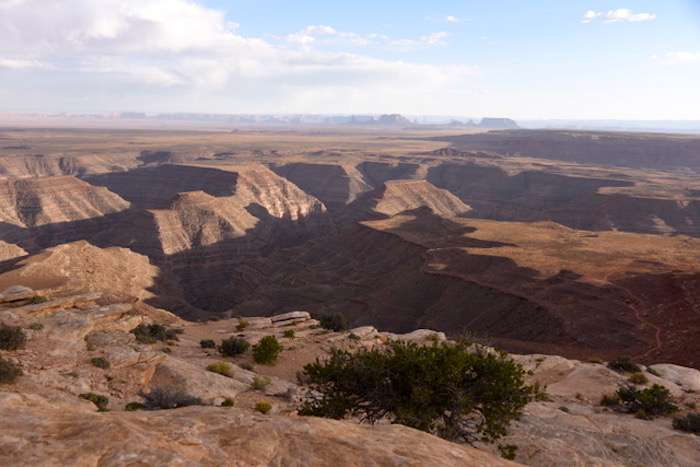
 Driving out of Butler Wash, we turned west and into Valley of the Gods. A single dirt road winds through this landscape of red rock towers and buttes rivaling Monument Valley several miles to the west. Valley of the Gods was in Obama’s monument, but not in Trump’s. Cedar Mesa loomed to the north, and a road invisible on this imposing wall until we reached it, the Moki Dugway, scaled this cliff in long switchbacks. RVs and trailers were not allowed up this exposed and remarkable road. At the top of this exciting drive is Muley Point with a view to the south over the Goosenecks of the San Juan River, to Monument Valley off to the southwest, and to Comb Ridge southeast. Storm clouds loomed to the east, flying banners of virga, and the wind howled as we set up camp, but the view was so incredible we hardly noticed. The sunset from this perch was a sight to see.
We traveled north across Cedar Mesa, the Bears Ears framing the horizon. We visited another ruin, then camped in Comb Wash, on the west side of Comb Ridge, the “sandstone spine,” as writer David Roberts called it in his book of that title. The trip was completed with a final foray to two ruins on the other side of the Comb, in Butler Wash, many miles north of where we had begun our exploration.
Though we explored from dawn to dusk, we hardly touched the wonders of this unique part of America’s public lands. We will need years to probe the wonders and mysteries of Cedar Mesa, Grand Gulch, Elk Ridge, Dark Canyon, and Comb Ridge. Bears Ears as a museum of antiquities and natural beauty should be protected, not mined and drilled and raced over in ATVs. We will go back and do everything we can to see that this heritage landscape is protected.
Stories about:
Story Categories:
A copy of National Parks Traveler's financial statements may be obtained by sending a stamped, self-addressed envelope to: National Parks Traveler, P.O. Box 980452, Park City, Utah 84098. National Parks Traveler was formed in the state of Utah for the purpose of informing and educating about national parks and protected areas.
Residents of the following states may obtain a copy of our financial and additional information as stated below:
- Florida: A COPY OF THE OFFICIAL REGISTRATION AND FINANCIAL INFORMATION FOR NATIONAL PARKS TRAVELER, (REGISTRATION NO. CH 51659), MAY BE OBTAINED FROM THE DIVISION OF CONSUMER SERVICES BY CALLING 800-435-7352 OR VISITING THEIR WEBSITE. REGISTRATION DOES NOT IMPLY ENDORSEMENT, APPROVAL, OR RECOMMENDATION BY THE STATE.
- Georgia: A full and fair description of the programs and financial statement summary of National Parks Traveler is available upon request at the office and phone number indicated above.
- Maryland: Documents and information submitted under the Maryland Solicitations Act are also available, for the cost of postage and copies, from the Secretary of State, State House, Annapolis, MD 21401 (410-974-5534).
- North Carolina: Financial information about this organization and a copy of its license are available from the State Solicitation Licensing Branch at 888-830-4989 or 919-807-2214. The license is not an endorsement by the State.
- Pennsylvania: The official registration and financial information of National Parks Traveler may be obtained from the Pennsylvania Department of State by calling 800-732-0999. Registration does not imply endorsement.
- Virginia: Financial statements are available from the Virginia Department of Agriculture and Consumer Services, 102 Governor Street, Richmond, Virginia 23219.
- Washington: National Parks Traveler is registered with Washington State’s Charities Program as required by law and additional information is available by calling 800-332-4483 or visiting www.sos.wa.gov/charities, or on file at Charities Division, Office of the Secretary of State, State of Washington, Olympia, WA 98504.


Comments
Excellent. Thank you, John. You did a very good job of portraying the challenges that will be faced by land managers. Nothing is easy, especially when a there are so many people whose stupidity drives them to destroy rather than protect places like these. The bullet holes are only one symptom. And based upon long personal experience, the vast majority of damage is done by local people and not by those who must drive long distances to visit these priceless places. The claim that "local people will protect this place best" is simply a lie.
The only hope we have is education of enough people that at least some of this behavior will be mitigated in the future.
Bears Ears needs a number of "Galen Clark" Gatekeeper heroes.
More people will be visiting, because we believe we need to go and see, while we can, and before it is spoiled further.
So ironic.
Great article. I just got back from a short trip there. Spent a night camping in Valley of the Gods, drove up Moki Dugway, saw the Bears Ears, and backpacked Bullet Canyon to Grand Gulch. It's a beautiful landscape, a great escape from civilization, and the abundance of native American artifacts is astounding. I hope the legal challenges regarding the 85% reduction are successful and Bears Ears is restored to its rightfully-designated original boundary. It's land worth preserving.
I think it's so sad that this was studied for so long and advocated for so fiercly by so many tribes only to be scratched out in a pen swipe by a President who has probably never stepped foot in a wilderness in his life. Dispicable. This must be overturned and returned to the originally boundaries that President Obama designated (which even those were smaller than what was asked for so it was a compromise as it was).
Here is an interesting article on Bears Ears, with links to a couple of substative comments made on Regulations.gov
https://www.huffingtonpost.com/entry/emails-bears-ears-national-monument...
Very interesting information in the Huffington article. We already knew even before any of this started that it was a done deal and no amount of public comment in favor of retaining the monument would be considered in any way. But the disclosure that San Juan County's commissioners paid $53,000 for opposition research (or propaganda?) was something I"ve not heard before.
Was it taxpayer money, or did it come from private pockets? Given the history of past cookedness by various Utah GOP politicians, I won't be surprised at all if it was funded by taxpayers.
There's more than enough sleaze to go around both here and now in Washington.