
“There is a way that nature speaks, that land speaks. Most of the time we are simply not patient enough, quiet enough, to pay attention to the story.” ― Linda Hogan, author
We, as a society, seem to be losing, or perhaps already have lost, our patience to understand the story of nature.
Texts, tweets, Facebook, and cellphones interrupt us daily, often on an hourly basis, if not more frequently. The societal demand to be connected 24/7 has pushed park after park to consider installing cellphone towers, or expand the number of towers they already have.
We take our devices on vacation with us, demanding to remain connected to the world we're trying to find some respite from. And the National Park Service has heard us, at Yellowstone and Yosemite, Grand Canyon and Theodore Roosevelt. And now, Bryce Canyon officials are moving toward installation of a cellphone tower. If installed, few of us will notice it rising above the forest ... but we will hear its impact.
Another intrusion on our senses, and nature, is being considered at Pictured Rocks National Lakeshore in Michigan. The beautiful setting captures a slice of boreal forest, crashing waterfalls, bogs, and soaring sandstone cliffs painted red, orange, and even blue and green by their mineral components, all cast against the tempestuous waters of Lake Superior, the lakeshore is a sublime setting in any season.
Once upon a time, as stories are told, the Park Service staff at Pictured Rocks had agreed to allow personal watercraft, aka Jet Skis, to zoom through the lake waters with their throaty growl and oil-and-gas-spitting engines. A lawsuit seemingly brought that plan to an end in 2010, when a U.S. district judge, ruling on a lawsuit against the watercraft in Pictured Rocks and Gulf Island National Seashore, scuttled it with a ruling in which she said, "(W)hy has NPS issued rules allowing Jet Ski use in two beautiful and pristine national parks, acknowledging that such use will impact, to varying degrees, water quality, air quality, wildlife, animal habitats, soundscapes, visitor use and safety, etc., when the users of jet skis are perfectly free to enjoy their vehicles in other, equally accessible areas, without threatening the serenity, the tranquility -- indeed, the majesty -- of these two national treasures?"
While the judge did block the PWC plan at Pictured Rocks, she allowed the plan to remain in place while the Park Service went back and reexamined issues related to the impacts of the watercraft.
Longtime observers of this issue might recall the flip-flopping the Park Service has done over these toys.
It was in 2000 that the agency concluded that Jet Ski use was a “controversial, recreational” activity and inappropriate in most areas of the National Park System. The agency deemed Jet Skis “high performance vessels designed for speed and maneuverability and are often used to perform stunt-like maneuvers.” When the Park Service moved back then to ban PWCs from Gulf Islands, it said in part that “PWC use poses considerable threats to estuarine flora and fauna, pollutes waters essential to estuarine and marine health, poses unacceptable risks of injury to operators and bystanders, and conflicts with the majority of other longstanding uses of the Seashore.”
And then, just six years later, the Park Service changed course and began finalizing regulations to allow PWCs back into these park units.
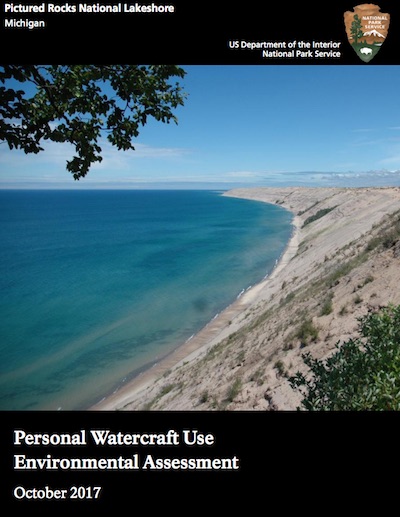
Fast-forward to last week, and the Park Service at Pictured Rocks released an environmental assessment revisiting the question of PWCs at the lakeshore. In reaching a proposal to allow the watercraft back into the lakeshore, the park staff acknowledged a handful of disturbing conclusions:
* The forest, dune, and lake communities at the national lakeshore provide important habitat for wildlife, including extensive numbers of mammals, birds, and fish. The presence and sound of PWCs can impact wildlife by disturbing breeding, feeding, and other wildlife behaviors. PWCs tend to have varying speeds and course, resulting in frequent changes in engine noise. PWC use can cause alarm, or flight, with avoidance of habitat and effects on reproductive success of waterfowl and shorebirds.
* PWCs can also introduce invasive species into Lake Superior, including zebra mussel, quagga mussel, and eotic grass. ... Due to the design of the PWC engine, it is more difficult to deconatminate than other watercraft engines. When PWCs and trailers are used in more than one waterbody without proper decontamination, invasive species can be easily transported.
* The national lakeshore remains a relatively undeveloped park. Summer visitors engage in activities including camping, hiking, backpacking, picnicking, boating, fishing, and swimming. One of the goals of the general management plan is to maintain natural quiet to enhance the visitor experience. The associated noise and environmental effects of PWC use can impact the experience of some visitors.
There are other concerns, but those are key ones. Despite listing those concerns, though, the Park Service wants to allow PWC use from the western boundary of the lakeshore to Miners Beach, or roughly one-fifth of the lakefront in the park. And while it would require that PWCs meet 2010 EPA air quality emission standards, that requirement wouldn't take effect until two years after the watercraft are allowed into the lakeshore.
The agency also decided against limiting the hours when PWCs could be operated in the lakeshore because of the "confusion" it would create with operational hours for PWCs in areas adjacent to the lakeshore, decided against limiting the number of PWCs that could be in use at any one time because that would be too confusing to manage, as well, and decided not to charge a special fee for PWC use because of the logistics of trying to enforce one.
More proposed rules were dismissed as well: Noise limits were said to be unnecessary because of existing rules when it comes to noise and the "low level of PWC use at the national lakeshore;" a boater safety program for PWC operators wasn't seen as necessary because Michigan state law would apply and cover that need, and; limiting the number of PWCs in one group was seen as necessary because they typically travel in pairs and, again, "because PWC use at the national lakeshore is low."
Just as, if not more, interesting is the lakeshore's position that, under the preferred alternative, impacts to wildlife and wildlife habitat wouldn't be a big issue, nor would impacts to threatened, endangered, and other protected species and their habitats because of the low use of PWCs at Pictured Rocks.
When the national lakeshore was established in 1966, it was done so to "preserve for the benefit, inspiration, education, recreational use, and enjoyment of the public a significant portion of the diminishing shoreline of the United States and its related geographic and scientific features."
What might have been added to that section of the enabling legislation, but wasn't, was a santuary of sorts from motorized recreation, particularly that of racing PWCs, which didn't arrive at the lakeshore until the 1990s.
In this opening pages of the EA, which public comment is being taken on through November 2, the Park Service points out that PWC use at Pictured Rocks "has remained relatively low, primarily as a result of the remoteness of the park and distance to large population centers, cold water temperature, cool ambient air temperature, sudden changes in weather conditions, and heavy winds and wave action on Lake Superior."
The Park Service should have looked at that section, and then at all the other sections describing the impacts of PWCs and those pointing to the controls its couldn't impose, tossed out its hopes that PWC use would remain low, and simply endorsed Alternative 3, the No Action/No PWC Use option.
It's not too late to listen to nature.
Stories about:
Story Categories:
A copy of National Parks Traveler's financial statements may be obtained by sending a stamped, self-addressed envelope to: National Parks Traveler, P.O. Box 980452, Park City, Utah 84098. National Parks Traveler was formed in the state of Utah for the purpose of informing and educating about national parks and protected areas.
Residents of the following states may obtain a copy of our financial and additional information as stated below:
- Florida: A COPY OF THE OFFICIAL REGISTRATION AND FINANCIAL INFORMATION FOR NATIONAL PARKS TRAVELER, (REGISTRATION NO. CH 51659), MAY BE OBTAINED FROM THE DIVISION OF CONSUMER SERVICES BY CALLING 800-435-7352 OR VISITING THEIR WEBSITE. REGISTRATION DOES NOT IMPLY ENDORSEMENT, APPROVAL, OR RECOMMENDATION BY THE STATE.
- Georgia: A full and fair description of the programs and financial statement summary of National Parks Traveler is available upon request at the office and phone number indicated above.
- Maryland: Documents and information submitted under the Maryland Solicitations Act are also available, for the cost of postage and copies, from the Secretary of State, State House, Annapolis, MD 21401 (410-974-5534).
- North Carolina: Financial information about this organization and a copy of its license are available from the State Solicitation Licensing Branch at 888-830-4989 or 919-807-2214. The license is not an endorsement by the State.
- Pennsylvania: The official registration and financial information of National Parks Traveler may be obtained from the Pennsylvania Department of State by calling 800-732-0999. Registration does not imply endorsement.
- Virginia: Financial statements are available from the Virginia Department of Agriculture and Consumer Services, 102 Governor Street, Richmond, Virginia 23219.
- Washington: National Parks Traveler is registered with Washington State’s Charities Program as required by law and additional information is available by calling 800-332-4483 or visiting www.sos.wa.gov/charities, or on file at Charities Division, Office of the Secretary of State, State of Washington, Olympia, WA 98504.


Comments
Huh. Even with all of these "disturbing conclusions", they are still allowing PWCs back onto the lakeshore? I recall reading a comment on some other article on this site, wherein the remark was made that, as urbanization continues its spread into wider areas, our national parks and monuments will become more and more isolated spots of nature. These isolated spots of nature are going to become more important for the fish, mammels, birds and other organisms that call national parks and monuments their home. I would think that it behooves us as stewards to maintain the pristine nature as much as possible for not only the national park and national momument inhabitants, but also for us humans to go and breathe in this story of nature, without the noise, gas, oil, and invasive species pollution that these watercraft are inevitably going to bring with them. Don't tell me you have not seen oil sheens on water, or smelled gas fumes that mask the usually pine/fir/juniper/cedar-scented air, or groused about the very loud "throaty growl" of PWCs. Glacier National Park had this issue with invasive mussels on the pristine waters within that park, so it's not like this is a unique occurrence. I'm not certain the NPS is serving the needs of the many so much as it is serving the needs of a select population here, at Pictured Rocks National Lakeshore.
""Why has NPS issued rules allowing Jet Ski use in two beautiful and pristine national parks, acknowledging that such use will impact, to varying degrees, water quality, air quality, wildlife, animal habitats, soundscapes, visitor use and safety, etc., when the users of jet skis are perfectly free to enjoy their vehicles in other, equally accessible areas, without threatening the serenity, the tranquility -- indeed, the majesty -- of these two national treasures?"
I have no doubt that understanding all this will require looking beyond the NPS to the dim, dark reaches of Congress or other places where moneyed interests of various kinds have been able to exert enough pressure to force NPS to accept yet another deal with the Devil.
Trouble is, it's almost impossible to backtrack on things like this because those whose special interests (money) are being met are masters at covering their tracks. And anyone who dares expose them risks serious personal harm.