


Okay, let’s get the most important thing out of the way right off the bat. If you are thinking of camping using a big RV or even a small camp trailer at Cave Creek Campground near the edge of Oregon Caves National Monument and Preserve, I have some very important advice: DON’T EVEN THINK ABOUT IT!
The road up into the national monument and Cave Creek is, shall we say, interesting. The entire campground is vertical. Absolutely vertical. Few, if any, of the campsites appear to invite a trailer or RV of any size. You may pitch a tent there, but if you decide to go potty, you’d better make sure someone you trust has a good belay on you.
And if you get up in the middle of the night and take a wrong step, you could wind up in the tent with the campers in the site below because pitching a tent there is a lot like pitching one halfway up the face of El Capitan.
Some of the guidebooks I picked up claim that “small trailers 16 feet or shorter are acceptable.” Perhaps. But only if they are about 14 feet shorter than 16 feet. And if you are driving an RV pulling a car or anything pulling a trailer, y’better plan on leaving the larger vehicle at the information center in Caves Junction or in the day-use area at Grayback Campground.
So take my advice, happy readers, and plan on camping at Grayback Campground in Rogue River-Siskiyou National Forest about eight miles outside the monument. Your chances of survival will be much better.
Remember that this sage counsel is given free of charge by one whose family will testify, with horror still in their eyes, that their daddy never met a road he wouldn’t tackle.
A Side Trip to the World of Bizarre
I’m not even sure if I should write about this or not, but given what’s going on around us now, I think I will. Not far from the entrance to Grayback Campground, I noticed a campsite that was somewhat ... well ... different than most. It was occupied by a small utility trailer upon which sat a pickup camper shell. The site was littered with all kinds of stuff. A small refrigerator sat on the picnic table with its electric cord dangling on the ground. Several unmounted tires were lying around, and some propane gas bottles added decoration. Hanging from a rope between two trees were two large yellow flags. One was the familiar “Don’t Tread On Me.” The other was “The Great Seal of the State of Jefferson.” (You can Google that.) It appeared that no one was home. It also seemed apparent that the site had been occupied this way for a pretty long spell.
I went out for a walk around the almost-empty campground the next morning. This time, there was a large, white, older-model sedan of ’70s or ’80s vintage with Oregon plates parked there. On the back were three large signs with bright lettering. The one on the left said “F### Hillary.” On the right was “Impeach the N####r.” The middle one had only one word: “TRUMP.”
Then I heard a man’s voice. “Uh, sorry. You kinda caught me at a bad time.” He was sitting on a 5-gallon bucket with a roll of toilet paper in his hand as he used the bucket to answer the call. Sitting next to him within easy reach was a gun that looked like an AK-47 with a curved magazine that had to have been at least 16 inches long. How many rounds did that thing hold? And what kind of arsenal did that camper probably hold?
I haven’t had such a disturbing experience since I got out of the law enforcement business years ago. I walked on without saying anything and took an alternate route back to my site.
This kind of thing really bothers me.

And Now Into The Cave, and More Pleasant Things
We’ve all heard of that fungus – white nose syndrome – that is killing bats worldwide. Because I had been in some lava tubes at Lava Beds National Monument just two days before, I knew I would have to be decontaminated at Oregon Caves. I made certain that the only things I was wearing or carrying that had been inside the tubes were my boots and camera. I changed all my other clothes.
Upon arrival at the Oregon Caves Visitor Center, I was asked the Big Question and confessed. That brought out a quick shout to someone in the back room: “We have one that needs to be decontaminated!” (I really didn’t think I looked or smelled that bad ....) (And truly, it didn’t sound at all like that, but hey, y’gotta keep a good story going, right?)
In just a moment, a young lady ranger arrived on scene and escorted me into a side room where I expected she was going to don one of those white haz-mat suits and start spraying me with purple juice or something. Instead, she handed me a hydrogen peroxide wipe to use on my camera and asked me to remove my boots.
Even then, she didn’t don the white suit. For the first time in my life, I actually had a pretty park ranger cleaning my boots with another peroxide swab. (I marveled at her courage. It takes real nerve to handle my boots.) In a few minutes, I was declared sanitary and told I could proceed.

So it was that I met Ranger Darcy McKinley-Lester, who, it turned out, would be leading the 10:30 cave tour for which I had tickets. Because the cave is tighter and tougher to navigate than many other caves I’ve visited, tour group size is kept to a minimum. There were about a dozen in the bunch.
We started out on the visitor center front porch with the mandatory safety talk and instruction on how to do the "cave walk." That exercise brought a lot of laughter, but you’re just going to have to visit Oregon Caves National Monument to find out why. By the way, kids must be at least 42 inches tall to participate in the tour. They need to be able to travel through the cave without assistance, so they must be tall enough to use railings along stairs and catwalks. This cave is definitely not ADA accessible or toddler-friendly. Parents may not carry a child.
In fact, Darcy explained that part of preparation for the walk includes a size-up of everyone in the group by the ranger. She said that sometimes they must advise a visitor that they cannot go on the tour because they are not dressed properly or appear to be physically unable to make it safely. Once we were inside the cave, the wisdom of this became apparent.
BUT it’s important to note here that the park staff will try as hard as they can to accommodate visitors who need some extra help with mobility or other challenges. All they ask is some advance notice, and they will do what they can, subject to safety requirements and resource protection, to at least provide a taste of the cave.
Most caves are found in limestone. Oregon Caves is different. It’s actually in marble - limestone that has been metamorphosed by tremendous heat and pressure into the very hard rock that many of our most important buildings are built of. An educated guess by this old geology major says the process of dissolving this cave had to have been a much slower process than producing a cave such as Carlsbad.
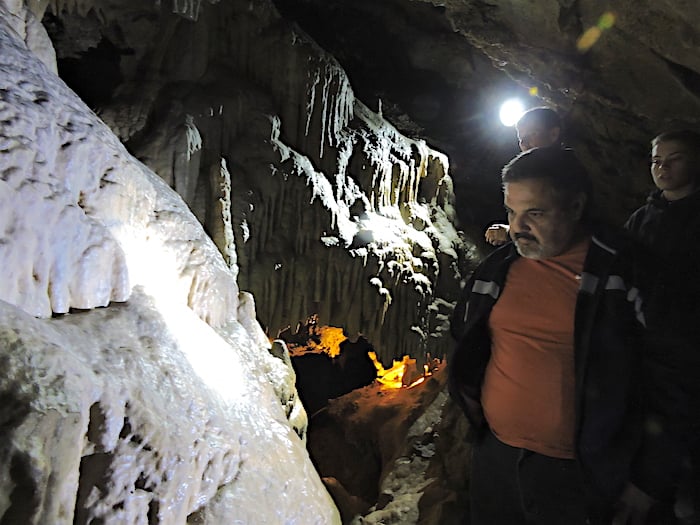
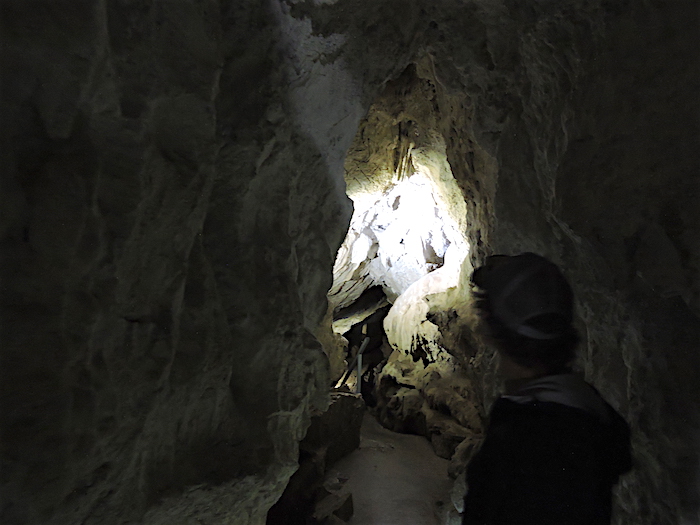
Every time I visit a National Park System cave, I find myself in awe of the special skills and very hard work that has to be done to build safe walkways, light the place, and generally keep people like me safe in its depths. That was especially true here because many of the passageways are extremely narrow, cramped, twisting, and feature lots of low ceilings. Steps inside the cave are a combination of some stairs carved or constructed with marble, and others are steel. Many of the steps are uneven and slippery. I found that in several places, lights that illuminate the path shone directly into my eyes and made it hard to see.
In no way is that meant to be a criticism. That’s just the way it is because, given an environment like this one, it’s the way it has to be. I’ve visited many caves in the National Park System and elsewhere and don’t remember any others in which building and maintaining the trail system appears to be so challenging.
My hat is really off to the folks who are responsible for making it all possible.
For about 90 minutes, Ranger Darcy led us as we walked, twisted, ducked, turned, clambered, and cave-walked (sort of a combination duck-walk, turkey waddle, and Sasquatch stomp) through some striking examples of cave features. Oregon Caves, unlike some others, is kind of drab when it comes to color, but its flowstone, stalactites and stalagmites, columns, and draperies are not to be missed.
Finally, it was up a long and steep exit tunnel to the outside, where it was a shock to leave the 45-degree dampness and reenter a sunny day with the temperature pushing 80.
Some Other Things
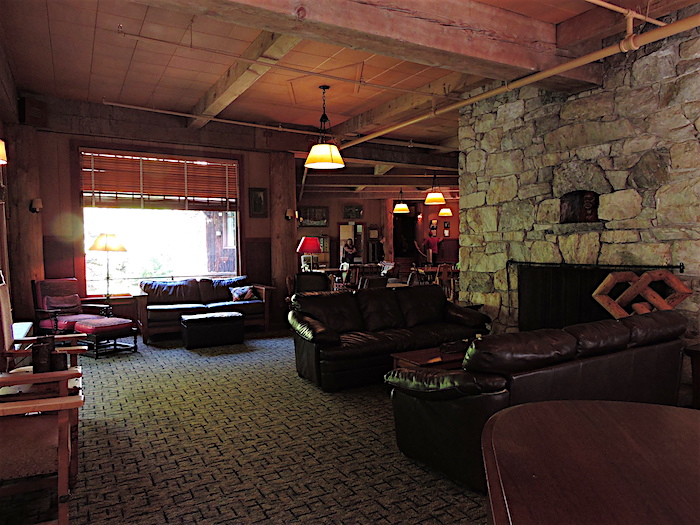
There are several miles of surface trails to explore. Then there are the famous Chateau and Lodge that have become almost as famous as the cave itself. The lodge, built between 1932 and 1934, looks like a part of the surrounding landscape and contains a coffee shop, restaurant, and small number of guest rooms. No trip to Oregon Caves National Monument is complete without visiting the Chateau to admire its beautiful architecture and quiet dignity. Dave and Kay Scott have written several articles about the Chateau for Traveler, so I won’t try to repeat anything they’ve already told us.
The Chalet also houses the visitor center. It was built in 1924 and, like everything else around here, seems to have somehow been glued to the side of a vertical world. The first floor houses the visitor center, while the upper floor is home to many of the rangers and NPS staffers who operate the place in summer.
Even though these buildings have received a lot of tender, loving care through the decades, it’s easy to see how hard it is to keep them in good repair. I noticed another building hanging among trees on the cliff face not far from the Chalet that obviously has been abandoned. Its walls and roof are in disrepair, and doors and windows are covered with plywood. I asked about that and learned that once upon a time, housing above the VC was for the ladies of the crew while the other building was for the boys. But now in our modern world, that’s no longer deemed necessary, and the dorm above the VC is coed. The problem, however, is what do you do with an old building on a historic register that has no current usefulness?
Maybe if they just wait a few more years, it will simply collapse and fall onto the driveway below it. Ah, the challenges of managing a national park!
Finally
Oregon Caves is a place I’ve wanted to visit for many years. I’m glad I came when I did because I can see that it won’t be too many more years before my legs and sense of balance might make me one of those folks who must be told by rangers that I’m one who probably shouldn’t try the cave tour. So if you haven’t been there yet, you’d better get busy because time’s a’wasting.
In summer, call ahead for tour reservations. Remember to park your big rig at the bottom of the hill and take the little one on up. The road is good and in fine shape. In fact, it’s kind of fun as long as you don’t leave your eyes open. On the way down, it reminded me of skiing down a slope with gentle sweeping turns right and left and left and right – swoop and swoop. Lower gears all the way.
Your life just won’t be complete until you’ve added Oregon Caves to your life list of parks.
Stories about:
Story Categories:
A copy of National Parks Traveler's financial statements may be obtained by sending a stamped, self-addressed envelope to: National Parks Traveler, P.O. Box 980452, Park City, Utah 84098. National Parks Traveler was formed in the state of Utah for the purpose of informing and educating about national parks and protected areas.
Residents of the following states may obtain a copy of our financial and additional information as stated below:
- Florida: A COPY OF THE OFFICIAL REGISTRATION AND FINANCIAL INFORMATION FOR NATIONAL PARKS TRAVELER, (REGISTRATION NO. CH 51659), MAY BE OBTAINED FROM THE DIVISION OF CONSUMER SERVICES BY CALLING 800-435-7352 OR VISITING THEIR WEBSITE. REGISTRATION DOES NOT IMPLY ENDORSEMENT, APPROVAL, OR RECOMMENDATION BY THE STATE.
- Georgia: A full and fair description of the programs and financial statement summary of National Parks Traveler is available upon request at the office and phone number indicated above.
- Maryland: Documents and information submitted under the Maryland Solicitations Act are also available, for the cost of postage and copies, from the Secretary of State, State House, Annapolis, MD 21401 (410-974-5534).
- North Carolina: Financial information about this organization and a copy of its license are available from the State Solicitation Licensing Branch at 888-830-4989 or 919-807-2214. The license is not an endorsement by the State.
- Pennsylvania: The official registration and financial information of National Parks Traveler may be obtained from the Pennsylvania Department of State by calling 800-732-0999. Registration does not imply endorsement.
- Virginia: Financial statements are available from the Virginia Department of Agriculture and Consumer Services, 102 Governor Street, Richmond, Virginia 23219.
- Washington: National Parks Traveler is registered with Washington State’s Charities Program as required by law and additional information is available by calling 800-332-4483 or visiting www.sos.wa.gov/charities, or on file at Charities Division, Office of the Secretary of State, State of Washington, Olympia, WA 98504.


Comments
Indeed, Oregon Caves NM is a most curious landscape to visit in SW Oregon. In addition
It was Newton B. Drury of The Save The Redwoods League who recognized the ecological attributes between coastal redwoods and Port Orford Cedar. Drury, former
Director of the NPS, called for an expanded Oregon
Caves NM (ORCA) at a time when the ancient Port Orford cedars could have been saved from loggers.
http://www.craterlakeinstitute.com/online-library/nature-notes/vol25-ove...
Many of the finest Port Orford Cedars were logged
when adjacent habitats were managed by the USFS.
Those relatively few remaining old growth trees now
face the perils of the dreaded introduced Phytophthora lateralis root disease which may be spread by hikers
(via water borne spores)
http://www.fs.fed.us/r6/nr/wildlife/decaid/IandDSpecies/Port-Orford-ceda...
Finally an expanded ORCA Monument:
http://kalmiopsiswild.org/6429/oregon-caves-national-monument-preserve-c...
and ORCA Pleistocene Life:
http://www.craterlakeinstitute.com/online-library/nature-notes/vol27-fos...
Even before Drury became NPS Director, in April 1940, while Arno Cammerer was still NPS Director, the National Park Service released a study titled: Field Report of Committee, Proposed Port Orford Cedar National Monument (a hard-to-read electronic copy can be found at: http://npshistory.com/publications/orca/port-orford-cedar-nm.pdf) recommending an extension of the boundaries of Oregon Caves NM. More details of the history of Oregon Caves NM is contained in Stephen Mark's excellent Historic Resource Study titled Domain of the Cavemen (electronc copy located at: http://npshistory.com/publications/orca/domain-of-the-cavemen2.pdf).
Oregon Caves ranks in the top 10 NPS units we've visited (out of about 200). Quite an accomplishment for one of the smaller, les granidose parks. We spent 2 nights in the Chateau, did the cave tour, hiked the trails and enjoyed the evening campfire with the few other guests in the chateau. I agree with Lee about the road up; it's no place for a large RV. I somehow missed the unusual campsite Lee describes. I think I'm glad i did. BTW isn't the first pic in the articla one of the Chalet rather than the Chateau as it says in the caption?
Good catch, Rich. We've corrected the caption. That was on us, not Lee.
Chalet, Chateau --- Too many Ch's to keep track of. I missed it, too, Kurt. No matter what you call 'em, they're both some classical buildings. But I just realized that I used the words Chateau and Lodge in the same paragraph to refer to the same building. The building is the lodging place for guests, but it is called the Chateau. The Chalet is located just across a narrow driveway. It houses the visitor center and housing for park employees. Sorry about that.
richp, the "unusual campsite" was not on the monument. It was about 8 or 10 miles down the hill at Grayback campground on the national forest. I wish I had taken a picture, but in order to do that I'd have had to be close because of dense vegetation. I was worried about possibly setting the gentleman off. Now I'm thinking I might have tried to assume the role of one who sympathized with his politics and tried to strike up a conversation. That might have been very interesting.
An opportunity missed.
My main memory of Oregon Caves is going there on my honeymoon and my then-husband giving himself a clunk right on the forehead because he didn't duck far enough!
Relevant References to a Trump Administration
Not Valuing Public Lands, but Possibly Selling to
Pay America's $20 Trillion $ Debt ?
http://www.uwyo.edu/uw/news/2012/09/uw-history-professor-tells-story-of-...
http://www.georgewright.org/331weber.pdf
Having worked at Oregon Caves National Monument for 2 years as a Park Ranger/Guide and 13 years as a Water Treatment Operator/Maintenance Worker, I can understand the confusion regarding the cave trail system. The portions of the trail system that are not rock are composed of on inorganic fiberglass and some stainless steel fittings and fasteners. Management removed carbon steel components over the years due to rust leaching into areas of the cave. I worked with several maintenance employees who worked nights for several years, removing rubble from passages and building temporary trail paths to accommodate the next day's tours. A logistical nightmare, to be sure!