
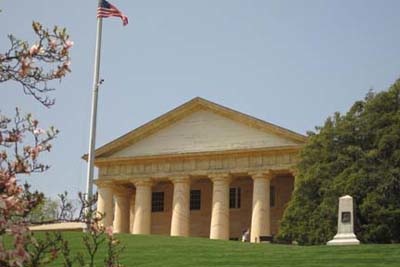
At Arlington House, where Robert E. Lee and his family lived before the Civil War, you can learn much about his life before the war. Outside you'll find the burial spot of Pierre Charles L’Enfant, who designed the city of Washington in 1791-1792. Danny Bernstein photos.
It’s not easy to visit Arlington House - the Robert E. Lee Memorial without getting distracted. The historic house is on the hill at the top of Arlington National Cemetery. There are so many possible diversions once you get into the cemetery, from its visitor center to the Tomb of the Unknown Soldier and the Kennedy graves, that it can be difficult to go directly to Arlington House.
But that's OK. This is a visit that should take time so you can take in all there is to see and learn.
Wander up the hill to see a group of buildings and gardens and you’ll get a good understanding of the human cost of the Civil War. You’ll also enjoy a wonderful view of Washington, D.C.
Arlington House has a distinguished history that starts with George Washington and ends with Confederate General Robert E. Lee. You see, George Washington Parke Custis, George Washington’s stepson, was raised by George and Martha Washington. Custis, who greatly admired Washington, first built the house on land he inherited from his natural father as a memorial to the first president. His youngest daughter, Mary Custis, married Robert E. Lee, and they raised their seven children in the house.
Gen. Lee had a distinguished career in the U.S. Army. It was said that he was against secession. But on April 19, 1861, Gen. Lee learned that Virginia had seceded from the Union. The general agonized over his future; should he stay with the Union or support his home state? The next day he resigned from the U.S. Army and sided with Virginia and the Confederacy. After he left for Richmond to command Virginia forces, Union troops prepared to occupy Arlington House and his wife and children left soon after.
Arlington House and its surroundings were transformed by the Union occupation. Union soldiers were encamped on the 1,100-acre estate. They cut down the forest and used the pastures and fields for drilling. The house became a headquarters and residence for officers and their staff. Many personal Lee family items were stolen.
Arlington National Cemetery was created in 1864 to bury the war dead that were pouring into Washington. Once that happened, it was obvious that General Lee and his family would never return to Arlington House. After the war, Gen. Lee became president of Washington College in Lexington, Virginia, and died there in 1870.
Later Lee’s son was compensated for the loss of his inheritance, and in 1933 the National Park Service acquired Arlington House. The children of former slaves helped in directing the restoration of Arlington House.
From the front of Arlington House, you can see many of the iconic Washington buildings: the Capitol, the Jefferson, Lincoln, and Washington memorials. The vista sweeps from Memorial Bridge over the Potomac River into Arlington Cemetery. Pierre Charles L’Enfant, who designed the city of Washington in 1791-1792, is buried right in front of the house.
Arlington House itself is being refurbished and is now empty, but you can still walk through it. The first floor has several parlors and the family dining room. The Lees had seven children and the second floor is full of bedrooms. The third floor was a storage attic, now closed off to the public.
There’s a small museum devoted to Gen. Lee’s life. It explains that the Memorial Bridge was positioned to unite Arlington (Lee’s residence) and the Lincoln Memorial across the Potomac River that divided North from South. Two small buildings housed the household slaves. One now holds a small museum explaining the role of slaves and freemen at Arlington House.
I walked to Arlington Cemetery from the Washington Mall area. The route took me past the Lincoln Memorial, and onto the Memorial Bridge with its wide pedestrian walkway over the Potomac River.
From the entrance into the cemetery it’s a 15-minute walk up the hill to Arlington House. Walking gave me a great feeling for the commanding location of Arlington. You can also get to the memorial on the Tourmobile shuttle. The Tourmobile makes several stops in the cemetery and you can get off and reboard the shuttle at any of the stops.
To commemorate the 150th anniversary of General Robert E. Lee’s decision to resign his U.S. Army commission and join the Virginia forces, there are several upcoming programs. On Saturday evening, April 16, there will be a Vigil Commemorating Robert E. Lee's Resignation. On April 19, an event leads up to the point when it is believed that Robert E. Lee penned his letter of resignation.
Historian Dr. Peter S. Carmichael will present a special lecture on Southern Honor and the Election of Abraham Lincoln at Arlington House, The Robert E. Lee Memorial, Sunday, April 24.
Story Categories:
A copy of National Parks Traveler's financial statements may be obtained by sending a stamped, self-addressed envelope to: National Parks Traveler, P.O. Box 980452, Park City, Utah 84098. National Parks Traveler was formed in the state of Utah for the purpose of informing and educating about national parks and protected areas.
Residents of the following states may obtain a copy of our financial and additional information as stated below:
- Florida: A COPY OF THE OFFICIAL REGISTRATION AND FINANCIAL INFORMATION FOR NATIONAL PARKS TRAVELER, (REGISTRATION NO. CH 51659), MAY BE OBTAINED FROM THE DIVISION OF CONSUMER SERVICES BY CALLING 800-435-7352 OR VISITING THEIR WEBSITE. REGISTRATION DOES NOT IMPLY ENDORSEMENT, APPROVAL, OR RECOMMENDATION BY THE STATE.
- Georgia: A full and fair description of the programs and financial statement summary of National Parks Traveler is available upon request at the office and phone number indicated above.
- Maryland: Documents and information submitted under the Maryland Solicitations Act are also available, for the cost of postage and copies, from the Secretary of State, State House, Annapolis, MD 21401 (410-974-5534).
- North Carolina: Financial information about this organization and a copy of its license are available from the State Solicitation Licensing Branch at 888-830-4989 or 919-807-2214. The license is not an endorsement by the State.
- Pennsylvania: The official registration and financial information of National Parks Traveler may be obtained from the Pennsylvania Department of State by calling 800-732-0999. Registration does not imply endorsement.
- Virginia: Financial statements are available from the Virginia Department of Agriculture and Consumer Services, 102 Governor Street, Richmond, Virginia 23219.
- Washington: National Parks Traveler is registered with Washington State’s Charities Program as required by law and additional information is available by calling 800-332-4483 or visiting www.sos.wa.gov/charities, or on file at Charities Division, Office of the Secretary of State, State of Washington, Olympia, WA 98504.

Comments
Some people still disparage Lee as a traitor to his country. Others lionize him as a great patriot of his state and his short-lived confederacy. One thing is sure; he was a man of great conscience. The decision to finally resign his commission and follow his state out of the union must have been an agonizing one, and deserves commemoration no matter how you feel about his ultimate choice.
When the Southen States ratified the constitution, thereby, joining the the Unites States of America, they did it with full belief that they could withdraw from the USA becaue they had been independent nations before joining. Without this belief, most -- perhaps all -- of the southern states would not have become part of the United States. At first Virginia did not want to ratify the constitution; but, did so only after being persuaded that it could withdraw from the US if it wanted. For southerners, their actual country was the state in which they lived. When Virginia seceeded, Robert E. Lee felt that to take command of the United States Army would have been unconscionable because he would be waging war against his country: Virginia.
The South did not feel that this was a Civil war; but, rather that it was a war in which the Northern States were fighting the Southern States. When I was growing up, Southerners did not call it the Civil War; instead, it was called The War between the States.
This entry is not an attempt to justify the South's secession; rather, it only an attempt explain the reasoning behind the it and Robert E. Lee's decision to join the Confederate Army.
I'm very pleased to see this wonderful piece on Arlington House, which is truly one of the Washington metro area's finest attractions. I've spent many days at this historic landmark, photographing events and assisting with documenting the restoration of the former slave's quarters at the rear of the mansion. This place and the surrounding land is steeped in such rich history that it's difficult not to be awestruck by it. And the view of DC is indeed magnificent - unparralled in my opinion (and I have years of experience photographing DC and her attractions).
Also of note are the rows and rows of former slave graves that rest on the Arlingotn House property and in the nearby in the cemetery - this land was once Freedman's Village (a place where freed slaves could live, and become educated to work in a variety of trades). Arlington is rich in American Black history, and many ancestors of former slaves still reside there to this day on the land that was given as part restitution after the Civil War.
Thank you for highlighting a National Park in the Metro DC area that has such incredible appeal - so often the cemetery is the main attraction and while it is also a place of incredible sights and historical significance, Arlington House is not to be overshadowed or missed.
George Washington Parke Custis was step-grandson of George Washington.
Editor's note: This is, indeed, what the author of this story, Danny Bernstein wrote. But at the Arlington House website it says the following:
As a result, the wording was edited to remove the grandson reference. If in error, my apologies to Danny. But perhaps there is more to this story that prompted the NPS to refer to the "stepfather" connection. If anyone has more to add to this issue of relationships, the input would be welcome.
The free pamphlet that's given out at the Visitor Center clearly says that George Washington Parke Custis was George Washington's stepgrandson.
The booklet Arlington House, the "Official National Park Handbook" also says stepgrandson. It explains that after Martha Washington's son by her first marriage died, "to ease the burden upon Custis' young widow, the Washingtons brought home to Mount Vernon the couple's two youngest of four children, the 6-month-old George Washington Parke Custis and his 2 1/2-year-old sister Eleanor Parke Custis. Martha Washington doted on "Tub" and "Nelly" overjoyed that her grandchildren were in perfect health and good spirits."
The website probably was in error on this matter.
Could anybody tell me about the distinct grave directly in front of the Arlington House with flat raised surface...is it the grave of union soldiers? Thanks
Pierre Charles L’Enfant, who designed the city of Washington in 1791-1792, is buried right in front of the house.