

An invasion of Snowy Owls, possibly precipitated by a population boom, has brought thousands of the showy birds of prey into the United States. Stock image from Bigstockphoto.com
The United States has been invaded.
None of the presidential candidates are talking about it and I haven’t even seen it mentioned on the national news reports yet.
Birders, however, are well aware of this invasion and we welcome our new owl overlords. Yes the country is being overrun with Snowy Owls (Bubo scandiacus), at least relative to how many of these magnificent birds are usually seen.
Since November, thousands have been spotted all across the northern states and even as far south as Oklahoma. The national parks have not been spared. Snowy Owls have been spotted in Pictured Rocks National Lakeshore and Cape Cod National Seashore. One was seen at Breezy point in Gateway National Recreation Area, just a stone’s throw from New York City.
There were also reports throughout December of a Snowy Owl on Cadillac Mountain in Acadia National Park. I can only presume that one was waiting to be the first in the United States to see the first sunrise of 2012. Others have been spotted near Olympic National Park and Theodore Roosevelt National Park.
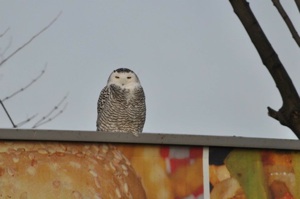
A juvenile Snowy Owl taking a break. Photo by Sue Wolfe.
These invasions are not particularly uncommon. Ornithologists even have a name for the phenomenon: irruption.
This should not be confused with eruption, which is something you’d find at Hawaii Volcanoes National Park, a spot notoriously deficient in tundra-dwelling owls.
Ecologists define an irruption as a sudden increase in an animal’s population. To birders in the United States, it has become synonymous with an unusually high number of a particular northern species arriving here for winter. Redpolls, Bohemian Waxwings, and Three-toed Woodpeckers all have irruptions from time to time, but none seem to generate the excitement of a Snowy Owl outburst.
Snowy Owl irruptions occur about every four to five years in relation to the population of lemmings, their favorite food on the tundra. When these little rodents become scarce, the owls head south in winter looking for food. Sadly, many of the owls forced down to Maine or Michigan are malnourished or virtually starving when they arrive. Many never survive to return north.
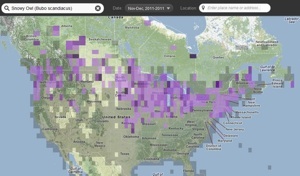
The heavy concentration of purple shows where Snowy Owls were spotted in November and December 2011. Map courtesy of eBird.
This year, the irruption is particularly intense and unique because by all accounts the lemming population was robust this fall. It’s believed the owls have had an unprecedented breeding season thanks to the lemming abundance and there were simply too many birds for the diminished hunting areas in the winter.
Juveniles and weaker adults were pushed out of their territory and before long, some of them found themselves a thousand miles from home in cornfields in Iowa.
Snowy Owls are all born with heavy banding and dark markings. As they age they become lighter colored, with adult males often becoming almost pure white. Most of the owls seen in the United States during an irruption will be heavily marked juveniles, but a pristine white male isn’t unheard of.
My first Snowy of the year was an adult male with hardly a mark on him.
What should you do if you spot a Snowy Owl? First, enjoy it! Not many people get to see one in the wild and it’s a real treat, even for a seasoned birder.
How cool is it to see Hedwig from the Harry Potter movies in the flesh? (For the record, Hedwig was supposed to be a female owl, but its white color clearly marks it as a male. In fact, the “actor” portraying Hedwig was a captive male owl named Gizmo.) So, by all means, appreciate the opportunity to catch a glimpse of these animals.
It’s important to remember a few things for the owls’ safety, however, keeping in mind that these are hungry and desperate birds.
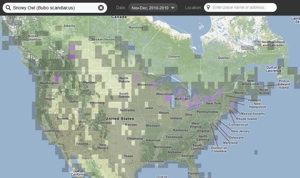
This map from November-December 2010 shows little purple, indicative of the few Snowy Owls spotted in the United States during that period. Map courtesy of eBird.
It’s critically important for birders and other observers to keep a respectful distance from owls. Any additional stress to a severely weakened bird could be the final nail its coffin. There are also sad tales of well-meaning birders accidentally flushing a Snowy Owl into a road where it is struck by passing traffic.
These birds live on the treeless tundra of the far north and they don’t like high perches. Since many of the irruptive arrivals here are juveniles, they have never even seen a tree before getting down here. A fence post or rock in a field is a perfectly acceptable perch, and they fly low when startled. Along a busy road, this can be tragic.
When spying on a owl from the road, it’s best to remain in the car. Pull safely off the road, wind down the window and use your binoculars from there. Cars make excellent blinds for any bird of prey. Many of them don’t seem to view a car as a threat, but will immediately fly away when you open the door.
If you see a Snowy Owl, particularly on an excursion to a park or protected area, it’s worth reporting it to the staff at the visitor’s center. Most parks maintain a bird list and for some of them, this year could mark the arrival of their first ever Snowy Owl. Keep your distance, share the experience, and enjoy the irruption!
Story Categories:
A copy of National Parks Traveler's financial statements may be obtained by sending a stamped, self-addressed envelope to: National Parks Traveler, P.O. Box 980452, Park City, Utah 84098. National Parks Traveler was formed in the state of Utah for the purpose of informing and educating about national parks and protected areas.
Residents of the following states may obtain a copy of our financial and additional information as stated below:
- Florida: A COPY OF THE OFFICIAL REGISTRATION AND FINANCIAL INFORMATION FOR NATIONAL PARKS TRAVELER, (REGISTRATION NO. CH 51659), MAY BE OBTAINED FROM THE DIVISION OF CONSUMER SERVICES BY CALLING 800-435-7352 OR VISITING THEIR WEBSITE. REGISTRATION DOES NOT IMPLY ENDORSEMENT, APPROVAL, OR RECOMMENDATION BY THE STATE.
- Georgia: A full and fair description of the programs and financial statement summary of National Parks Traveler is available upon request at the office and phone number indicated above.
- Maryland: Documents and information submitted under the Maryland Solicitations Act are also available, for the cost of postage and copies, from the Secretary of State, State House, Annapolis, MD 21401 (410-974-5534).
- North Carolina: Financial information about this organization and a copy of its license are available from the State Solicitation Licensing Branch at 888-830-4989 or 919-807-2214. The license is not an endorsement by the State.
- Pennsylvania: The official registration and financial information of National Parks Traveler may be obtained from the Pennsylvania Department of State by calling 800-732-0999. Registration does not imply endorsement.
- Virginia: Financial statements are available from the Virginia Department of Agriculture and Consumer Services, 102 Governor Street, Richmond, Virginia 23219.
- Washington: National Parks Traveler is registered with Washington State’s Charities Program as required by law and additional information is available by calling 800-332-4483 or visiting www.sos.wa.gov/charities, or on file at Charities Division, Office of the Secretary of State, State of Washington, Olympia, WA 98504.


Comments
I know I'll probably take some flack for this, but here goes anyway.
How about sending some of those owls to Utah? There are plenty of mindless lemmings out here who will follow their leaders off the cliff. Maybe if snowy owls take out a bunch of them, Utahns will stop voting for anyone who has a big letter R after their name on ballots and we'll get rid of some of our legislators and Congress critters like Representatives Rob Bishop and Jason Chaffetz, Senators Orrin Hatch and Mike Lee and at least half of our state legislature.
Snowy owls could be the salvation of Utah's environment.
Lee, after two seasons you wouldn't be able to see across Bryce Canyon because the owls would be so thick and Kurt would be writing articles about having to bring in sharpshooters to thin them out.
Anyway, you've had a total of ONE Snowy Owl this year - on the Antelope Island Causway where you Utahns seem to get all your rare birds. I'm afraid you'll have to keep your debate skills polished for lemming control, you're not getting many owls.
Kirby, thanks for the ineresting news about the owl on the causeway. As for rare birds, we already have plenty of them. Or odd birds, if you count folks like me.
Kirby,
What a wonderfully informative and well written article! Short and sweet, as they say. Having had the chance to see one of the snowy owls this winter, I consider myself lucky indeed. While I could probably get a glimpse of another one down here, I am planning to head back up to the shores of Lake Superior to look for more shortly!
Thanks for providing the background with which to frame these sitings-
Cliff
Thanks, Cliff. Lake Superior's shores have been quite productive for snowies, but of course that's true in non-irruptive years as well. I'm not sure where you are now, but the Michigan shore of Lake Huron and the Wisconsin shore of Lake Michigan have been pretty awesome. My local patch is the Huron shore near Alpena, MI.
Great article, Kirby. How about sending a snowy or two down here to South Carolina? It's 20 degrees in Columbia this morning, and that should suit 'em just fine.
We never got out of the single digits yesterday up here in your old stomping grounds, Bob. Some of that freezing SC air would feel fine to me.Just to throw out more trivia: There was a Snowy Owl halfway between Columbia and Camden, just off Rte. 1, on November 24, 1986. That's the only South Carolina record I could find, although one was mere feet across the border in Savannah in 1931. Suffice it to say you don't see them often down there.
The Snowy Owls have returned to Ocean Shores, Washington, a small beach community just 46 miles southwest of Olympic National Park. I observed one yesterday and today on the beach. Last year there were numerous sightings daily on the tundra like peninsula called Damon Point. I will attempt to post the photo I took this morning.