
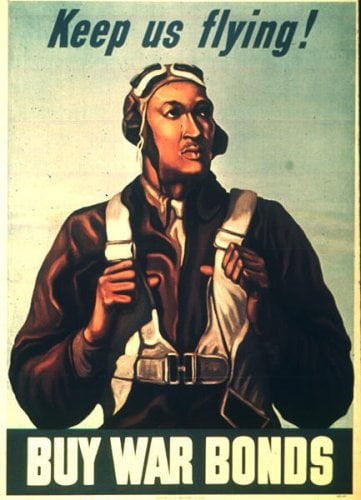
Places such as the Tuskegee Airmen National Historic Site and Grant-Kohrs Ranch National Historic Site harbor rich stories of our nation's history. Tuskegee Airmen poster by NPS, smithy at work at Grant-Kohrs photo by Kurt Repanshek.
There are more than 200 national parks in the cultural-historical wing of the National Park System. While some get lots of media attention and droves of visitors -- Gettysburg National Military Park and the Washington Monument, for example -- many are small, minimally staffed, and lightly visited. Some of the units in the lesser-publicized niches of the cultural-historical wing deserve much more love than they've been getting.
In a recent Traveler article that focused on the Park System's cultural-historical wing I pointed out that the role of the cultural-historical parks as vehicles for "telling America's story" could be understood through the systematic exploration of ten broad thematic orientations. Each of these ten categories contains at least one park that is greatly underappreciated. Here are ten that you might want to consider for your personal "A" list.
Chaco Culture National Historical Park
The Original Inhabitants (aboriginal-themed) parks focus on archeological and historical sites associated with Native Americans or Native Hawaiians. Mesa Verde National Park and Arizona's Canyon de Chelly National Monument are two higher-profile examples. New Mexico's lightly-visited Chaco Culture National Historical Park (34,226 visits in 2010) is a hidden gem.
Located northwest of Albuquerque, Chaco Culture National Historical Park is an especially important Pueblo site. Proclaimed in 1907 as Chaco Canyon National Monument, this 33,974-acre park contains the ruins of Pueblo Bonito (Spanish for “beautiful village”), the community that is thought to have functioned during the period A.D. 850 to 1250 as the trade, ceremonial, and administrative capital of the Four Corners area of the ancestral Pueblo realm.
Chaco Culture is renowned for its distinctive architecture and the spectacular character of its public and ceremonial buildings. Among the archeological sites are the ruins of a dozen major pueblos with over 100 rooms each, a 63-feet wide kiva, a large marketplace, ball courts, and other fascinating artifacts. The Chacoans who constructed this remarkable complex, which includes associated roads, ramps, dams, mounds, and other engineering features, combined pre-planned architectural designs, astronomical alignments, geometry, landscaping, and engineering in ways that continue to amaze us.
Anthropologists are still trying to figure out why this site was selected. Chaco Canyon lies in a very remote location and has poor soil, a very short growing season, and no significant water source. There is no evidence that it was developed as a farming area.
Salinas Pueblo Missions National Monument
Beginning in the 15th century, European colonial powers -- Spain, England, France, Denmark, and Netherlands -- explored, laid claim to, and established settlements in parts of what is now the United States and its territories. Archeological evidence of these activities and events is preserved in more than 20 national parks that address the general theme of Early European Exploration and Settlement. Among the higher-profile examples are Colonial National Historical Park, Cabrillo National Monument, and Castillo De San Marcos National Monument. One of the hidden gems is New Mexico's Salinas Pueblo Missions National Monument.
Located near Mountainair, Salinas Pueblo Missions National Monument is an old park (established 1909) that preserves the best existing examples of Spanish Franciscan mission churches and convents that were built during the early colonial period. Preserved at three separate sites in this park are the ruins of several of America’s six remaining 17th-century Spanish mission churches as well as three of the largest Pueblo Indian villages. Included among the latter is the partially excavated pueblo of Las Humanas (known today as the Gran Quivira pueblo). The park, which entertained 32,941 visitors in 2010, has an interpretive trail through the missions and pueblos and offers related activities such as picnicking and bird watching.
Cane River Creole National Historical Park and Heritage Area
More than two dozen cultural-historical parks comprise the category Colonial Life and the Revolutionary War. Three higher- profile examples are Boston National Historical Park, Independence National Historical Park, and Valley Forge National Historical Park. A standout among the lesser-known parks in this category is Cane River Creole National Historical Park and Heritage Area
Cane River Creole National Historical Park and Heritage Area, which is located in and near Natchitoches, Louisiana, includes a collection of several dozen National Register and state historic properties in a 35-mile-long zone. The park's two plantation properties (Oakland Plantation and parts of Magnolia Plantation) nicely illustrate the history of colonization, frontier influences, French Creole architecture and culture, slavery, social practices, and the Cotton Kingdom agricultural era. Included in the sprawling heritage area is the city of Natchitoches, the oldest community in the Louisiana Purchase. This park attracted just 25,115 visitors last year, and that is a crying shame.
Grant-Kohrs Ranch National Historic Site
Cumberland Gap National Historical Park, Jefferson National Expansion Memorial, and Little Bighorn Battlefield National Monument are prime examples of the cultural-historical genre that I've labeled Pioneer America, Western Settlement, and the Indian Wars. There are a number of hidden gems in this category, but none more deserving of special mention than Grant-Kohrs Ranch National Historic Site.
Grant-Kohrs Ranch National Historic Site near Deer Lodge, Montana, preserves and interprets the historic headquarters of a 19th-century cattle empire that once controlled over 10 million acres of land grazed by vast herds of cattle. The 1,618-acre park, which is still a working cattle ranch, preserves over 80 historic structures and numerous artifacts associated with over 125 years of ranching. This park was established in 1972, has since expanded twice, and now entertains about 22,000 visitors a year with guided tours of the main ranch house, self-guided tours of the bunkhouse and other outbuildings, ranger programs, and many other activities and special events.
Andersonville National Historic Site
When people think of parks that preserve Civil War battlefields and related sites, they tend to think of places like Fort Sumter National Monument, Gettysburg National Military Park , Antietam National Military Park, Shiloh National Military Park, Vicksburg National Military Park, and Appomattox Court House National Historical Park. Few think of Andersonville National Historic Site, but more certainly ought to.
Georgia's Andersonville National Historic Site preserves the site of the notorious Camp Sumter, a Confederate-run prisoner of war camp in which more than 45,000 Union prisoners were interred over a period of 14 months. Conditions at the camp were so appallingly crowded and unhealthy that nearly a third of the prisoners, around 13,000 in all, died of disease, malnutrition, or exposure to the elements. (Henry Wirz, the camp commander, was convicted of war crimes and hanged.) The park includes the National Prisoner of War Museum and Andersonville National Cemetery. The latter contains 16,000 interments, including 1,004 unidentified remains. Last year the park attracted 121,535 visitors. That tally is likely to increase as the commemoration of the Civil War Sesquicentennial hits its stride and more people become aware of this unusual park.
Marsh-Billings-Rockefeller National Historic Site
There are dozens of parks of the Commemorating Famous Americans variety (including 29 created to honor Presidents). The higher-profile examples include Washington Monument, Lincoln Memorial, Thomas Jefferson Memorial, Franklin Delano Roosevelt National Memorial, and Mount Rushmore National Memorial. Among the numerous comparatively neglected parks in this category is Vermont's Marsh-Billings-Rockefeller National Historic Site, a hidden gem that attracted just 31,209 visitors last year (0.5% of the Lincoln Memorial count).
Marsh-Billings-Rockefeller National Historic Site in tiny Woodstock, Vermont (pop. ca. 3,200), is the Green Mountain State's only national park except for the Appalachian Trail. The Conservation Study Institute is headquartered there, and it's no wonder that an organization striving to enhance leadership in the field of conservation would find the park an inspirational workplace.
Some of the most important members of America's early conservation movement lived there. The park was home to pioneer conservationist George Perkins Marsh and has a model farm and forest that was developed by Frederick Billings and continued by his granddaughter Mary French Rockefeller and her husband Laurance S. Rockefeller (Nelson Rockefeller's brother). It was the Rockefellers who transferred the 643-acre property to the federal government, which established the park (initially designated Marsh-Billings National Historical Park) in 1992.
Today the park operates in partnership with the privately owned Billings Farm and Museum and focuses on conservation themes and the stewardship of working landscapes and the agricultural countryside. Ranger-guided tours of the historic Marsh-Billings-Rockefeller Mansion and gardens are the main attraction. The historic Carriage Barn (1895) houses the park's visitor center.
Thomas Edison National Historical Park
Parks addressing themes of the Transportation Systems, Industrial Development, and Technological Progress variety are some of the most fascinating units in the National Park System. Among the higher-profile examples are Chesapeake and Ohio Canal National Historical Park, Lowell National Historical Park, and Wright Brothers National Memorial. Why Thomas Edison National Historical Park should be so relatively neglected -- just 63,000 visits in 2010 -- is something of a puzzle.
Thomas Edison National Historical Park in West Orange, New Jersey, preserves and interprets the laboratory complex of world-famous inventor Thomas A. Edison. Best-known for his invention of the electric light and the phonograph in the late 1880s, Edison created an “invention factory” that operated here for more than 40 years (1887-1931), accumulated 1,093 patents, and produced a wondrous array of technological achievements that included not only the electric light and phonograph, but also sound recordings, the motion picture camera, sound movies, and the nickel-iron-alkaline storage battery. The 21-acre park complex that visitors roam today includes Edison’s 29-room home (Glenmont), a chemistry lab, a machine shop, a library, and the world’s first motion picture studio.
Tuskegee Airmen National Historic Site
Parks commemorating Twentieth Century Wars are represented by some of the most prestigious units in the National Park System, including National World War II Memorial, World War II Valor in the Pacific National Monument (featuring the USS Arizona Memorial), Korean War Veterans Memorial, and Vietnam Veterans Memorial. There are some hidden gems too, and one of them is Tuskegee Airmen National Historic Site.
Tuskegee Airmen National Historic Site in Tuskegee, Alabama, honors the “Tuskegee Airmen” (1942-1946), the 992 African American fighter pilots who trained at Moton Field and Tuskegee Army Air Field before serving with distinction in combat. Not long after America entered the war, it became clear that more fighter pilots would have to be trained. At the same time, there was considerable political pressure to expand the role of African Americans in the military.
Tuskegee Institute had a well-respected aeronautical engineering and flight program, so it was logical to train some African American pilots there. The pilots and support personnel of the African American units (the 99th Fighter Squadron and 332nd Fighter Group) compiled an admirable combat record in North Africa and Italy, with the 99th Fighter Squadron completing 1,578 missions (including 200 bomber escort missions), destroying 260 enemy planes and even sinking a German warship. The grand opening of the 87-acre park was held in 2008. Although little remained of the 1940s-era Moton Field except for a hangar, a control tower, and a few outbuildings, the Park Service has undertaken an ambitious program to rebuild the base and add interpretive facilities and services. The visitor center and scenic overlook are still under construction, but the Hanger #1 Museum and its Orientation Room are currently open to the public. The park logged 60,827 visitors in 2010.
The German destroyer that pilots from the 99th Fighter Squadron sank with cannon fire was reportedly the only warship sunk by fighter aircraft during World War II. Although the feat was documented by the Royal Navy and supported by other records, the U.S. government withheld official credit for the sinking until quite recently.
Roger Williams National Memorial
Statue of Liberty National Monument, which includes Ellis Island National Monument as an administrative unit, is the crown jewel of the the cultural-historical wing's Cultural Diversity and Religious Freedom component. At the other end of the spectrum, occupying a nearly invisible niche in this category, is a tiny park in a tiny state -- Rhode Island's Roger Williams National Memorial.
Roger Williams National Memorial in Providence commemorates the life of the founder of Rhode Island and a champion of the ideal of religious freedom. Williams, who had been banished from Massachusetts for his religious beliefs, founded Providence in 1636 as a refuge where all could worship as they chose without government interference. The little 4.56-acre park, which was created on October 22, 1965, occupies the site where the Providence community was founded.
If you go to this urban park today (as 55,159 folks did last year) you'll find a nicely landscaped site with a visitor center, exhibits, a short introductory film, and interpretive programs. A visit to this inspirational park affords additional high-quality recreational/educational opportunities, since it is situated within the John H. Chafee Blackstone River Valley National Heritage Corridor, an NPS partner area with numerous nationally significant historic sites associated with this region's role as the "Birthplace of the American Industrial Revolution."
Manzanar National Historic Site
Parks oriented to The Struggle for Equality and Justice are represented by a number of higher-profile sites like Martin Luther King, Jr. National Historic Site in Atlanta and Women's Rights National Historical Park in Seneca Falls, New York. Manzanar National Historic Site is one of the sites of this genre that deserves much more publicity and visitation.
Manzanar National Historic Site occupies an 814-acre desert tract at the foot of the Sierra Nevada Mountains in the Owens Valley area of eastern California. This little-known park preserves the remains of one of the ten concentration camps in which Japanese American citizens and resident Japanese were imprisoned during World War II. (Though their constitutional rights were violated in this harsh way, many of the internees honorably served in America's armed forces and none was ever convicted of a treasonous act.)
Manzanar National Historic Site was established in 1992 under the supervision of Death Valley National Park. Today it remains a work in progress. A 3.2-mile auto tour provides an excellent overview of the site, providing views of sentry posts, the camp auditorium, ruins of the administrative complex, concrete foundations of many types, rock gardens, portions of the water system, and the camp cemetery. The park's Interpretive Center has 8,000 square feet of exhibits, a bookstore, and theaters that show the award winning 22-minute film "Remembering Manzanar."
To explore the park's "virtual museum," which explores the three distinct eras represented by the Paiute people inhabiting the Manzanar area from 600 to the early 1900s, the 1860-1930 ranching and farming period, and the War Relocation Center that confined over 10,000 Japanese Americans on the premises during 1942-1945, visit this site. The park counted 76,592 visitors last year, and would surely tally more if it were not in such a remote location.
Story Categories:
A copy of National Parks Traveler's financial statements may be obtained by sending a stamped, self-addressed envelope to: National Parks Traveler, P.O. Box 980452, Park City, Utah 84098. National Parks Traveler was formed in the state of Utah for the purpose of informing and educating about national parks and protected areas.
Residents of the following states may obtain a copy of our financial and additional information as stated below:
- Florida: A COPY OF THE OFFICIAL REGISTRATION AND FINANCIAL INFORMATION FOR NATIONAL PARKS TRAVELER, (REGISTRATION NO. CH 51659), MAY BE OBTAINED FROM THE DIVISION OF CONSUMER SERVICES BY CALLING 800-435-7352 OR VISITING THEIR WEBSITE. REGISTRATION DOES NOT IMPLY ENDORSEMENT, APPROVAL, OR RECOMMENDATION BY THE STATE.
- Georgia: A full and fair description of the programs and financial statement summary of National Parks Traveler is available upon request at the office and phone number indicated above.
- Maryland: Documents and information submitted under the Maryland Solicitations Act are also available, for the cost of postage and copies, from the Secretary of State, State House, Annapolis, MD 21401 (410-974-5534).
- North Carolina: Financial information about this organization and a copy of its license are available from the State Solicitation Licensing Branch at 888-830-4989 or 919-807-2214. The license is not an endorsement by the State.
- Pennsylvania: The official registration and financial information of National Parks Traveler may be obtained from the Pennsylvania Department of State by calling 800-732-0999. Registration does not imply endorsement.
- Virginia: Financial statements are available from the Virginia Department of Agriculture and Consumer Services, 102 Governor Street, Richmond, Virginia 23219.
- Washington: National Parks Traveler is registered with Washington State’s Charities Program as required by law and additional information is available by calling 800-332-4483 or visiting www.sos.wa.gov/charities, or on file at Charities Division, Office of the Secretary of State, State of Washington, Olympia, WA 98504.

Comments
Great choices. Thanks for pointing us to those often overlooked parts of the National Park System. I'd like to recommend Grant-Kohrs Ranch especially for the visitor experience. Remembering the "open range" time of ranching is one thing. But visiting a working ranch is living history and a wonderful experience for all ages.
Great choices, all, but Pipe Spring National Monument in Arizona would be a worthy addition. Located on the north side of the Grand Canyon, the spring for which the monument is named has provided water for wanderers as early as the paleoindian period. The current monument emphasizes experiences of Morman settlers, but traces of earlier settlers including Basketmakers and PI and PIII ancestral puebloans are just below the surface. And its located just an hour drive from the Toroweep overlook on the north side of the Grand Canyon.
I would add the Olmstead House in Brookline, MA.
I agree especially on the Tuskeegee Airman. I had the pleasure of talking with several of the orginal members and they are a fascinating bunch.
I am NOT a visitor center type of person, tho a park lover, just v. outdoor-oriented and pretty ADD, but the visitor center at Manzanar had me CAPTIVATED for an HOUR. I am NEVER in vc's that long. NEVER. And the average visit length in the vc (at least a few years ago right after the huge re-do) is 45 minutes which is WAY longer than typical.
Just fascinating stories, hearing the voices of the actual people who were there, the amazing spirit and creations of the imprisoned people.
Of course, the natural setting of it all is absolutely breath taking--shockingly grand, stunning landscape. Amazing experience, guaranteed.
Bob, these features of yours are a delight, and this one is particularly welcome.
Here are some observations about a few of the sites you mention:
TUSKEGEE AIRMEN: of course; well merited to be on your list. With the passing of the last airmen, it will be interesting to see how well the site sustains the interest, and tells the story. When the developments are complete we will be interested, Bob, to hear what you have to say about the success of the site.
ROGER WILLIAMS NM -- if there ever was a time when TOLERANCE should be a major point of focus for our Nation, this certainly is that time. Roger Williams National Monument should play a greater role, and the NPS needs to recognize how significant this theme is to the NP System, and how little represented elsewhere in the System. Williams himself lived just across the way from the park site; his Baptist Church also very nearby stood for real freedom of thought and worship; he was a Seeker for his whole life and never settled. How can the NPS do a better job emphasizing this aspect of the development of the American Nation?
The problem with Thomas Edison NHS is the exterior. It does not beckon you to come in. But if you do get out of your car and go in, you will be dazzled at the laboratories and the experience.
CANE RIVER CREOLE NHP does have a problem with its message, because it is difficult to process plantations owned by people of African Descent "owning" enslaved African Americans. Like all cultural sites telling untold stories, all of us need to come to an understanding of all the major things that made us who we are, but it is still touchy.
MARSH-BILLINGS-ROCKEFELLER NHP -- this site has a larger influence than just the "visitors" because of its special relationship with the Conservation Study Institute of the NPS. The publications, conferences, panel discussions and the general professional dialog of the park and the Institute in some ways is the most important work of the park. Visitation alone does not tell the story. It seemed to me that toward the end of the Bush II administration, some NPS bureaucrats attempted to put the brakes on the Institute. If true, this would be a mistake, not just for this park, but for the NPS as a whole.
Like Marsh-Billings-Rockefeller, many of the 'cultural' parks need especially innovative strategies to tell the story. How can the question of Tolerance and its role in the USA be better emphasized at Roger Williams NM? How can the issue of northern Slavery and the fight for dignity and cultural identity at the African Burial Ground NM be better told? That site may be a good one to watch, although the funds that were to be available for education outreach and cultural programs were cut in half of what was identified as needed just as the African Burial Ground NM was being established.
But it may be a break through, a model, of how cultural sites can connect.
For another small cultural site: t is sad to see the name change idea for the Longfellow NHS in Cambridge MA to ANOTHER George Washington site -- it would be much better if the initiative instead would be for more creative ways of dealing with the literary life of the nation, than yet another place Washington slept and used as a headquarters. Is this beyond the NPS? Why can't this be a model also for these small cultural sites?
This is an important topic of the National Parks can really tell the story of the places that symbolize the American Experience. There is work to do, and the NPS should reach out to the world of the Arts, to Philosophers, to communicators, to scientists and others to come up with exciting ways to tell these stories.
Thank you Bob for spotlighting these important places.
Andersonville is really nice. Very moving.