

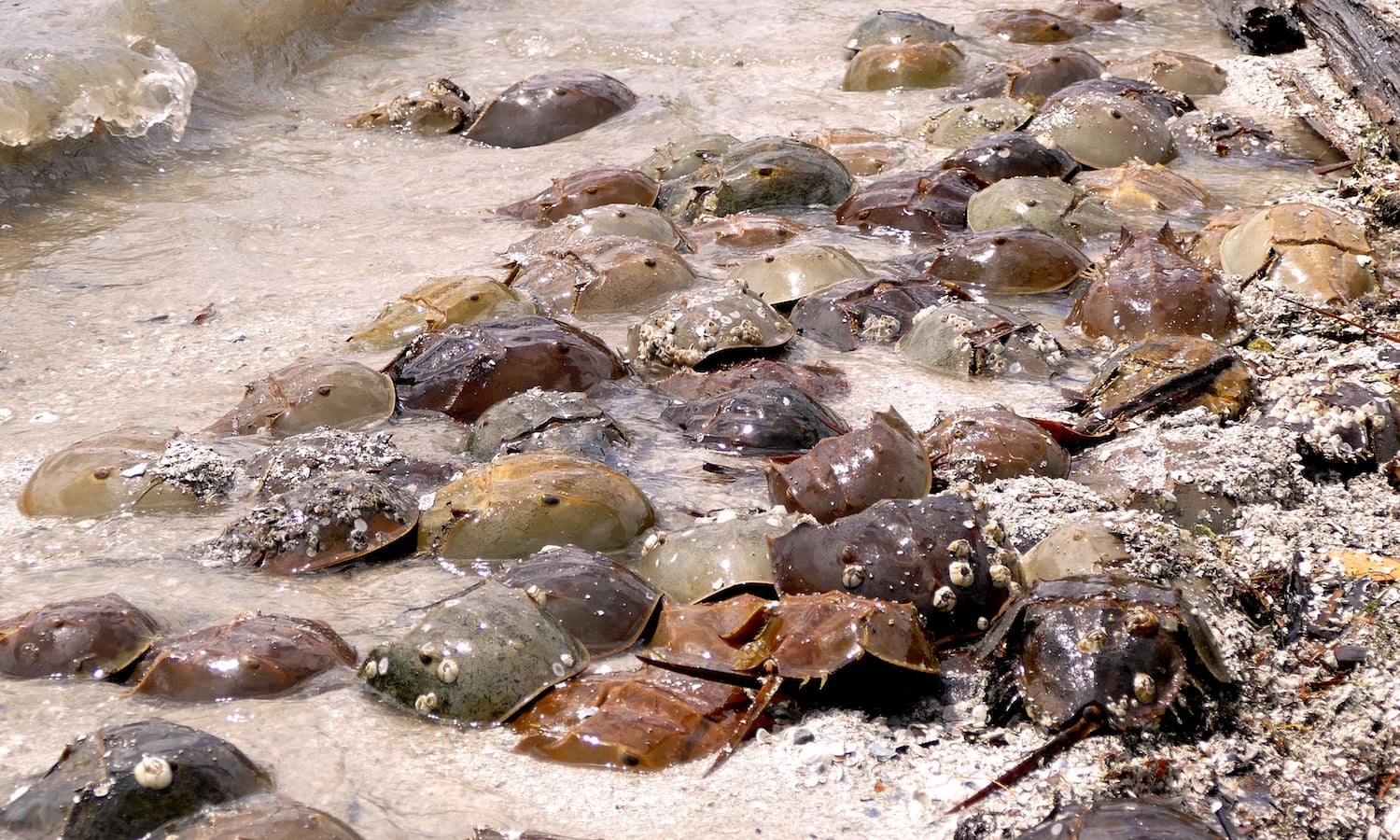
How A Once-Toxic Cape Cod Lagoon Became A Horseshoe Crab Haven
NORTH TRURO, Massachusetts — It’s a warm, sunny June morning as Sophia Fox pulls on her wetsuit and wades into the cool waters of East Harbor. About ten feet from the shore, she stops, scans the surface, and plunges her arm into the shallow waters. Waves ripple outward, and for a moment, nothing happens. When she straightens again, her cupped hand lifts something out of the water, dripping into the light.
With a domed shell the same shape and dull green as a World War II helmet, the horseshoe crab, Limulus polyphemus, waves its pointy tail around as she slowly turns it over in her hands. The males are smaller than the females, and this one measures about five inches at its widest point. It is a creature so ancient that its ancestors were crawling the seafloor some 450 million years ago, long before the dinosaurs. When Fox flips it onto its backside, the creature reveals rows of shiny appendages that undulate in slow, rhythmic waves.

“It’s a male,” the Cape Cod National Seashore biologist says, pointing to the front pair of legs. “He has pedipalps…you can see claspers here,” she continues, pointing to the hooked ends, bulging like tiny boxing gloves. “He uses them to grab onto the female during mating.”
As her palm cradles the upside-down shell, its legs move nonstop, paddling at nothing. Fox carries the creature to the shore, jots down its measurements, and then affixes a white plastic disc, about 1 inch in diameter, bearing a six-digit code to its shell. Then, she releases him back into the water to find a mate.
This crab is one of 50 that she’ll capture and tag during one of the busiest weeks of the annual horseshoe crab mating season. What seems like a typical day in the life of a national seashore park ranger wasn’t always like this. Just 25 years ago, this 750-acre lagoon, which sits at the tip of Cape Cod in North Truro, was so toxic that tens of thousands of dead fish washed ashore, suffocated by oxygen-depleted waters.
The area was once a large-mouthed harbor, called East Harbor, that emptied into Cape Cod Bay, but in 1868, a massive 1,000-foot dike built to support the Provincetown Railroad cut off the harbor from the bay’s tidal currents. For more than a century, its trapped waters stagnated, losing salinity, tides, and the sea life that once inhabited it. It became too hot, too oxygen-depleted, and too perfect for toxic algae to bloom and take over.

The die-off prompted the town of Truro and national seashore staff to install an 800-foot-long pipe to deliver fresh ocean water to the lagoon. In 2002, the pipe opened, and for the first time in more than a century, ocean water flowed back in, restoring the tides, salinity, and the horseshoe crabs. By 2010, Fox began to see mature adults that she could tag. The timing fit with their biology: horseshoe crabs take at least seven years to become sexually mature.
She recalls a particularly crowded mating season in 2024.
“We had about a thousand crabs in a space the size of a bedroom—everywhere you looked,” she recalled. “It was extraordinarily exciting for us.”
On this day, she estimates that hundreds, maybe thousands, are now thriving here.
The story is a bright spot in an otherwise unhappy one for the ancient animal, which is widely considered to be in decline across Massachusetts and beyond. Horseshoe crabs, despite their names, aren’t actually crabs. They are arachnids, more closely related to spiders and scorpions. Despite surviving for the past 450 million years, their populations are shrinking by up to 9 percent annually due to overharvesting, habitat loss, and climate change.
Populations along the Atlantic range have declined by as much as 80 percent since the mid-1980s. These declines have been well documented in other parts of Cape Cod, where they wash up to spawn along the protected, sandy beaches of the inner Cape. Their decline has been linked to declining numbers of other animals that feed on their eggs, including Red Knots, a migratory shorebird listed as threatened under the Endangered Species Act that flies from their wintering grounds in Brazil to the Arctic each year.

When Bob Glenn, now a deputy director at the Massachusetts Division of Marine Fisheries, started at the agency in the early 1990s, there was no management plan for the crabs; in fact, horseshoe crabs were considered pests. They were blamed for preying on shellfish and disrupting local fisheries–a central part of the Massachusetts coastal economy. In Massachusetts, and elsewhere, towns paid bounties of three to five cents in the 1950s for horseshoe crab tails. They led to the killing of roughly a million crabs per year. Although the bounties officially ended in the 1970s, they are still commercially harvested as bait, and their blood is prized by the biomedical industry for detecting bacterial contamination in pharmaceutical products.
Things started to change in 2010 when Massachusetts put regulations in place to address declining numbers, beginning with the closure of commercial fisheries during their mating seasons. Thanks to these measures, Glenn and his team are seeing Massachusetts numbers stabilize during the 15-year period after the protections were enacted.
“Luckily, over time, the views on horseshoe crabs have changed substantially, and not only are they now regulated, but they’re also revered as an important wildlife in Massachusetts, and one that needs protection,” says Glenn.
But nowhere in the state has seen such a successful recovery as in East Harbor. Fox and her team suspect that the crabs that have made their way into the pond have mated and never left. She suspects that up to three-fourths of the population remains in the pond year-round, which is evidenced by their remarkably clean shells, free of barnacles and other sea life (called epibionts) that typically attach to crabs in the ocean.
In addition to a standard long-term tagging program, which allows Fox’s team to identify individual crabs over their lifetimes through recapture and citizen-science tracking efforts, they also run an acoustic tracking program. By tagging the animals with electronic devices that emit ultrasonic pings detectable by underwater hydrophones, Fox’s team can track crabs in real time to determine whether they are coming or going.
Some crabs do travel back out to the ocean and return. The biologists also monitor environmental conditions, such as water temperature and quality. The pond can become dangerously warm, roughly 30 degrees Celsius, in the summer months, which has killed off other organisms like seagrass. But the crabs seem mostly unaffected.
“There's a lot of interest in this program because they're just doing so well,” Fox says. “We'll keep trying to figure out what they're doing in there, and how they can be helping the populations outside.”
Stories about:
Story Categories:
A copy of National Parks Traveler's financial statements may be obtained by sending a stamped, self-addressed envelope to: National Parks Traveler, P.O. Box 980452, Park City, Utah 84098. National Parks Traveler was formed in the state of Utah for the purpose of informing and educating about national parks and protected areas.
Residents of the following states may obtain a copy of our financial and additional information as stated below:
- Florida: A COPY OF THE OFFICIAL REGISTRATION AND FINANCIAL INFORMATION FOR NATIONAL PARKS TRAVELER, (REGISTRATION NO. CH 51659), MAY BE OBTAINED FROM THE DIVISION OF CONSUMER SERVICES BY CALLING 800-435-7352 OR VISITING THEIR WEBSITE. REGISTRATION DOES NOT IMPLY ENDORSEMENT, APPROVAL, OR RECOMMENDATION BY THE STATE.
- Georgia: A full and fair description of the programs and financial statement summary of National Parks Traveler is available upon request at the office and phone number indicated above.
- Maryland: Documents and information submitted under the Maryland Solicitations Act are also available, for the cost of postage and copies, from the Secretary of State, State House, Annapolis, MD 21401 (410-974-5534).
- North Carolina: Financial information about this organization and a copy of its license are available from the State Solicitation Licensing Branch at 888-830-4989 or 919-807-2214. The license is not an endorsement by the State.
- Pennsylvania: The official registration and financial information of National Parks Traveler may be obtained from the Pennsylvania Department of State by calling 800-732-0999. Registration does not imply endorsement.
- Virginia: Financial statements are available from the Virginia Department of Agriculture and Consumer Services, 102 Governor Street, Richmond, Virginia 23219.
- Washington: National Parks Traveler is registered with Washington State’s Charities Program as required by law and additional information is available by calling 800-332-4483 or visiting www.sos.wa.gov/charities, or on file at Charities Division, Office of the Secretary of State, State of Washington, Olympia, WA 98504.
