

Several years ago, concerns surfaced at Big Bend National Park about the potential for the park’s spring-fed water supply to run dry due to the long-running drought that the Southwest has been locked in since the turn of the century. Located in West Texas and sitting on the border with Mexico, Big Bend’s canyons, rivers, and desert landscapes run up against the Ouachita Mountains in the north and the Rio Grande Wild and Scenic River in the south. In the past decade, visitation to the park has increased by nearly 200,000 visitors.
Driving Big Bend's water woes is the pipeline that draws water from Oak Spring and pumps it uphill roughly 2.5 miles to the Chisos Basin and the lodge there. In 2023 the Traveler was told that due to the exorbitant cost of finding a new water source and building a replacement pipeline (estimated at $70 million-$100 million), the Park Service was hoping that fixing the leaks and increasing storage from 500,000 gallons to 1 million gallons would extend the spring's life 10-20 more years.
Early in 2025 that hope took a hit when a significant water line leak and ongoing drought conditions forced park staff at Big Bend to temporarily close the public-facing flush toilets in the Chisos Basin. A bigger hit struck on December 23, 2025, when the water pumps at Oak Spring "failed completely," prompting park visitors, concessions workers, and staff to conserve water.
Big Bend isn’t the only park with a vulnerable water supply. Parks across the West face a variety of water problems. At Grand Canyon National Park, aging water lines have been causing headaches for years.
Originally built in the 1960s, the park’s Transcanyon Waterline provides potable water for facilities on the South Rim and inner canyon. The waterline has exceeded its expected lifespan and experiences frequent failures, which require expensive and continuous maintenance work to repair leaks. Since 2010, there have been over 85 major breaks that have each disrupted water delivery. The National Park Service recently started construction on a multi-year, $208 million rehabilitation of the Transcanyon Waterline and upgrades to the associated water delivery system. This crucial investment in infrastructure will ensure the park is able to meet water supply needs for six million annual visitors and approximately 2,500 year-round residents.
Additionally, water shortages caused by high visitation led to the closure of some bathroom facilities at Logan Pass at Glacier National Park in August 2025. Glacier went from 2.34 million visitors in 2015 to 3.1 million last year, and more visitors means more water use.
Glacier’s name reflects the many active glaciers across the park, which have carved out U-shaped valleys and left behind lakes as they’ve melted or retreated across the landscape. However, the glaciers, an important source of fresh water, have been shrinking: between 1966 and 2015, every named glacier in the park got smaller, some by more than 80 percent. Glaciers shrink when summer melting outpaces winter snow accumulation, so their shrinkage is an indicator that park water supplies are also in danger.
“For Glacier National Park’s Logan Pass water supply, recent observed shortages are likely explained by a combination of increasing visitation as well as rising temperatures, which result in less snow and earlier runoff,” explained Naaman Horn, a public affairs specialist for national parks in the Intermountain region. Horn mentioned that more research is needed to characterize climate-related impacts to water supplies in other areas of the park.
The National Park Service overall began to realize that a more widespread study needed to take place to identify the diverse water issues facing the parks. The agency approached researchers at a Colorado State University lab that specializes in aggregating disparate and large data sets to examine the problems.
The result is an ongoing, multi-year assessment of parks across the National Park System that aims to identify potential water supply issues and offer solutions that parks can implement to protect their water resources. Preliminary analysis for the project began in July 2022, though detailed park reports have only recently begun to be published. The work is proceeding as a collaborative project with the National Park Service under a Cooperative Ecosystem Studies Unit agreement.
“Many national parks are in remote places, and they aren't hooked up to a municipal water supply like houses in a city, so they have to source their own water,” explained Kristen Cognac, a water analyst at CSU and a co-lead on the project. “And natural resources, water resources, are highly impacted by climate, by precipitation and rain, but also by changes in temperature, which drive up plant water demands and atmospheric water demands.

“Water is essential not just for visitors at national parks. It's essential for national park operations and staff. There’s a lot of maintenance that goes on at parks, and that requires water. Without us doing this work or the National Park Service specifically seeking to understand these things, there's significant risk to access in national parks for everybody.”
The research team has been working to identify and analyze both known and unknown water supply issues across the Park System, an endeavor that involves a great deal of data analysis. They are using climate data from across the United States, as well as water balance models derived from national scale data sets, including fire risk and sea level rise data sets.
“We are assessing the same variables at each water system…And then we're looking at which ones have either the greatest projected change in, say, a decrease in water inputs or an increase in drought or increase in sea level rise or the most area around them that are going to become inundated by projected sea level rise,” explained Cognac. “We're comparing the same variables across all water systems to identify which might be most vulnerable.”
The assessment will be applied to all national parks across the continental United States, though the early stages of the analysis have focused on parks in the West, as they’re generally considered more vulnerable to water supply issues.
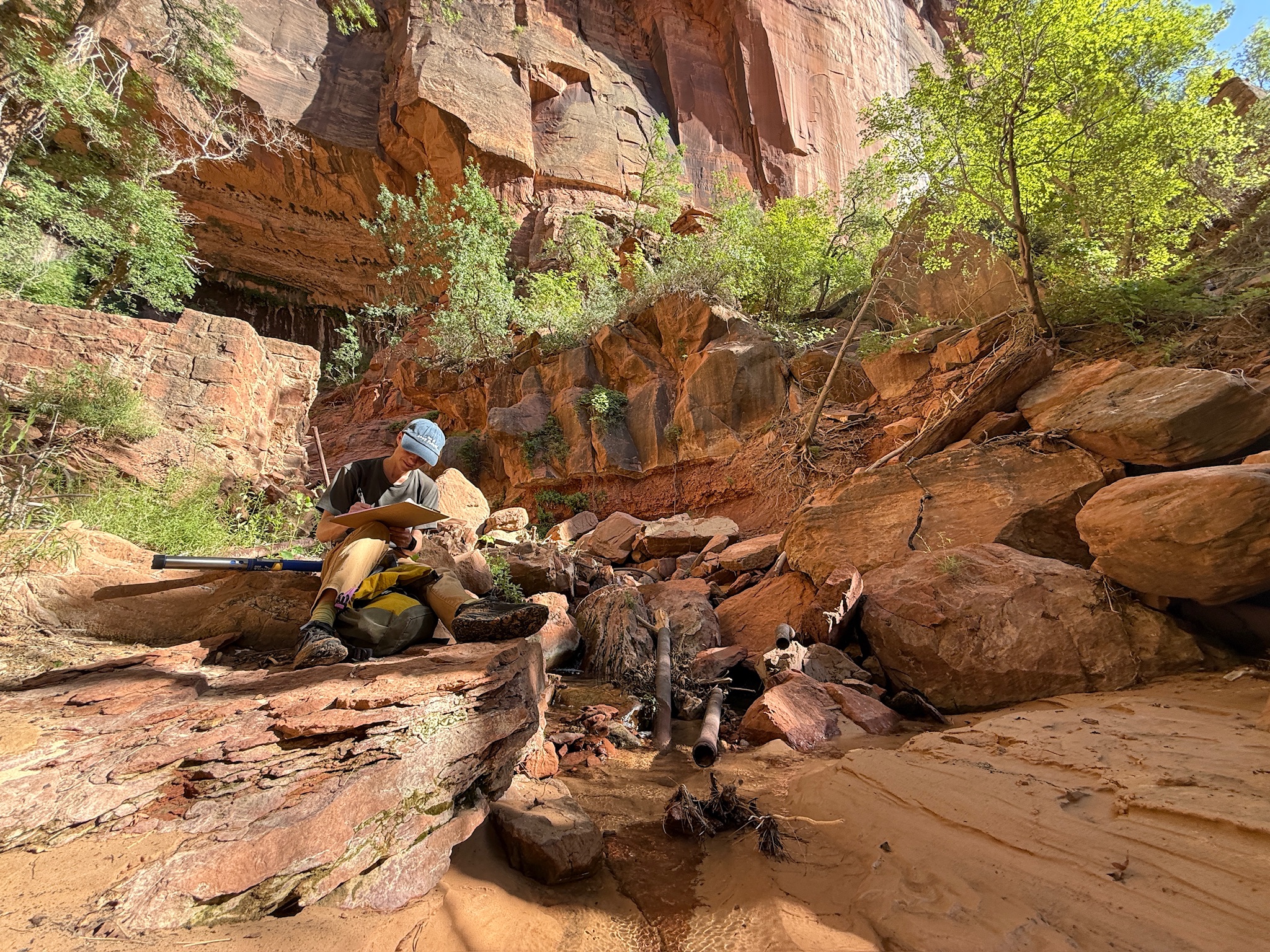
“We are hydrologists by training,” explained Katie Willi, a data scientist at CSU and another co-lead on the project. “So, we also have the tools equipped with not only this kind of broader assessment of where these issues are occurring, but what we are calling ‘deep dives.’”
The deep dive assessments involve collecting a lot of information about an individual park’s water system. The team meets with the water system manager and gets on the ground data if it's available. Next steps include bringing in climate models, running a water balance model to look at changes in inflows and outflows over time, and looking at site-specific fire data sets.
“We've been to parks like Valles Caldera, where all their infrastructure was damaged from flash floods following a wildfire, and that water was really silty,” explained Cognac. “They had to move to a groundwater supply for a little bit, so wildfires have a huge impact.”
The team also uses a conceptual model to make any inferences about future changes in water quality, which includes analyzing the park’s past water quality data and what issues the park has faced, as well as how those might change in the future based on what the projections reveal. Those projections involve utilizing metrics and statistics, including how much more frequent droughts will be or how water seasonality might change.
Cognac specifically offered an example of what they found at Bryce Canyon National Park in Utah, where the researchers discovered that the groundwater levels in the park’s aquifer are tightly linked to annual changes in water balance, which tracks water inflows, outflows, and changes in storage in a hydrologic system.
“We identified the potential for 30 percent reductions in recharge to that aquifer and the potential for water levels to drop below their management thresholds a lot more frequently in the future,” explained Cognac. “We found that their water supply is very sensitive to changes in climate. And in a drier future – many global climate models do project a much drier future for Bryce Canyon – they will likely run into issues that they'll have to address.”
For Bryce Canyon’s situation, the research team suggested that the park expand its water storage capacity to prepare for drier years. The park’s current tank storage amounts to 1,320,000 gallons for its primary water system. “We recommended that they improve monitoring to better track real-time changes in tank storage. Rather than prescribing a static volume, we advised the park to evaluate expansion needs based on these improved datasets to ensure long-term resilience,” said Cognac.
The changes can’t come soon enough, as Bryce Canyon went from 1.7 million visitors in 2015 up to 2.5 million in 2024 before dipping a bit to 1.9 million last year.

Other management strategies that the team incorporates into its reports include proactive and real-time monitoring of things like leak detection; protecting water systems from wildfires; tracking water demands vs. water inputs; and developing alternative water sources if parks rely on just one.
While the team has not identified any ongoing leaks during their park visits, both Bryce Canyon and Cedar Breaks identified historical leaks as the cause of past usage spikes, pointing to how important improved, real-time monitoring is when it comes to the timely detection of leaks.
“Our No. 1 recommendation that we found across all the parks that we've looked at so far is that increased monitoring is essential,” said Cognac. “It's really hard to evaluate climate-water linkages without field location-specific data. A lot of parks haven't historically had that, but it's a lot more possible now with the automated technology.”
Cognac and Willi explained that they have so far conducted deep dives at Bryce Canyon National Park, Valles Caldera National Monument, and Cedar Breaks National Monument. Deep dives are also currently taking place at Zion National Park and Glacier National Park.
“Generally, across the Western U.S. in parks like Bryce Canyon, Cedar Breaks, Zion, and Valles Caldera, temperature increases impact the amounts and timing of snowmelt,” said Horn. “This threatens park water supplies, particularly supplies that rely on surface water and shallow groundwater sources.”
Many of these parks are in areas that have seen a decades-long drought and are already facing known water issues, making them ideal sites to start the deep dives. But there’s another reason the team visited these parks first.
“In general, these parks have been selected because there's been a potentially big infrastructure project that's going to happen, and they want to confirm that the water supplies are sustainable in the long term before they make these financial investments,” said Cognac.
For example, Cognac mentioned that Bryce Canyon is getting new piping from their existing wells to the distribution and treatment system. At Valles Caldera, the park is planning a significant expansion of visitor services, which would include adding water services for visitors and installing a new well, treatment, and distribution system.
Horn added that a project is being planned in Big Bend to address the aging water distribution lines in the park’s developed areas, including the 3-mile pipeline from Oak Spring up to the Chisos Basin. “Many of those lines date to the 1950s and have far exceeded their useful lives,” he said. According to the Park Service website, work on the lines is set to begin in May 2026 and should take about two years.
The reports being generated by the assessment are crucial when it comes to helping the parks understand their unique water situations, but the project is going a step further by developing an app that parks can use to get information on their water supplies.
“All of our indicators that we're calculating and our final vulnerability scores will be available on that app,” said Cognac. “Any park can go in, zoom into the specific water supplies, and look at the fire risk, the projected changes in runoff, and how it compares to all other parks across the country, as well as other parks in their region, and even potentially just across the park.”
The team hopes to have the app up and running by mid-2027.
The researchers have high hopes for the project’s overall impact, especially considering that visitation to national parks has been trending upward and shows few signs of slowing.
“We really hope that this data can be used to help and support the park to make wise decisions,” said Willi. “Water infrastructure is one of the biggest expenses, actually. It's very expensive to maintain and create these water supply systems and oftentimes are some of the biggest infrastructure investments at the parks, so to help them do that wisely is going to be really a good thing for them.”
Story Categories:
A copy of National Parks Traveler's financial statements may be obtained by sending a stamped, self-addressed envelope to: National Parks Traveler, P.O. Box 980452, Park City, Utah 84098. National Parks Traveler was formed in the state of Utah for the purpose of informing and educating about national parks and protected areas.
Residents of the following states may obtain a copy of our financial and additional information as stated below:
- Florida: A COPY OF THE OFFICIAL REGISTRATION AND FINANCIAL INFORMATION FOR NATIONAL PARKS TRAVELER, (REGISTRATION NO. CH 51659), MAY BE OBTAINED FROM THE DIVISION OF CONSUMER SERVICES BY CALLING 800-435-7352 OR VISITING THEIR WEBSITE. REGISTRATION DOES NOT IMPLY ENDORSEMENT, APPROVAL, OR RECOMMENDATION BY THE STATE.
- Georgia: A full and fair description of the programs and financial statement summary of National Parks Traveler is available upon request at the office and phone number indicated above.
- Maryland: Documents and information submitted under the Maryland Solicitations Act are also available, for the cost of postage and copies, from the Secretary of State, State House, Annapolis, MD 21401 (410-974-5534).
- North Carolina: Financial information about this organization and a copy of its license are available from the State Solicitation Licensing Branch at 888-830-4989 or 919-807-2214. The license is not an endorsement by the State.
- Pennsylvania: The official registration and financial information of National Parks Traveler may be obtained from the Pennsylvania Department of State by calling 800-732-0999. Registration does not imply endorsement.
- Virginia: Financial statements are available from the Virginia Department of Agriculture and Consumer Services, 102 Governor Street, Richmond, Virginia 23219.
- Washington: National Parks Traveler is registered with Washington State’s Charities Program as required by law and additional information is available by calling 800-332-4483 or visiting www.sos.wa.gov/charities, or on file at Charities Division, Office of the Secretary of State, State of Washington, Olympia, WA 98504.


