


WASHINGTON, D.C. — Bobbi Stevenson Bauer loves her flowers. The Arlington, Virginia, resident often travels to downtown Washington, D.C., to visit the Enid A. Haupt Garden at the Smithsonian and the U.S. Botanic Garden, two of the many tourist destinations that are situated along the National Mall. So she has a good sense of what is typical for tourist traffic this time of year.
“I haven’t seen it this empty since Covid,” she reported during a recent visit. “It could just be that it’s the end of [the summer] tourist season, but it feels almost eerie. The most noticeable difference [recently] is that now [some of] the National Guard are carrying rifles, not the small arms announced earlier.”
In mid-August, President Donald Trump deployed the National Guard to D.C. to purportedly “rescue our nation’s capital from crime, bloodshed, bedlam and squalor and worse,” sending hundreds of soldiers to areas across the city including the Mall, Union Station, subway stations, and other places. In response, critics have pointed out that the capital city’s violent crime rate has been dropping significantly in recent years—hitting a 30-year low in 2024—and accused the president of having political motives for drawing negative attention to a Democrat-leaning city. The District of Columbia has now sued the Trump administration in federal court, claiming "illegal federal overreach." The president has suggested that similar deployments will soon happen in Chicago, New York, and other cities.
Since January, the Trump administration’s decisions regarding NPS, particularly a 24% reduction in its workforce, have led to shuttered visitor centers, deferred maintenance, and understaffed areas, as well as widespread concerns about longer-term impacts on the park system. In D.C., one major issue seems to be that the military presence may be keeping visitors away from the city's beloved monumental core. And when people do congregate on parkland, it tends to be in protest.
A Visible Presence
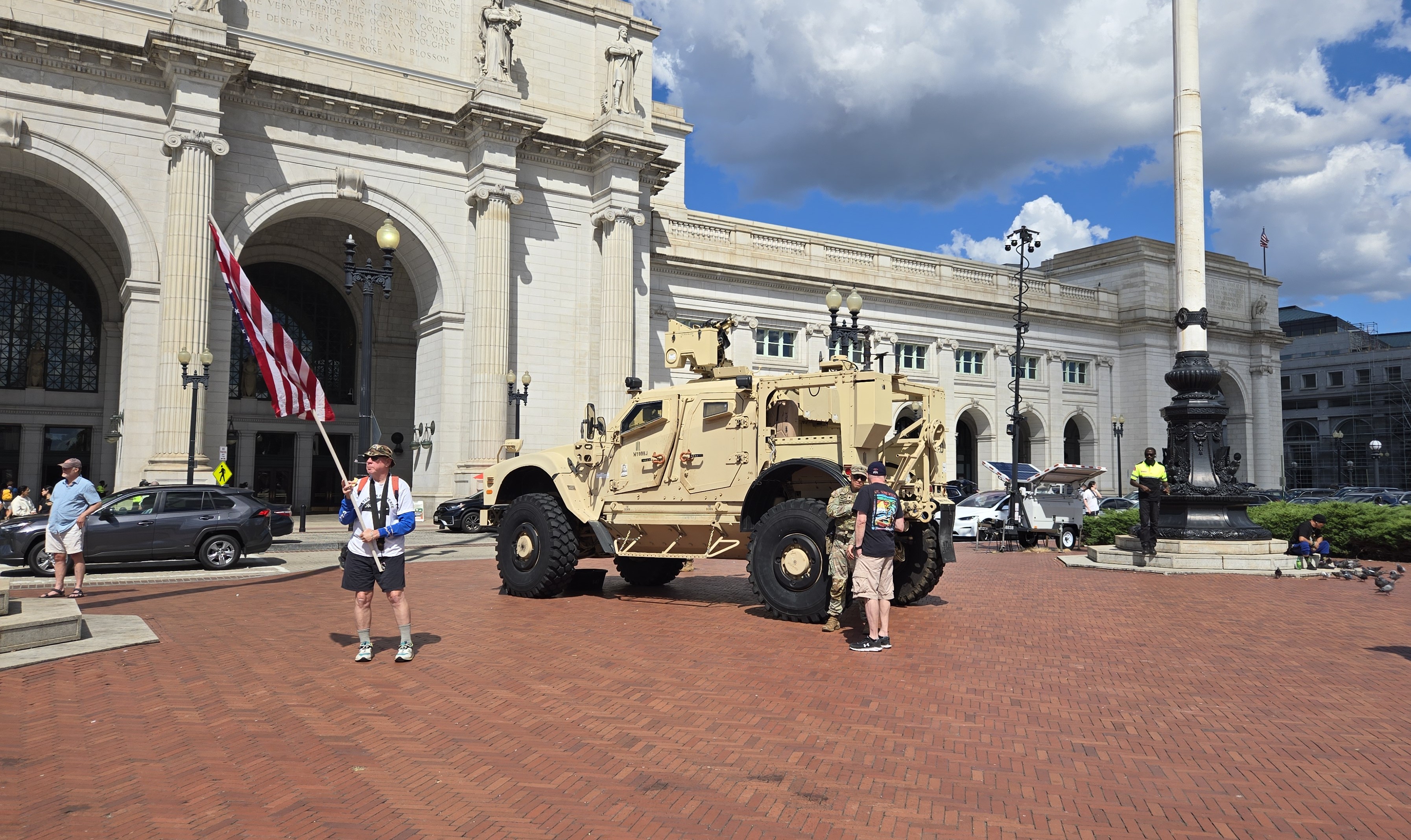
Since they were called up, National Guard members have been spotted in many popular tourist areas in downtown Washington, most of which fall under National Park Service jurisdiction, despite the fact that these public areas are generally low in crime. Statistics show that Washington’s most serious crimes—murder, assault, burglary, etc.—occur in neighborhoods miles away from D.C.’s monumental downtown. Trump recently instructed the Guard members to pick up trash and do landscaping to help beautify the city (and presumably give them more to do).
The deployment to low-crime but popular areas is an intentional show of force, as Col. Dave Butler, an Army spokesman, told ABC News: “That's part of our assignment—to go to the national monuments and be present.” More areas around the Mall have also now been framed with metal barricades as well.
When asked whether the National Guard presence was intimidating or caused any travel issues for them, a handful of tourists on the Mall recently said that they were mostly a non-factor. “There is a higher presence [on the Mall] but nothing is really happening,” one person stated. “It's daytime, it's a tourist area, and that section of the city traditionally has pretty low crime to begin with. But DC is emptier than I have seen it since Covid, and quiet.” Others noted that construction for renovations of the Hirshhorn Museum and Sculpture Garden, one of several Smithsonian museums that line the Mall, and the Lincoln Memorial were more challenging to navigate around than the military.

Like proving a negative, however, what’s harder to quantify is the extent to which the military presence is keeping significant numbers of people from visiting, due to fears about checkpoints, the possible use of force, and increased difficulty getting around military vehicles and barricaded areas. But some signs are pointing in that direction. In a recent interview with The Washington Post, an executive with Tours By Foot, which leads a popular 2.5-hour walking tour of the National Mall and other itineraries, reported a “marked downturn” in bookings in the three weeks since Trump brought in troops. The Post also reported that foot traffic in D.C. had dropped an average of 7 percent and that at least 41 organizations had cancelled their planned annual trips to Washington for next year, according to a tourism organization called Destination DC. Reports have noted that restaurant patronage has dropped as well.
Anecdotal evidence appears to support these numbers. On the recent three-day Labor Day weekend, D.C. was enjoying unusually mild weather with temperatures in the upper 70s and low humidity. And yet foot traffic was relatively light on the National Mall, with only slightly more people seen around the Lincoln Memorial and the Washington Monument. Small groups of two to four National Guard members could be seen strolling up and down the crushed-gravel pathways of the Mall, eating a snack at an NPS kiosk, and standing on street corners talking with each other. Three guardsmen were spotted chatting with a couple civilians near a line of ice cream and smoothie trucks.
Places for Protest
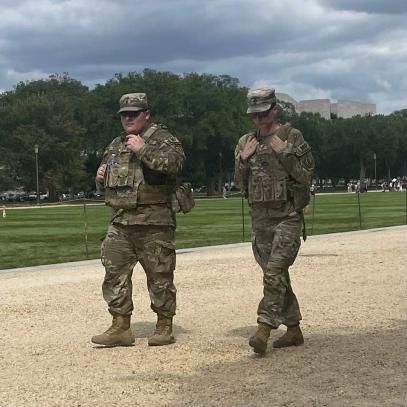
Other areas were not as placid. Public spaces in the nation’s capital have always drawn protests, which are allowed in certain park areas with a permit, and it is not surprising, in the age of a polarizing figure like Trump, that these activities have intensified. One focal point for these protests is D.C.’s Union Station. This Beaux-Arts architectural masterpiece is fronted by Columbus Circle, an elliptical park managed by NPS that contains an ornate marble fountain designed by Lorado Taft in collaboration with Union Station architect Daniel Burnham.
Here, the National Guard has taken a more aggressive stance, with two heavy armored vehicles stationed on the circle directly across from the station’s entrance. On a recent afternoon, several soldiers were visible along with U.S. Park Police (a division of NPS) nearby on horseback and in vehicles.
The circle has recently become the focus of an ongoing protest "sit-in" against the current militarization, led by veterans and joined by private citizens, often carrying signs and yelling slogans. Although the Guard and protesters mostly are peacefully coexisting, on a recent afternoon occasional shouting matches erupted between the picketers and pro-Trump passersby. The congregation of soldiers, protesters, and travelers coming and going created a snarl of car and bus traffic inching around the station. Blaring car horns, officers whistling and directing traffic, and the general fracas made for a chaotic, tense scene.
Standing nearby was one protester, Ashley Kauhn, a homemaker who came to D.C. from central Alabama to join the sit-in, her second time traveling to Washington this year to protest. Carrying a sign that read, “Don’t Take the Word of the Orange Turd,” Kauhn stated that the protesters generally are cognizant that the National Guard is simply following orders.
“The individuals in the Guard, this is not their fault,” Kauhn said. “A lot of them probably don't want to be here. They are contractually obligated. It’s not their fault as individuals. We know whose fault it is, and so we’re going to just make sure that we keep the focus where it needs to be.”
On September 1, just three days before the District filed its lawsuit, Trump declared D.C. a “crime-free zone,” noting that Mayor Muriel Bowser had announced an 87% decrease in carjackings since the National Guard deployment, from 31 for the comparable period in 2024 down to 5 in recent weeks. But it remains unclear how long the Guard will be deployed in D.C. and what the long-term impacts on the parks, tourism, and the local economy will be. In the meantime, will people come to the nation's capital because of the National Guard's presence, or in spite of it? Or will they just stay home?
Story Categories:
A copy of National Parks Traveler's financial statements may be obtained by sending a stamped, self-addressed envelope to: National Parks Traveler, P.O. Box 980452, Park City, Utah 84098. National Parks Traveler was formed in the state of Utah for the purpose of informing and educating about national parks and protected areas.
Residents of the following states may obtain a copy of our financial and additional information as stated below:
- Florida: A COPY OF THE OFFICIAL REGISTRATION AND FINANCIAL INFORMATION FOR NATIONAL PARKS TRAVELER, (REGISTRATION NO. CH 51659), MAY BE OBTAINED FROM THE DIVISION OF CONSUMER SERVICES BY CALLING 800-435-7352 OR VISITING THEIR WEBSITE. REGISTRATION DOES NOT IMPLY ENDORSEMENT, APPROVAL, OR RECOMMENDATION BY THE STATE.
- Georgia: A full and fair description of the programs and financial statement summary of National Parks Traveler is available upon request at the office and phone number indicated above.
- Maryland: Documents and information submitted under the Maryland Solicitations Act are also available, for the cost of postage and copies, from the Secretary of State, State House, Annapolis, MD 21401 (410-974-5534).
- North Carolina: Financial information about this organization and a copy of its license are available from the State Solicitation Licensing Branch at 888-830-4989 or 919-807-2214. The license is not an endorsement by the State.
- Pennsylvania: The official registration and financial information of National Parks Traveler may be obtained from the Pennsylvania Department of State by calling 800-732-0999. Registration does not imply endorsement.
- Virginia: Financial statements are available from the Virginia Department of Agriculture and Consumer Services, 102 Governor Street, Richmond, Virginia 23219.
- Washington: National Parks Traveler is registered with Washington State’s Charities Program as required by law and additional information is available by calling 800-332-4483 or visiting www.sos.wa.gov/charities, or on file at Charities Division, Office of the Secretary of State, State of Washington, Olympia, WA 98504.
