


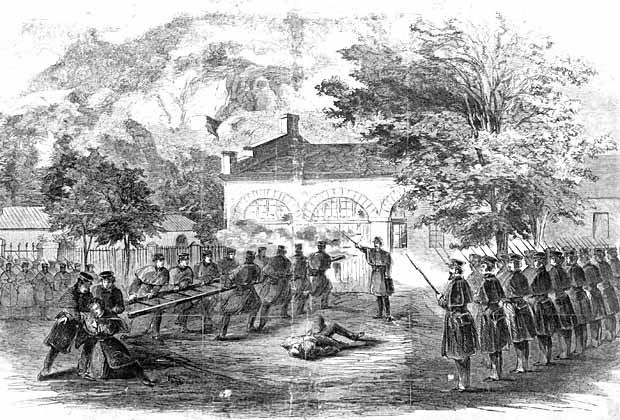
Leaving their farmhouse hideout at night, a band of wannabe saviors brimming with revolt made their way to a West Virginia hamlet one early October morning. But their plans soon went awry. Instead of seizing a federal weapons cache and inciting a massive resistance, the band wound up captured or killed by the U.S. government.
Many people have heard of John Brown’s 1859 raid, a story preserved at Harpers Ferry National Historic Park. There, the white abolitionist led a brazen attack in hopes of ending slavery. We think of John Brown as a prescient man, a wise man, a hero.
But his boldness was not unprecedented. Other men had been conspiring and revolting to end slavery in America since colonial times. They, too, were prescient, wise, and heroic: they were Black, and they were enslaved.
From the 1960s to the present, the National Park Service (NPS) has been documenting or preserving sites where people risked everything for freedom. The agency has left its stamp on at least 15 sites that include the largest slave revolts in the South, across three states and nearly 100 years of history.
Some of these places are within parks owned by NPS. Most are sites that communities, nonprofits, and state agencies have nominated for inclusion in NPS historic preservation programs. In those cases, NPS provides site owners with funding, preservation planning, and technical assistance.
National Historic Landmarks (NHLs) are NPS’s highest designation short of a national park, deemed by the Interior Secretary as nationally significant. Sites on the National Register of Historic Places (NRHP), which includes national historic districts, form “the cornerstone of historic preservation in this country,” according to retired NPS historian Diane Miller. Some of the sites are part of other Congressionally authorized NPS partnership programs, such as the 800-site Underground Railroad Network to Freedom created by Congress in 1998. Miller was the network’s national program manager for 25 years.
“These sites are clearly important to the public because the public is nominating them” for preservation, Miller said. “This isn’t the government going out there with an agenda. This is what’s important to the American people.”
When it comes to slavery, NPS tends to highlight stories about “escape…through evasion, flight, and resistance,” rather than big armed rebellions, said Alan Spears, government affairs senior director of cultural resources at the National Parks Conservation Association. An NPS study in 2000 referred to these large-scale revolts as “early anti-slavery” movements.
“We [as a nation] still haven’t quite figured out how we talk about the major uprisings, the violence and [people resisting] in a different way that is not a Dr. Martin Luther King Jr.‒turn-the-other-cheek‒nonviolent way,” Spears said.
But the large uprisings are proof of “resistance from Day One,” Spears noted.
The National Parks Traveler is offering a unique inventory of these lesser-known sites to highlight the significance of the enslaved fighting their bondage and stolen labor. These stories also shed light on the leaders’ wisdom, ingenuity, military strategy, persistence, and bravery.
Early Days: Stono Rebellion, 1739
Anti-slavery revolts erupted on American soil well over a century before the Civil War. The event that NPS calls “the largest organized violent resistance to slavery in British Colonial North America” took place in 1739, before the American Revolution.
More than 70 enslaved people, led by Jemmy from Angola, attacked the Elliott and Rose rice plantations on what is now the 654-acre Caw Caw Interpretive Center in Ravenel, South Carolina. Today’s visitors on walking paths can see cuts in the wetland vegetation, canals, and earthen dikes—traces of rice fields that enslaved Africans slashed out of cypress swamp.
The nature preserve, operated by the Charleston County Parks and Recreation Commission, is part of the Underground Railroad Network to Freedom and the Gullah Geechee Cultural Heritage Corridor created by Congress in 2006 as a National Heritage Area.
Witnesses to the revolt described men marching “like a disciplined company” as they fled towards free Spanish Florida, according to NRHP documents for the nearby Stono River Slave Rebellion National Landmark, a stretch of today’s U.S. Highway 17 where the rebellion began.
State militia quelled the rebellion and executed the participants. Then the state passed the Negro Act of 1740, curtailing enslaved people’s rights.

Bloodiest: Nat Turner Revolt, 1831
“Nat Turner’s Revolt was the stuff of nightmares for slaveholders across the South,” NPS says on a web page about the insurrection’s impact. In Southampton County, Virginia, Turner and 50 others revolted in August 1831 in what the agency describes as the “bloodiest slave insurrection in American history.” The insurrectionists went house to house killing 55 people, including women and children. Whites responded by killing “hundreds of other blacks…murdered in retribution for this insurrection throughout the South,” according to NPS. At least 18 participants were hanged.
Turner considered himself a prophet and a preacher, acting on a sign from a spirit. During religious gatherings in the woods, he strategized with co-conspirators and collected intelligence about the location of ammunition, weapons, and horses. The goal: to liberate the enslaved by erasing enslavers—but sparing poor whites, non-enslavers, and Turner’s childhood friends.
Occasional private tours today start in the village of Courtland, where many white planter families took refuge during the four-day revolt. It’s the center of the 135-acre Courtland Historic District. Tours cross cotton and peanut fields where enslaved people once worked and past moldering houses where the murders took place. A sign for Blackhead Signpost Road, where whites displayed the severed heads of captured freedom-seekers, was visible in the countryside until a few years ago.
Other sites on the NRHP are Mahone’s Tavern, a command center for militias and a refuge for white citizens during the revolt, now owned by a nonprofit; the Rebecca Vaughn House, the only home targeted by Turner that’s still intact, preserved by the Southampton County Historical Society; and Belmont, an 18th century plantation house where troops quashed the revolt, now a private dwelling.
Despite entreaties from many Virginians to end slavery after this revolt, the Virginia General Assembly instead cracked down on the enslaved population’s religious freedoms and curtailed the rights of free Blacks.

Breaking Point: Chatham Slave Revolt, 1805
The slave dwellings are gone, and the white Roman-goddess statues tucked into manicured gardens belie the chaos that erupted in 1805 at Chatham, a 1771 Georgian-style mansion and grounds donated to NPS in 1975 that’s part of Fredericksburg & Spotsylvania National Military Park in Virginia. It started when the overseer cut short the Christmas holiday for 100 enslaved people.
Such breaks were important recreation and family time and served “as conductors, or safety-valves, to carry off the rebellious spirit of enslaved humanity,” the formerly enslaved historian and statesman Frederick Douglass later wrote.
But the Chatham uprising capped “years of unrest,” according to a Chatham video, including brutal treatment and floggings, as well as enslaver William Fitzhugh’s selling of people to pay debts.
Led by Robin, an enslaved carpenter, a group of men—including Phill, Abram, James, Robin, and Cupid, tied up and whipped the overseer, explained Beth Parnicza, branch manager of interpretation and education at the park. Phill was shot in a fight when other whites came to suppress the revolt, Abram was executed and the state paid Fitzhugh $400 (about $11,000 today) as reimbursement, and Robin and Cupid were sentenced to death but sent out of the country instead. The military park, Parnicza said, has for years included context about “the causes of the Civil War, especially the central role of race-based chattel slavery.”
“We examine resistance to slavery, including the 1805 revolt,” she said, adding that this material is important to “contribute to the larger American history tapestry.”
Rangers offer occasional “Sparking Freedom” tours at the mansion that focus on the revolt and “resistance to slavery onsite, as well as stories about an enslaved laundress who fundraised for her freedom, and an enslaved man who joined the U.S. Colored Troops,” Parnicza said.
Long Planned: Gabriel’s Conspiracy, 1800
Gabriel Prosser, born into enslavement in 1776, rebelled in August 1800.
Gabriel Prosser Circle, in Richmond, Virginia’s Bryan Park, is a NRHP site where visitors today can find a grassy area with picnic tables near a rocky stream and lily pond, and where enslaved workers in 1800 sought the spot’s serenity for their fish-fries and barbecues on days off.
Young’s Spring is hidden, but that’s where Gabriel revealed his plan for liberty to field hands. As a skilled carpenter who traveled to other plantations, Gabriel was able to recruit co-conspirators among enslaved dockworkers and artisans, free Blacks, and white sympathizers, in Richmond and 11 counties beyond.
Gabriel intended to attack the captors (sparing Quakers, Methodists, and poor whites), overtake key government buildings and weaponry in Richmond, and capture the governor (and future president) James Monroe to negotiate freeing Virginia's slaves.
A storm and two fearful participants thwarted the plan. Of 72 people brought to trial— though testimonies indicate thousands may have been involved—26 were hanged, including Gabriel.
Recently, community activists and the city have been working to commemorate other sites related to Gabriel’s conspiracy; Ana F. Edwards, a public historian, said they hope NPS can be “a likely partner down the road.”
Largest: Denmark Vesey Rebellion, 1822
In the early 1820s, a formerly enslaved, multi-lingual carpenter and lay preacher named Denmark Vesey recruited up to 9,000 enslaved and free Blacks and “mulattos” to revolt in the Black-majority city of Charleston, South Carolina. Vesey amassed six infantry and cavalry companies and corresponded with the president of the new independent Black nation of Haiti—where he planned to lead his followers afterwards—to ask for military assistance, according to David Robertson, author of Denmark Vesey: The Buried Story of America’s Largest Slave Rebellion and the Man Who Led It. But the revolt planned for July 14, 1822, was betrayed.
Nearly 200 people were captured and 35 hanged. White Charlestonians formed a municipal guard and amassed an arsenal, which became known as The Citadel, to defend against future uprisings.
The Denmark Vesey House is a National Historic Landmark, and Mother Emanuel AME Church, where Vesey recruited and organized, is on the National Register. The story of one of Vesey’s co-conspirators, Gullah Jack, is part of the online interpretation at NPS’s Timucuan Ecological & Historic Preserve in Florida where he lived in bondage at the Kingsley Plantation, also a National Register site.
Greatest Distance: German Coast Uprising, 1811
Enslavers who survived the German Coast Uprising of 1811 displayed 100 decapitated heads of the freedom-seekers starting from the Place d’Armes in New Orleans and up the Mississippi for more than 40 miles on River Road.
Sixty-three ceramic heads now commemorate the resistors in a permanent outdoor display at the Whitney Plantation, a nonprofit museum and former indigo, sugar, and rice plantation in Wallace, Louisiana, part of the Whitney Plantation Historic District.
Central to the Whitney Plantation is the story of slavery and what Daniel Rasmussen, author of American Uprising, wrote was “the largest act of armed resistance against slavery in the history of the United States.”
Charles Deslondes, an enslaved man of Haitian descent, along with Komina, Gilbert, Cook, Mathurin, Dagobert, Joseph L’Espagnol, Hippolite, Amar, and Lindor, led years of secret meetings, recruited at public markets, and provided covert military training. They began a two-day march along the Mississippi River toward New Orleans on Jan. 8, 1811, joined by nearly 500 people from surrounding plantations. Waving flags and beating drums, they set buildings aflame and attacked enslavers.
“Freedom or death,” they shouted.
Woodland Plantation, where the uprising began, and Destrehan Plantation, where 67 freedom-seekers were tried and 45 condemned to death, are NRHP sites owned by nonprofits, and the River Road African American Museum Gallery is listed on the Underground Railroad Network to Freedom .
The Park Service continues to document freedom fighting, one location at a time. In May, the agency acknowledged 31 additional sites through its Network to Freedom, including the Greenup Slave Revolt of August 1829 in Kentucky.
Stories about:
Story Categories:
A copy of National Parks Traveler's financial statements may be obtained by sending a stamped, self-addressed envelope to: National Parks Traveler, P.O. Box 980452, Park City, Utah 84098. National Parks Traveler was formed in the state of Utah for the purpose of informing and educating about national parks and protected areas.
Residents of the following states may obtain a copy of our financial and additional information as stated below:
- Florida: A COPY OF THE OFFICIAL REGISTRATION AND FINANCIAL INFORMATION FOR NATIONAL PARKS TRAVELER, (REGISTRATION NO. CH 51659), MAY BE OBTAINED FROM THE DIVISION OF CONSUMER SERVICES BY CALLING 800-435-7352 OR VISITING THEIR WEBSITE. REGISTRATION DOES NOT IMPLY ENDORSEMENT, APPROVAL, OR RECOMMENDATION BY THE STATE.
- Georgia: A full and fair description of the programs and financial statement summary of National Parks Traveler is available upon request at the office and phone number indicated above.
- Maryland: Documents and information submitted under the Maryland Solicitations Act are also available, for the cost of postage and copies, from the Secretary of State, State House, Annapolis, MD 21401 (410-974-5534).
- North Carolina: Financial information about this organization and a copy of its license are available from the State Solicitation Licensing Branch at 888-830-4989 or 919-807-2214. The license is not an endorsement by the State.
- Pennsylvania: The official registration and financial information of National Parks Traveler may be obtained from the Pennsylvania Department of State by calling 800-732-0999. Registration does not imply endorsement.
- Virginia: Financial statements are available from the Virginia Department of Agriculture and Consumer Services, 102 Governor Street, Richmond, Virginia 23219.
- Washington: National Parks Traveler is registered with Washington State’s Charities Program as required by law and additional information is available by calling 800-332-4483 or visiting www.sos.wa.gov/charities, or on file at Charities Division, Office of the Secretary of State, State of Washington, Olympia, WA 98504.
