
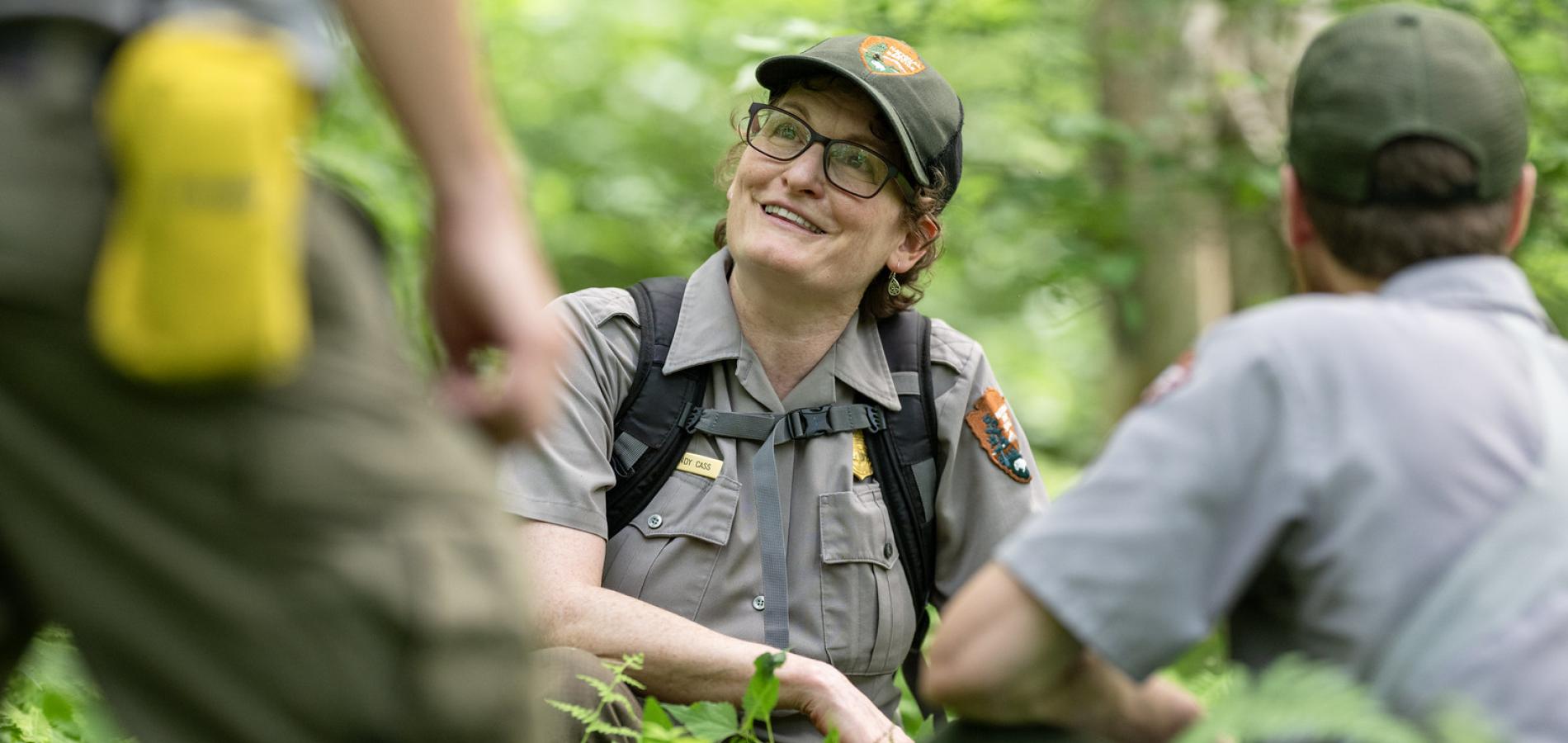

Wendy Cass is tromping through the sun-dappled forest of Shenandoah National Park, wearing her summer park ranger uniform of short-sleeved shirt, brown pants, and a green National Park Service ball cap. At a certain point, she stops, checks the coordinates, and begins surveying her surroundings. To the untrained eye, it appears as if she is standing in a thicket of trees and shrubs indistinguishable from any other patch of Appalachian forest. But as a longtime park botanist, Cass knows exactly where she is—a designated forest monitoring plot whose resident trees have become as familiar as old friends.
For nearly three decades, Cass has studied plant life at Shenandoah, monitoring how this highland ecosystem has responded to climate change and other pressures. At the heart of her work is the park’s forest matrix project, an ecological monitoring program now entering its 22nd year. Cass and her staff monitor 160 forest plots—each measuring 24 by 24 meters, about the size of two pro basketball courts put together—to track the health, growth, and composition of Shenandoah’s trees over time. Currently, the plots contain 6,391 trees, including oak, hickory, ash, maple, hemlock, spruce, and many more.

Park staff chose the plots through a method known as stratification, which ensures representative coverage across this mostly linear park, a 105-mile-long landscape of profuse forests, exposed rocky areas, shady hollows, and wetter riparian areas. “We stratified plots by what we call Ecological Land Unit types—defined by elevation, slope aspect, and bedrock geology,” Cass says. “These are stable environmental variables that affect forest cover and composition.”
What is less stable, of course, is the future makeup of this ecosystem in the face of climate change and other threats. How are rising temperatures, more frequent and severe storms, shifting weather patterns, and invasive species affecting forest health? It’s a complicated question, but one that park staff are committed to answering.

Fieldwork And Forests
Cass first became interested in plants as an undergraduate, when she began following the late Dr. George T. Jones, professor emeritus of botany at Oberlin College, on Sunday afternoon field walks near campus. “I really loved the time we spent ambling about the rich flood plains and forests of northern Ohio,” Cass says. “A picture of him is still on my office bulletin board.”
Now Cass leads her own forest walks. As the park’s botany program lead, Cass is responsible for a variety of monitoring, management, and support tasks throughout the park. In any given week, the work might take Cass from assisting law enforcement with resource damage assessments to managing volunteers who maintain native plant gardens at the park’s visitor centers. One ongoing project monitors rare plants at the summit of Old Rag, the park’s famous stand-alone peak (known as a monadnock) whose summit boasts 360-degree views.
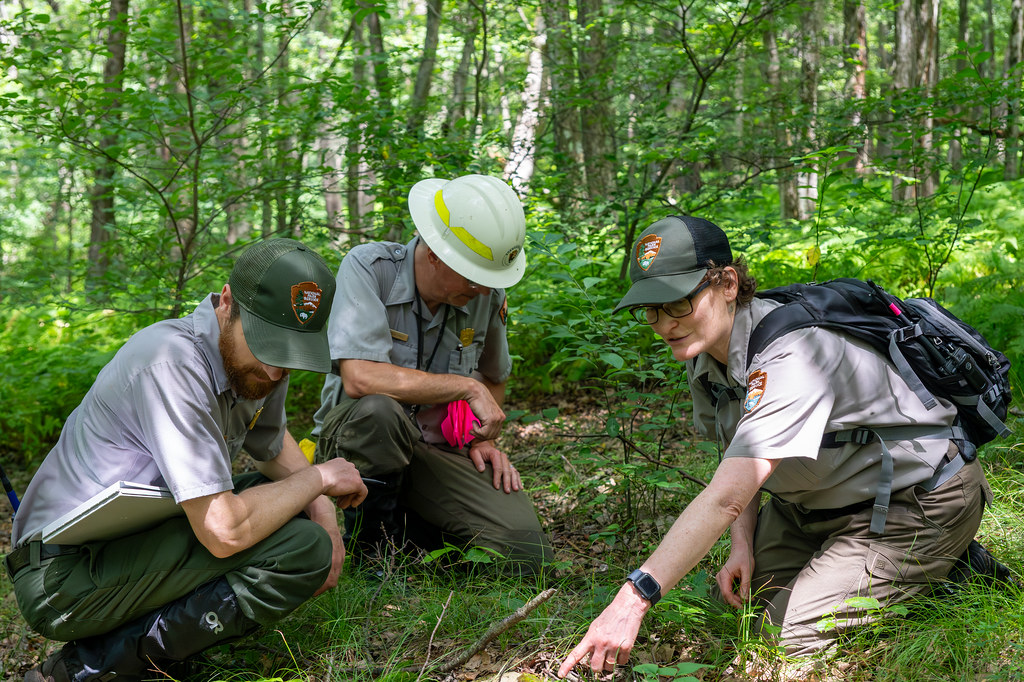
For the forest matrix project, Cass and her team—including a biological science technician and a rotating staff of temporary technicians and interns—systematically visit and monitor each plot every four years. During a visit, park staff gather data on tree species, diameter, crown condition, saplings and seedlings, invasive species, dominant ground cover, and more. All woody plant species in the plot with a diameter-at-breast-height (DBH) greater than or equal to 10 centimeters are defined as trees. Woody plant stems with a DBH less than 10 centimeters and a height greater than or equal to 1.5 meters are defined as saplings or shrubs.
What they are learning is that the park’s forests have already been significantly altered—and they may continue to be. “The main thing we’re learning is that the park’s forest may change quite a bit in the future,” Cass says. “About half of the park’s ash trees have been killed by emerald ash borers so far, and most of the rest are in poor health. We’ve also lost about 20% of our mature oak trees over the last two decades. That’s a big loss because oak is a dominant component of the forest.”

Seeding Future Science
This work also feeds into ongoing research led by scientists outside the park. For example, the team collaborated with Dr. Kristina Anderson–Teixeira from the Smithsonian Conservation Biology Institute’s ForestGEO lab to use matrix data in a study, published in the academic journal Ecosystems in 2021, on the long-term impacts of invasive insects and pathogens on the composition, biomass, and diversity of Blue Ridge Mountain forests. The study found that exotic forest pests had “substantially impacted” at least 24% of tree genera (larger umbrella groups of tree species) and were linked to between 21% and 29% of biomass losses in the region in recent decades.
The study authors concluded that such pests and pathogens are likely to have an even greater impact in the future, “given the number of nascent [invasive species] threats combined with continuing introductions and exacerbating effects of climate change. From a scientific standpoint, ongoing monitoring and model development will be critical to predicting how [these pests] will impact future forest dynamics.”
Last year, the Shenandoah National Park Trust awarded a grant to help Cass’s team produce a comprehensive report on their findings, expected in 2026, as well as to temporarily promote their lead technician to ecologist to complete high-level data analysis and modeling.
“The focus of our current report is on mortality and regeneration for larger tree species that are found in the forest canopy,” Cass says. “There are many other things that we could look at, such as how small subcanopy tree species are faring, or changes in shrub cover and composition over time.”
“Like many, we’re concerned about the future of our forests,” says Jessica Cocciolone, executive director of the Shenandoah National Park Trust. She notes that 95% of Shenandoah is forested, representing one of the last intact examples of mid-Atlantic mountain ecosystems. “So, when we talk about protecting the forest, we’re talking about more than just trees. We’re talking about biodiversity, climate resilience, and communities.”
The Trust has long supported projects focused on plant and species health in Shenandoah, including funding the park’s early detection and monitoring system for invasive species. A current pilot project is aimed at identifying the most effective long-term strategy to eradicate invasive bittersweet vine, an aggressive plant that girdles and chokes native trees.
“Without the forest, Shenandoah simply wouldn’t be Shenandoah,” Cocciolone says. “This kind of consistent, decades-long ecological monitoring gives the park an extraordinary advantage—not just in understanding how things are changing, but in using that knowledge to take meaningful action.”
As individual trees go, of course, so goes the forest ecosystem as a whole. “The park was created to preserve a functioning ecosystem that represents the Blue Ridge and Central Appalachian biome,” Cass says. “Knowing how forest composition is changing helps managers protect that ecosystem for future generations.”
Stories about:
Story Categories:
A copy of National Parks Traveler's financial statements may be obtained by sending a stamped, self-addressed envelope to: National Parks Traveler, P.O. Box 980452, Park City, Utah 84098. National Parks Traveler was formed in the state of Utah for the purpose of informing and educating about national parks and protected areas.
Residents of the following states may obtain a copy of our financial and additional information as stated below:
- Florida: A COPY OF THE OFFICIAL REGISTRATION AND FINANCIAL INFORMATION FOR NATIONAL PARKS TRAVELER, (REGISTRATION NO. CH 51659), MAY BE OBTAINED FROM THE DIVISION OF CONSUMER SERVICES BY CALLING 800-435-7352 OR VISITING THEIR WEBSITE. REGISTRATION DOES NOT IMPLY ENDORSEMENT, APPROVAL, OR RECOMMENDATION BY THE STATE.
- Georgia: A full and fair description of the programs and financial statement summary of National Parks Traveler is available upon request at the office and phone number indicated above.
- Maryland: Documents and information submitted under the Maryland Solicitations Act are also available, for the cost of postage and copies, from the Secretary of State, State House, Annapolis, MD 21401 (410-974-5534).
- North Carolina: Financial information about this organization and a copy of its license are available from the State Solicitation Licensing Branch at 888-830-4989 or 919-807-2214. The license is not an endorsement by the State.
- Pennsylvania: The official registration and financial information of National Parks Traveler may be obtained from the Pennsylvania Department of State by calling 800-732-0999. Registration does not imply endorsement.
- Virginia: Financial statements are available from the Virginia Department of Agriculture and Consumer Services, 102 Governor Street, Richmond, Virginia 23219.
- Washington: National Parks Traveler is registered with Washington State’s Charities Program as required by law and additional information is available by calling 800-332-4483 or visiting www.sos.wa.gov/charities, or on file at Charities Division, Office of the Secretary of State, State of Washington, Olympia, WA 98504.
