


Gingerly exploring an overgrown gulch about 20 minutes west of Pearl Harbor, the serenity punctuated only by the chatter of Common myna birds, it’s hard to believe that this seemingly idyllic place once hid the largest and longest-running WWII incarceration site in Hawaiʻi.
It was known as Hell Valley — jigoku-dani — because the heat, mosquitos, bed bugs and cockroaches were so oppressive, the camp so isolated and the chain of events that forced people here from 1943 to 1946 so unjust.
Gone are the 175-odd buildings, guard towers and tents. Gone also are the seven compounds, named in Roman numerals, that separated the prisoners of war, American civilian incarcerees and army administration.
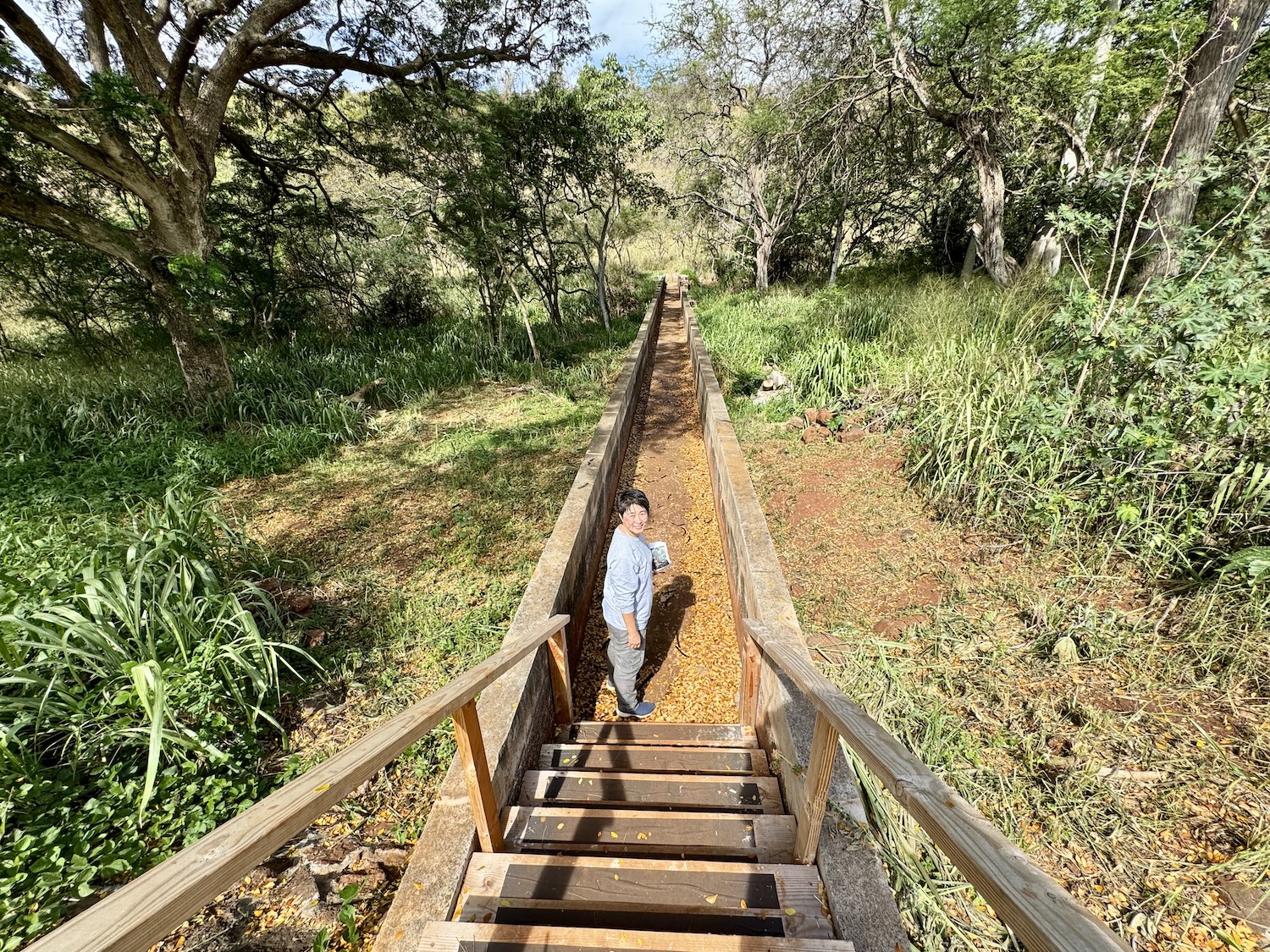
But then I spot the sugar plantation-era aqueduct that helped people rediscover the lost Honouliuli Internment Camp site and fight for its protection. I stand in front of a historic rock wall that looks like it did in archival photos. And I walk on the cracked concrete foundation of what was once a mess hall.
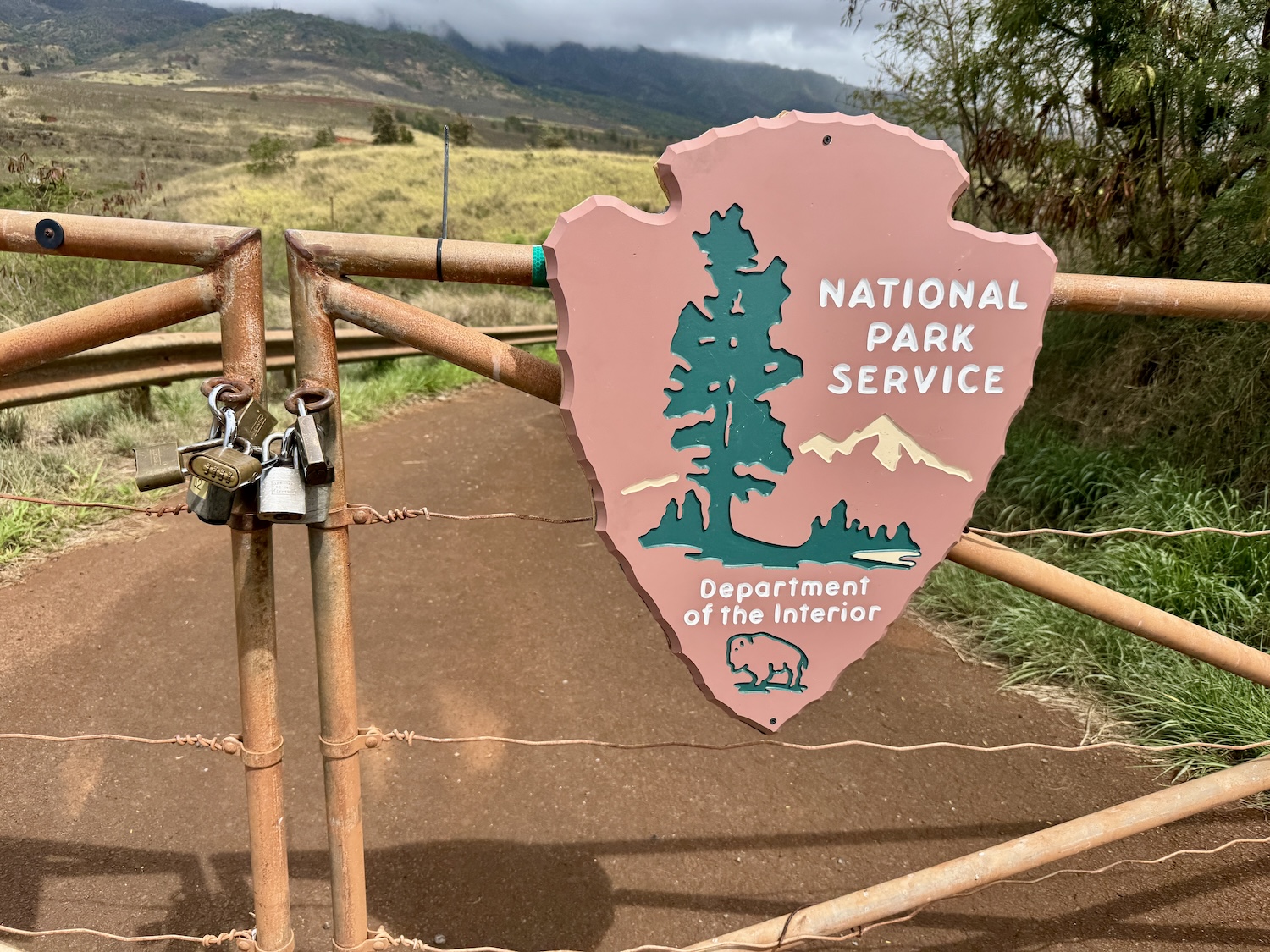
This is Honouliuli National Historic Site and although it’s celebrating 10 years under National Park Service care, it’s not yet open to the public so Superintendent Christine Ogura is giving the Traveler a private tour “This was a very unfortunate part of American history and these were real people’s lives that were impacted,” she says. “And I just think there are a lot of lessons to still be had about why this type of history is important to preserve.”
I’ve come to Oʻahu, the most populated of the Hawaiian Islands, to visit both Pearl Harbor National Memorial and Honouliuli. One tells the military story of the surprise Dec. 7, 1941 Japanese attack on the naval base that claimed more than 2,400 lives and forced the United States into World War II. The other tells the civilian story of what happened immediately after the attack when Hawaiʻi declared martial law.
The Honouliuli story is one that even Ogura, who was born here to Japanese immigrants, didn’t know. “I just want people to know that the park exists and to reconnect the park to our communities,” she says. But that’s easier said than done.

I pull into the parking lot of the University of Hawaiʻi West Oʻahu at 8 a.m. — about 12 hours after landing in Honolulu —and hop into Ogura’s work truck for the short but complicated journey into the park.
We pass through two locked fences and drive down dirt roads across university property until we stop along the road and walk down a foot path to a wire that marks the park boundary. The only other way in is across property that belongs to Bayer Hawaiʻi and then down a one-lane emergency access road that’s mainly used by the Board of Water Supply.
Bayer, a vital part of Hawaiʻi's agricultural community, donated 123 of the internment camp’s original 160 acres of land to help protect this story. President Barack Obama declared the land a national monument on Feb. 24, 2015 and Congress elevated it into a national historic site four years later.

The park — hidden in the gulch of the Honouliuli Stream in what easily became "a rugged natural prison" — has a foundation document. But it’s starting to work on its first general management plan while tackling access agreements. Bayer has promised another 22 acres.
Ogura is cautiously optimistic that there might be a guided tour this fall. The short-term goal is to have one a month, for education purposes.
“Literally what you’re experiencing now may be what we’re able to start up later this year,” she says as we make our way down a historic path into the gulch on the 'Ewa Plain.

To understand Honouliuli, you must consider these islands when they were a U.S. territory at the time of Pearl Harbor.
The sugar-cane industry was in full swing thanks to a cheap labor force from Asia and around the world. By World War II, nearly 40 per cent of the local population had Japanese ancestry.
But within hours of the surprise Japanese attack on Pearl Harbor, martial law was declared here giving the FBI and military the power to single out, interrogate and detain civilians suspected of disloyalty to the United States.

People were tried without lawyers in trials that typically lasted five minutes and didn’t include evidence. They were held at 17 makeshift confinement sites scattered across six islands. Most would be transferred to camps on the U.S. mainland until the newly built Honouliuli ("Dark Bay") Internment Camp opened on March 2, 1943.
This wasn’t like the mass incarceration of Japanese Americans on the mainland that happened under Executive Order 9066 — another shameful story that’s told at Idaho’s Minidoka National Historic Site, Colorado’s Amache National Historic Site, and California’s Tule Lake National Monument and Manzanar National Historic Site.

In Hawai‘i, arrests were made under martial law and targeted educated people like business and religious leaders as well as civilians of European ancestry.
Alongside 4,000 POWs who were Japanese, Korean, Okinawan, Taiwanese, Filipino and Italian, nearly 400 innocent civilians were interned here. There could have been more had they not been needed to maintain the island’s workforce and had the logistics of so many arrests not been so daunting. The civilians were Japanese Americans and European Americans.

“So I think the way I try to make this relevant for people is to also share that these were just normal people,” explains Ogura.
Teachers. Buddhist priests. A symphony conductor. A museum janitor. Newspaper writers. A chef from Waikiki's Royal Hawaiian hotel where I’m staying and where the navy frolicked during the war as a "rest and recuperation center" for the Pacific Fleet. “These are all institutions that are in our lives today," she points out. "These were just people doing their jobs, living their lives.”
This part of the story is even more poignant to Ogura since she and her mother (first-generation and second-generation Japanese Americans) could have been targeted had they been born earlier.

Honouliuli Internment Camp finally closed in 1946. It was dismantled and the history was largely forgotten until a local television reporter doing a story on Schindler’s List called the Japanese Cultural Center of Hawai‘i and asked what had become of it.
Volunteer Jane Kurahara didn't know but, with friend and fellow retired librarian Betsy Young, spearheaded a mission to find out.
The camp was rediscovered in 2002 on overgrown property that was then owned by Monsanto. As the NPS says: “Honouliuli had been found, never to be forgotten again.” Before the pandemic, the center led regular public bus tours to the site with access through what's now Bayer's property.
As I make my way into the gulch, stopping to acknowledge Pearl Harbor (the actual harbor, not the national memorial) in the distance, I learn how families were blindfolded when they finally got to visit. One girl hated visiting her dad because the red dirt stained her white sneakers.
Walking across the aqueduct, I hear how it divided the POW and American detainee sides of the camp. “This was also a significant feature because this was also one of the features that the JCCH used to confirm that this was the location of the camp,” notes Ogura. “I was told the Japanese American incarcerees would actually cross this aqueduct to go to the mess hall, so they actually did physically use it as a walkway as well.”
By a small stream, she wonders who “might have taken solace in this babbling water.”

It starts to rain as we pause by the historic rock wall to hear how a Historic Preservation Training Center team of the National Park Service recently stabilized it so it doesn’t buckle and crack. Ogura’s small team includes an archaeologist and a biotechnician who doubles as outreach education and volunteer coordinator. They keep a shipping container here for their weed whackers and other tools.
“People think NPS and they think interpretation, but we’re also land management,” the superintendent says. Her focus right now is on education, outreach, clearing vegetation to preserve historic features and restoring existing historic features. The park is starting its general management process this year and will soon be seeking public input.
To all those who keep asking if Honouliuli will get a visitor center or museum, Ogura says “get involved — get engaged.” There's no way of knowing what this site will look like in the next decade — whether buildings will be reconstructed or how this war-era story could be told. She is eager, though, has just asked for volunteers to help with the weed whacking and is ready to hear from descendants and accept artifacts.

Somewhere in this overgrown jungle, there are traces of water and sewer systems, latrines, guard tower posts and even a baseball field, but not everything has been properly marked yet.
It’s at the mess hall foundation that Ogura tears up. “It doesn’t look like much,” she admits, “but this is where families were brought together to visit their mother, their father, somebody’s aunt or uncle, son, daughter. This is where those family gatherings occurred.” It’s also where incarcerees would have presented their families with things they had made like toothbrush rings, bird pins and shell jewelry.
When they were finally released, these people were stigmatized again, this time enduring suspicion, ostracism, isolation and shame from friends and neighbors for being targeted for incarceration.

In 1988, Congress passed the Civil Liberties Act which acknowledged the injustice of internment. President Ronald Reagan apologized on behalf of the American government and gave $20,000 to each surviving Japanese-American civilian internee.
“The commission (Commission on Wartime Relocation and Internment of Civilians) concluded there was no evidence, they did nothing wrong and what happened to Japanese Americans was the result of racial prejudice, wartime hysteria and the failure of political leadership,” says Ogura.
She’s determined to make sure this camp is preserved so people’s struggles weren’t for nothing. To quote the park’s proclamation, Honouliuli is a "powerful reminder of the need to protect civil liberties in times of conflict” and “a place to reflect on wartime experiences and recommit ourselves to the pursuit of freedom and justice.”
For now, the NPS directs people to other sites around Honolulu to learn more.
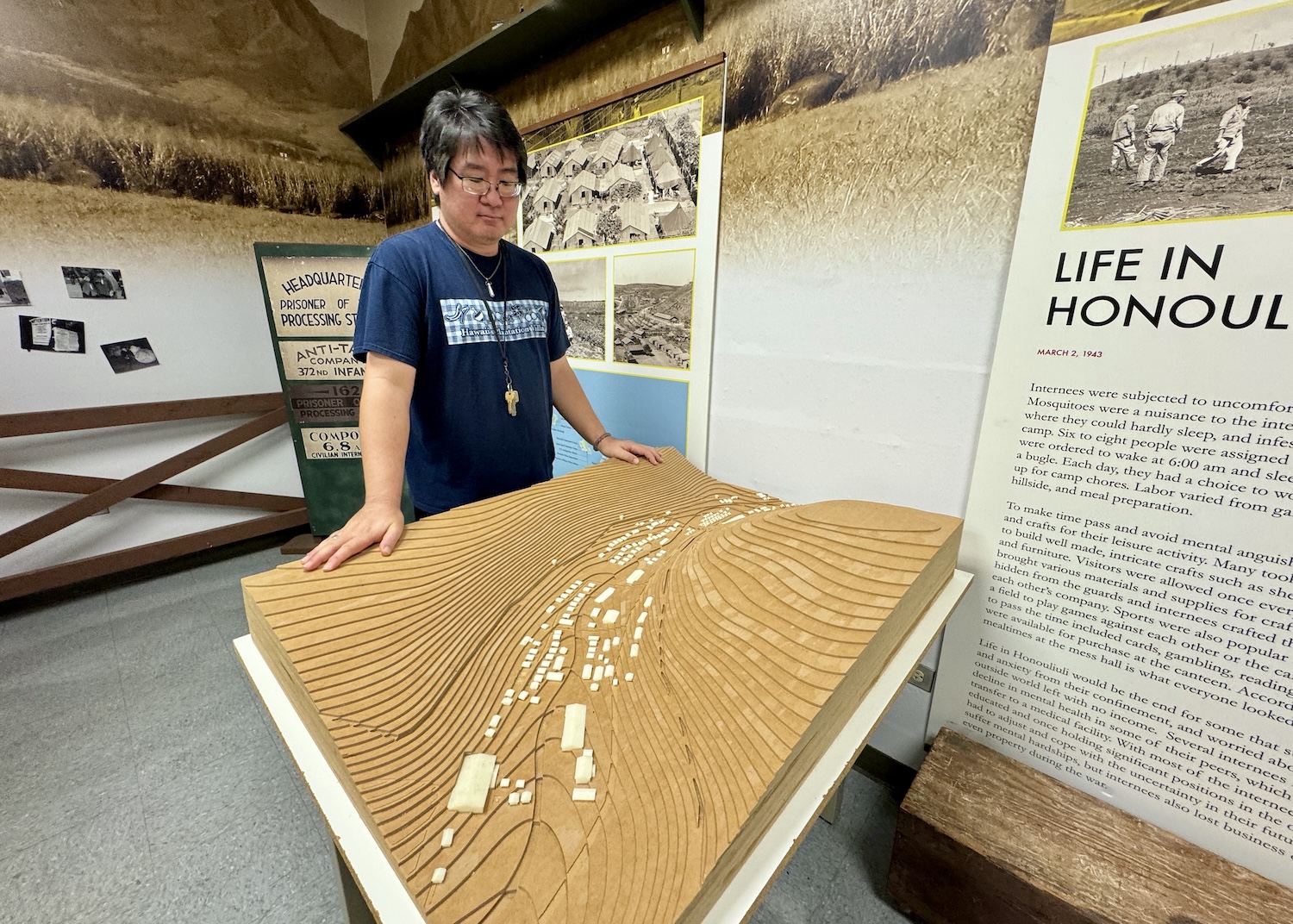
The King Kamehameha V Judiciary History Center, where families were forced to say goodbye to loved ones, has a martial law exhibit. Hawaii’s Plantation Village has a room devoted to Honouliuli that includes a 3D camp model and a guard tower. The American Institute of Architects Honolulu Chapter is working the story into its downtown walking tours.
For the year-long 10th anniversary celebrations, the park service is working with dozens of partners on virtual and in-person events, plus it's active on Facebook and Instagram.

On a Saturday morning, I drop by a table event at Patagonia where shoppers can read a Honouliuli banner, learn about the park service's management plan process and try their hand at origami. The banner delves into the terms internment and incarceration, noting that words that were used historically were sometimes euphemisms that masked injustices, or were incorrect or inadequate.
"The word internment may be properly used when referring to the detention of non-U.S. citizens," it says, noting that many immigrant incarcerees were not even eligible to seek citizenship. "In many cases, the words incarceration, incarceree, or incarcerate are more accurate, especially when discussing Nisei and Kibei, American citizens who were detained for long periods without the due process to which they should have been constitutionally entitled."
At Pearl Harbor National Memorial, I find a few references to Honouliuli in one of the museum's exhibit halls and in a devoted nook of the gift shop that sells books about it and has a banner telling people the story “reminds us of the critical importance of safeguarding civil liberties and maintaining our national values during times of crisis.”

Back in the gulch, the Hawaiian "drizzle storm" passes and Ogura and I walk up the emergency access road to the gate that separates the park from Bayer’s land.
On the other side of the locked gate, there’s a small memorial site featuring a rock garden and stone bench overlooking Honouliuli. I spend a few quiet minutes reading a national historic site plaque on a large rock, and an interpretive panel loaded with a comprehensive historic timeline. The hope, as the plaque says, is that this memorial will “serve as a place to reflect on the lessons of the past.”
Short of bushwhacking for more remnants of camp life, we've seen all that we can see. Strolling back down into the gulch one final time, and then up the opposite hill, we brainstorm different ways this place might look when it's ready for regular visitors. I'm sweaty but grateful for the rare preview of a raw site. Ogura, who always welcome the chance to get out of the office and into the park, radios the office to let her staff know we've safely emerged from the bush.
Stories about:
Story Categories:
A copy of National Parks Traveler's financial statements may be obtained by sending a stamped, self-addressed envelope to: National Parks Traveler, P.O. Box 980452, Park City, Utah 84098. National Parks Traveler was formed in the state of Utah for the purpose of informing and educating about national parks and protected areas.
Residents of the following states may obtain a copy of our financial and additional information as stated below:
- Florida: A COPY OF THE OFFICIAL REGISTRATION AND FINANCIAL INFORMATION FOR NATIONAL PARKS TRAVELER, (REGISTRATION NO. CH 51659), MAY BE OBTAINED FROM THE DIVISION OF CONSUMER SERVICES BY CALLING 800-435-7352 OR VISITING THEIR WEBSITE. REGISTRATION DOES NOT IMPLY ENDORSEMENT, APPROVAL, OR RECOMMENDATION BY THE STATE.
- Georgia: A full and fair description of the programs and financial statement summary of National Parks Traveler is available upon request at the office and phone number indicated above.
- Maryland: Documents and information submitted under the Maryland Solicitations Act are also available, for the cost of postage and copies, from the Secretary of State, State House, Annapolis, MD 21401 (410-974-5534).
- North Carolina: Financial information about this organization and a copy of its license are available from the State Solicitation Licensing Branch at 888-830-4989 or 919-807-2214. The license is not an endorsement by the State.
- Pennsylvania: The official registration and financial information of National Parks Traveler may be obtained from the Pennsylvania Department of State by calling 800-732-0999. Registration does not imply endorsement.
- Virginia: Financial statements are available from the Virginia Department of Agriculture and Consumer Services, 102 Governor Street, Richmond, Virginia 23219.
- Washington: National Parks Traveler is registered with Washington State’s Charities Program as required by law and additional information is available by calling 800-332-4483 or visiting www.sos.wa.gov/charities, or on file at Charities Division, Office of the Secretary of State, State of Washington, Olympia, WA 98504.
