


Standing on the shore of Ford Island just after sunrise, looking out at Pearl Harbor and the USS Arizona Memorial, Khyle Dixon is itching to begin his work day. Three of his colleagues kayak by, carrying jugs of water and the tools they’ll need for a day of historic preservation work on a mooring quay in the blistering Hawaiʻi sun.
The memorial is empty for now, floating over a sunken battleship that marks the final resting place for more than 900 men who were killed in the Japanese attack on Dec. 7, 1941. But the boat tours from Pearl Harbor National Memorial will soon start up, run every 15 minutes and give thousands of people the chance to pay their respects.
Some of those visitors will spot Dixon’s crew, wave, take photos and maybe even ask interpretive rangers what’s going on.

“I am sure I am on a million Facebook feeds daily,” says Dixon.
“As you look up, you constantly see the photos and so on, but it’s not as irritating as you would think and it makes you a little bit proud. This allows people to understand what we’re doing and it gives us a broader audience so I encourage them to record, to take photos, to see what we’re doing. It keeps us accountable, it keeps us safe and it keeps people informed about what preservation is.”
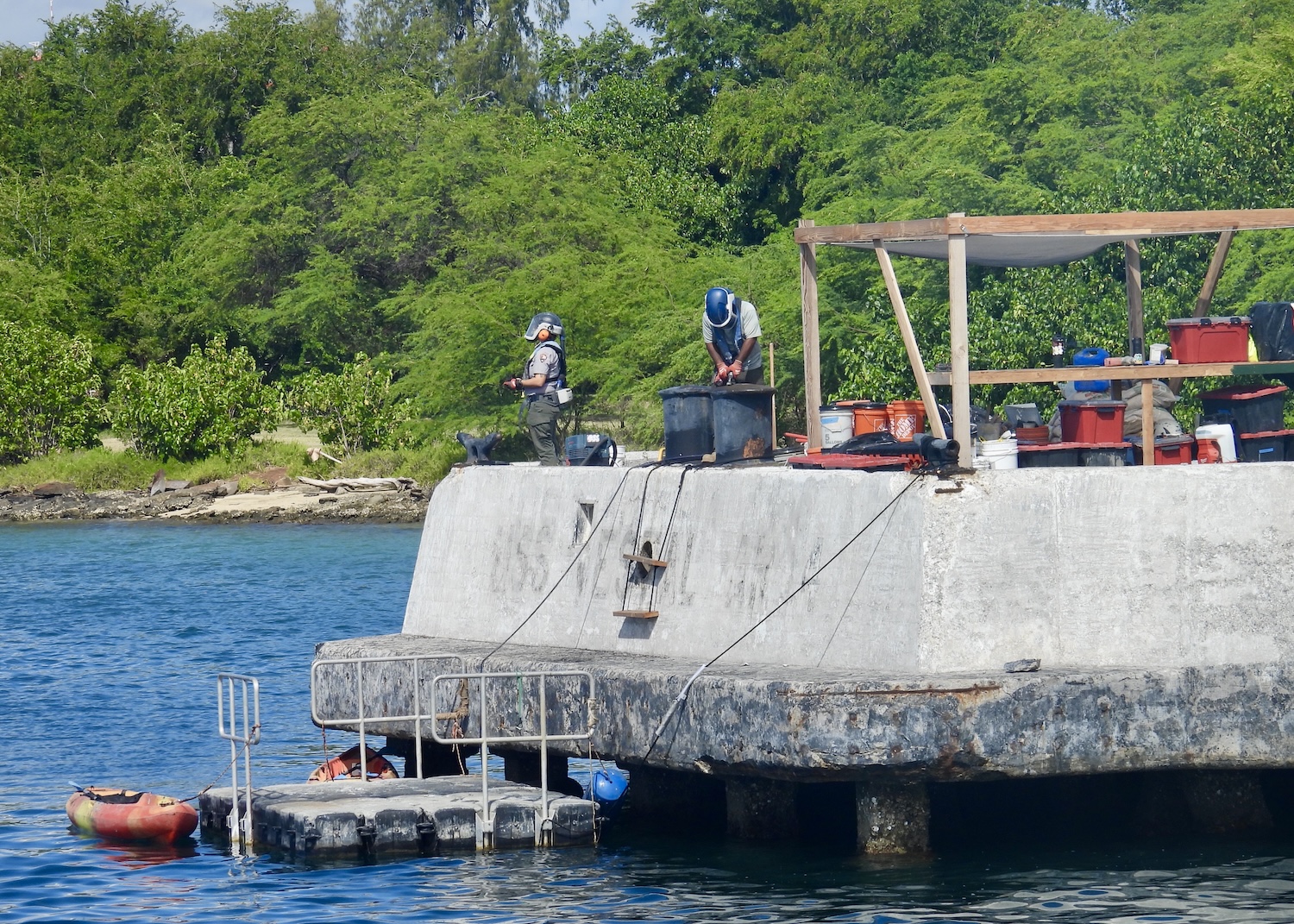
Dixon is the exhibits specialist and Pacific West Region section project leader for the Historic Preservation Training Center of the National Park Service. His team is restoring three pairs of mooring quays that provided anchor points to ships here on Battleship Row on that devastating 1941 day that killed more than 2,400 Americans.

They’ve restored and preserved two quays since 2023 and hope to complete the other four by 2028. They need three, month-long tours per quay to scrape off paint, tackle spalls, patch concrete, do corrosion prevention and repaint.
“The job is interesting because it requires a very meticulous hand,” says the Vancouver, Washington-based Dixon, who was in the Army National Guard. “We are trying not to affect any of the battle damage that occurred, but purely affect any areas that are due to corrosion jacking or anything that’s caused by just the wear of time.”

Fun fact, though. Dixon saw the 2001 Pearl Harbor romantic war drama — starring Ben Affleck, Josh Hartnett and Kate Beckinsale — “probably 50 times” as a kid. “I never really expected I would work on it. It was more like a fantasy. I was obsessed with it. I was obsessed with military history as a kid so that’s what makes it special to me.”
I promise to rewatch the film just to see the mooring quays make cameos, but for now I’ve come to Oʻahu to see how the park service tells the story of Pearl Harbor and the U.S. entry into World War II. I also tour Honouliuli National Historic Site, which isn’t yet open to the public, to learn what happened when martial law was declared here right after the attack and Japanese/European Americans were unjustly sent to incarceration camps alongside POWs.
Pearl Harbor, within Joint Base Pearl Harbor-Hickam, has countless stories to tell but my microfocus is on the unsung mooring quays.

David Kilton — interpretation, education and visitor services lead — explains that ships would have pulled up along Ford Island’s “Battleship Row” and tied off to 16 concrete mooring quays instead of dropping anchor. “There would have been a ship tied off to a pair of them, and then there would have been another ship tied off to that ship on the outside.”
Anchored to these quays — built in the 1930s and designated F-1 through F-8, North and South — at the time of the attack were the USS Arizona, USS Vestal, USS Nevada, USS Tennessee and USS West Virginia. The navy has given the park service six quays. Simply put, these concrete platforms were made by using cement-filled lumber forms, filled with sand and placed on concrete piles driven into the sea floor.
“We’re fighting against the elements here,” Dixon says. “They’re sitting in salt water which is the worst place for us to work with concrete.” His team has finished work on the quays that held the Tennessee and West Virginia. Now they’re tackling the one that was connected to the Vestal, a repair ship that was tied to the Arizona. The Arizona and Nevada quays are next.

“The quays were silent sentinels to the events of that day,” the NPS has said. “During the chaos, they served as places of refuge for sailors and soldiers as they escaped the burning ships exploding around them. The quays once survived bombs and fire damage but are now facing threats of time and saltwater.”
USS Arizona survivor Don Erwin McDonald has talked about the horror of leaving the ship, getting on a mooring quay, jumping into the water, and swimming through fire and oil surrounded by explosions that “felt like it was enough to tear your flesh off.”
The goal is to preserve the battle damage and avoid repairs that “create a false sense of history.” That means returning the quays to their 1941 appearance using titanium white and iron oxide black linseed oil paint. Ship names, added in the 1980s, are being removed so while quay F-6-N once read USS Tennessee BB 43, it now reads F6. Banners bearing the ship names will help people understand what they’re seeing.

Pearl Harbor National Memorial drew nearly 1.6 million visitors last year. The top attraction is the USS Arizona Memorial, but it can only handle about 4,000 of the 6,000 to 8,000 daily visitors, and the goal is to encourage a multi-day visit.
The Pacific Fleet Submarine Museum, Pearl Harbor Aviation Museum and Battleship Missouri Museum provide more options but aren't run by the park service. Pacific Historic Parks offers four virtual reality experiences, including one with a mooring quay scene. Its self-guided audio tour talks about the oil that still floats above the USS Arizona Memorial as it slowly leaks from the sunken ship.
“To remove the oil would be to desecrate the tomb,” narrator Jamie Lee Curtis says. “Many survivors think of all the droplets as the tears of their comrades.”

Superintendent Tom Leatherman says “we’ve been telling the story here at Pearl Harbor for awhile,” but his goal is to start humanizing the story. “You begin understanding these were more than just names on the wall — these were people. They were people who came from somewhere and they have a story. We have been collecting a lot of information about sailors but haven’t been sharing it.”
That’s happening now on the Ford Island Bus Tour, which launched in 2021 to show off two hidden gems — the USS Oklahoma Memorial and USS Utah Memorial. Since the island is an active military base, everyone must show ID, be escorted and promise not to photograph private residences. The evolving tour might soon start from a visitor contact station created from one of the historic chief petty officer’s bungalows.
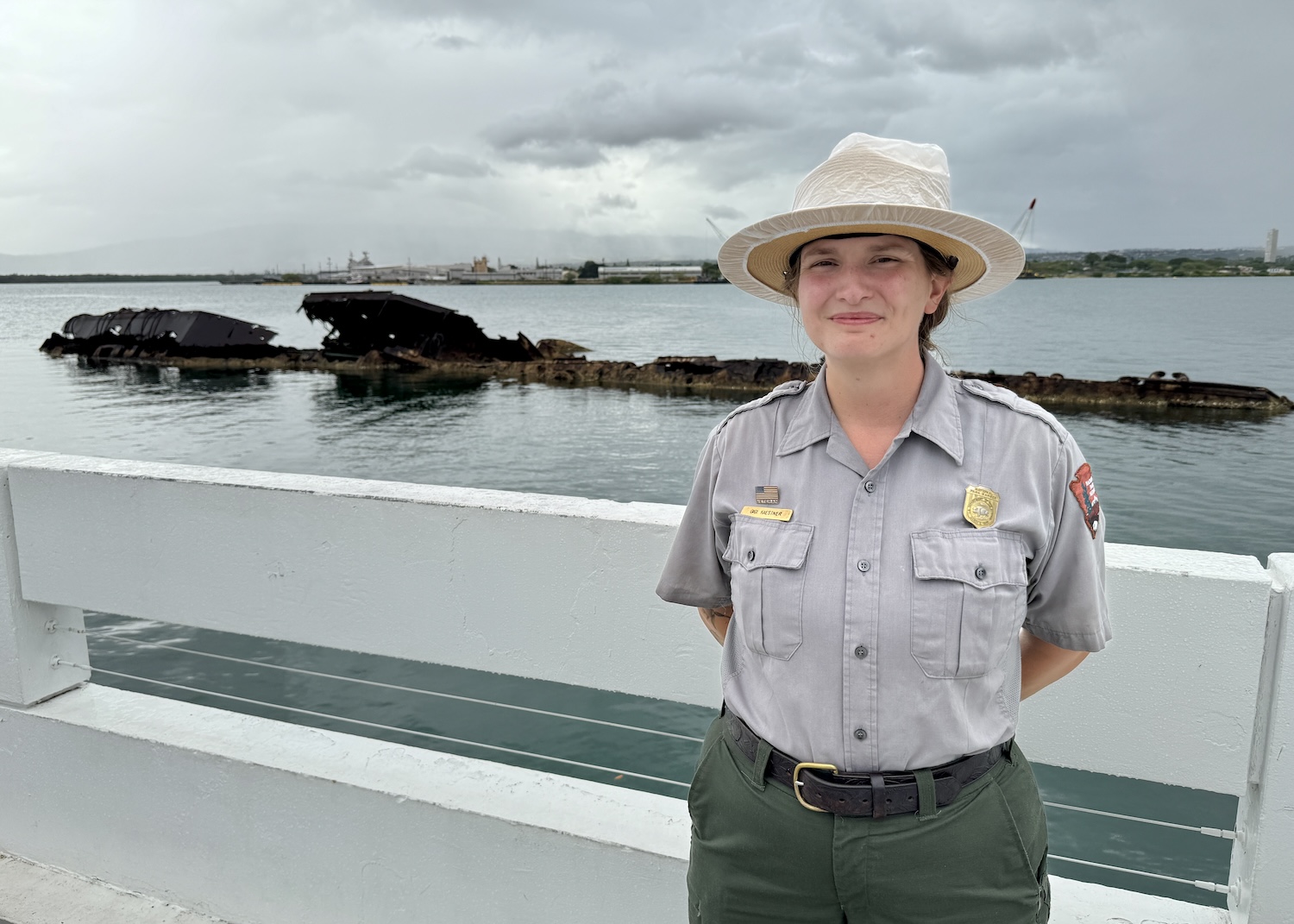
When I join the double-decker bus tour, ranger Gigi Kaestner immediately highlights the mooring quays. "You may have seen our historic preservation team doing work on those quays while you were on the USS Arizona Memorial," she says. "They are working to keep these around for as long as possible so future generations will get to come and see them as well.”
As we cross the bridge to the island, Kaestner points out the USS Nevada’s mooring quays and relays how that battleship got underway during the attack thanks to Edwin Joseph Hill. “He himself dove into the harbor, climbed up on each of the moorings, untied the ship and then as the Nevada is making her way down the harbor, he dove back into the harbor,” she says. “And then swam to his ship before climbing back aboard.”
But the Nevada was hit by bombers and had to be run aground so it wouldn’t block the harbor. Mills was killed and posthumously awarded the Medal of Honor for military valor.

I hear about other heroes on the navy-operated shuttle to the USS Arizona Memorial.
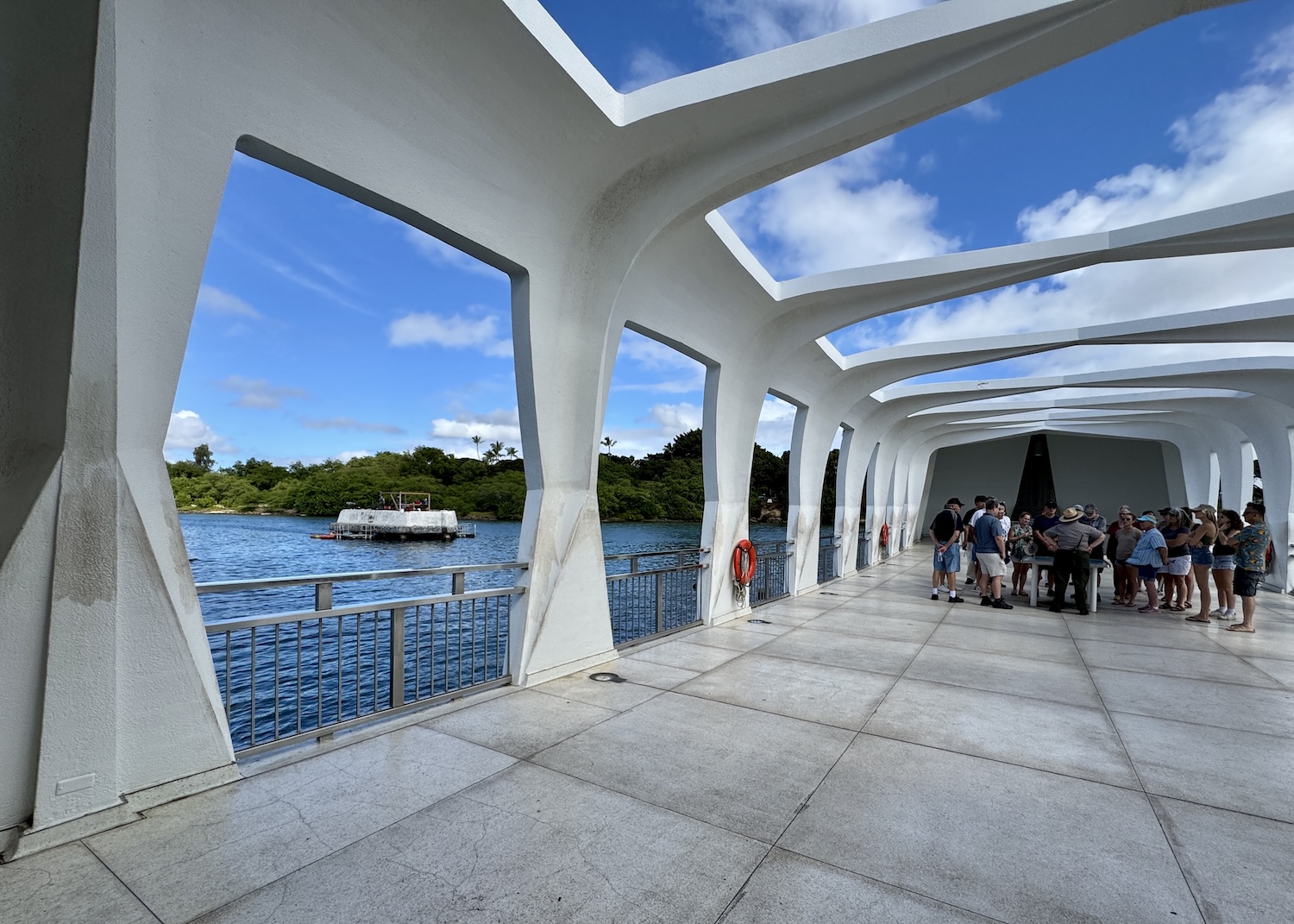
The clever design with a deliberately sagging center conveys the message of initial defeat and ultimate victory. In an interesting twist, the memorial is the work of architect Alfred Preis who fled his Nazi-occupied home in Austria to America but was interned for three months at the Sand Island Detainment Camp on Oʻahu after the Pearl Harbor attack.
“As we go out, if you look again to either side of the memorial, you’ll see these white structures sticking up out of the harbor. One of them you can actually see a crew working on today,” Kilton tells everyone. “They’re actually restoring it, refurbishing it, so we can maintain and preserve it. They’re leaving battle damage to it but any other damage, like weathering, they’re just going to go ahead and repair.”
We hear about Joe George, a heavyweight boxer who was under house arrest on the Vestal for an unsanctioned fight (on the heels of a sanctioned navy fight) but was put back to work during the attack and told to cut the lines connected to the sinking Arizona.
As Arizona crew members screamed for help, George disobeyed his orders, dropped the hatchet, grabbed a rope and threw it between the ships helping six men crawl to safety. George lived until 1996 and finally in 2017 was posthumously awarded a combat medal for his bravery.

Hearing this poignant story, I’m reminded of Dixon telling Kilton “we preserve so that you guys can interpret.”
Standing on the USS Arizona Memorial, I train my zoom lens on the historic preservation team without fear of invading their privacy. They’ve got everything they need for long shifts, including a hand wash station, potable water, ice, shade structures and purified air respirators. I feel for them, though, knowing they must paddle to shore when nature calls, and must constantly resist the urge to fix historical damage.
What seems like difficult work conditions to me is a coveted assignment to them. “My boss says I have an obsession with the quays and it might be true,” Dixon confided. “I dream about my job. It’s something that I enjoy thoroughly.”
Stories about:
Story Categories:
A copy of National Parks Traveler's financial statements may be obtained by sending a stamped, self-addressed envelope to: National Parks Traveler, P.O. Box 980452, Park City, Utah 84098. National Parks Traveler was formed in the state of Utah for the purpose of informing and educating about national parks and protected areas.
Residents of the following states may obtain a copy of our financial and additional information as stated below:
- Florida: A COPY OF THE OFFICIAL REGISTRATION AND FINANCIAL INFORMATION FOR NATIONAL PARKS TRAVELER, (REGISTRATION NO. CH 51659), MAY BE OBTAINED FROM THE DIVISION OF CONSUMER SERVICES BY CALLING 800-435-7352 OR VISITING THEIR WEBSITE. REGISTRATION DOES NOT IMPLY ENDORSEMENT, APPROVAL, OR RECOMMENDATION BY THE STATE.
- Georgia: A full and fair description of the programs and financial statement summary of National Parks Traveler is available upon request at the office and phone number indicated above.
- Maryland: Documents and information submitted under the Maryland Solicitations Act are also available, for the cost of postage and copies, from the Secretary of State, State House, Annapolis, MD 21401 (410-974-5534).
- North Carolina: Financial information about this organization and a copy of its license are available from the State Solicitation Licensing Branch at 888-830-4989 or 919-807-2214. The license is not an endorsement by the State.
- Pennsylvania: The official registration and financial information of National Parks Traveler may be obtained from the Pennsylvania Department of State by calling 800-732-0999. Registration does not imply endorsement.
- Virginia: Financial statements are available from the Virginia Department of Agriculture and Consumer Services, 102 Governor Street, Richmond, Virginia 23219.
- Washington: National Parks Traveler is registered with Washington State’s Charities Program as required by law and additional information is available by calling 800-332-4483 or visiting www.sos.wa.gov/charities, or on file at Charities Division, Office of the Secretary of State, State of Washington, Olympia, WA 98504.
