
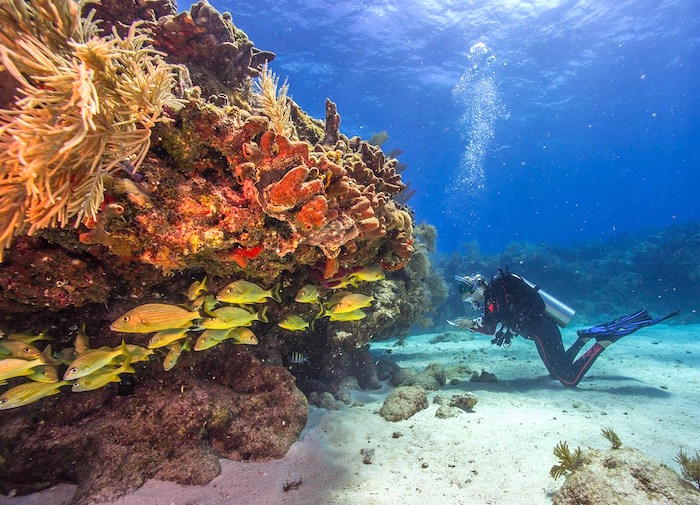
A subtropical wilderness surrounded by urbanized Florida, Biscayne National Park is a tantalizing water world inviting you to get wet.
Though encompassing almost 173,000 acres, 95 percent of this shimmering jewel is under water, a fact that encourages visitors to don mask and fins for snorkeling or scuba, take to sea in a kayak, canoe, or sailboat, or spend the day fishing. For those who prefer to stay ashore, there's camping and picnicking available at Boca Chita Key and Elliott Key.
Hiking, not surprisingly in this watery park, is not high on anyone's list, The longest trail, on Elliott Key, runs just a mile. Though Biscayne has very little above-water land to explore, it nevertheless is a good place for birders, with a nice selection of neo-tropical water birds -- Mangrove cuckoo, Yellow-crowned night heron, Bananaquit, and more than a dozen warbler variations among the park's bird community -- to spot as you explore the Great Biscayne Birding Trail.
But if the marine side of the world fascinates you, Biscayne is a great place to visit. The park's reef system belongs to the world’s third-largest barrier reef system, the Florida Reef Tract, which extends from Fowey Rocks on Biscayne’s northern boundary to Loggerhead Reef on the western boundary of Dry Tortugas National Park.
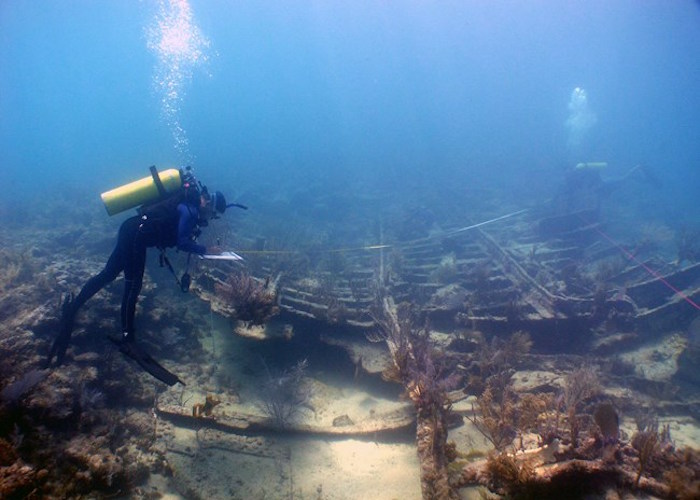
What's certainly unique to the park system is Biscayne's Maritime Heritage Trail, an underwater route that leads you past six historic shipwrecks, with some dating back to the 19th century.
However, when Biscayne was established, it was clear that preserving the park’s ecological, scenic, and cultural resources would be very difficult due to nearby Miami-Dade County, one of America’s larger urban regions. It comes as no surprise that Biscayne’s resources are in constant jeopardy. The park has been heavily impacted by chronic overfishing, boating accidents, disruption of natural water flow, pollution, and adjacent land-use activities.
Although there are many resource management challenges at Biscayne, the central, monumentally difficult one is preserving and restoring Biscayne’s coral reef system. This reef complex, which covers about half of the park, consists primarily of small patch reefs – about 4,000 in all – that are part of the Florida Keys chain. There are some transitional barrier reefs on the Atlantic (eastern) margin of the park.
The Park Service has been trying its best to protect that reef, and in 2015 park officials set aside 6 percent of the park for a marine reserve in a bid to restore and protect a stretch of the only tropical coral reef system in the continental United States. But that 10,502-acre reserve, which would be off-limits to fishing, has been under attack from the recreational fishing industry and Florida politicians.
Legislation proposed by U.S. Sen. Bill Nelson would require the Park Service go through formal consultation and coordination with the Fish and Wildlife Conservation Commission of the State of Florida. Additionally, the bill calls for science produced by the state of Florida to take precedence over the science the Park Service used to justify creation of the marine reserve.
While those lining up behind the senators say the marine reserve isn't needed, back in 2001 scientists warned that the park's fisheries were facing 'imminent collapse' without immediate help and protection. Additionally, by including 2,663 acres of coral reef in the preserve, the Park Service would contribute towards the U.S. Coral Reef Task Force's goal of having 20 percent of Florida's reefs within such reserves.
The challenge going forward is whether this marine park struggles to protect its resources and remain a gem in the National Park System.
"Biscayne has been overfished and over-stressed for decades. Experts at the National Park Service confirmed that Biscayne’s coral reefs are dying, and that some species are on the verge of collapse. Once plentiful native fish like mangrove snapper and black grouper are at record low levels of abundance and most are too small for anglers to keep," Caroline McLaughlin, the Biscayne program manager for the National Parks Conservation Associaton, told the Traveler in 2016. "In fact, recent studies show that a majority of snapper and grouper caught in the park are below state, federal, and international standards for sustainability."
So when you visit Biscayne, take a dive, marvel at the underwater treasures, but also take a moment to ponder the future of this magical place if better protections are not allowed.
Traveler's choice for: Snorkeling, scuba diving, kayaking, and birding.
Stories about:
Story Categories:
A copy of National Parks Traveler's financial statements may be obtained by sending a stamped, self-addressed envelope to: National Parks Traveler, P.O. Box 980452, Park City, Utah 84098. National Parks Traveler was formed in the state of Utah for the purpose of informing and educating about national parks and protected areas.
Residents of the following states may obtain a copy of our financial and additional information as stated below:
- Florida: A COPY OF THE OFFICIAL REGISTRATION AND FINANCIAL INFORMATION FOR NATIONAL PARKS TRAVELER, (REGISTRATION NO. CH 51659), MAY BE OBTAINED FROM THE DIVISION OF CONSUMER SERVICES BY CALLING 800-435-7352 OR VISITING THEIR WEBSITE. REGISTRATION DOES NOT IMPLY ENDORSEMENT, APPROVAL, OR RECOMMENDATION BY THE STATE.
- Georgia: A full and fair description of the programs and financial statement summary of National Parks Traveler is available upon request at the office and phone number indicated above.
- Maryland: Documents and information submitted under the Maryland Solicitations Act are also available, for the cost of postage and copies, from the Secretary of State, State House, Annapolis, MD 21401 (410-974-5534).
- North Carolina: Financial information about this organization and a copy of its license are available from the State Solicitation Licensing Branch at 888-830-4989 or 919-807-2214. The license is not an endorsement by the State.
- Pennsylvania: The official registration and financial information of National Parks Traveler may be obtained from the Pennsylvania Department of State by calling 800-732-0999. Registration does not imply endorsement.
- Virginia: Financial statements are available from the Virginia Department of Agriculture and Consumer Services, 102 Governor Street, Richmond, Virginia 23219.
- Washington: National Parks Traveler is registered with Washington State’s Charities Program as required by law and additional information is available by calling 800-332-4483 or visiting www.sos.wa.gov/charities, or on file at Charities Division, Office of the Secretary of State, State of Washington, Olympia, WA 98504.
INN Member

The easiest way to explore RV-friendly National Park campgrounds.

Here’s the definitive guide to National Park System campgrounds where RVers can park their rigs.
Our app is packed with RVing- specific details on more than 250 campgrounds in more than 70 national parks.
You’ll also find stories about RVing in the parks, tips helpful if you’ve just recently become an RVer, and useful planning suggestions.

