
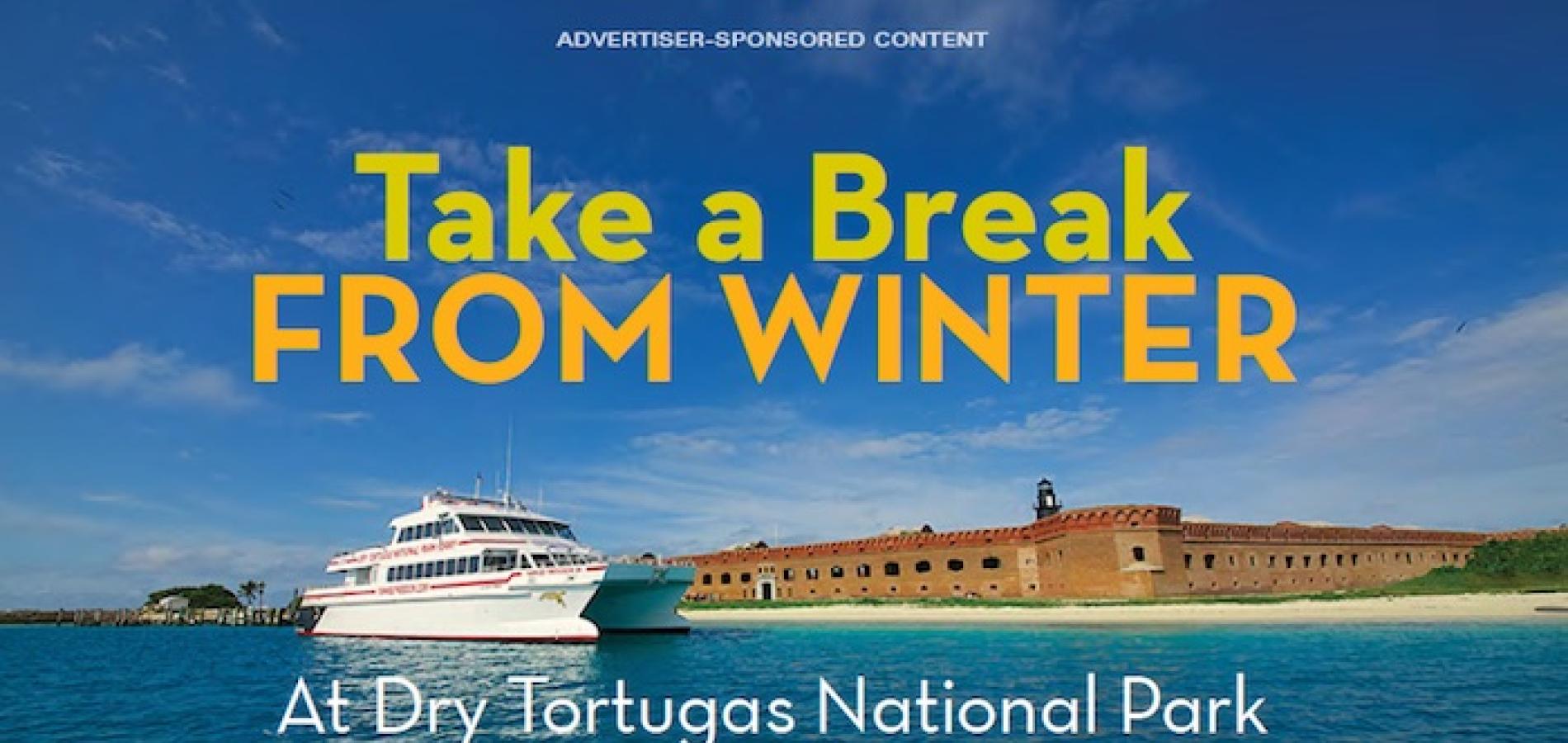
As you shovel your walks, chip ice from your windshield, and brace against the winter wind, think some warm thoughts, because down south, the Dry Tortugas are calling your name. Stow the snow shovel for a few days to snorkel clear waters dancing with tropical fish, walk the sandy beaches for some relaxation, and watch our feathered-friends as they pass through. It’s beyond wonderful.
These seven, small islands (only 70 miles and a three-hour boat ride from Key West, Florida) are home to one of our least-visited national parks, Dry Tortugas National Park, which welcomes fewer than 80,000 visitors per year. And winter is a great time for a trip.
Originally named Las Tortugas by Ponce de Leon in 1513, they are now called the Dry Tortugas due to their total lack of fresh groundwater. The Dry Tortugas are well-named, since from November to April (known as the dry season) there’s only a little more than two inches of rainfall per month, while temperatures range from the mid-60s to the mid-70s. Unlike the sweltering summer months, humidity is usually only around 50 percent during the mild winter.
While northern storms at times kick up swells and waves, might reduce underwater visibility and drop the temperatures, most of the time it’s just sunny weather, clear blue skies, and cooler temps. Perfect.
There are fewer visitors, but lots of birds seeking safety from passing fronts. These islands are right on the main flyway between Cuba and Central America, and while there are only seven nesting species, more than 300 migrating species pass through. You might spot the Brown Noddy, Sooty Tern, Brown Pelicans, Magnificent Frigatebirds, or Black-bellied Plovers. Spring months are the best time to see these migrating species.

While Yankee Freedom III provides snorkeling gear you can use, you might want to bring a wetsuit, as the ocean is a bit cooler during the winter months. Once suited up, you can explore the underwater world just offshore and revel in the abundant undersea wildlife. You’ll encounter corals, manatees, turtles (tortugas), and schools of brilliantly colored fish. The coral reefs and near pristine seagrass beds are still prime habitats for marine life and scuba divers. Or, kayak and fish, sunbathe and camp, or dive and boat along these islands. Another bonus? There are fewer insects during the dry season.
Of course, you can’t miss one of the main attractions at the park: historic Fort Jefferson on Garden Key. This three-level, six-sided fort was built in 1846 to control the Straits of Florida and Gulf of Mexico during the Civil War, was armed with more than 400 cannon, and housed more than 1,000 soldiers. Its 11-foot-thick brick walls are surrounded by a moat, and there are 109 cisterns that were built to capture rainwater.
You can take a ranger-led tour, or explore this incredible structure on your own. Dr. Samuel Mudd (who set John Wilkes Booth’s broken leg following the assassination of President Abraham Lincoln) served time here, where he eventually earned salvation by containing a yellow fever outbreak in 1867.
While these islands are only accessible by water or air, the 115-foot Yankee Freedom III, based in Key West, runs daily trips out to the Dry Tortugas. Make sure you take a sweater for the ride, and for the cooler temps on the islands. In Key West, before or after your visit to Dry Tortugas, learn more about the local color and history at the national park at the Key West Bight Museum. You’ll see a model of Fort Jefferson, and there’s even a special Kids Exploration Station.
February through April is the busiest season in Key West, but don’t let that lead you to neglect “Papa.” Author Ernest “Papa” Hemingway’s home, haunts, and dives are everywhere, and his own trips to the Dry Tortugas are still legendary. He and what he called his “Mob” (writers, painters, fishermen, and saloon-keepers) boated, fished, and drank their way to the islands many times. During their last trip they were even stranded by weather for a week. Luckily they’d stashed away enough canned food, coffee, and gin to survive. But at the end, they were fishing for their suppers.
So enjoy the hustle, flavors, and fun of the Keys, but take a trip out to these incredible islands, and spend some time away from civilization and winter. It’s what Papa would have done.
Stories about:
Story Categories:
A copy of National Parks Traveler's financial statements may be obtained by sending a stamped, self-addressed envelope to: National Parks Traveler, P.O. Box 980452, Park City, Utah 84098. National Parks Traveler was formed in the state of Utah for the purpose of informing and educating about national parks and protected areas.
Residents of the following states may obtain a copy of our financial and additional information as stated below:
- Florida: A COPY OF THE OFFICIAL REGISTRATION AND FINANCIAL INFORMATION FOR NATIONAL PARKS TRAVELER, (REGISTRATION NO. CH 51659), MAY BE OBTAINED FROM THE DIVISION OF CONSUMER SERVICES BY CALLING 800-435-7352 OR VISITING THEIR WEBSITE. REGISTRATION DOES NOT IMPLY ENDORSEMENT, APPROVAL, OR RECOMMENDATION BY THE STATE.
- Georgia: A full and fair description of the programs and financial statement summary of National Parks Traveler is available upon request at the office and phone number indicated above.
- Maryland: Documents and information submitted under the Maryland Solicitations Act are also available, for the cost of postage and copies, from the Secretary of State, State House, Annapolis, MD 21401 (410-974-5534).
- North Carolina: Financial information about this organization and a copy of its license are available from the State Solicitation Licensing Branch at 888-830-4989 or 919-807-2214. The license is not an endorsement by the State.
- Pennsylvania: The official registration and financial information of National Parks Traveler may be obtained from the Pennsylvania Department of State by calling 800-732-0999. Registration does not imply endorsement.
- Virginia: Financial statements are available from the Virginia Department of Agriculture and Consumer Services, 102 Governor Street, Richmond, Virginia 23219.
- Washington: National Parks Traveler is registered with Washington State’s Charities Program as required by law and additional information is available by calling 800-332-4483 or visiting www.sos.wa.gov/charities, or on file at Charities Division, Office of the Secretary of State, State of Washington, Olympia, WA 98504.


