
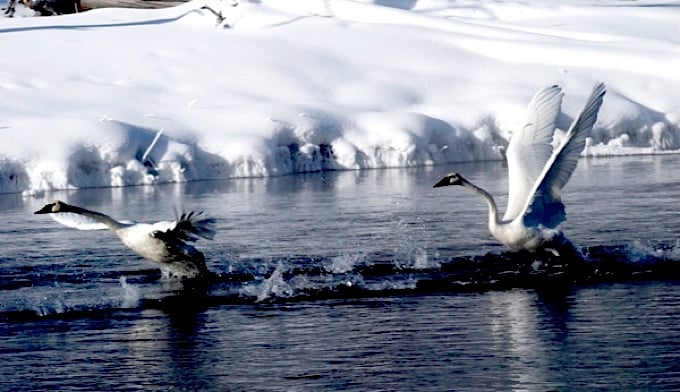
Yellowstone officials have a better approach to protect park resources than the one they're proposing. Trumpeter swans on the Firehole River. Kurt Repanshek photo.
Yellowstone National Park, the world's first national park and the place that started the global national parks movement, deserves a better winter-use plan than the one being pushed by park officials.
It deserves a better plan that not only reflects and respects the ideals of the national parks movement and the National Park Service Organic Act, but one that makes economic sense.
National Park Service officials don't need more studies to develop such a plan. Their latest Draft Supplemental Winter Use Environmental Impact Statement -- the fifth full-blown environmental impact study on winter-use in the park in the past dozen years -- offers, and supports, a better plan. In Yellowstone, arguably the crown jewel of the National Park System, officials should continually strive to minimize impacts to the air, water, wildlife, and soundscape. Instead the Park Service is willing to give the snowmobile industry another five years to live up to promises it made as far back as 2004.
"We are basically asking the industry to deliver on the promises that they made in 2004 and 2005 where they said (snowmobiles) would continue to get quieter and cleaner," Yellowstone Superintendent Dan Wenk said last week. "In fact, they haven’t since about 2006, and we’re saying they need to go back and make the machines quieter and cleaner."
At the same time that park officials are willing to hold out hope that another five years will produce the results that Superintendent Wenk says are technologically feasible today, they are willing to, in effect, spend more than $1,100 per person in these trying economic times so a relative handful of visitors can safely ride over-snow vehicles into the park via Sylvan Pass.
That $1,150 figure, attributed to the high cost of grooming and controlling avalanche chutes above Sylvan Pass, grows absurdly large when you consider -- based on the park's $2.5 million winter operations budget and the 285,142 visitors who came to Yellowstone last winter -- that it costs the park, on average, about $9 per winter visitor.
Why, in tight budgetary times, are Yellowstone officials willing to spend so much tax money to facilitate a very small number of over-snow visitors -- just 110 last winter -- over an extremely hazardous area of Yellowstone that otherwise would be unpolluted and quiet?
Economically Feasible?
Economic impact of policies is important. And in terms of Sylvan Pass, it's simply not economically justifiable to keep it safely open.
Even the DSEIS notes that over-snow access through the park's East Entrance and across Sylvan Pass is insignificant in terms of tax dollars Yellowstone generates for Park County, Wyoming (and Cody, specifically), in winter: "Recent lodging and tax data for Fremont (Idaho) and Park counties indicate that declines in snowmobile entries in winter visitation in the park in general, and into Yellowstone in particular, have not detectably impacted the overall winter tourist economy in the counties as measured by monthly lodging tax collections."
Yet seemingly the Park Service ignores its own statement in the DSEIS's Executive Summary that "(D)ismissed from further analysis were alternative elements that were considered but were not technically or economically feasible...."
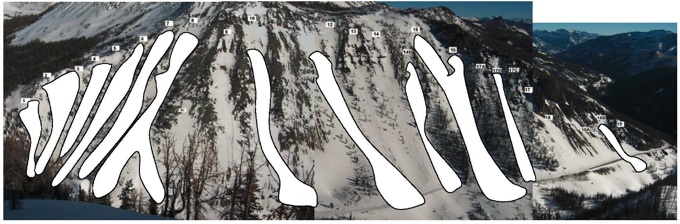
Avalanche chutes above Sylvan Pass that park personnel must ensure won't slide on over-snow visitors to the park. NPS graphic.
It was gratifying that Superintendent Wenk wasn't satisfied with the initial Draft Supplemental Winter Use Environmental Impact Statement prepared last summer and directed his staff to take a closer look at some key questions.
But the revisions don't rise to the level of resource protection the Park Service is tasked with. Underlying data for the park's preferred alternative show that that desired alternative could result in unnecessary air quality impacts, and not just from carbon monoxide. Benzene emissions also will increase in the near-term, as will levels of formaldehyde and acetaldehyde, according to numbers contained in the DSEIS.
(Oddly, in writing the DSEIS park planners seemingly pulled some punches when discussing CO emissions. On page 110 of Chapter 3, they wrote that "(M)aximum 8-hour CO concentrations at Old Faithful have declined from 1.2 ppm in 2002/2003 to 0.4 ppm in 2007/2008." But if you turn to page 114, Table 16 shows that while 8-hour CO emissions did indeed dip to 0.4 ppm during the 2007/08 winter season, they rose to 1.7 ppm in 2009/10 before sliding a bit to 0.9 ppm in 2010/11. The numbers get worse when you look at 1-hour maximum levels, which rose from 0.9 ppm at Old Faithful in 2007/08 to 7.6 ppm in 2009/10 and 4.3 ppm in 2010/11.)
Inconsequential Air Pollution?
Yellowstone Management Assistant Wade Vagias offers that those pollution levels are inconsequential, that "if we were starting winter-use planning today, set aside the past 12 years, air quality would be an issue that is basically considered, but dismissed because these levels are so low."
But why, in Yellowstone or any other national park, wouldn't you lower pollutants as far as you feasibly, and reasonably, could? And in Yellowstone, the voluminous research collected on winter-use points to snowcoaches, equipped with the "best available technology (BAT)," as far and away the least-polluting option currently available for winter travel in the park. By a large margin.
According to the data laid out in charts in Chapter 4 of the DSEIS, the current mix of snowmobiles and snowcoaches used in the park (318 snowmobiles and 78 snowcoaches allowed per day the past three winters) generates 138 tons per year of carbon monoxide. Under Alternative 3, which would phase out snowmobile use in favor of 120 snowcoaches per day, CO generation would fall to 104 tons per year.
West Thumb warming hut. Kurt Repanshek photo.
Under the park's preferred alternative, which could allow upwards of 480 snowmobiles and 60 snowcoaches per day, CO emissions would jump to 252 tons per year until BAT kicked in for the 2017-18 winter season, when CO would dip to 212 tons.
If Alternative 4B were adopted, which would allow just 106 snowcoaches and 20 noncommerically guided snowmobiles into the park per day, CO emissions would drop to 98 tons per year.
Other toxics also could be reduced more so than under the preferred alternative. Benzene emissions from the current mix of over-snow vehicles amounted to 0.17 tons per year. Under Alternative 3, those emissions would fall to just 0.05 tons, while under the park's preferred alternative, they would grow to 0.29 tons until the 2017-18 season, when they'd dip to 0.18 tons, still more than the current fleet.
Park officials realize their plan doesn't deliver short-term results, stating in the DSEIS that under their preferred alternative CO output from snowcoaches and snowmobiles would create a "moderate impact" on park resources until the winter of 2017-18, "when additional CO requirements would be implemented."
As for noise levels, over-snow vehicle travel in the park would be noisier under the preferred alternative than under the daily limit of 318 snowmobiles and 78 snowcoaches allowed the past three winters, according to the park's data.
How Aggressive Are Officials Being In Protecting Yellowstone?
Why is this plan being promoted, when the Park Service's own Management Policies state that the agency "will preserve and protect the natural resources, processes, systems, and values of units of the national park system in an unimpaired condition to perpetuate their inherent integrity and to provide present and future generations with the opportunity to enjoy them"?
Quiet winter beauty along the Mammoth Hot Springs terraces. Kurt Repanshek photo.
More so, the Management Policies add that "the NPS will assume an aggressive role in promoting and pursuing measures to protect air quality related values from the adverse impacts of air pollution." (Emphasis added)
Passing over a cleaner, more economically feasible option, while allowing the snowmobile industry to surpass standards the Park Service established eight years ago and now is proposing to give them a pass for five more years, does not seem aggressive.
The Park Service needs to scuttle its currently preferred alternative and support the winter-use option that truly works the best in reducing air pollution and noise in Yellowstone, protecting wildlife, and which makes the most economic sense in these tough times.
Story Categories:
A copy of National Parks Traveler's financial statements may be obtained by sending a stamped, self-addressed envelope to: National Parks Traveler, P.O. Box 980452, Park City, Utah 84098. National Parks Traveler was formed in the state of Utah for the purpose of informing and educating about national parks and protected areas.
Residents of the following states may obtain a copy of our financial and additional information as stated below:
- Florida: A COPY OF THE OFFICIAL REGISTRATION AND FINANCIAL INFORMATION FOR NATIONAL PARKS TRAVELER, (REGISTRATION NO. CH 51659), MAY BE OBTAINED FROM THE DIVISION OF CONSUMER SERVICES BY CALLING 800-435-7352 OR VISITING THEIR WEBSITE. REGISTRATION DOES NOT IMPLY ENDORSEMENT, APPROVAL, OR RECOMMENDATION BY THE STATE.
- Georgia: A full and fair description of the programs and financial statement summary of National Parks Traveler is available upon request at the office and phone number indicated above.
- Maryland: Documents and information submitted under the Maryland Solicitations Act are also available, for the cost of postage and copies, from the Secretary of State, State House, Annapolis, MD 21401 (410-974-5534).
- North Carolina: Financial information about this organization and a copy of its license are available from the State Solicitation Licensing Branch at 888-830-4989 or 919-807-2214. The license is not an endorsement by the State.
- Pennsylvania: The official registration and financial information of National Parks Traveler may be obtained from the Pennsylvania Department of State by calling 800-732-0999. Registration does not imply endorsement.
- Virginia: Financial statements are available from the Virginia Department of Agriculture and Consumer Services, 102 Governor Street, Richmond, Virginia 23219.
- Washington: National Parks Traveler is registered with Washington State’s Charities Program as required by law and additional information is available by calling 800-332-4483 or visiting www.sos.wa.gov/charities, or on file at Charities Division, Office of the Secretary of State, State of Washington, Olympia, WA 98504.

Comments
To really protect this crown jewel of our National Parks, I would recommend that snowmobiles be banned at Yellowstone, except for emergencies and work use. Yellowstone is a pristine environment especially in the winter, and we should protect it at all costs!
Take a look at the Yellowstone's Official Facebook page during past winter months. You will see evidence of people on snowmobiles driving right up to Old Faithful. This is absurd. The evidence is via the webcams and users watching them in others area as well. People were posting complaints on the Yellowstone FB page. Some even calling into the ranger stations as they watched in disbelief.
It’s a free for all through Yellowstone on a snow mobile. Nothing prevents them driving over and into these areas of protection as the boundaries and paths are under the snow! There is no positive or financial gain by allowing this.
Allowing snowmobiles into the park to tread wherever they want is not conducive of preservation. The National Parks’ service primary obligation is to protect the park and wildlife, not the snow mobiles.
I believe all snowmobile use in YS is thru licenced guides-- I don't know of any private snowmobile use. When our family did did a snowmobile tour 2 years ago the guides were very sensitive to what we did and to ensure we made as little of an impact as possible. I never saw anyone bothering wildlife and certainly no one driving around Old Faithful.Our family has been to YS 4 times in the past 3 years--during the summer ,fall and winter. The snowmobile tour was one of the most enjoyable trips we did as a family.I understand all the controversey about the snowmobiles but arguing about air-pollution seems disingenuous compared to the millions of cars spewing pollution in the park the rest of the year. Everyone has the right to enjoy the park and there are many different ways to do it with reasonable impact.
I prefer Yellowstone in the winter over the summer as it seems cleaner and quieter in the winter than it is in the summer. Sure you can nitpik stats but to me in real life there is no comparison between summer and winter in regards to all the issues you are complaining about.
I also highly doubt ChrisR's claims about snowmobiles going rampant through the park. They have required a guide for several years who discuss the rules before they even go in the park. With all the rangers around Old Faithful if a snowmobile went somewhere they shouldn't be they would contact the guide in charge of the snowmobile off limits and the guide would probably be fired and the outfitter supplying the snowmobile would probably lose their permit to even operate in the park and there are people who would love to see that happen and I haven't seen anything like that happen yet Chris.
I just want to say go enjoy the park when you can and enjoy it and respect it for its beauty and the winter use plan sounds sensible.
Those who condamn snowmobiles and a good deal of other mechanized access to Yellowstone in winter should stand in front of a full length mirror in July when they espouse that. They berate the lack of " solitude" from the noise of snowmachines, the disturbance to wildlife, the air quality and noise issues , Sylvan Pass is uneconomical ...blah blah... in winter, yet are silent on summer use. Trying to displace the argument that the YNP summer travel experieince is different from the YNP winter travel experieince is is a deceit - wholly and unnecessarily anthropomorphic. It's an argument made by narrowminded elitists without respect to context and the essential nature of Nature. Yellowstone exists.
Each and every issue surrounding access to Yellwostone in winter has been crafted by a special interest group or yielded by a Yellowstone management cabal unduly and not impartially subjugated by a special interest. On the one edge, the snowmobilers. On the other edge , the environmental advocates. Make no mistake : Both entities are special interests, ut the Yellwostone admins have decided arbitraily and capriciously to cater to the activist greens on the winter issues and the equally activism tourist trade in the summer. in doing so, they have developed two ( or more) sets of rules and regulations and wholly blurred their own mission statement in allowing Yellowstone Park ( a bureaucratic fiefdom more than a protected ecological reserve ) , besides being all over the board on enforcement and management.
Frankly , we humans are doing a bad job of managing Yellowstone in any season. It's just more apparent in the winter when the issues are so stridently polarized and hyperbolic ( hypergolic, too ). I personally have a hard time reconciling allowing a few dozen personal snowmobiles access to Yellowstone's highways December-March and reasonably accomodating the users with normal Park management practice and logistics, versus allowing a few thousand obnoxious Harley Davidons, a few hundred roadhogging land barge motor homes, and tens of thousands of idiots practicing urban gridlock in the Hayden Valley in their SUV's and Buicks , choking the roads. I drove thru the Lamar Valley at dusk last week and absolutely could not believe the hundreds of vehicles constipating the road on their internal combustion wolf safaris.
We humans are abject HYPOCRITES through and through. The only solution that protects the resources is to manage Yellowstone as a real wilderness and allow only foot or horseback travel , with no support structure such as cellphone towers or lodges or cafeterias or gift shops...none of those things.
I'm sure THAT yearround "Plan" will play out real well with the whiners on both ends of the spectrum and those misguided Park Managers in the middle, all of whom are quite a few paradigms short of a load , but long on their respective arrogance. Then again , even the Free Trappers of Osborne Russell's ilk in the 1830's abused the Yellowstone resources in all seasons , permitting. I am immensely thankful that the dice throws of History somehow steered Lewis & Clark elsewhere in their epic journey of 1805-06 , buying the Yellowstone ecosystem a precious 50 years temporal buffer. Otherwise, contemporary Yellowstone would look like the Swiss Alps and be populated with passenger trains, ski chalets, tourist havens, and small cities all powered by geothermal plants and full of jet setters.
Hypocrisy abounds.
Not to metion a new summer plan.
Is Yellowstone still proposing to "pave treed land in the Fishing Bridge RV campground to accommodate bus-sized recreational vehicles"?
http://www.jhnewsandguide.com/article.php?art_id=8284