
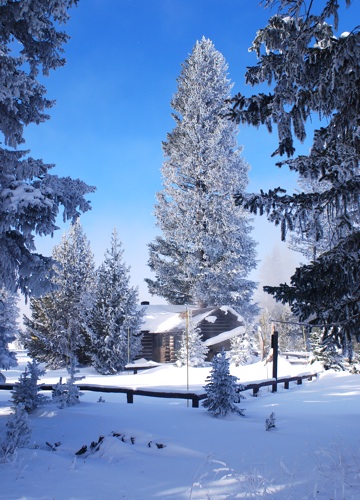
Winter in Yellowstone National Park is never easy, but it can be fascinating and picturesque as these photos of the warming hut at West Thumb and Old Faithful in eruption show. Kurt Repanshek photos.
Rocky Mountain air starts out dry, and then the sub-zero cold of its winters pulls out just about all of whatever atmospheric moisture remains. The result is not just a crystal clear sky, but one that seemingly is magnified. Looking at the constellations above Craig Pass in Yellowstone National Park, it sure seemed possible to reach up and pluck a star out of the night.
But I wasn't about to pull my gloves off, not while standing on snow in temperatures that had slipped down below zero degrees Fahrenheit just as the sun slipped down below the western horizon. In fact, I wouldn't have been standing in the snow at all had the throttle cable on the old Bombardier snowcoach not literally froze-up as we shuttled from Flagg Ranch just south of the park to Old Faithful and the warm, welcoming confines of the Old Faithful Snow Lodge. The freeze-up was a blessing in disguise, though, as it forced the coach's occupants out beneath that pin-holed night sky while Zack, the driver, pulled up the floorboards to remedy the situation.
The Big and Little Dippers were easy to spot overhead, but my lack of celestial navigation greatly limited what other constellations I could accurately identify. Orion no doubt was up there, too, and so too Gemini. Fortunately, in light of the biting cold, spotting others wasn't possible as Zack quickly fixed the throttle cable and I soon was walking through the front doors to the Snow Lodge.
Cold notwithstanding, the night skies over Yellowstone are fascinating, as is the relative silence that cloaks the park when snow-bound roads prevent wheeled-traffic from shuttling around the Grand Loop. It's against this starry, quiet backdrop that Xanterra Parks & Resorts, the concessionaire that operates the park's lodges, inns, and hotels, offers evening Steam Stars & Winter Soundscapes tours in the Upper Geyser Basin, treks that lead you into the night where your eyes study the skies and your ears capture the fizzing, plopping, whooshing, boiling, and sputtering of the basin's waterworks.
* * * * * * * * * *
Just as many folks head to Death Valley National Park in mid-August to measure themselves against that park's searing heat, I had returned to Yellowstone in winter after a nearly decade-long absence in search of a true Rocky Mountain winter, one with cold so nasty it can freeze your skin in minutes, one that dumps foot after foot after foot of snow as the days on the calendar tick by, and the journey earlier this month largely (I wished for more snow) did not disappoint. While I'd like to think the park was welcoming me back, it was merely the coincidence of my late-afternoon arrival in the park that washed the mountains with the orange and pink hues of alpenglow.
Throughout my visit overnight temperatures quickly dropped not just below zero, but deep below, to 30 and 40 degrees below even before the wind began to blow. That's not cold enough to freeze your spit in mid-air, as was the case with the character in Jack London's To Build A Fire, but those still can be dangerously cold temps if one doesn't come prepared. The cold of -20 degrees Fahrenheit and below seems to soak into any exposed flesh much like water soaks into a sponge.
But such cold also can create spectacular settings. Trees near geysers quickly are covered not just in hoar-frost from the bitter cold, but also in layers of rime that result when the water and steam from the eruptions coat trunks and branches. In the lodgepole forests there's the occasional cracking and popping as trees struggle with the cold. Heavy snows bend trees into submission, and result in curious bends and twists in trunks stuck for so long in those positions throughout the park's long winters that the contortions become permanent. Steam from geysers, fumaroles, and hot springs you might not notice when the air temperature is in the 70s stands out under the cold like so much smoke curling skyward from campfires.
An early morning mile-long hike to the top of the Observation Point above Old Faithful was comfortable as long as I kept moving, but my beard and mustache quickly iced over as the moisture in my breath froze. Fingers that stayed out of my gloves too long to snap photos possibly suffered first-degree frostbite as they seemed more susceptible to cold down the road. Down below Observation Point, the geyser basin appeared lake-like as steam spread out like an undulating blanket under the colder cap of air, hiding what was down below.
The cold can't muzzle Yellowstone's geothermal wonders. Old Faithful's actual eruptions do become a bit harder to make out, as the intense cold creates even more steam around this national park icon than you see in summer. But that makes for more interesting photos as the breezes push the billowing clouds around. Excelsior Geyser in the Midway Geyser Basin continues to dump 4,000 gallons of water per minute into the Firehole River during eruptions no matter how cold it might be. And while the terraces at Mammoth Hot Springs are engulfed in swirling banks of steam, breezes poke holes to allow momentary glimpses of the thermals down below.
The cold does seriously tamp down visitation to the park. I had the boardwalk that winds through the Upper Geyser Basin to myself, conditions perhaps best suited for noting the geothermal machinations. They say the buried plumbing of the basin's features are largely interconnected, and I saw evidence of that first-hand while working my way back along the boardwalk to Old Faithful for its scheduled 9:49 a.m. eruption one morning. Watching my step on the ice-coated boardwalk, my eyes caught the sputtering of Anemone Geyser. Stopping to get my camera focused, I was startled when Plume Geyser just over my left shoulder erupted in a mix of steam and water. These eruptions proved a precursor to Old Faithful's show, which went on on schedule minutes later.
Wildlife in Yellowstone seemed little put off by the temperature. Bison continued life uninterrupted, either resting on the ground chewing their cud, standing and using their massive heads to bulldoze snow out of the way to reach the few nibs of grasses beneath, or simply standing in place. Three trumpeter swans in the Firehole River seemed impervious to the cold. At one point they dipped their heads into the river and seemed to bathe. American dippers -- Water Ouzels -- continued to dip beneath the surface of rivers in search of meals. Bald eagles surveyed the landscape as they drifted by overhead, and coyotes remained on the prowl. Twice I paused to watch two of these canines stalk mice or voles beneath the snow, freezing every muscle ever-so-briefly before pouncing on their quarry, and then raising their heads to chomp, chomp, chomp the meal.
Elk also were readily visible -- one cow was spotted standing in the Firehole while munching on shoreline vegetation -- and one afternoon I encountered a scene filled with two moose -- one lying comfortably in the snow, another standing nearby. Wolves didn't make an appearance, though I apparently missed one howling in the Upper Geyser Basin by less than an hour.
Though Yellowstone often is seen as a single entity -- its geysers, wildlife, and landscapes all wrapped into one package -- it has many divisions of visitors. Just as there is a culture of wolf watchers that flood the Lamar Valley, there are geyser gazers who sit for hours before a particular geyser to watch its perturbations and record its behaviors, and there are birders who pan the forests, meadows, and river corridors with binoculars to track the park's many species.
* * * * * * * * * *
Winter travel in Yellowstone is not easy, and can at times be incredibly dangerous. For more than a decade now the snowcoach vs. snowmobile debate has dragged on, and there's no end in sight. Both have merits, and both have pitfalls.
Snowcoaches can lurch along in certain snow conditions, and older models can be cold and noisy. Indeed, during the ride into the park in the Bombardier we were offered blankets and ear plugs. Newer versions, though, are truly more like "coaches." The ride, while at times still lurching, is much more comfortable and the large windows that remain clear thanks to defrosters offer expansive views across the landscape. Drivers double as interpretive guides, and their microphones make it easy to hear their interpretations. And they can stop...almost on a dime...so you can get out to take pictures.
Snowmobiles in theory offer more freedom of exploration, but it can come with a price. During a stop at the warming hut at Madison Junction I listened as snowmobilers lamented the deep cold -- it was at least 20 below zero -- that was icing up their goggles and sunglasses behind their helmet's visors as the condensation in their breath quickly froze. Indeed, imagine riding a snowmobile at 30 mph in minus-20 temperatures? The resulting windchill is a downright deadly -53 degrees! And yet, overhead the sky was a deep blue, the snow covering the meadows painfully white to unshaded eyes, and the Gibbon River flowing choked with ice flows. It was a setting not to be missed due to the cold.
Winter travel can be challenging in Yellowstone no matter what your form of transportation. But then, shouldn't it be that way?
Story Categories:
A copy of National Parks Traveler's financial statements may be obtained by sending a stamped, self-addressed envelope to: National Parks Traveler, P.O. Box 980452, Park City, Utah 84098. National Parks Traveler was formed in the state of Utah for the purpose of informing and educating about national parks and protected areas.
Residents of the following states may obtain a copy of our financial and additional information as stated below:
- Florida: A COPY OF THE OFFICIAL REGISTRATION AND FINANCIAL INFORMATION FOR NATIONAL PARKS TRAVELER, (REGISTRATION NO. CH 51659), MAY BE OBTAINED FROM THE DIVISION OF CONSUMER SERVICES BY CALLING 800-435-7352 OR VISITING THEIR WEBSITE. REGISTRATION DOES NOT IMPLY ENDORSEMENT, APPROVAL, OR RECOMMENDATION BY THE STATE.
- Georgia: A full and fair description of the programs and financial statement summary of National Parks Traveler is available upon request at the office and phone number indicated above.
- Maryland: Documents and information submitted under the Maryland Solicitations Act are also available, for the cost of postage and copies, from the Secretary of State, State House, Annapolis, MD 21401 (410-974-5534).
- North Carolina: Financial information about this organization and a copy of its license are available from the State Solicitation Licensing Branch at 888-830-4989 or 919-807-2214. The license is not an endorsement by the State.
- Pennsylvania: The official registration and financial information of National Parks Traveler may be obtained from the Pennsylvania Department of State by calling 800-732-0999. Registration does not imply endorsement.
- Virginia: Financial statements are available from the Virginia Department of Agriculture and Consumer Services, 102 Governor Street, Richmond, Virginia 23219.
- Washington: National Parks Traveler is registered with Washington State’s Charities Program as required by law and additional information is available by calling 800-332-4483 or visiting www.sos.wa.gov/charities, or on file at Charities Division, Office of the Secretary of State, State of Washington, Olympia, WA 98504.

Comments
Thanks for the report Kurt. Must have been an incredible experience. As I've been to Yellowstone in summer only - unless you count that night in early June when we actually got about one inch of snow - I'd like to know a bit more on how you got there and got around.
To Observation Point, did you take snow shoes, cross country skis or was the snow on the trail compacted and you could just walk? And while your report covers the Upper Geyser Basin, you mention the terraces at Hot Springs as well. Did you got there too? And if so, how? Is there some kind of snow coach, shuttle, public transportation system? Or are those day tours from the base at the Upper Geyser Basin area? I know there are tours to the Canyon area, but where else can you go and how long do those tours take, as I imagine snow coaches to travel slower than cars in summer? Many questions, some probably could be answered by digging into the parks website and those of the concessionaires, but maybe you can answer them here too.
Again thanks for the report of your amazing trip.
So glad you enjoyed your visit to Yellowstone this Winter! While we were there over Christmas, we enjoyed Ginatess Geyser erupting! It started on Christmas Eve and on Christmas Day, my husband photographed it going off, 7 different times! We enjoyed our snowmobile ride on the 23rd but the next day, Christmas Eve, the day we skiied into Lone Star Geyser, it was so cold that the snomobiles scheduled for that day had to return to the Snow Lodge. A certain part was freezing up. I know how cold it was waiting for nearly 2 hours for Lone Star to erupt and I am in total agreement about how cold your hands can get when you take them out of your gloves to photoograph!
To MRC, there are day trips that come in from West and from Gardiner but Xanterra also offers snow coach rides into different areas of the park. Their EXPRESS from Snow Lodge to West or vice versa is *90 minutes, with allowing one stop at Madison's Warming Hut for bathroom or snacks.
When we were there we took the Photo Safari with Lisa Culpepper who is an accomplished Photographer. She will stop wherever you want if something looks promising as well as, spots that she knows of that have good photography potential. She'll help you out with your camera and she'll even pour you hot coffee or hot chocolate!
One day we took the Firehole Run with Liz and we enjoyed Midway Geyser Basin at length.
Of course, one of the highlights for me was just to wander through the Upper Geyser Basin making my way down to Riverside and Morning Glory as well as out to the Black Sand Basin.
Can't wait to hear more and see some photos!
Connie
MRC,
I've working up a separate on getting to Observation Point that I hope to post in the coming days. It will answer your questions. And since the answers to your other questions no doubt will be of interest to others, I'll package those in a separate post as well. I did consider tagging such information on the bottom of the above story, but figured it'd get too lengthy.
Nice post. Thanks.
Just back a few minutes ago from three WONDERFUL Yellowstone winter days. But these last few days, Yellowstone was experiencing a January thaw. When I left northern Utah Sunday morning, the temp was +3 degrees Fahrenheit. But a few hours later as I drove through Bozeman and Livingston, it was an astonishing 53 F! Upon arrival in Mammoth, it was still a balmy 48. Night and early morning temps ran in the mid-twenties.
Sunday, while traveling through Island Park, Idaho, I counted 54 trumpeter swans floating around on the blue waters of Henry's Fork of the Snake River. This was immediately behind a store, restaurant and gas station. Got some fine photos!
Drove out in my own vehicle to Lamar on Monday where some fine folks from Yellowstone Institute were helping anyone who came along spot a pair of wolves. Too far for a photo with my humble equipment, the YI people allowed me to peek through their spotting scope. Although it wasn't anywhere near as exciting as seeing them closer, I can at least say now that I've seen a couple of wolves in person. Along the way, I managed to collect some excellent bighorn sheep shots, and of course more bison and elk than I can count. My photo file now numbers literally hundreds of elk and buffalo. (Isn't digital great?)
Tuesday was the highlight. An all day snowcoach trip from Mammoth to Canyon and then southward to Mud Volcano turn around point. Our driver, Victor Sawyer, was as fine an interpreter as anyone wearing an NPS uniform. His concern for the animals and environment showed through loud and clear in deeds as well as words. And his knowledge of things Yellowstone was astounding. Enjoyed the company of a couple from Italy and another couple from Kansas. More photos of elk and bison and trumpeters --- and my first ever sighting of otters in the wild as four of them frolicked in the stream just west of the Museum of the National Park Ranger at Norris. Yes, the tour costs $135, but it was worth every penny and then some. Lodging at Mammoth Hotel was very reasonable, too. Less expensive than most motels at only $49 a night (a room with the bath down the hall -- just like an ol' college dorm . . . )
And the temperatures? Low thirties most of the day. I guess I can't brag about any hardship -- but when you're old and creaky, maybe hardship isn't as much fun as it once was. The only drawback? Gray skies that made the falls blend in with surrounding ice.
I'm afraid I may be something of a hypocrite -- or maybe it's just the uh, wisdom?, that comes with age. Once upon a time, I was known to hold forth at length with loud opinions very anti-snow machine. But now that I've reached the point I can no longer ski or snowshoe long distances, I've sort of mellowed out. However, the new four-stroke snowmobiles and all the snow coaches I saw and heard in action were much, much quieter than their ancestors. (Or maybe my old ears don't work so well any more -- but I don't think that's it.) The big coach was comfortable and view was great. Many excellent photos out the windows. (Vic is also a great window washer, too.)
I have faith that someday, a good and balanced answer will be found to the quandary of machines in Yellowstone in winter. Perhaps it has already been reached, but we just don't know it yet.
Quick question about Yellowstone in the winter. Do you know if any of the geysers freeze? I couldn't find anything on the web with frozen geysers. I imagine that they don't, but I would love to photograph a frozen geyser.
I've never heard of a geyser freezing, Bill, but they can get walls of ice built up from their spray turning to ice once it hits the ground, and continually building up. But the conditions have to be right.