

Potholes in Canyonlands National Park provide habitat for fairy shrimp. Kurt Repanshek photo.
Roam the normally arid and dusty trails through Arches or Canyonlands national parks, and you’re bound to come upon bowl-shaped depressions, often caked with dried mud, in the sandstone. These nondescript basins are nothing to stop and ponder...until the rains come.
That’s when their otherwise out-of-sight residents come to life.
A surprising array of creatures relies on these potholes for life, and one of the most curious is the fairy shrimp. These unique crustaceans are found in small potholes or vernal pools in America’s Southwest. Their eggs maintain resilience during the dry season, and during the spring as the rains strike, the shrimp hatch.
There are more than 300 varieties of fairy shrimp, the most common being the Eubranchipus Vernalis, more popularly know as the Vernal Pool Fairy Shrimp. These little guys, measuring in at ½- 1 ½ inches as adults, can be found anywhere ephemeral pools are present, though the majority of their population resides in California and Oregon.
Fairy shrimp vary in color (magically?) depending on the menu found in their particular pool of residency, ranging from translucent, to orange, even to blue! They feature 11 pairs of legs to propel themselves upside-down, or more scientifically, ventral side-up. They also use these incredibly helpful legs to eat unicellular algae, ciliates, and bacteria by filter and suspension feeding methods. They filter feed by pumping water through filtration structures -- located in their multi-purpose legs -- thus capturing the food. They also are adept at suspension feeding by plucking food floating in the water, again, with their tentacle-like legs. They may also grab or scrape food from the surfaces of other things in their vernal pool, such as sticks and rocks.
Able To Endure Droughts
Fairy shrimp typically lay drought-tolerant eggs during the summer that over-winter in the dried sediment on the bottom of the pool and then hatch in the spring when the potholes fill with rainwater However, if the water never returns to their particular pool, eggs can be transferred to other pools by floating in gusts of wind or being carried by a particularly curious animal. These eggs are tough and can withstand varying temperatures, drought, and even the test of time; eggs in laboratory settings have survived intact up to 15 years before hatching (now that really is magic).
These types of eggs are referred to as “winter eggs,” and are the ideal and most common egg of the fairy shrimp. However, in times of need, fairy shrimp may produce what are called “summer eggs.” If female fairy shrimp sense a lack of males in the vernal pool, they will lay summer eggs -- obviously during the summer -- and these miraculous eggs will then be able to hatch and complete their full life cycle in about 16 days.
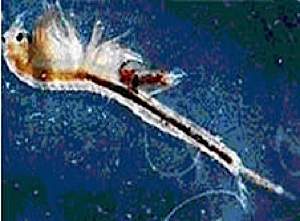
One species of fairy shrimp. USFWS photo.
This rapid reproduction allows for the population to spike back up before season's end.
Threats Confronting Fairy Shrimp
But all is not well in the fairy shrimp realm. In 1994 some species of fairy shrimp were listed on the endangered species list.
While they don't have many natural predators, these creatures have become threatened for several reasons:
* First, they require a certain amount of oxygen to survive. Their legs take care of obtaining this as they swim, as long as the oxygen is available. If it’s not, they’ll die. The amount of oxygen in their pools of water depends on the water temperature, salinity, and pressure. There is most oxygen when the temperature is cool, the salinity level is low, and the altitude is also low. So if any of these conditions are too extreme, or if there is a high level of microbes in the pool, which use up lots of oxygen for energy, that will result in too little oxygen for the fairy shrimp to survive.
* Humans can inadvertently kill fairy shrimp. One thing we can do to avoid this is to abstain from drinking from potholes, touching them, or stepping in them, as this could instantly harm the fairy shrimp, and other organisms who call potholes their home. Swimming in potholes can lead to their deaths, as well, from sunscreen washing off our bodies.
* Agricultural and development expansion are a key threat to fairy shrimp, for they thrive when surrounded by neighbors in other vernal pools. The different pools of shrimp lead to genetic diversity. When the wind or animals move the eggs to different pools, that genetic diversity spread out, thus giving all shrimp pools a chance to reproduce the most disease-resilient and strong genes. Many vernal pools are found on flat land, land that also is prime for farming or housing developments. The danger to fairy shrimp is a part of the over-arching debate regarding urban sprawl in California wetlands.
As travelers, you can do your part to help the fairy shrimp by leaving their vernal pools alone. As mentioned before, drinking water, stepping in, or touching a pool can throw off the entire mini eco-system located in this fascinating habitat. Remember, our fingers are very salty, so even if you’re using a gentle touch, do not put your fingers in a vernal pool, as it will raise the salinity and throw off the dissolved oxygen percentage needed for our fairy shrimp to survive.
In the National Park System, under the right conditions you can observe fairy shrimp in Canyonlands, Arches, and Death Valley national parks, as well as El Malpais National Monument in New Mexico, Wupatki National Monument in Arizona, and Natural Bridges National Monument in Utah, just to name a few locations.
Canyonlands and Arches boast at least two species of fairy shrimp: Branchinecta packardi - the Packard Ferry Shrimp, also known as the Rock Pool Ferry Shrimp or the Arizona Ferry Shrimp, and Streptocephalus texanus - the Great Plains Ferry Shrimp.
Remember, fairy shrimp hatch in the Spring, right after the potholes and vernal pools re-fill with water, so that will be your prime sighting time.
Hadley Kunz is a Traveler intern. A recent West Virginia University graduate with a Bachelor of Science degree in Journalism, she grew up with a regular diet of outings in the Poconos, and expanded that once in college to outdoors locations in Pennslyvania, West Virginia, Colorado and Utah.
Story Categories:
A copy of National Parks Traveler's financial statements may be obtained by sending a stamped, self-addressed envelope to: National Parks Traveler, P.O. Box 980452, Park City, Utah 84098. National Parks Traveler was formed in the state of Utah for the purpose of informing and educating about national parks and protected areas.
Residents of the following states may obtain a copy of our financial and additional information as stated below:
- Florida: A COPY OF THE OFFICIAL REGISTRATION AND FINANCIAL INFORMATION FOR NATIONAL PARKS TRAVELER, (REGISTRATION NO. CH 51659), MAY BE OBTAINED FROM THE DIVISION OF CONSUMER SERVICES BY CALLING 800-435-7352 OR VISITING THEIR WEBSITE. REGISTRATION DOES NOT IMPLY ENDORSEMENT, APPROVAL, OR RECOMMENDATION BY THE STATE.
- Georgia: A full and fair description of the programs and financial statement summary of National Parks Traveler is available upon request at the office and phone number indicated above.
- Maryland: Documents and information submitted under the Maryland Solicitations Act are also available, for the cost of postage and copies, from the Secretary of State, State House, Annapolis, MD 21401 (410-974-5534).
- North Carolina: Financial information about this organization and a copy of its license are available from the State Solicitation Licensing Branch at 888-830-4989 or 919-807-2214. The license is not an endorsement by the State.
- Pennsylvania: The official registration and financial information of National Parks Traveler may be obtained from the Pennsylvania Department of State by calling 800-732-0999. Registration does not imply endorsement.
- Virginia: Financial statements are available from the Virginia Department of Agriculture and Consumer Services, 102 Governor Street, Richmond, Virginia 23219.
- Washington: National Parks Traveler is registered with Washington State’s Charities Program as required by law and additional information is available by calling 800-332-4483 or visiting www.sos.wa.gov/charities, or on file at Charities Division, Office of the Secretary of State, State of Washington, Olympia, WA 98504.

Comments
I watched some last week in a pothole just south of the visitor center at Hovenweep. That pothole is just off the trail leading from the campground to the Square Tower trail.
While your comments about harming the shrimp are accurate, the reality is that in many very remote locations, in certain seasons, I'm thinking the Esplanade and similair areas at Grand Canyon, the only source of water for human consumption and survival are the potholes. So, in those places carry as much water as you can, but if you run out, and they are your only source of water, use the potholes rather than place your life in danger. The wildlife does.
Nice article. For anyone interested in more about these pools & fairy shrimp:
From my biased perspective, you missed out the coolest thing about them. Only eggs (technically, diapausing embryos) can survive a pool drying up. Depending on the temperature & species, it takes 12 days to several months (for Tripos tadpole shrimp) for a hatched egg to grow & develop and be able to start laying eggs. If the pool drys up in less than that time, all shrimp that hatched during that pool filling die without reporducing. So moms lay eggs where only a fraction hatch the next filling, another fraction of the eggs hatch the second filling, etc., out to at least 40 fillings. That's the same thing that annual plants do in deserts, where in some years it doesn't keep raining and all seeds that germinate die before flowering and making new seeds.
Tim Graham of USGS was the expert on what's in the pools. [Permanent lakes & ponds can have fish, which eat tadpoles.] If a temporary or ephemeral pool holds water long enough, it can have frogs and tadpoles, which eat the fairy shrimp, tadpole shrimp, and clam shrimp. The deep pools in the sandstone fins hold water for up to 2-4 months and have tadpole & fairy shrimp. The shallow pools on flat sandstone (such as pothole point in Canyonlands) don't last long enough for tadpole shrimp, but have fairy shrimp & clam shrimp. The same process scales down to even smaller "pools" with filling durations measured in hours. Tim poured a little water from his canteen into a depression no bigger or deeper than a dinner plate, and with his hand lens showed me the cladocerans (?, sorry Tim) that hydrated and revived after 2 or 3 minutes, and a new (genus) of predatory mite he discovered that makes its living by waking up in less than a minute after a pool fills, thus having a minute to run around and capture prey before the prey were active & able to swim away.
Craig Childs' The Secret Knowledge of Water is a fun read about these pools and fairy shrimp (my papers: not so fun).
So yes, please stay out of the pools (just like stay off the cryptograms!), but if you're at risk because of thirst, do as Old Ranger says and drink the water, especially if you have a filter with you. In most cases, even when the pool is full, there are many more dormant eggs in the mud than shrimp in the water.
Capitol Reef also has fairy shrimp. You can go on a short hike to the "tanks" where the water pot holes they call tanks are filled with shrimp. I have seen them there in the spring and fall.
Also, your article has been very helpful. I'm getting ready to give an interpretive presentation about fairy shrimp in Capitol Reef in a couple of weeks.