
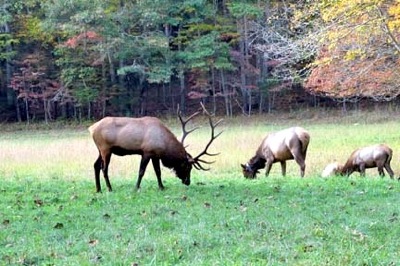
The return of elk to Great Smoky Mountains National Park has restored another aspect of nature to the landscape. Photos by Danny Bernstein.
Editor's note: What started out as an experiment in 2001 is now considered a success. Elk once again roam the mountains and valleys in Great Smoky Mountains National Park, giving visitors in fall another slice of nature to enjoy, as Contributing Writer Danny Bernstein tells us.
With a backdrop of fall crispness, the earthy smell of decaying leaves, and a forest daubed red, orange, brown and green, a bull elk ambles through the rolling field checking his harem. He sidles up to each cow and sniffs her rump. Raising his massive rack of antlers, he sees two young bulls, chases them out of the field, and resumes his inspection. Seemingly satisfied, and determined to both reassure his ladies and warn away other males, he lifts his face to the sky and bugles – a loud, mournful sound that cuts through the air and resounds off the surrounding forest walls.
That's what's going on now in the Cataloochee Valley of Great Smoky Mountains National Park. Not too long ago, the only sounds in this valley were of park visitors and the splashing of Cataloochee Creek and the branches that tumble into it.
Elk disappeared in North Carolina before the 1800s because they were over-hunted. They also lost their habitat when settlers cleared land and moved in livestock. But the calendar, figuratively, was turned back in 2001, when the park, determined to see if elk could once again flourish in the Smokies, imported 25 elk from the Land between the Lakes National Recreation Area, between Kentucky and Tennessee. The next year saw another 27 elk arrive, this time from an Alberta, Canada, herd.
The program has been quite successful. There currently are right around 135 animals in the park's herds, including 25 calves born this year. Joe Yarkovich, a wildlife biologist for the park, would like to see that number grow eventually to several hundred elk through the park.
Today visitors, determined to see the elk, pour into the valley, which is not a particularly easy place to get reach. Once you get off I-40, you take a two-lane road that winds up and turns to dirt as it continues to climb. At the top at Cove Creek Gap, you enter the park. Then the single-lane road bumps and plunges down like a twisted ribbon. This would not, you tell yourself, be a good place to meet anyone driving a monster truck coming the other way.
Since this was the original road used by Cataloochee residents, the road will not be paved or widened. Even the valley is like a museum piece, little changed since the residents left to make way for the park. There are no services in the valley, though there are some nicely maintained homesteads and churches from a bygone era to explore and ponder life from long ago.
Visitors who know come to Cataloochee prepared with food, water, and gas. Some visitors who've planned a day of elk gazing sit in their folding chairs with their picnics and binoculars the whole afternoon, waiting for dusk and the elk to come out of the forest.
If you make the trek this fall to Cataloochee and spot some of the herd, you'll notice that most are numbered with a tag dangling from their ear. Elk are big animals. Male elk can weigh up to 700 pounds, a female up to 500 pounds. They're bigger and faster than bears - their only predators in the park.
What’s the evolutionary advantage of elk harems? Isn't nature supposed to spread its DNA around? "The dominant male is supposed to be the perfect male,” Mr. Yarkovich explains. “Any single elk only stays dominant for two to three years. Then he's retired by a younger and stronger male."
Out in a large field, a bull elk walks around while four females and their yearling calves graze. Then he bugles. It begins deep and resonant, becomes a high pitched squeal, and ends with several grunts.
During the rut, it’s like an elk Peyton Place and all the clichés that we use for humans are true:
Following the herd
Big rack
Young buck
One bull can control many cows, so it's not good for the other, less-dominant bulls. That's obvious in the crowd watching a lonely, obviously unhappy elk, whose bugles draw only human onlookers, not interested cows. These 2-year old bulls, with only a single shoot for an antler, don’t have a chance to mate.
The success of the recovery program is evident in the elk that have moved out of the Cataloochee Valley. They've been seen regularly on Newfound Gap Road north of Oconaluftee Visitor Center. Young males also hang around the lawn in front of the Educational Complex on the Cherokee Reservation. They're fine anywhere unless they cause trouble on private land.
Last year, Elk #22 was euthanized because he went where elk didn’t belong, ate non-elk food, and generally became a juvenile delinquent, if people still use that expression. He broke fences, damaged crops, almost collided with cars, and even chased visitors. When he got into the Cherokee Tribal Gardens that was the last straw. The Cherokee tribe made the decision, with support from the park, to take him out.
A few years ago, the park trained a group of volunteers to patrol and keep traffic moving in the Valley. Called the Elk Bugle Corps, they educate the public about the elk and the history of the park. But most importantly, they keep people at least 50 yards from these large, grazing animals.
Story Categories:
A copy of National Parks Traveler's financial statements may be obtained by sending a stamped, self-addressed envelope to: National Parks Traveler, P.O. Box 980452, Park City, Utah 84098. National Parks Traveler was formed in the state of Utah for the purpose of informing and educating about national parks and protected areas.
Residents of the following states may obtain a copy of our financial and additional information as stated below:
- Florida: A COPY OF THE OFFICIAL REGISTRATION AND FINANCIAL INFORMATION FOR NATIONAL PARKS TRAVELER, (REGISTRATION NO. CH 51659), MAY BE OBTAINED FROM THE DIVISION OF CONSUMER SERVICES BY CALLING 800-435-7352 OR VISITING THEIR WEBSITE. REGISTRATION DOES NOT IMPLY ENDORSEMENT, APPROVAL, OR RECOMMENDATION BY THE STATE.
- Georgia: A full and fair description of the programs and financial statement summary of National Parks Traveler is available upon request at the office and phone number indicated above.
- Maryland: Documents and information submitted under the Maryland Solicitations Act are also available, for the cost of postage and copies, from the Secretary of State, State House, Annapolis, MD 21401 (410-974-5534).
- North Carolina: Financial information about this organization and a copy of its license are available from the State Solicitation Licensing Branch at 888-830-4989 or 919-807-2214. The license is not an endorsement by the State.
- Pennsylvania: The official registration and financial information of National Parks Traveler may be obtained from the Pennsylvania Department of State by calling 800-732-0999. Registration does not imply endorsement.
- Virginia: Financial statements are available from the Virginia Department of Agriculture and Consumer Services, 102 Governor Street, Richmond, Virginia 23219.
- Washington: National Parks Traveler is registered with Washington State’s Charities Program as required by law and additional information is available by calling 800-332-4483 or visiting www.sos.wa.gov/charities, or on file at Charities Division, Office of the Secretary of State, State of Washington, Olympia, WA 98504.


Comments
Since the elk that formerly inhabited the Smokey Mountains were the Eastern Elk, a now extinct subspecies, aren't the newly "reintroduced" elk exotic to the park? The Kentucky Elk are Rocky Mountain Elk as I assume the Canadian elk are also. In either case there is no genetic relationship to the original elk found in the park. How was that reconciled with NPS policy?
Anonymous,
As you note, the eastern elk species is extinct. The NPS settled on elk that originated from the Elk Island National Park in Canada because "(T)hese elk were thought to be the closest genetically to the extinct eastern species because of their geographic proximity and similar body characteristics (Murrow 2007) consistent with Management Policies (NPS 2006, Section 4.4.2.2."
Here's the key wording from 4.4.4.2:
The elk from Land Between the Lakes NRA originated from that Alberta herd.
Great question. This kind of question keeps me on my toes.
Basically, the park got as close as they could get to the extinct species.
Here's what the Elk management plan http://parkplanning.nps.gov/document.cfm?parkID=382&projectID=28732&docu... says:
All animals had to come from herds that originated from Elk Island National Park, Alberta, Canada because of their stringent disease monitoring protocols. On 2 April 2001, 25 (13 males (M):12 females (F)) elk from the Elk and Bison Prairie at Land between the Lakes National Recreation Area, in Kentucky and Tennessee, were released into Cataloochee Valley (elk were originally brought to Land Between the Lakes from the Elk Island herd). The following year, on 20 April 2002, 27 (8M:19F) elk originally from Elk Island National Park, Alberta, Canada, were released into Cataloochee Valley. These elk were thought to be the closest genetically to the extinct eastern species because of their geographic proximity and similar body characteristics (Murrow 2007) consistent with Management Policies (NPS 2006, Section4.4.2.2). Elk are extremely robust to inbreeding, so the same original source herd was not detrimental.
Murrow, J. L., J. D. Clark, and E. K. Delozier. 2009. Demographic analysis of an
experimentally released population of elk in Great Smoky Mountains National Park. Journal of Wildlife Management 73:1261–1268.
Murrow, J. L. 2007. An experimental release of elk into Great Smoky Mountains National
Park. Dissertation, University of Tennessee, Knoxville, USA.
For the policy statement, look at http://www.nps.gov/policy/mp2006.pdf.
Pg. 37 seems to be where the intent of your question would be answered.
Biological or physical processes altered in the past by human activities may need to be actively managed to restore them to a natural condition or to maintain the closest approximation of the natural condition when a truly natural system is no longer attainable. Prescribed burning and the control of ungulates when predators have been extirpated are two examples. Decisions about the extent and degree of management actions taken to protect or restore park ecosystems or their components will be based on clearly articulated, well-supported management objectives and the best scientific information available.