
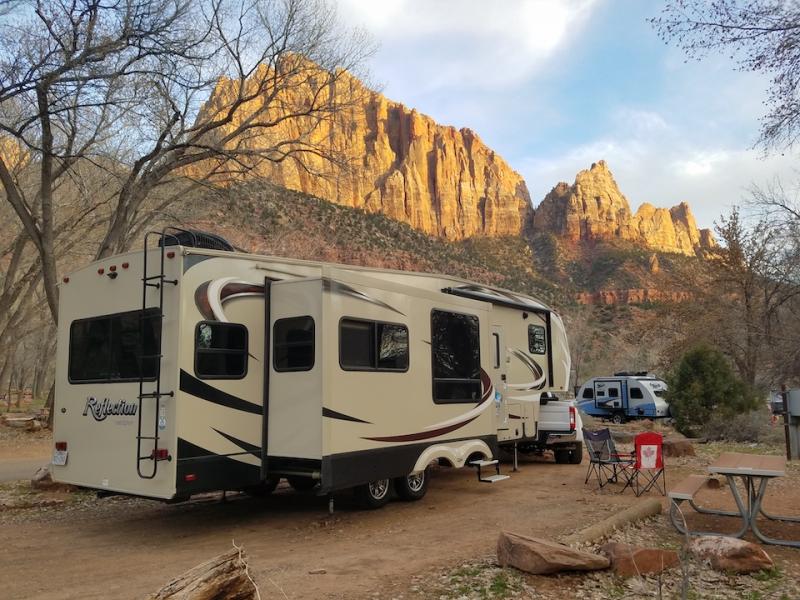
Zion National Park//Pat Williams "Cletch"
RVing used to be so simple. You plan for a road trip, you pack your rig, and you go. But in our post-pandemic nation, we’ll have an added layer of RV etiquette basics to consider when camping in national parks. Common neighborly courtesies like respecting campsite boundaries and minimizing generator noise are still advisable. But now, all of us will have to go a step further to nurture neighborliness and reap the rewards of life after lockdown. As RV life ambassadors, here’s what we need to preach and practice from arrival to departure.
How to Minimize Your RV Footprint in the Campground
Coronavirus made all of us keenly aware of how one person’s behavior impacts an entire community. As we shed the shackles of confinement and hit the road, respect for other campers’ outdoor experiences is more important than ever. America’s travel industry experts predict that the post-pandemic domestic travel market will rebound long before international globetrotting does and as a result, thousands of antsy Americans will discover the joys of RVing. In a National Park System that’s already burdened by overcrowding, these RV etiquette tips can make everyone’s experience much better.
Campground Courtesies 101: The Top Three Bad Camping Behaviors
Before we take a deep dive into campground conduct, let’s review the top three infractions many of us might inflict on others:
- Speeding in the campground. Some vacationing campers have a hard time remembering to lighten up on the gas pedal. All of us can ease into relaxation mode by obeying posted campground speed limits. Going slower minimizes noise, decreases road dust, and lowers the risk of tragic collisions with wildlife and people.
- Letting unsupervised kids run amok. Watching children explore their wild side in a natural setting creates a lifetime of fond family memories. But campground neighbors don’t always want to be part of that together time. Teach kids boundaries by explaining that each person’s campsite is their own “house” and cutting through yards is not allowed. While you’re at it, you may need to educate some lazy adults, too.
- Being bad pet parents. National parks have strict pet rules for a reason. Their un-scooped poop pollutes and their noise disturbs wildlife—as well as your neighbors. Pick up pet waste and use a non-retractable, flat leash on walks to set a good example for all pet parents. And don’t forget that while pets love to play outdoors, nature isn’t always kind to them. Cats and dogs of all sizes are easy prey for fierce critters on the hunt for dinner, so don’t leave your fur kid unattended outside of your RV, even in an exercise pen.

Lone Rock Campground at Glen Canyon National Recreation Area/Colleen Martel
Go Beyond Basic RV Etiquette in National Parks
Let’s be honest: the vast majority of RVs in national parks take up a lot of space and seem out of place. Those tall boxy homes emblazoned with names like “Attitude,” “Intruder,” and “Vengeance,” don’t exactly give non-RVers a great impression of the lifestyle we love. Here’s how you can keep a low profile and considerately use RV amenities around campground neighbors who might be leery when they see your rig pulling into the campground.
Create a cone of silence at your campsite.
RVs create a comfortable camping experience for anyone lucky enough to travel in one. From surround sound stereo systems to outdoor kitchens and patio bars, even the smallest RVs are loaded with creature comforts that make Edward Abbey roll over in the grave. Unfortunately, RVs don’t come with residential grade insulation to contain the noise generated by those amenities. Other campers probably don’t enjoy the same kind of music or movies that you do, so creating a zone of silence around the campsite is a simple gesture any RVer can make. For example:
- Wear wireless headphones. Turn them on when cranking your favorite music or watching movies on the patio, especially at night.
- Minimize generator use. National park campground generator rules often allow for a few hours of morning and evening use. But just because we’ve got the green light to fire it up, doesn’t mean we can set it and forget it. When your RV batteries are fully charged, turn it off to give your neighbors a break from the din.
- Party respectfully. Friends, food, and beverages are some of the key ingredients to a good time around the campfire. But when neighbors aren’t part of the celebration, keep voices low and call it a night when evening quiet time hours kick in.

Capitol Reef National Park/Heather Yandziak
Embrace dark skies.
Nobody goes to national parks to gaze up at light pollution. Dark skies are why many of us go camping in the first place, but RVs can impact darkness in several ways. From patio awnings with built-in LED strands, to motion detector security lights glaring into neighbors’ windows, these conveniences might help some RVers sleep better, but they annoy most other campers who choose to live without them. Here’s how you can avoid being that jerk:
- Take time after dark to see how your RV lighting impacts neighbors.
- If any of your patio lights are reflecting off neighbors’ sites, turn them off.
- Don’t forget to turn off your porch light when quiet hours kick in.
- Some people say that strands of LED lights placed under your rig will keep rodents away. The problem is there’s no proof that this trick works, so leave the extra lights at home.
Clean up at the dump station.
Few things are more disgusting than pulling into a park’s RV dump station left with smelly evidence of incompetent users. When you’re emptying holding tanks, practice the same level of sanitation procedures that you've been following during the coronavirus pandemic.
- Wear gloves. You’ll avoid cross-contamination during the dumping process.
- Be efficient. Don’t take any longer than you need to effectively empty your holding tanks without making a mess.
- Don’t leave a mess. Spray down the dump station hose connection basin with water, and leave it cleaner than you found it for other RVers.

Furnace Creek Campground at Death Valley National Park/Nicole Williams
Give campers space.
The essence of RV camping etiquette is remembering that our actions always affect another person’s experience of the national park. Giving neighbors enough physical and mental space not only helps them enjoy the park as they had hoped, but returns the favor to you. Here’s how to keep the kindness flowing:
- Avoid parking right next to other campers if additional spots are available. People want their elbow room so if other campsites are open, grab one that isn’t right next to another camper.
- Manage your campfire. Next to unsupervised kids and dogs, one of the biggest pet peeves of any camper is a lonely, smoldering fire pit. If you build a fire, keep a close watch and when you’re done, drown it out with enough water to snuff out any billowing smoke pouring into your neighbor’s spot.
When my husband and I were backpackers, we used to think of RVing as the lazy person’s camping choice. But eventually, we discovered the appeal of sleeping on a nice mattress in the wilderness and were hooked. Since we hit the road full-time in 2007, we’ve witnessed good and bad RV camping etiquette all over the country, most of it good. Those small acts of kindness influence so much more than our personal experience in the national parks—they make us happier people who want to return the favor. Paying that forward is the least we can do in a world that needs joy more than ever before.
This article was made possible by RVShare.com.
Story Categories:
A copy of National Parks Traveler's financial statements may be obtained by sending a stamped, self-addressed envelope to: National Parks Traveler, P.O. Box 980452, Park City, Utah 84098. National Parks Traveler was formed in the state of Utah for the purpose of informing and educating about national parks and protected areas.
Residents of the following states may obtain a copy of our financial and additional information as stated below:
- Florida: A COPY OF THE OFFICIAL REGISTRATION AND FINANCIAL INFORMATION FOR NATIONAL PARKS TRAVELER, (REGISTRATION NO. CH 51659), MAY BE OBTAINED FROM THE DIVISION OF CONSUMER SERVICES BY CALLING 800-435-7352 OR VISITING THEIR WEBSITE. REGISTRATION DOES NOT IMPLY ENDORSEMENT, APPROVAL, OR RECOMMENDATION BY THE STATE.
- Georgia: A full and fair description of the programs and financial statement summary of National Parks Traveler is available upon request at the office and phone number indicated above.
- Maryland: Documents and information submitted under the Maryland Solicitations Act are also available, for the cost of postage and copies, from the Secretary of State, State House, Annapolis, MD 21401 (410-974-5534).
- North Carolina: Financial information about this organization and a copy of its license are available from the State Solicitation Licensing Branch at 888-830-4989 or 919-807-2214. The license is not an endorsement by the State.
- Pennsylvania: The official registration and financial information of National Parks Traveler may be obtained from the Pennsylvania Department of State by calling 800-732-0999. Registration does not imply endorsement.
- Virginia: Financial statements are available from the Virginia Department of Agriculture and Consumer Services, 102 Governor Street, Richmond, Virginia 23219.
- Washington: National Parks Traveler is registered with Washington State’s Charities Program as required by law and additional information is available by calling 800-332-4483 or visiting www.sos.wa.gov/charities, or on file at Charities Division, Office of the Secretary of State, State of Washington, Olympia, WA 98504.

Comments
You didn't mention that dog owners need to keep their dogs quiet. Dog owners walk around campgrounds and when they pass other dogs they start to bark. We've experienced this many times. It is pretty annoying. I personally would keep dogs out of campgrounds. Also, not all pet owners keep their dogs off the trails that do not allow dogs. Along, with the dog barking, I appreciate that people do not play music at their campground. The National Parks should be peaceful places. Thank you!
I agree. We have been rv'ers since 1996, and our greatest dislike has been the dog owners who allow their dogs to roam...bark all day while they are out...and do their business everywhere, including on our sites hookups/tow vehicle...and even right within/in front of our sites front door! (And the owners get ticked off at YOU when you tell them to get the heck away!) This has not been occasional, this has been at EVERY campground we have been in...especially in the private campgrounds like KOA and Good Sams. Forget about mentioning it to the Front Desk folks....waste of time. We have a few years more of road-time to go, but it is this one thing we hate the most.
Cathy, Dogs have been man’s best friend for thousands of years. Sorry you don’t like them… You may want to stay in the safety of you own home.
I will glafdly keep my dogs out of campgrounds, as soon as you keep your children and grandchildren out of campgrounds!!
How, exactly, does one MAKE a dog not bark at another dog or wild animal?
How about staying completely away in peak season. RVs are an embarassment crammed into Yellowstone and other over-used resources.
How about if you don't like RV's you stay home.
I second that comment. Too many whiners.
Great response Kevin M.
Ha! Lots of luck with that! Most NP campgrounds were built decades ago and today's monster rigs cannot come close to fitting in. Still, the NPS wants to allow as many RVers as their campgrounds permit. But I've seen many campground trees with deep scars from rigs too large and which the NPS should disallow. While most NP campgrounds have sites just for tents, last year in Glacier NP one campground suddenly ejected all tent campers because some idiot left their garbage can unattended resulting in a mature black bear encounter. That rver was ejected from the campground but all tent campers were forced to leave for safety purposes until the bear problem was overcome, about 2 weeks!
The NP did the only safe thing they could do.
Bud Ramey how are RVs are an embarrassment? And how dare you imply that you sir are better than anyone else. That’s a pretty selfish attitude.
Just stay home. The gateway communities don't need your community spread in our restaurants, grocery stores, gas stations, clinics, etc. If you can camp without pumping gas, using a public restroom or shopping in a store outside your own hometown, go for it. Otherwise, you are part of the problem.
This is wrongheaded on many fronts, though understandable. Businesses in gateway communities heavily depend on visitors, including rvers, for their livelihoods. I agree that during peak season these communities may be flooded with out-of-towners seeking adventure in and around our national parks. If I lived in one I'm sure I'd get annoyed, too, by the crush of visitors. But like all things in life, there's the ying and the yang of tourism. But if I owned a small business, the last thing I'd want to see is tourists going elsewhere. This summer will likely provide a forced experiment with reduced park attendance given the covid-19 debacle, i.e., how much will park services and gateway communities feel the effects?
If you think that gas station that sells me 50-100 gallons of desiel fuel wants me to stay away I think you don't know your local bussiness man very well. how about spending $100.00 or more for those groceries and soda pops, and lets not forget about all the sweet shirts that have those little town names printed on the front. I'm willing to stay away just let me know where you don't want me and when those bussiness close up or move away you can drive to my town to shop we would love the extra cash influx.
As a business owner, thank you for supporting us. Please excuse uneducated, stay live of the government opinions.
It's not just attended smoldering fires that are annoying and polluting. So many people don't know how to build a fire and and up filling the entire campground with thick smoke.
Agreed! Our biggest pet peeve is smoldering stinky fires, whether with people sitting by them or not. Leaves should never be put into filres as they give off carcinogenic fumes. Regardless, those of us there to enjoy the fresh air, or who have lung issues (yes, we deserve to camp also) do not want to smell your stinky smoldering fire. It seems like that's the most frequent kind of fire, sadly. Wet wood and burning things that should not be in the firepit in the first place are probably the culprits. Use dry wood, don't build a fire if there is a wind to carry the smoke further than your site, and put the fire out when going to bed or leaving. "It's not camping if I can't have a fire, " is something I hear, but really, a fire is NOT necessary to enjoy camping, especially when it's already 85 degrees outside. Be a good neighbor and consider others when building your fire. If you can't, then go boondock miles from everyone else.
Well said.
National Parks are public property and belong to all the citizens of America. Americans have access to all Federal public lands unless otherwise directed by authorities. It does no good to criticize others who visit these places and businesses. They support the local economies and those who would criticize visitors should probably consider staying home.
That's nopt a get out of jail for being a jerk. Oh, I forgot it's all about me and to hell with everyone else.
Phillip--
I have no right to ask or tell you to stay away. But some gateway communities like Moab and Tusayan and some tribal areas ask visitors to stay away at least for now. Please join me in respecting their judgements: they are trading off their visitor-based income against their risk of exposure and lack of medical facilities to handle an outbreak, and going for safety. Other gateway communities with different situations are making different determinations. I hope that they all remain safe and relatively covid-19 free this summer.
As for the actual topic of this article: I'm happy with RVers respecting others and doing more etiquette than the minimum required by regulations. All of us can do more to make the experience better for our fellow campers. I would love more campgrounds to have separate RV vs tent loops, and regulations both ways: no big RVs or trailers in the tent area, and no car tent camping in the large pull-through sites for RVs and trailers.
As for pets, I have a great dog, but I don't take her camping with me except for a couple of specific FS areas. Not just the presence and noise from dogs, but even the scent of dogs keeps foxes and other meso-predators out of areas for days after the dogs have left.
Lets respect all those around us when we are camping. That means if they are having a problem dumping help them
Great article! You hit most of the main issues. Here's another. Keep your dog on a leash. Saying "He/she won't bite" suddenly becomes an issue when he/she decides to.
Well I, for one, am kind of surprised at the unwelcoming attitude of some of our R.V. family.
some families can only get time off during peak season, how some choose to camp and what they drive is their business.
resoect others-treat others like family-leave nothing more than footprints and haul out you garbage.
Hope the pandemic is over soon and we can all travel and enjoy what this country has to offer.
Unfortunately, the people that need this article the most will never read it.
Been camping for over 60 years. I've gone tent camping, back packing, car camping, motorcycle camping, tent trailer camping, VDub camper van camping, travel trailer camping, and 5th wheel camping. I'm even going to try bicycle camping this summer! I go camping for a variety of reasons. First and foremost to get out and enjoy the outdoors, to get away from the weekly routine, and to recharge my batteries. Time was everyone cooked over a open fire. The smell of smoke and food cooking in the morning and at night have always been a part of camping along with the noise of kids and their dogs and people having fun and enjoying themselves. You sat around at night talking, playing games, or telling stories. Sometimes there would be someone playing guitar and people singing old camp songs. Quiet time was when it got dark outside and camp noise returned when it got light again.
If the smells and noise of camping annoy you maybe you should just stay at the glamp camps where your sheltered from from the drugeries of real camping.
Thank you for the memories Tony. Those quiet, beautiful nights have turned into fairground light shows, with blaring TVs and party zones. Pretty sad!
. Looks like the the author of this article is trying to take her HOA enforcement duties with her to the great outdoors. RV etiquette is simple - Just follow the Golden Rule and be tolerant.
There are lots of private fifty-five-year-old year old and older camp grounds and upscale motorhome parks with exclusive rules available for those that don't want to share the beauty of the national parks with their fellow campers.
RV travelling is nothing but the most idiotic way to go around endangering society at large during pandemic conditions imaginable. If you do so you deserve to be buried in the piece of junk which all RVs are to begin with. Period.
Tom, I'm guessing you don't like RV's. Thats too bad, it's a great way to travel.
Encourage everyone to take a look and comment on the draft guidelines.
https://parkplanning.nps.gov/projectHome.cfm?parkID=415&projectID=97629
Thank you for sharing this information on rv etiquette basics post pandemic world. It was useful and interesting. You indeed have written it in a layman way so that anyone can understand and work accordingly. You have done a great job.They offer same information here campflaresort.com one must check them also.
Dogs, dogs, dogs! I love'em but what's up? I've camped next to folks with four. The slightest noise from people, animsls or wind sets them all off. It's bad enough in the neighborhood. Seems like the whole country has become a kennel.