
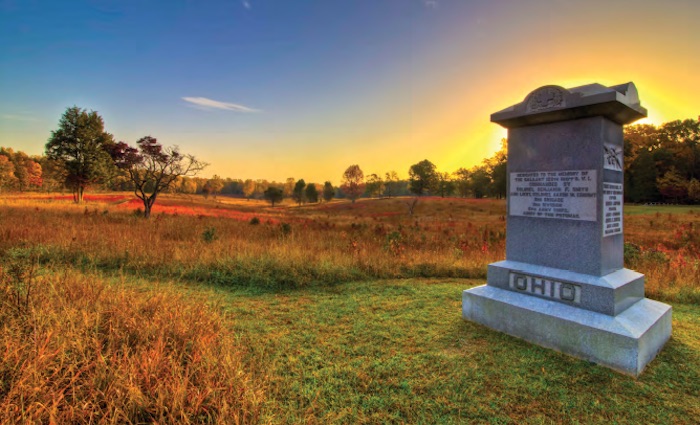
Growing up in the Pacific Northwest, I learned about the Civil War through books, movies, and plastic action figures. There just weren’t any battlefields in Oregon for a ten-year-old to experience first-hand. So, when I started traveling east, I was drawn to iconic battlefields like Gettysburg and Antietam. Until I started my quest to visit all the national park units, I had no idea of the sheer number of battlefields or how integrated into local communities they were and still are.
Heading south out of Washington, D.C., my girlfriend Craig and I recently did a sweep through Civil War battlefields in and around the Confederate capital of Richmond, Virginia. I had heard of Fredericksburg, Petersburg, Richmond, Spotsylvania, and Chancellorsville, but hadn’t realized these battles were all in Virginia, were relatively close together, and represented the action on the southern end of the D.C.-Richmond corridor. Here, Confederate and Union troops see-sawed back and forth over the course of the war as generals on both sides tried to take each other's capital.
Basing out of Richmond, we started our three-day Civil War adventure at the Fredericksburg visitor center to learn all we could about Fredericksburg’s four local battlefields (Fredericksburg, Spotsylvania, Chancellorsville, and The Wilderness). Exploring some parks is possible without a visitor center orientation, but I cannot imagine trying to understand all that went on at these battlefields without first seeing the movie, studying the dioramas, reading the exhibit narratives, and securing the driving tour guides.
There are driving guides to the four Fredericksburg battles and we spent the best part of a day exploring them all. Be sure and spend some time at the Chancellorsville visitor center and take the short walk to where General Stonewall Jackson, in the confusion of the battle, was mortally wounded by his own soldiers. Take the time to walk some of the fields where union and confederate soldiers crashed into each other. Look at the battles from the artillery perspective. The Park Service has placed cannons in many places to help us imagine how integral they were to winning some of these fights. It’s all there for you to check out, so be sure and give yourself enough time.
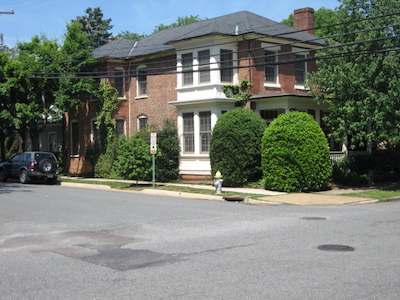
And pay close attention to the exhibits in all the visitor centers, you never know what kind of personal connection you might find. You can imagine my surprise when one of the Fredericksburg exhibits told the story of the “Stratton House,” a solidly built brick structure that provided safe haven to wounded Union soldiers because, unlike the predominately wooden houses in the area, it didn’t get blown to bits during the battle. It is still being lived in and is on the National Register of Historic Places. I shared this possible distant relative with my sister who maps the Stratton family genealogy and she is researching the family connection. So in addition to new Park Passport stamps, I may have added to Stratton family history!
What really struck me about the Fredericksburg Battlefield is its location relative to the local community. The Stratton House, which served as a battlefield hospital 150 years ago, is now in a neighborhood that could be Anytown, USA. So, in addition to visiting the park units, we also wanted to explore the local communities in and around these battlefields … and nothing beats going local like AirBnB or locally owned Bed and Breakfasts. They can connect you to the local community in ways you would never expect. For example, our AirBnB host in Richmond, who rents his place when he travels, requested that should we run into the actual owner of the apartment where we were staying, to please say we were friends of his girlfriend’s parents so his landlord wouldn’t know he was renting out his place. You just don’t get to participate in that kind of conspiracy at a Holiday Inn!
Meals are another community connection. Our Richmond apartment was located near Virginia Commonwealth University, in close proximity to some really fine eating establishments that featured local beers and locally sourced food, two more windows into the Virginia culture. I can recommend beers from Starr Hill, Devil’s Backbone, and Blue Mountain breweries. And while stocking up at the neighborhood grocer, the store’s bulletin board alerted us to an upcoming Bar-B-Cue competition at the county fairgrounds, which we ate our way through later in the week.
We spent our second day working through many of the 13 units that make up the Richmond National Battlefield Park. The Tredegar Visitor Center in Richmond is a good place to start. It is in a civil war era building that was one of the confederacy’s most important ironworks. It is a great old building that tells the stories of the four major campaigns that were fought in/around Richmond. There are several driving tours available to Richmond area battlefields.
The most interesting site for us in Richmond was at Chimbaroza on the site of one of the Confederacy’s largest hospitals. The medical stories told in the visitor center/museum, located in an urban setting just south of downtown, were fascinating. We learned how nurses washing wounds and changing bandages noticed that patients farther down the row of beds suffered more infections and higher mortality than those at the beginning of the row. Through observation, they determined that fresh water for each patient greatly decreased the rate of infection. Yes, they had been using one bucket of water to treat dozens of patients. Seems common sense to us, but it was a revelation in the 1860s.
On our last day we went to Petersburg and learned about the failed Union effort to utilize a gap blown in the confederate defenses caused by a tunnel dug under the confederate lines and filled with dynamite. The explosion worked and the huge crater is still there for you to see, but when union troops moved into the crater rather than around it as they charged the confederate lines, they became like fish in a barrel for confederate soldiers. It took another eight months of siege warfare before Petersburg ultimately fell to union troops.
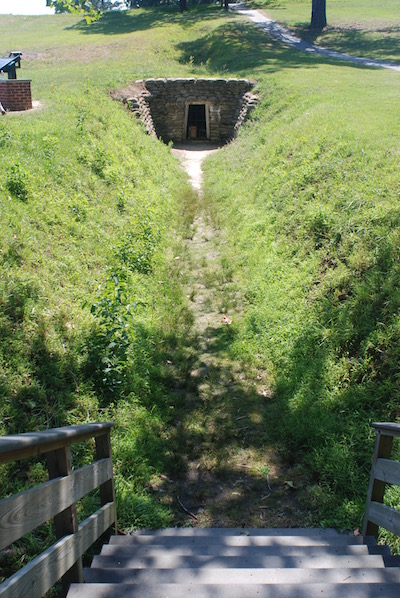
As we hiked around the many sites associated with the Fredericksburg, Richmond, and Petersburg battlefields, we marveled at not only the remnants of military fortifications (trenches, fox holes and earthen berms) but also structures, like the Stratton House, the Richmond Ironworks and the location of the Chimbaroza Hospital, that help you imagine what the battlefield landscape was like 150 years ago. Homesteads, farms, stores, churches, and villages were integral players in these battles, by choice or not, providing cover, officer quarters, and hospitals for nearly every engagement.
Many of these very same communities are still integral to the battlefields today. So as you explore Civil War battlefields, whether iconic or lesser known, don’t forget to check in with the locals.
Stories about:
Story Categories:
A copy of National Parks Traveler's financial statements may be obtained by sending a stamped, self-addressed envelope to: National Parks Traveler, P.O. Box 980452, Park City, Utah 84098. National Parks Traveler was formed in the state of Utah for the purpose of informing and educating about national parks and protected areas.
Residents of the following states may obtain a copy of our financial and additional information as stated below:
- Florida: A COPY OF THE OFFICIAL REGISTRATION AND FINANCIAL INFORMATION FOR NATIONAL PARKS TRAVELER, (REGISTRATION NO. CH 51659), MAY BE OBTAINED FROM THE DIVISION OF CONSUMER SERVICES BY CALLING 800-435-7352 OR VISITING THEIR WEBSITE. REGISTRATION DOES NOT IMPLY ENDORSEMENT, APPROVAL, OR RECOMMENDATION BY THE STATE.
- Georgia: A full and fair description of the programs and financial statement summary of National Parks Traveler is available upon request at the office and phone number indicated above.
- Maryland: Documents and information submitted under the Maryland Solicitations Act are also available, for the cost of postage and copies, from the Secretary of State, State House, Annapolis, MD 21401 (410-974-5534).
- North Carolina: Financial information about this organization and a copy of its license are available from the State Solicitation Licensing Branch at 888-830-4989 or 919-807-2214. The license is not an endorsement by the State.
- Pennsylvania: The official registration and financial information of National Parks Traveler may be obtained from the Pennsylvania Department of State by calling 800-732-0999. Registration does not imply endorsement.
- Virginia: Financial statements are available from the Virginia Department of Agriculture and Consumer Services, 102 Governor Street, Richmond, Virginia 23219.
- Washington: National Parks Traveler is registered with Washington State’s Charities Program as required by law and additional information is available by calling 800-332-4483 or visiting www.sos.wa.gov/charities, or on file at Charities Division, Office of the Secretary of State, State of Washington, Olympia, WA 98504.


