
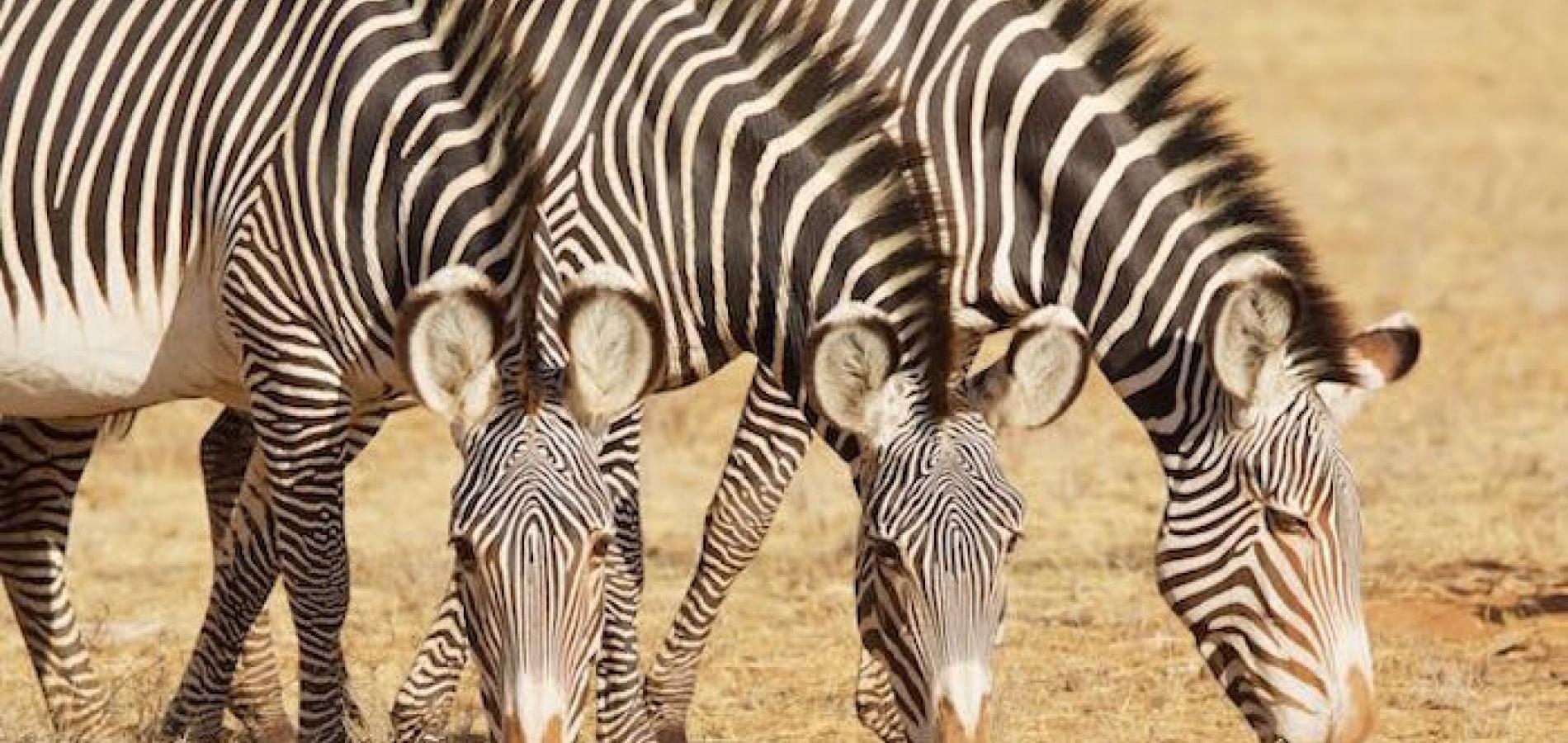

Kenya is a land of great natural beauty, where exotic animals roam: fearsome predators like the big cats; massive and powerful rhinoceros, hippopotamus, and elephants; elegant and graceful giraffes, zebras, and antelope; unusual animals like wildebeest, topi, and cape buffalo; colorful and amazing birds; unique carnivores like the hyena.
Kenya has more than 50 national parks and reserves and is the most popular safari destination in Africa. It is a great place to visit and one of the best places in the world to observe wildlife.
During two weeks in three Kenya national parks and reserves, we marveled at the abundance and diversity of wildlife. Kenya respects and values its wildlife and historically has taken wildlife management very seriously. Kenya banned hunting in 1977 and has a zero tolerance policy regarding poachers in national parks - they are shot on sight.
We were treated wonderfully everywhere we visited. Kenyans are warm and friendly people who appreciate visitors. It is safe to eat anything served at hotels catering to tourists from the United States and United Kingdom, and bottled water is readily available.
Accommodations in and near the Kenya national parks are found at prices from budget to luxury. You may rent a car or rent a vehicle with a driver, usually for a full package tour. The best way to see wildlife is to travel with an experienced Kenyan safari guide.
Samburu National Reserve
In Samburu National Reserve, very dry, mostly open grassland, or savanna, is mixed with acacia and thorn trees. The lush vegetation along the banks of the Uaso Nyiro River, which runs through the park, draws elephants, giraffes, zebra, and other animals. Lions, leopards, and cheetah hide in the brush and prey on numerous species of antelope and other animals. Exotic birds are easily seen.
We knew it would be a fabulous two weeks in Kenya when, on the way from the park entrance to our safari camp, driving under thorn trees adorned with as many as 40 nests of the fascinating weaver birds per tree, we saw three cheetahs, several elephants, small herds of zebra, giraffes, impala, oryx, gazelles, and lions on a kill. The next day we saw even more, including two lions mating; and watched a fight between two male lions.
Lake Nakuru National Park
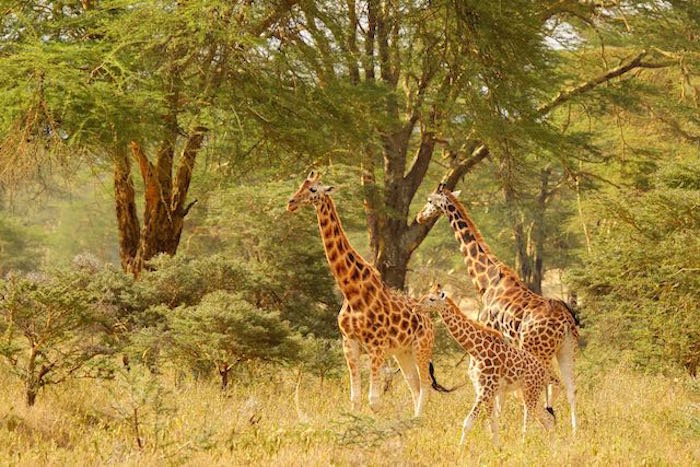
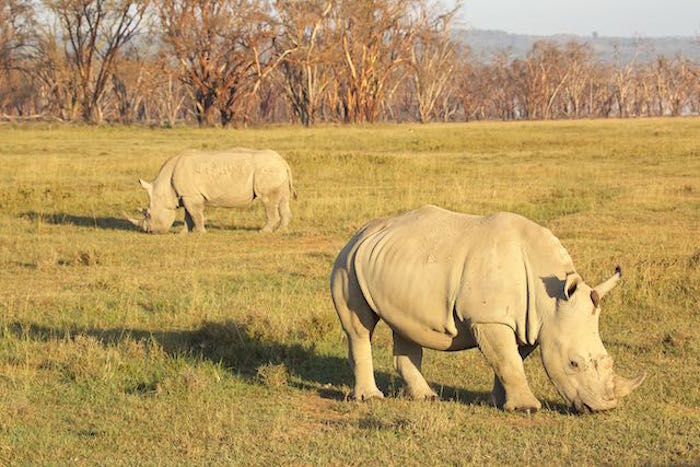
Lake Nakuru is one of a group of alkaline “soda lakes” in the Great Rift Valley, which together are a priority region for the World Wildlife Fund for conservation. The park is enchantingly beautiful, encompassing the lovely lake, luxuriant forest of yellow-barked acacia, as well as open grasslands and rocky ridges. It has been a sanctuary for the critically-endangered white rhinoceros and black rhinoceros since the 1970s, and we observed both species at fairly close range. Rothschild’s giraffes graze in the acacia forest. Cape buffalo and plains zebra are commonly seen, as are impala, gazelle, and other types of antelope. Lions and leopards hunt; baboons play along the roads; and greater and lesser flamingos along with many other birds are attracted to the lake - although in smaller numbers in recent years due to the rising water level in all the Rift Valley lakes.
Masai Mara National Reserve
We quickly understood the deep reverence of our Kenyan guides for what Kenyans simply call the Mara. The Masai Mara National Reserve, contiguous with Tanzania’s Serengeti National Park, is part of the Mara-Serengeti Ecosystem, a vast, beautiful, and wild land populated by millions of magnificent animals. A single gaze across the landscape might include giraffes, zebras, wildebeests, topis, elephants, impalas, and gazelles all at once. Very likely a lion, leopard, cheetah or hyenas are stalking some of these animals or feeding at a kill. Rhinos are less common but stroll through the same landscape, while rivers and pools are populated by hippos and Nile crocodiles. Exotic birds including dramatic African crowned cranes, hornbills, storks, herons, secretary birds, and many raptors, along with hundreds of species of other birds, are found.
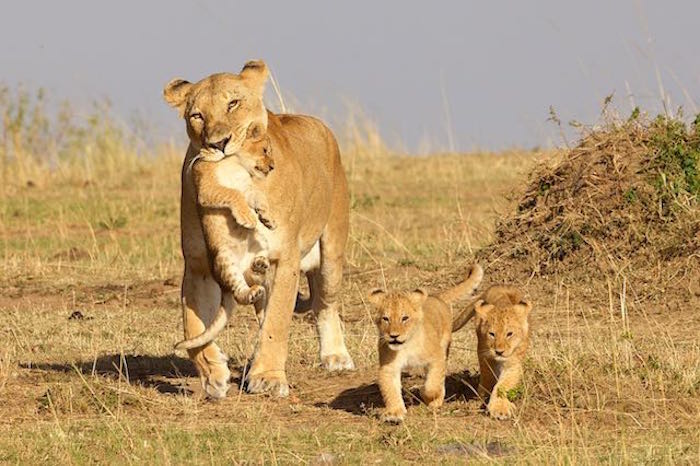
Highlights were watching a lioness move her three cubs, carrying one of them in her mouth; and observing a cheetah and leopard with cubs at fairly close range. Being a few feet from a lion or elephant in our safari vehicle, and watching a lion stalk and kill a wildebeest were amazing experiences. But our most vivid memories are simply trying to take in the immensity of the scenes and the abundance of wildlife.
We were fortunate to visit the Mara during the Great Migration of one to two million wildebeest, topi and zebra, during which these animals must cross the crocodile-infested waters of the Mara River. It is an indescribably thrilling experience to watch ten thousand animals cross the river within a matter of minutes, leaping wildly from the banks in clouds of dust, running, swimming, splashing and flailing through the water, then desperately clambering out on the opposite bank.
Wildlife in danger
We loved the magnificent panoramas and awesome wildlife of Kenya’s national parks. However, as Jim Burnett has written for the Traveler, poaching financed by international organized crime is having a terrible impact throughout Africa. Together, poaching, human population growth and development, and destruction of habitat, are taking a drastic toll on Africa’s beautiful land and its wildlife, and parallels what we have already done in North America. The statistics on the decline of wildlife in Africa are horrifying. The numbers of elephants and lions have declined by 90% in the last 50 years, and an award-winning international author has written of “The Specter of Africa Without Wildlife.”
As similar factors impact wilderness and wildlife around the world, national parks hold increasing importance in preserving the ecosystems on which all life depends. Otherwise, as Native American Chief Seattle foretold in a profound and disturbing truth, “When all the animals are gone, people will die of a great loneliness of spirit.”
Jean Bjerke is a nature photographer who seeks to capture the beauty of mountains, wildlife and wild places in her images, and to inspire others to want to protect the Earth's plants, animals, and the natural systems on which all life depends. She and her husband Randy launched their photography business in 2010 and sell prints, photo note cards, canvas wraps, and licensing rights to our nature images through Randy & Jean Bjerke Photography.
Stories about:
Story Categories:
A copy of National Parks Traveler's financial statements may be obtained by sending a stamped, self-addressed envelope to: National Parks Traveler, P.O. Box 980452, Park City, Utah 84098. National Parks Traveler was formed in the state of Utah for the purpose of informing and educating about national parks and protected areas.
Residents of the following states may obtain a copy of our financial and additional information as stated below:
- Florida: A COPY OF THE OFFICIAL REGISTRATION AND FINANCIAL INFORMATION FOR NATIONAL PARKS TRAVELER, (REGISTRATION NO. CH 51659), MAY BE OBTAINED FROM THE DIVISION OF CONSUMER SERVICES BY CALLING 800-435-7352 OR VISITING THEIR WEBSITE. REGISTRATION DOES NOT IMPLY ENDORSEMENT, APPROVAL, OR RECOMMENDATION BY THE STATE.
- Georgia: A full and fair description of the programs and financial statement summary of National Parks Traveler is available upon request at the office and phone number indicated above.
- Maryland: Documents and information submitted under the Maryland Solicitations Act are also available, for the cost of postage and copies, from the Secretary of State, State House, Annapolis, MD 21401 (410-974-5534).
- North Carolina: Financial information about this organization and a copy of its license are available from the State Solicitation Licensing Branch at 888-830-4989 or 919-807-2214. The license is not an endorsement by the State.
- Pennsylvania: The official registration and financial information of National Parks Traveler may be obtained from the Pennsylvania Department of State by calling 800-732-0999. Registration does not imply endorsement.
- Virginia: Financial statements are available from the Virginia Department of Agriculture and Consumer Services, 102 Governor Street, Richmond, Virginia 23219.
- Washington: National Parks Traveler is registered with Washington State’s Charities Program as required by law and additional information is available by calling 800-332-4483 or visiting www.sos.wa.gov/charities, or on file at Charities Division, Office of the Secretary of State, State of Washington, Olympia, WA 98504.


Comments
I thoroughly enjoyed the wonderful article, photos, and visual storytelling of your journey through Kenya. Each of your destinations provide sufficient diverse animal and plant life to justify their visit. You were extremely fortunate to witness several uncommon events such as a massive migration crossing, lion and lioness mating, lions fighting or stalking and a kill. And your statement “most vivid memories are simply trying to take in the immensity of the scenes and the abundance of wildlife” was humble and quite grounded. Thanks!
Thank you for your comments! Yes we were amazed at all the animals we were fortunate to see, which exceeded our already high expectations many times over. I choked up as we took off in a small plane from the tiny airstrip in the Masai Mara at the end of our trip, soaring above zebra, wildebeest, and other animals grazing on the savannah below and not knowing how many more years the abundant wildlife will be there.
My wife and I recently returned from 6 weeks in South Africa, Botswana, Zambia, and Zimbabwe. We saw every animal mentioned except the cheeta. The density of animals was amazing and in some short hikes there was not a square foot of ground without a track. Outside the game preserves there was no large game, few small mammals, and much fewer birds. Without the dollars from the relatively rich world there will be no wildlife left in Africa
I’m posting some excepts from my son’s animal picture book that we created before our visit to Kenya when he was 10. He updated each animal page describing what we saw that day.
There was a herd of over 60 “red” elephants in Masai Mara who were traveling from afar. One of the mothers trumpeted at us.
Our driver slammed on his brakes when we were driving on the highway to Masai Mara to avoid hitting a full grown giraffe who came out of nowhere.
The baby giraffe stood under his mom. How cute!
The waiters at our lodge in Samburu used slingshots to frighten away the monkeys who stole a bread roll from our table. (I did buy him a slingshot from a Masai warrior as well as a bow with arrows. He thought he would hunt squirrels at home but I knew he didn’t have the heart to hurt them).
Four gerenuks were standing up eating leaves from a tall tree.
One white rhino came so close that the driver had to move the van.
Never saw a klipspringer, reedbuck, greater kudu, wild dog, or fox.
Where did all those ostriches come from? And then they disappeared.
A cape buffalo didn’t like us looking at him and charged our van as we passed by.
Spotted a leopard tortoise that had big spots.
A hyena was stalking a mongoose but the elephants scared him away.
Three jackals chased a dik dik but fortunately he got away.
Eight lionesses were ready to attack a giraffe as he prepared to drink from the river in Samburu but the very thirsty giraffe never bent over and walked away.
We saw a herd of many oryx and when another van came they all moved off.
We were very lucky today as we saw 4 leopards including 2 brothers.
The resting leopard in Samburu spotted a genet and chased him up a tree. The genet climbed higher and higher as the leopard followed. The genet felled out to the high tree and I can’t believe he ran right back up the same tree and the leopard caught him …
I love the observations posted above from the 10-year-old boy. He might enjoy the 7-minute video at this link with highlights of our visits to the three parks mentioned in the article: https://www.youtube.com/watch?v=1cZJmbSWEs0
Thank you for the video link. Really loved the closeups of the wildlife including the many colorful birds. And the visit to the Masai village was enlightening. We did not go during the migration (early Feb) but there was still so much to see.