
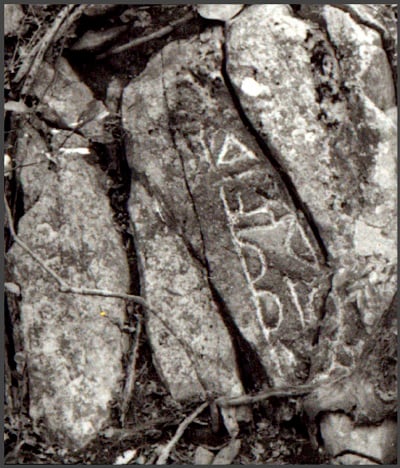
A "missing" petroglyph, one whose existence was known due to an overlooked roll of film, has been rediscovered at Virgin Islands National Park along the Reef Bay Trail. Top photo shows the "lost" petroglyph, the middle shot is of the well-known Taino petroglyphs mirrored in a small pool of water along the trail, and the bottom photo a close-up of petroglyphs found in the park. NPS photos.
Ken Wild knew that somewhere in Virgin Islands National Park's tangle of mango, lime, and tamarind trees, intertwined with various palm species and thick, cloaking pockets of Sansevieria, was an ancient carving in rock. An old roll of film confirmed as much.
But where?
The images, taken from the roll that had itself gotten overlooked for an unknown period of time -- in the park's archives, not within its lush tropical forests -- included some of the well-known Taino carvings in a rock above a pool of water along the Reef Bay Trail. But then there was the other curious image, one without any water in sight and with a different, vertical, orientation of rock palette.
Several times Mr. Wild, the park's archaeologist, had searched on his own for the missing petroglyph without success. Then in late January he recruited a group of volunteers from Friends of Virgin Islands National Park to help with the hunt and they all set off down the Reef Bay Trail for the Taino petroglyphs, which would serve as the starting point.
"Ken explained to our group that he’d looked for this several times but had been unsuccessful. He hoped that our group hunt would lend him many extra pairs of eyes to scour the site," Sue Borger, who along with her husband, Darrell, had been coming to the park for a decade, noted in a piece she wrote for the friends group.
"Finding proof of these ancient markings would be evidence of much earlier visits of the Native Americans, perhaps as much as 500 years earlier to a date of 1 AD. He handed out photocopies of the film to each of us to study and after a brief lunch break and informational lecture about Taino history, we spread out across the treacherous rocks, photocopies in hand."
The approach Mrs. Borger took in searching for the "lost" petroglyph was to look for unusual rock formations, as the photo clearly showed the vertical orientation of the rocks bearing the carving.
"It was evident that the carvings were not over water, but inscribed on rougher stone with obvious, slanted fissures. Turning around with my back to the pool, I scanned the rocks, looking for the distinctive tilt in the fissures," she recounted. "I could hardly believe it, but those rocks were right in front of me! I called to Ken and began to pull away the Sansevieria. 'Darrell,' I said, 'these are the rocks!'
"Darrell spotted the petroglyphs and yelled, 'Here it is! We’ve got it!' Great excitement and high-fives followed the discovery, after which we all posed for pictures."
In an email to the Traveler, Mr. Wild said "(E)vidence that the petroglyphs were carved by the Taino Indians has been strongly supported through the designs found on pottery at the Cinnamon Bay and Trunk Bay archaeology excavation along with correlating radiocarbon dates." While he said discovering the missing petroglyph was exciting in its own right, he added that "it also has significant implications regarding Reef Bay and the history of St. John:
* The design of the recently documented petroglyph is similarly found painted on the oldest dated pottery style in the islands. The style known as Saladoid pottery has been dated between 100 BC – 500 AD. This means that the people that were coming to the area of the Reef Bay petroglyphs were utilizing this site for a lot longer than we once thought, possibly a thousand years more. And the carving could be potentially 2,500 years old.
* This finding strongly supports continuity in ritual places as cultural beliefs shifted towards a Classic Taino society. In essence the carving represents at least 1,500 years of people coming to a single place that they felt was sacred. It really emphasizes the significance that Reef Bay had to the people who lived here prior to the European colonization of the islands.
* This style of carving is also found down island, in St. Lucia and even as far as Venezuela, further confirming the route of those who came to live in St. John possibly going back to the 4th century BC. This also exemplifies how far people traveled and how widely spread their cultural beliefs and ties extended throughout the Caribbean.
"In short," the archaeologist said, "this find is new to us and we know we have some research to do. It raises more questions, but we understand enough to know that this is a unique find and that is very exciting."
Story Categories:
A copy of National Parks Traveler's financial statements may be obtained by sending a stamped, self-addressed envelope to: National Parks Traveler, P.O. Box 980452, Park City, Utah 84098. National Parks Traveler was formed in the state of Utah for the purpose of informing and educating about national parks and protected areas.
Residents of the following states may obtain a copy of our financial and additional information as stated below:
- Florida: A COPY OF THE OFFICIAL REGISTRATION AND FINANCIAL INFORMATION FOR NATIONAL PARKS TRAVELER, (REGISTRATION NO. CH 51659), MAY BE OBTAINED FROM THE DIVISION OF CONSUMER SERVICES BY CALLING 800-435-7352 OR VISITING THEIR WEBSITE. REGISTRATION DOES NOT IMPLY ENDORSEMENT, APPROVAL, OR RECOMMENDATION BY THE STATE.
- Georgia: A full and fair description of the programs and financial statement summary of National Parks Traveler is available upon request at the office and phone number indicated above.
- Maryland: Documents and information submitted under the Maryland Solicitations Act are also available, for the cost of postage and copies, from the Secretary of State, State House, Annapolis, MD 21401 (410-974-5534).
- North Carolina: Financial information about this organization and a copy of its license are available from the State Solicitation Licensing Branch at 888-830-4989 or 919-807-2214. The license is not an endorsement by the State.
- Pennsylvania: The official registration and financial information of National Parks Traveler may be obtained from the Pennsylvania Department of State by calling 800-732-0999. Registration does not imply endorsement.
- Virginia: Financial statements are available from the Virginia Department of Agriculture and Consumer Services, 102 Governor Street, Richmond, Virginia 23219.
- Washington: National Parks Traveler is registered with Washington State’s Charities Program as required by law and additional information is available by calling 800-332-4483 or visiting www.sos.wa.gov/charities, or on file at Charities Division, Office of the Secretary of State, State of Washington, Olympia, WA 98504.

Comments
I've lived in the southwest most of my life. I have seen some rock writings that very few will see. I think this find is great. It will add to our knowledge of our past people.
It's too bad the park won't fund a Curator to look after those archives....without which, that image would have never seen the light of day.
Yes, the only reason this glyph is known today is because the park's Museum Curator at the time, Susanna Pershern, found an old photo of it and made it known that this glyph had never been formally recorded by the park. ken wild had absolutely nothing to do with this find except for the fact that he took credit for Susanna's work, then he set up a 'let's find the new petroglyph fundraiser'. Although the archaeologist who worked for ken already told him where the glyph was located before he ever went there with the Friends fundraiser group, he still continued to let the park visitors believe they found the glyph becuase it was good for public media. The only thing missing was MTV Real World videoing the sad but laughable ken wild show.
Congratulations to Ken Wild and the Friends of the Park volunteers who found it. This is wonderful and exciting news. We appreciate the work both he and the volunteers do especially in light of this historic find. Hats off to you all.