
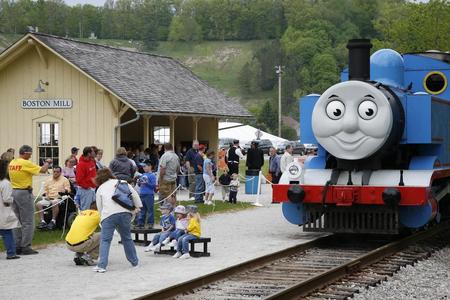
Cuyahoga Valley Scenic Railroad Thomas the Tank Engine 2 at Boston Mill. NPS photo.
A park that attracts as many people as Cuyahoga Valley National Park does -- nearly 2.6 million in 2009 -- has got to be doing something very right. That "something" is providing high-quality outdoor recreation opportunities for the heavily-populated Cleveland-Akron urban region of northeastern Ohio. The nearly 33,000-acre park is certainly well-positioned to do this, since it is centered on the rural Cuyahoga River Valley stretching some 22 miles between the two big cities and containing segments of the Ohio & Erie Canal and a scenic railroad, historic farms, and other attractions besides the meandering river (Cuyahoga is an Indian word for "crooked river") and glaciated terrain with a good deal of variety. The northern boundary of the park is less than ten miles from downtown Cleveland.
Coming into existence as a National Recreation Area in 1974, and redesignated National Park in 2000, Cuyahoga Valley National Park was born out of the 1970s-era urban park movement that produced a half-dozen or so national parks situated cozily inside the day-tripper zones of major urban centers and catering to the outdoor recreation needs of the nearby city dwellers. Within this "mass recreation" model, preserving and interpreting natural and cultural resources plays a secondary role (though by no means an unimportant one).
Other NPS units parks created on the National Recreation Area urban model include Gateway National Recreation Area (serving New York City/northern New Jersey), Golden Gate National Recreation Area (San Francisco Bay area), Santa Monica Mountains National Recreation Area (Los Angeles), Chattahoochee National Recreation Area (Atlanta), Jean Lafitte National Historical Park & Preserve (New Orleans), and in 1996, Boston Harbor Islands National Recreation Area.
With these understandings in mind, here are Traveler's recommendations for things that people should see and do when visiting Cuyahoga Valley National Park for the first time.
CAVEATS
Water quality problems and navigation obstructions severely constrain water sports in this park. Before engaging in recreational activities that take place on or in the water, make sure you understand the do's and don'ts. Generally speaking, assume that the water in the river, streams, and ponds is unsafe for skin contact unless you are told otherwise. Don't eat fish taken from park waters.
The only lodging in the park is at the Inn at Brandywine Falls or the Cuyahoga Valley HI-Stanford Hostel.
Don't bring alcoholic beverages with you. They're banned in the park.
ACTIVITIES
** Bring your picnic basket. There are picnicking areas throughout the park. The Ledges and Octagon Shelters sites can be reserved for a small fee. All other sites are first come, first served.
** Enjoy the scenery and wildlife. The intermingling of Appalachian Plateau and Central Lowlands landscapes hasn't produced jaw-dropping beauty here, but along the winding river and in adjacent areas you'll see rolling wooded hills, steep ravines, sandstone ledges, lush farmland, and an assortment of wildlife that includes white-tail deer, beaver, and nearly 200 bird species. Among the park's 70 waterfalls is Brandywine Falls, Cuyahoga Valley's most popular natural attraction. There's a darn nice photo op at Tinkers Creek Gorge, too.
If you're a leaf peeping fan, the park is a great place to be in the fall when the maple, oak, birch, beech and hemlock trees at their scenic best. You'll have company; this park gets roughly half a million visitors in September-October.
** Stop at the Canal Visitor Center. There you'll find park information and an overview of valley and canal history. You can also sign up for ranger-led tours and special events.
** Hike or bike the Towpath Trail. As the name implies, the Towpath Trail runs along the towpath of the historic Ohio & Erie Canal. Extending from downtown Cleveland southward along the Cuyahoga River, the trail passes through the park on its way (via Akron) to the historic community of Zoar. The nearly 20-mile stretch in the park has ten trailheads, lots of wayside exhibits, and a nearly level surface that offers outstanding hiking and biking. There are over 100 miles of other trails in the park, including dandies like the Brandywine Gorge Trail, the Plateau Trail, and the Bridal Veil Falls Trail.
You can ride a horse, but stay on the designated trails. There are six bridle trails in the park, including Riding Run Trail and Brecksville Reservation. They range from 3 to 14.5 miles in length, and if you want to ride them you'll need to provide your own horse.
** Take the path less traveled. There are some rugged backcountry hiking trails in the park. If overnighting is in your plans, there are five primitive campsites for hikers and bicyclists at Stanford House Backcountry Campsites. Reservations are required.
** Ride the rails. A trip aboard the Cuyahoga Valley Scenic Railroad, with its vintage (1940s and 50s) engines and coaches, is a recreational staple of this park. The northern terminal is near Thornburg Station at the park's northern border, and there are stops at the Canal Visitor Center, Hale Farm & Village, the Village of Peninsula, and several other places. If you're headed north out of Akron, you can get on at the Zoo, Stan Hywett Hall & Gardens, or Inventure Place ((National Inventors Hall of Fame).
** Visit Hale Farm & Village and take in some history. The park has a number of preserved and restored displays of 19th and early 20th century sustainable farming and pastoral living environments. The Hale Farm & Village (at Bath) depicts a Western Reserve settlement of the late 1840s. Not federally-owned and operated, it is a compatible-use site very popular with park visitors. Adult admission is about $12.00.
** Attend an outdoor concert at the Blossom Music Center. Located on Steels Corners Road near the south end of the park, the Blossom Music Center serves as the summer weekend "annex" of the renowned Cleveland Orchestra. In addition to its slate of classical performances, the center is a major venue for rock and pop concerts during the summer months. Contact the center for a schedule of events.
** Enjoy water sports (but be careful). Water quality problems and navigation obstructions severely constrain water sports in this park. While swimming, wading, paddling and fishing are legal in various water bodies within the park, none of these activities is recommended except in certain places or under certain conditions. For example, while swimming is permitted in all areas of the park except Indigo Lake and Kendall Lake, the only healthy place to do it is at the Dover Lake Waterpark. And while fishing is allowed in the river and numerous ponds, it's not safe to eat the fish you catch. For more information on water quality at Cuyahoga Valley National Park visit this site.
** Give Questing a try. Questing is a fairly new search-and-find interactive recreational activity that bears some similarity to geocaching, but does not require the use of a GPS unit or the exchange of trinkets. Participants only need a pen or pencil, walking shoes, and the ability to follow rhyming clues and a curious map. When you find a quest box, you collect its unique stamp, sign its logbook, and then re-hide it for others. The next questing season at Cuyahoga Valley is scheduled for April 15 to November 15. For more information about questing at the park, visit this site
** Have some winter fun. The snow and ice season means cross-country and downhill skiing, snow tubing, snowshoeing, sledding, ice fishing and other winter fun at Cuyahoga Valley. For sledding hills and snowshoeing/cross-country ski programs and trails, visit the Winter Sports Center on Truxell Road at Kendall Lake Shelter southwest of the Happy Days Visitor Center. The Cuyahoga Nordic Ski Patrol monitors the trails and sledding hills. Contact the park for open dates and remember that the center closes when the snow depth is less than four inches.
RESOURCES
The Cuyahoga Valley National Park website is a well-indexed source of visitor information.
Click to the park's maps site for a nice selection of maps organized by area and activity.
The Stanford Backcountry Campsites FAQs site has detailed camping information.
For a complete listing of the park's hiking trails and related information, go to this site.
FRIENDS ORGANIZATION
The Cuyohoga Valley National Park Association mission is to engage public support for the park and enhance public use and enjoyment of the park. CVNPA accomplishes its mission by developing and operating a variety of programs and services that educate the public, add to the park experience, and reach a diverse community. By engaging the public in participation and philanthropic support, CVNPA energetically and enthusiastically strives to achieve its vision to ensure that Cuyahoga Valley National Park achieves its full benefit to the citizens of Northeast Ohio and the nation.
Story Categories:
A copy of National Parks Traveler's financial statements may be obtained by sending a stamped, self-addressed envelope to: National Parks Traveler, P.O. Box 980452, Park City, Utah 84098. National Parks Traveler was formed in the state of Utah for the purpose of informing and educating about national parks and protected areas.
Residents of the following states may obtain a copy of our financial and additional information as stated below:
- Florida: A COPY OF THE OFFICIAL REGISTRATION AND FINANCIAL INFORMATION FOR NATIONAL PARKS TRAVELER, (REGISTRATION NO. CH 51659), MAY BE OBTAINED FROM THE DIVISION OF CONSUMER SERVICES BY CALLING 800-435-7352 OR VISITING THEIR WEBSITE. REGISTRATION DOES NOT IMPLY ENDORSEMENT, APPROVAL, OR RECOMMENDATION BY THE STATE.
- Georgia: A full and fair description of the programs and financial statement summary of National Parks Traveler is available upon request at the office and phone number indicated above.
- Maryland: Documents and information submitted under the Maryland Solicitations Act are also available, for the cost of postage and copies, from the Secretary of State, State House, Annapolis, MD 21401 (410-974-5534).
- North Carolina: Financial information about this organization and a copy of its license are available from the State Solicitation Licensing Branch at 888-830-4989 or 919-807-2214. The license is not an endorsement by the State.
- Pennsylvania: The official registration and financial information of National Parks Traveler may be obtained from the Pennsylvania Department of State by calling 800-732-0999. Registration does not imply endorsement.
- Virginia: Financial statements are available from the Virginia Department of Agriculture and Consumer Services, 102 Governor Street, Richmond, Virginia 23219.
- Washington: National Parks Traveler is registered with Washington State’s Charities Program as required by law and additional information is available by calling 800-332-4483 or visiting www.sos.wa.gov/charities, or on file at Charities Division, Office of the Secretary of State, State of Washington, Olympia, WA 98504.


Comments
It was disappointing, but not a surprise, to learn of the water quality problems still found in the Cuyahoga. I grew up in Hiram, not very far east of the river and used to spend a lot of time canoeing on its upper reaches. Although muddy, the upper waters were reasonably clean back in the 1950's and very early 1960's. But downstream? Oh, my.
While still in high school, some friends and I decided to canoe its full 100 or so mile length. The river follows a U-shaped course south from headwaters just east of Burton down to Akron and then north to Lake Erie at Cleveland. Just upstream from Kent, there was a reservoir that supplied drinking water for Kent and Akron. Water from the small lake was treated heavily with who-knew-what. This was long before bottled water and I remember how many of us attending Kent State University tried to avoid drinking the stuff.
Further downstream the river passed through Akron and became a sewer. Rubber factories along its banks discharged huge amounts of foul sludge into it. Raw human sewage poured from large pipes along its banks. For a distance of about half a mile, the river actually ran underground. Water level was low and we could see daylight at the other end so we pressed on -- my only underground canoe trip. When he exited the other end, we were all dizzy and lightheaded. (More so than is usual for high school kids.) A little later at a training session for volunteer fire fighters conducted by the Akron FD, (in those days even high school kids had the opportunity to serve their communities in meaningful ways) we learned of toxic gases that filled the tunnel.
Continuing on through the beautiful country that is now CUVA, we pressed on to Cleveland where just a year or two earlier the river had caught fire -- again -- and had burned down a couple of bridges. On both sides of the river's banks were huge steel mills, automobile engine foundries, an oil refinery or two, and other complexes that added their filth to the river. When we pulled out at the edge of Lake Erie, we found our canoes covered with a layer of ugly scum that took hours of work with putty knives and paint thinner to remove.
I learned to fly in high school, and one day while flying to Cleveland's Burke Lakefront Airport, I took a swing out over the lake because I'd become fascinated by the rainbows of color swirling around in Cleveland Harbor's water. A plume of oil slick and whatever else was in the water surged through the breakwater's opening and spread well over five miles out into the lake -- completely engulfing the "Crib" that served as intake for Cleveland's water supply. I suddenly understood why Cleveland's water tasted as bad as it did.
(It was around that time, too, that I took off from our little airstrip near Hiram on a clear winter morning and noticed a red plume of smoke heading south from Youngstown's steel mills. I followed it trying to see how far it went. I reached the Ohio River and Kentucky and the red ash cloud still kept going as far south as I could see.)
This was, of course, before the Clean Water and Clean Air Acts. I wish all Americans could have in their memories the things we kids saw and smelled as we went adventuring back then. Maybe if we all could share those kinds of memories, we'd be much more vigilant when some of our government and corporate "leaders" try to beat back the hard-won progress of the last half century.
Was it any wonder that some of us kids who survived the Cuyahoga canoe trip became staunch conservationists?
Gosh, Lee, I intentionally left out that "river that used to catch caught fire" stuff to keep from being tarred and feathered by CUVA supporters (their park "doesn't get a lot of love," you know), and here you've gone and let the cat out of the bag.
Well, Bob, I guess they can come tar and feather me instead.
Although this park is one that may have been marginal in its inception, (I'm sure there was at least a bit of Congressional pork hunting involved) it is now certainly a very real asset for people living in northeast Ohio. But I really do believe that if the staff there now fails to recount the history of pollution and grunge that once (and apparently to a degree, still does) affected the river and air around the place, then they are failing terribly in the responsibility all us NPS folks have to educate our visitors properly.
When I first started hearing of the proposals to create CUVA, I found myself with some very mixed feelings. On the one hand, I did question NATIONAL park status. But on the other, as a long ago high school boy who was one of the founding members of the Cuyahoga River Conservation Association, there was a feeling of very real satisfaction.
Whatever the current feelings -- political and otherwise -- may be, CUVA is still something to be treasured.
I'm planning on visiting next summer. Much of CUVA I'm familiar with (grew up in Canton) but haven't seen it for ages. Its quiet beauty along with my father's incessant lecturing on natural history bear primary responsibility for my love of the outdoors.
Good for you, Anon. And good for your father, who has earned my envy. Like him, I lectured incessantly on natural history to my own children. Unfortunately, the only thing I inspired in them was a love of quiet.
I was a bit surprised to see Jean Lafitte NHP & Preserve included in the list of National Parks in the "National Recreation Area urban model". Jean Lafitte is a rather unique National Park with six units that includes four cultural centers, a historic battlefield, and a nature preserve - but I wouldn't characterize any of them as focusing on "recreation" the way the other urban-model National Recreation Areas do... or indeed, like Cuyahoga Valley - which probably should never have had its designation changed.
I agree that Jean Lafitte NHP & Preserve is unique, Sabattis, but it is still an example of a park created on the National Recreation Area urban model. It was a cobbled-together park (as you've pointed out) intentionally established in the New Orleans day-tripper zone so that New Orleans metro area residents would have "their" national park. It doesn't matter that natural areas were included. Various-sized natural areas of some kind and quality were included in all of the parks created on that model (Gateway even has a National Wildlife Refuge). All of the facilities you listed in your comment provide recreation opportunities for people who live in a heavily-populated urban region. Given the political realities of the time, Jean Lafitte NHP & Preserve would never have been established if its backers hadn't been able to prove that to Congress' satisfaction. BTW, a Traveler's Checklist for Jean Lafitte is working its way through the queue and might even be posted before the month is out.