
Allies Of The Earth - Railroads And The Soul Of Preservation
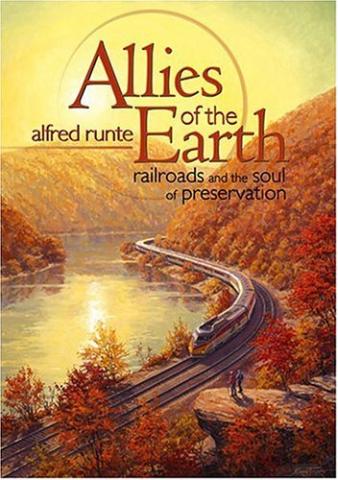
Author : Alfred Runte
Published : 2006-01-01
Support National Parks Traveler, and purchase this product at Amazon.com

When I mentioned in a Traveler comment a few weeks ago that I was reading Dr. Alfred Runte’s book, Allies of the Earth: Railroads and the Soul of Preservation, Kurt asked if I would write a review. Since then, there have been a couple of articles batting some of Alfred’s ideas back and forth. When I took a look at Traveler the other morning, I found a rebuttal by Dr. Runte regarding one of those articles. Now I sit at my keyboard wondering if I am qualified – or even want to – wade into the middle of all this.
But being a good Irishman, I’ll just pick up my shillelagh and go to work. After a quick scan of Dr. Runte's rebuttal and a quick review of previous pieces on both sides, I can see that what I’d planned to write will still work. I’m not a historian, so what I write will be about his book, as read with the eyes of a layman.
As I read Allies of the Earth, I found myself repeatedly thinking things like, "I remember that!" or "He got that right!" But then there were other times when I caught myself thinking "Really? I’m not too sure about that." I recall trips by rail when I was very young. I may even have ridden one of the classic trains that he recounts when my mother, brother, and I rode from Cleveland to Seattle as we went to board a U.S. Navy transport to join my father in Japan not long after the war. (About 1947 when I was six years old.)
I remember a compartment with seats that converted into beds and going to eat in the dining car. I vividly recall being in the Observation Car at the end of the train as we passed through what must have been the Rocky Mountains and my little boy’s thrill of seeing a real cowboy on a horse alongside the tracks. And I remember being lulled to sleep at night in an upper bunk by clacking wheels passing over rail joints and distant chuffing of a steam locomotive pulling us through the night.
Remembering that I’m not a historian, what I say next may or may not be entirely correct. Much of this book seems to be largely a personal reminiscence by a lifelong rail fan who is mourning the passing of passenger trains rather than a history book. More of an opinion piece than history. While I’m certainly not qualified to judge, I got the distinct impression as I reviewed the book’s notes that many of the sources cited were also opinion pieces rather than scholarly studies of history. Much of the book consists of Dr. Runte’s personal experiences as a rail passenger in both the United States and Europe.
Although I fully agree that our nation made a very serious mistake when we allowed our passenger mass transit to be sacrificed and replaced by hoards of automobiles and all the concrete and asphalt needed to support them, I still had a vague feeling throughout that at least some of his ideas were simplistically slanted because of his love for rail travel. But I do agree with his contention that railroads were much less destructive of our nation’s natural beauty than are autos. In fact, I found myself agreeing with his idea that perhaps in some cases a carefully planned rail system inside some of our parks could have avoided negative impacts of automobile specific infrastructure.
Dr. Runte points out, rightly in my view, that a set of rails requires only about ten feet while a road right-of-way must be at least 30 feet wide. Then there are all the turnouts, parking lots, and other accessories that auto traffic requires.
Much of his thesis throughout the book is the idea that railroads profoundly influenced preservation of our national parks. Perhaps they did. Railroads certainly had enormous influence in the evolution of parks like Grand Canyon, where we are still paying the price for development that grew around a rail station just yards from the canyon’s rim. Thus, I would argue that not all railroad influences on our parks were beneficial in the long run.
He pushes the idea that development of Yellowstone and Glacier national parks and even Zion and Bryce Canyon were heavily influenced by railroads. There’s no doubt they were. But unlike Grand Canyon, railroads serving those parks stopped at park boundaries or much farther away and did not enter the parks. In fact, in Glacier, Zion, Bryce Canyon and some others, it was buses or large autos that transported visitors from trains into and through the parks.
Dr. Runte also points out that many, or even most, of the great lodges of the parks were built by railroads and ascribes that as support of his idea that the railroads were setting a tone of preservation. I couldn’t help wondering if that was entirely true or if, like so many other stories in history, most of what happened was simply just the way they did things in those days. After all, as he repeatedly points out, in the early days our parks were places only wealthy people could afford to visit, and railroads were simply the most practical method of travel at the time.
In those days, America was competing with Europe for American tourist dollars; were the magnificent lodges of our parks built that way to provide competition for castles and palaces of that other continent? Were those lodges more the result of an effort to attract wealthy people with luxurious accommodations than a deliberate desire to protect and preserve the natural wonders where they stood? Granted, as he points out, the railroads did make efforts to change visitor behavior in a time when visiting a park often included collecting samples or washing handkerchiefs in a hot spring. Or was that just a realization that if the beauty of the parks was destroyed, customers would no longer want to visit?
I found this book by Dr. Runte to be fun to read. He uses some good sharp humor every so often that is right on point. His memories of his childhood and young adult train rides brought back many memories for me. His accounts of rail travel in Europe reminded me of the ease and comfort my family was able to enjoy as we traveled around parts of Europe and in the city of Linz, Austria, when my father was stationed there in the early 1950s. But did a lot of the success of European public transportation come about because leaders there had to rebuild a system that had already been in place and had a chance to improve on it after their nations were devastated by war? He points out that the European culture is one primarily geared to meeting the common good rather than ours that demands individual independence.
I fully agree that the demise of American passenger rail was a horrible mistake. I watch with some bemusement now as our befuddled nation and its cities grapple with traffic congestion and over-development caused by our rapidly increasing population and our automobiles and their supporting infrastructure. I agree with Dr. Runte that most Americans have no idea what our nation is missing because few have ever had a chance to experience how much we are missing.
But while he seems to ascribe most of the demise of passenger service here to avarice on the part of railroad managers in their search for more profitable freight business, I find myself wondering if it’s just not one more tragic example of the almost universal tendency of Americans to be terribly short-sighted as we, and our leaders, completely fail to look to the future as we try to manage our nation. He does touch on that, but only briefly. He laments the fact that we seem to constantly seek for a non-existent ideal dream of perfection that doesn’t exist instead of making the best of what we have and building upon it to make it better.
All in all, I found the book to be pleasant and compelling reading. Much easier to enjoy than the more academic history contained in Yosemite, The Embattled Wilderness. It is really filled with a number of thought-provoking ideas. Or at least ideas that should be thought-provoking. It’s impossible in a short space to fully and fairly discuss all this book has to offer. And so I wish more people, particularly some of those who make decisions about the future of our nation, would read it and actually think about what he has to say. Careful reading and consideration of his thoughts should raise questions that responsible planners of our future need to consider lest they simply make the same mistakes again.
In this time when many American communities and states are looking to reinvent public transportation because automobiles are strangling us, some of Dr. Runte’s ideas are certainly worth considering. Unfortunately, that isn’t likely to happen.
However, no matter what your feelings about public transportation or the preservation of our parks may be, I really do recommend that you get this book and read it. Then weigh what he has to say and make up your own mind. Perhaps if you do, you’ll have some ideas to pass on to your elected officials or neighbors.


National parks and their natural resources belong to you. The National Parks Traveler works to ensure you know how these essential places are being cared for.
Sign Up For Our Weekly Newsletter
Unsubscribe at any time.
INN Member

The easiest way to explore RV-friendly National Park campgrounds.

Here’s the definitive guide to National Park System campgrounds where RVers can park their rigs.
Our app is packed with RVing- specific details on more than 250 campgrounds in more than 70 national parks.
You’ll also find stories about RVing in the parks, tips helpful if you’ve just recently become an RVer, and useful planning suggestions.

