
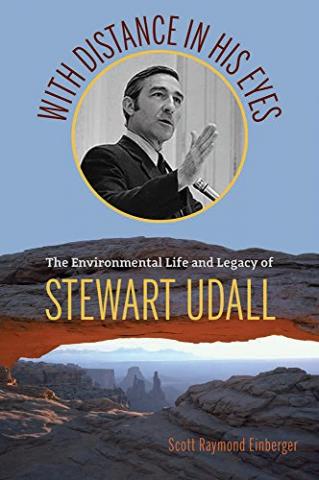
With Distance In His Eyes: The Environmental Life And Legacy Of Stewart Udall
Published : 2018-04-16
Support National Parks Traveler, and purchase this product at Amazon.com

As a college student in 1963 I read a book by Stewart Udall that has been one of the most personally impactful books I’ve read. The Quiet Crisis piqued my interest in environmental conservation, introduced me to its history in American society, and sent me down a path of teaching, writing, and activism in conservation that I pursue to this day. It was a small book, written in collaboration with Wallace Stegner, a distinguished Western writer and historian, whose work I later came to know and love. At the time I knew little of the American West or of conservation, and nothing about Stewart Udall. I, like the author of this book, became an admirer.
Two books have been published in the past two years that draw much-deserved attention to Stewart Udall, whose work as Secretary of Interior in the Kennedy and Johnson administrations stands in stark contrast to the occupants of that office in the Trump administration. Thomas Smith wrote a full biography of Udall titled Stewart Udall: Steward of the Land, published in 2017. Scott Raymond Einberger has focused his book almost exclusively on Udall’s conservation and environmental work, briefly touching on his life before President Kennedy named him to his cabinet. The two books are complementary and timely in the way they reveal how a Secretary of the Department of Interior can and should serve the American people.
Throughout its history the Department has tempted its leaders to favor special interests with public largesse, as Trump’s appointments to the office are doing today. As Einberger documents throughout his book, Udall was aware of this history and defined the principles that would guide him as Secretary. In a speech shortly after taking office in 1961, he asserted:
“Decisions will never be made for the purpose of rewarding one special interest group against another, nor for the benefit of one segment of the economy to the detriment of the larger public interest. And we shall try to never forget that the ‘larger public interest’ includes the welfare of future generations.”
Udall largely hewed to these principles throughout his eight years as Secretary in a political environment where adherence to principles is often very difficult. Einberger, an environmental historian, sees Udall’s record in this regard as exceptional. Stuart Brody, in his 2019 book The Law of Small Things: Creating a Habit of Integrity in a Culture of Mistrust, defines integrity as “a practice of discerning promises – expressed and implied, large and small – and fulfilling the duties they create.” Einberger describes, in Stewart Udall, a politician and public servant of such integrity.
Before becoming Secretary, Udall was an Arizona congressman and proponent of building large water projects, including dams, to water his home state. This posed an immediate challenge to his stated principles and his integrity. His department housed both the dam-building Bureau of Reclamation and a “nature protection bureau” like the National Park Service. According to Einberger, he skillfully walked a tightrope in dealing with these clashing mandates.
He supported both. Udall balanced dam-building projects with river-preservation projects, thus promoting dams in some cases and wild rivers in many others. While some might call this a cop-out, Udall consistently and successfully promoted compromise throughout the 1960s and beyond, and his balancing of dams with wild rivers is a classic example. In fact, the art of compromise was one of the major reasons Udall accomplished so much good as interior secretary.
This spirit of compromise allowed the building of dams in some places, and passage of the Wild and Scenic Rivers Act that protected parts of rivers, like the upper Rio Grande in northern New Mexico where I live.
Udall aggressively pursued his agenda of “expanding the National Park System, increasing recreational opportunities for urban masses, and diminishing pollution,” and enjoyed considerable success. Einberger cites eight key reasons for the successes:
Udall would (1) take what we today call stakeholders on highly publicized conservation trips. He pursued his goals (2) in a period of “widespread public interest [in conservation] and bipartisanship in Congress.” This was a key factor in successful conservation work and Einberger amply documents this in various sections of his book. Udall was, from a conservation perspective, the right man at the right time. He was (3) not afraid to compromise. Udall was (4) served by exceptional staff, and (5) addressed his conservation agenda right after release of a landmark Outdoor Recreation Resource Review Commission (ORRRC) report that specified needs to which Udall responded with leadership. He was (6) working in a period of cooperation between his Interior Department and the Department of Agriculture, and the Land and Water Conservation Fund, established in 1964 (and on a path to permanent authorization as I write in February 2019), provided funding for the many projects needed to attain his goals. Finally, Udall was persuasive in his speaking and writing. Einberger cites The Quiet Crisis as an example, the best known of his eight books.
Udall’s support for expansion of the National Park System resulted in congressional creation of many parks; Canyonlands National Park, Saguaro National Park-Tucson Mountain District, Guadalupe Mountains National Park, and others. He successfully championed parks in the East and near urban areas, and new kinds of parks like national seashores, national lakeshores, and riverways among others. He didn’t accomplish all of this by himself, of course, but his leadership made a big difference in the political struggles that inevitably are part of park-making.
Einberger writes short, informative chapters on how Udall supported wildlife protection and expansion of the National Wildlife Refuge System; favored reform of the Bureau of Land Management that made it more a multiple-use agency; advocated for both dams and wild rivers; achieved a tempered approach to managing oil, coal, and mineral development on public lands; threw support to the Wilderness Act, which was approved in 1964; and worked for urban environmental revitalization, and even stabilization of the human population. Udall’s department had a broader mandate than it does today with the Department of Energy now assuming part of what he had to deal with. Einberger describes an administrator with amazing breadth and far-sightedness.
Udall was successful on many fronts, but failed on some, which Einberger describes in a chapter titled “Controversies of the Interior Secretary.” He supported a plan to bring water to his home state that would require two dams that would impact the Grand Canyon region. Eventually he decided against the dams, but this resulted in a coal-fired power plant that impacted the air quality in the area. He threw his support behind a Great Basin National Park and a Prairie National Park, but they were not established during his tenure (though Great Basin was realized two decades after he left Interior).
His biggest failure, according to Einberger, was his inability to convince President Johnson to use the Antiquities Act to establish several national monuments just before Johnson left office. Among them were a Gates of the Arctic National Monument, expansion of Mt. McKinley National Monument, a Marble Canyon National Monument, and expansions of Arches and Capitol Reef national monuments. Missteps by both the president and the secretary resulted in Johnson not acting on the proposal. Einberger describes a heated exchange between the two men:
“You let the cat out of the bag yourself, Mr. President, in your speech,” Udall yelled. When LBJ ordered his interior secretary to terminate the press release [announcing the 7 million acres of new monuments], Udall offered his resignation in disgust and protest. Johnson denied Udall’s request, but then snapped at his interior secretary, “Hell of a way to run a department.” LBJ then hung up the phone, and these were the last words ever spoken between Udall and Johnson.
This was a sad end to a historically productive relationship.
Udall’s long tenure as Secretary of Interior ended with the election of Richard Nixon in 1968, but he continued to work on behalf of the environment. He advocated for energy conservation and diversification of energy sources in the 1970s, calling for “clean” energy sources well before their potential began to be taken seriously. He saw, in the 1980s, the problem of anthropogenic climate change looming in the future and wrote and spoke about it to a nation not ready to listen. A great injustice had been done to the Navaho people who were victimized by government atomic bomb building in the 1940s and ‘50s, especially to Navaho uranium miners who suffered terribly from radiation sickness and death, caused, in his view, by a callous government. Udall used all his legal skills for many years to win compensation for these workers and their families. Einberger describes the frustrating outcome of this long effort.
With Distance in His Eyes describes a truly amazing record of effort on behalf of the American people to conserve and protect public resources and care for their needs as they were served by the vast reach of the Department of Interior. This “small” 280-page book is a summary of Udall’s efforts on behalf of the environment from 1960-’68 and beyond. As I finished the book it occurred to me that Udall deserves the treatment given the other Interior Secretary with whom he is often compared, Harold Ickes. Many consider these two men the greatest stewards of Interior in American history, and Ickes life and contributions have a 1000-page treatment in T.H. Watkins Righteous Pilgrim: The Life and Times of Harold H. Ickes, 1874-1952, published in 1990. The American people deserve to know in 2019 that they have been and can be better served by men of this caliber in the Department of Interior.


National parks and their natural resources belong to you. The National Parks Traveler works to ensure you know how these essential places are being cared for.
Sign Up For Our Weekly Newsletter
Unsubscribe at any time.
INN Member

The easiest way to explore RV-friendly National Park campgrounds.

Here’s the definitive guide to National Park System campgrounds where RVers can park their rigs.
Our app is packed with RVing- specific details on more than 250 campgrounds in more than 70 national parks.
You’ll also find stories about RVing in the parks, tips helpful if you’ve just recently become an RVer, and useful planning suggestions.

