
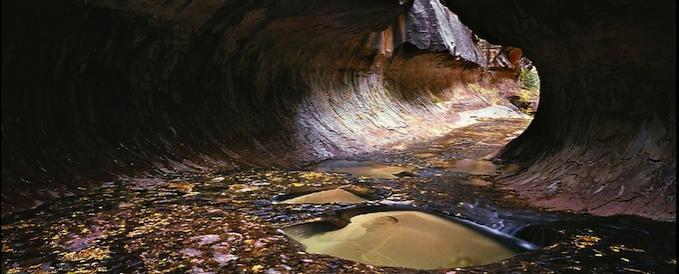
The Subway, copyright QT Luong.
Featured Photographer

I celebrate the splendor and variety of the natural and human heritage with my photography. For the past twenty-five years, I have been privileged to travel, trek, and climb in some of the most remote and beautiful corners of the earth. Laying down in a colorful meadow dense with wildflowers, clinging precariously to a vertical icy mountain face, listening to the silence of desert sand dunes or to the calls of a bustling floating market might seem like very different experiences, however, I feel that they share the same life-affirming benefits.
For more of Tuan's national park images, visit www.terragalleria.com/parks
"Mukuntuweap"
It doesn't roll as easily off the tongue as does "Zion," but its definition better describes the landscape. It was the name given the colorful redrock canyon and surrounding landscape in southwestern Utah by Major John Wesley Powell, who explored it in 1872 after his journey down the Green and Colorado rivers, an excursion that took him through three other landscapes that today are part of the National Park System.
The major felt "Mukuntuweap," a Southern Paiute word meaning "straight arrow," or "straight canyon," was the proper name for this landscape of aeries and slot canyons. But that didn't hold, and how the name was changed to "Zion" will be explained in the section on park history.
Whatever the name, though, this is a magical landscape, one you can gaze down upon from on high, walk into through cracks in the ruddy underbelly, or quietly admire in awe from the banks of the Virgin River that ripples through its core.
Though a fairly good-sized park, at nearly 150,000 acres (60,703 hectares), most visitors to Zion National Park stick to that core, Zion Canyon. Day hikes lead off in all directions from this canyon, and can be as demanding (Angel's Landing) or as tranquil (Weeping Rock) as you feel up to. It's a park with soaring ramparts of sandstone that conjure images of Yosemite National Park, yet without the crowds.
Climbers test themselves on the walls of Zion Canyon, while many others find themselves at the head of the canyon after navigating the "Narrows," a 16-mile (25.7-km) adventure through a slot canyon. Still others are drawn to the peacefulness of the canyon with its singing birds, hanging gardens, and rippling waters.
But there's much more to Zion than simpy its namesake canyon. Head to the northwest corner of the park, through the Kolob Canyons entrance, and you'll find not only a scenic drive that shows off box canyons painted in oranges, pinks, and golds, but also a backcountry trail that will lead you to one of the largest arches in the world, Kolob Arch. Another, shorter, hike leads past two homesteader cabins to Double Arch Alcove.
Take the Kolob Terrace Road that heads north from Virgin, Utah, and you'll gain more access to the backcountry and sweeping views of this colorful country. Stand on one of the overlooks here and you'll understand why many consider Zion one of the prettiest national parks in the system.
Traveler's Choice For: Canyoneering, geology, photography, hiking
- By Kurt Repanshek - February 17th, 2025 5:37am





